 The Light Eaters: How the Unseen World of Plant Intelligence Offers a New Understanding of Life on Earth
Quotes from the Book
Thomas A. Edison told his associates that "Carver is worth a fortune" and backed up his statement by offering to employ the black chemist at an astronomically high salary. Carver turned down the offer. Henry Ford, who thought Carver "the greatest scientist living," tried to get him to come to his River Rouge establishment, with an equal lack of success. Because of the strangely unaccountable source from which his magic with plant products sprang, his methods continued to be as wholly inscrutable as Burbank's to scientists and to the general public. Visitors finding Carver puttering at his workbench amid a confusing clutter of molds, soils, plants, and insects were baffled by the utter and, to many of them, meaningless simpFcity of his replies to their persistent pleas for him to reveal his secrets. To one puzzled interlocutor he said: "The secrets are in the plants. To elicit them you have to love them enough." "But why do so few people have your power?" the man persisted. "Who besides you can do these things?" "Everyone can," said Carver, "if only they believe it.
2
Perhaps the elements of memory in plants are superficially treated," he writes, "but at least there they are in black and white! Yet no one calls his friends or neighbors, no one shouts in a drunken voice over the telephone: Have you heard the news? Plants can feel! They can feel pain! They cry out! Plants remember everything!" When Soloukhin began to telephone his own friends in excitement he learned from one of them that a prominent member of the Soviet Academy of Sciences, working in Akademgorodok, the new town inhab ited almost exclusively by research scientists on the outskirts of Siberia's largest industrial center, Novosibirsk, had stated: Don't be amazed! We too are carrying out many experiments of this kind and they all point to one thing: plants have memory. They are able to gather impressions and retain them over long periods. We had a man molest, even torture, a geranium for several days in a row. He pinched it, tore it, pricked its leaves with a needle, dripped acid on its living tissues, burned it with a lighted match, and cut its roots. Another man took tender care of the same geranium, watered it, worked its soil, sprayed it with fresh water, supported its heavy branches, and treated its burns and wounds. When we electroded our instruments to the plant, what do you think? No sooner did the torturer come near the plant than the recorder of the instrument began to go wild. The plant didn't just get "nervous"; it was afraid, it was horrified. If it could have, it would have either thrown itself out the window or attacked its torturer. Hardly had this inquisitor left and the good man taken his place near the plant than the geranium was appeased, its impulses died down, the recorder traced out smooth one might almost say tender-lines on the graph.
2
A job pays you for what the role/designation does rather than for what you can do, which is why the compensation it pays doesn’t justify your capabilities.
2
fundamental nature of success: it’s hidden among failures.
1
Burbank's power of love, reported Hall, "greater than any other, was a subtle kind of nourishment that made everything grow better and bear fruit more abundantly. Burbank explained to me that in all his experimentation he took plants into his confidence, asked them to help, and assured them that he held their small lives in deepest regard and affection." Helen Keller, deaf and blind, after a visit to Burbank, wrote in Out look for the Blind: "He has the rarest of gifts, the receptive spirit of a child. When plants talk to him, he listens. Only a wise child can understand the language of flowers and trees." Her observation was particularly apt since all his life Burbank loved children. In his essay "Training of the Human Plant," later published as a book, he anticipated the more humane attitudes of a later day and shocked authoritarian parents by saying, "It is more important for a child to have a good nervous system than to try to 'force' it along the line of book knowledge at the expense of its spontaneity, its play. A child should learn through a medium of pleasure, not of pain. Most of the things that are really useful in later life come to the children through play and through association with nature." Burbank, like other geniuses, realized that his successes came from having conserved the exuberance of a small boy and his wonder for everything around him. He told one of his biographers: 'Tm almost seventy-seven, and I can still go over a gate or run a foot race or kick the chandelier. That's because my body is no older than my mind-and my mind is adolescent. It has never grown up and I hope it never will." It was this quality which so puzzled the dour scientists who looked askance at his power of creation and bedeviled audiences who expected him to be explicit as to how he produced so many horticultural wonders. Most of them were as disappointed as the members of the American Pomological Society, gathered to hear Burbank tell "all" during a lecture entitled "How to Produce New Fruits and Flowers," who sat agape as they heard him say: In pursuing the study of any of the universal and everlasting laws of nature, whether relating to the life, growth, structure and movements of a giant planet, the tiniest plant or of the psychological movements of the human brain, some conditions are necessary before we can become one of nature's interpreters or the creator of any valuable work for the world. Preconceived notions, dogmas and all personal prejudice and bias must be laid aside. Listen patiently, quietly and reverently to the lessons, one by one, which Mother Nature has to teach, shedding light on that which was before a mystery, so that all who will, may see and know. She conveys her truths only to those who are passive and receptive. Accepting these truths as suggested, wherever they may lead, then we have the whole universe in harmony with us. At last man has found a solid foundation for science, having discovered that he is part of a universe which is eternally unstable in form, eternally immutable in substance.
1
Whatever the future brings, Vogel believes that his research with plants can help man to the recognition of long-ignored truths. By developing simple training kits, which he is presently designing, he thinks he can teach children to release their emotions and watch the effects in a measurable way. "They can thus learn the art of loving," says Vogel, "and know truly that when they think a thought they release a tremendous power or force in space. By knowing that they are their thoughts, they will know how to use thinking to achieve spiritual, emotional, and intellectual growth.
1
The progressive realization of predetermined worthwhile goals, stabilized with balance and purified by belief’.
Sperm cells turned out to be surprisingly canny in that they seemed to be capable of identifying and reacting to the presence of their own donor, ignoring the presence of other males. Such observations seem to imply that some sort of total memory may go down to the single cell, and by inference that the brain may be just a switching mechanism, not necessarily a memory storage organ.
fail and fail often—but keep the cost of each failure low, so that you can keep going until you succeed.
Now Mrs. Retallack wondered how the effects of what she called "intellectual mathematically sophisticated music of both East and West" would appeal to plants. As program director for the American Guild of Organists, she chose choral preludes from Johann Sebastian Bach's Orgelbuchlein and the classical strains of the sitar, a less-com plicated Hindustani version of the south Indian veena, played by Ravi Shankar, the Bengali Brahmin. The plants gave positive evidence of liking Bach, since they leaned an unprecedented thirty-five degrees toward the preludes. But even this affirmation was far exceeded by their reaction to Shankar: in their straining to reach the source of the classical Indian music they bent more than halfway to the horizontal, at angles in excess of sixty degrees, the nearest one almost embracing the speaker. In order not to be swayed by her own special taste for the classical music of both hemispheres Mrs. Retallack, at the behest of hundreds of young people, followed Bach and Shankar with trials of folk and "country-western" music. Her plants seemed to produce no more reaction than those in the silent chamber. Perplexed, Mrs. Retallack could only ask: "Were the plants in complete harmony with this kind of earthy music or didn't they care one way or the other?" Jazz caused her a real surprise. When her plants heard recordings as varied as Duke Ellington's "Soul Call" and two discs by Louis Arm strong, 5 5 percent of the plants leaned fifteen to twenty degrees toward the speaker, and growth was more abundant than in the silent chamber. Mrs. Retallack also determined that these different musical styles markedly affected the evaporation rate of distilled water inside the chambers. From full beakers, fourteen to seventeen milliliters evaporated over a given time period in the silent chambers, twenty to twenty five milliliters vaporized under the influence of Bach, Shankar, and jazz; but, with rock, the disappearance was fifty-five to fifty-nine milliliters.
Singh then experimented on a vast number of species, such as com mon asters, petunias, cosmos, and white spider lilies, along with such economic plants as onions, sesame, radishes, sweet potatoes, and tapioca. Each of these species Singh entertained for several weeks just before sunrise with more than half a dozen separate ragas, one per experiment, played on the flute, violin, harmonium, and veena; the music lasted a half hour daily, scaled at a high pitch, with frequencies between one hundred and six hundred cycles per second. From all this experimentation Singh was able to state, in the magazine of the Bihar Agricultural College at Sabour, that he had "proven beyond any shadow of doubt that harmonic sound waves affect the growth, flowering, fruiting, and seed-yields of plants.
This effort has turned Lawrence the engineer into Lawrence the philosopher. "There was a time, when I was a child, when the whole world seemed alive and knowing," he wrote in Organic Gardening and Farming. "Trees were friends and as George Eliot put it: ,'Flowers see us and know what we're thinking about. ' Then came a time when plants just grew, silently and without emotion. But today, I'm entering a second childhood, as least as far as plants are concerned.
Nevertheless, his suspicion that plant tissues could pick up human thought and emotion slowly became more concrete in the light of Backster's achievements. Lawrence was re minded that years previously Sir James Jeans, the British astronomer, had written that "the stream of human knowledge is impartially heading toward a non-mechanical reality: the Universe begins to look more like a great thought than a great machine. Mind no longer appears as an accidental intruder into the realm of matter. We are beginning to suspect that we ought rather to hail it as the creator and governor of this realm.
Asked to sum up the importance of his research with plants, Vogel replied: "So much of the ills and suffering in life comes from our inability to release stresses and forces within us. When a person rejects us, we rebel inside and we hold on to this rejection. This builds a stress which, as Dr. Wilhelm Reich showed so long ago, becomes locked in as muscular tension, and if not unlocked, depletes the body's energy field and alters its chemistry. My research with plants indicates one pathway to deliverance.
Vogel makes the prediction, which he stresses is as yet far from established fact, that since living things all have a high water content, the vitality of a person must be in some way related to the rate of respiration. As water moves around the body and through its pores, charges are built.
plants might originate in a supramaterial world of cosmic beings to which, long before the birth of Christ, the Hindu sages referred as “devas,” and which, as fairies, elves, gnomes, sylphs and a host of other creatures, were a matter of direct vision and experience to clairvoyants among the Celts and other sensitives.
Watch on YouTube
About Peter Tompkins
We have collected 16 quotes from 1 book by Peter Tompkins on BookQuoters.
More about the author →About the book
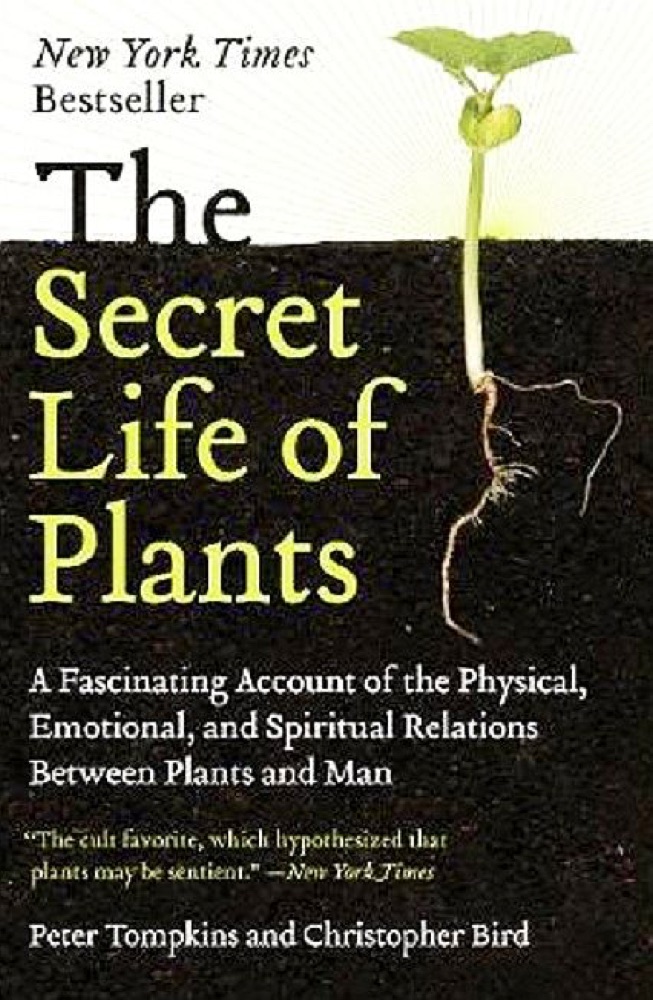
Exploring the world of plants and its relation to mankind as revealed by the latest discoveries of scientists, The Secret Life of Plants includes remarkable information about plants as lie detectors and plants as ecological sentinels; it describes their ability to adapt to human wishes, their response to music, their curative powers, and their ability to communicate with man. Authors Peter Tompkins and Christopher Bird suggest that the most far-reaching revolution of the 20th century — one that could save or destroy the planet — may come from the bottom of your garden.
Book details
- First published
- 1973
- Author
- Peter Tompkins
- Genre
- Nonfiction
- Goodreads rating
- 3.96 (3k ratings)
Keep reading
The Light Eaters: How the Unseen World of Plant Intelligence Offers a New Understanding of Life on Earth
 The Botany of Desire: A Plant's-Eye View of the World
 What a Plant Knows: A Field Guide to the Senses
 Why Fish Don’t Exist: A Story of Loss, Love, and the Hidden Order of Life
 Gathering Moss: A Natural and Cultural History of Mosses
 The Ascent of Man
 The Lives of a Cell: Notes of a Biology Watcher
 The Social Animal: The Hidden Sources of Love, Character, and Achievement
 The Song of the Cell: An Exploration of Medicine and the New Human
 The Code Breaker: Jennifer Doudna, Gene Editing, and the Future of the Human Race
 Dragons of Eden: Speculations on the Evolution of Human Intelligence
 The Big Picture: On the Origins of Life, Meaning, and the Universe Itself
 The Well-Gardened Mind: The Restorative Power of Nature
 The One-Straw Revolution
 How to Change Your Mind: The New Science of Psychedelics
 The Forest Unseen: A Year’s Watch in Nature
 The Fifth Science
 The Tell-Tale Brain: A Neuroscientist's Quest for What Makes Us Human
 Stories of Your Life and Others
 Silent Spring
 The Biology of Belief: Unleashing the Power of Consciousness, Matter and Miracles
 The Log from the Sea of Cortez
 The Occult
 A Devil's Chaplain: Reflections on Hope, Lies, Science, and Love
 Creativity: Flow and the Psychology of Discovery and Invention
 The Future of the Mind: The Scientific Quest to Understand, Enhance, and Empower the Mind
 The Overstory
 How the Mind Works
 Drive Your Plow Over the Bones of the Dead
 Villa Incognito
 The Wizard and the Prophet: Two Remarkable Scientists and Their Dueling Visions to Shape Tomorrow's World
 Shadows of Forgotten Ancestors
 Genome
 2312
2312
 Understanding Media: The Extensions of Man
 Myths to Live By
 The Futurological Congress: From the Memoirs of Ijon Tichy
 The Gene: An Intimate History
 Man and His Symbols
 The Schopenhauer Cure
 Bewilderment
 Natural Causes: An Epidemic of Wellness, the Certainty of Dying, and Killing Ourselves to Live Longer
 Psych: The Story of the Human Mind
 The Gay Science
 Echopraxia
 Power vs. Force
 Sapiens: A Brief History of Humankind
 The Cosmic Serpent: DNA and the Origins of Knowledge
 The Convoluted Universe, Book 1
 The Book: On the Taboo Against Knowing Who You Are
 Zen and the Art of Motorcycle Maintenance
 My Inventions
 Tao: The Watercourse Way
 A Language Older Than Words
 How to Know Higher Worlds: A Modern Path of Initiation
 The Meaning of It All: Thoughts of a Citizen-Scientist
 House Corrino
 Introductory Lectures on Psychoanalysis
 The Blind Watchmaker: Why the Evidence of Evolution Reveals a Universe Without Design
 The Accidental Universe: The World You Thought You Knew