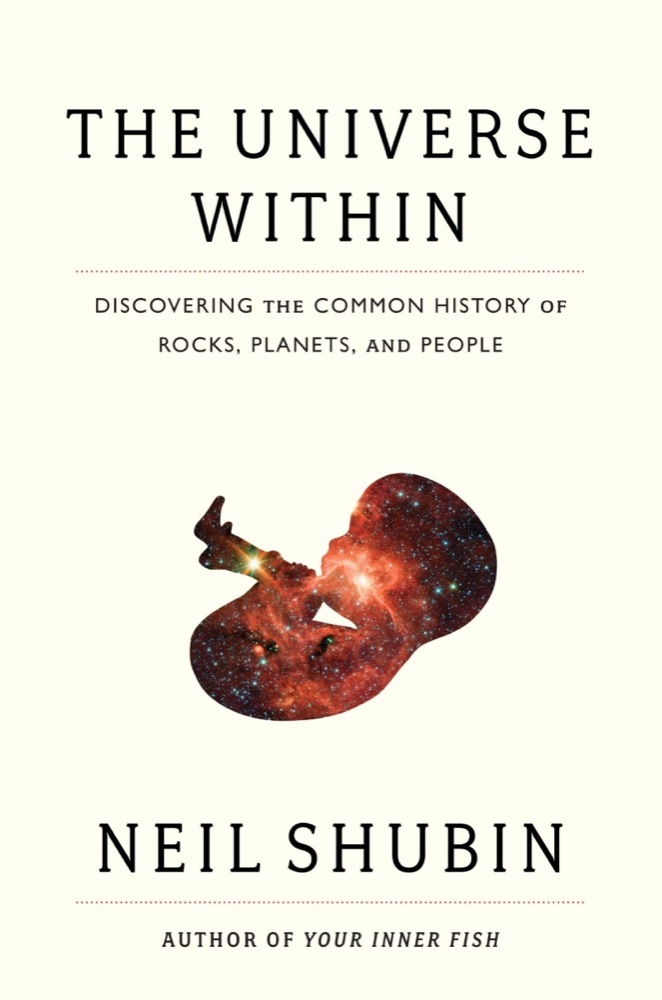
 The Universe Within: Discovering the Common History of Rocks, Planets, and People
Quotes from the Book
We were not designed rationally, but are products of a convoluted history.
In a perfectly designed world —one with no history— we would not have to suffer everything from hemorrhoids to cancer.
Take the entire 4.5-billion-year history of the earth and scale it down to a single year, with January 1 being the origin of the earth and midnight on December 31 being the present. Until June, the only organisms were single-celled microbes, such as algae, bacteria, and amoebae. The first animal with a head did not appear until October. The first human appears on December 31. We, like all the animals and plants that have ever lived, are recent crashers at the party of life on earth.
No sane paleontologist would ever claim that he or she had discovered "The Ancestor." Think about it this way: What is the chance that while walking through any random cemetery on our planet I would discover an actual ancestor of mine? Diminishingly small. What I would discover is that all people buried in these cemeteries-- no mater whether that cemetery is in China, Botswana, or Italy-- are related to me to different degrees. I can find this out by looking at their DNA with many of the forensic techniques in use in crime labs today. I'd see that some of the denizens of the cemeteries are distantly related to me, others are related more closely. This tree would be a very powerful window into my past and my family history. It would also have a practical application because I could use this tree to understand my predilection to get certain diseases and other facts of my biology. The same is true when we infer relationship among species.
We would never have scales, feathers, or breasts if we didn't have teeth in the first place.
But why live in these environments at all? What possessed fish to get out of the water or live in the margins? Think of this: virtually every fish swimming in these 375-million-year-old streams was a predator of some kind. Some were up to sixteen feet long, almost twice the size of the largest Tiktaalik. The most common fish species we find alongside Tiktaalik is seven feet long and has a head as wide as a basketball. The teeth are barbs the size of railroad spikes. Would you want to swim in these ancient streams?
In preparing for battle, I have found that planning is essential, but plans are useless. - Dwight D. Eisenhower
The immediate thing that strikes you when you see the inside of the hand is its compactness. The ball of your thumb, the thenar eminence, contains four different muscles. Twiddle your thumb and tilt your hand: ten different muscles and at least six different bones work in unison. Inside the wrist are at least eight small bones bones that move against one another. Bend your wrist, and you are using a number of muscles that begin in your forearm, extending into tendons as they travel down your arm to end at your hand. Even the simplest motion involves a complex interplay among many parts packed in a small space.
[T]he unknown should not be a source of suspicion, fear, or retreat to superstition, but motivation to continue asking questions and seeking answers.
Over 99 percent of all species that ever lived are now extinct.
What is it about a hand that seems quintessentially human? The answer must, at some level, be that the hand is a visible connection between us; it is a signature for who we are and what we can attain. Our ability to grasp, to build, and to make our thoughts real lies inside this complex of bones, nerves, and vessels.
My building was constructed in 1896, and the utilities reflect an odd design that has been jerry-rigged further with each renovation. If you want to understand the wiring and plumbing in my building, you have to understand its history, how it was renovated for each new generation of scientists. My head has a long history also, and that history explains complicated nerves like the trigeminal and the facial.
At conception, we start as a single cell that contains all the DNA needed to build our body. The plan for that entire body unfolds via the instructions contained in this single microscopic cell. To go from this generalized egg cell to a complete human, with trillions of specialized cells organized in just the right way, whole batteries of genes need to be turned on and off at just the right stages of development. Like a concerto composed of individual notes played by many instruments, our bodies are a composition of individual genes turning on and off inside each cell during our development.
Some people can detect the odor molecules in a green bell pepper at a concentration of less than one part per trillion. That is like picking out one grain of sand from a mile-long beach.
Tiktaalik has a shoulder, elbow, and wrist composed of the same bones as an upper arm, forearm, and wrist in a human. When we study the structure of these joints to assess how one bone moves against another, we see that Tiktaalik was specialized for a rather extraordinary function: it was capable of doing push-ups.
knowing something about the deep origins of humanity only adds to the remarkable fact of our existence: all of our extraordinary capabilities arose from basic components that evolved in ancient fish and other creatures.
They took an alga that is normally single-celled and let it live in the lab for over a thousand generations. Then they introduced a predator: a single-celled creature with a flagellum that engulfs other microbes to ingest them. In less than two hundred generations, the alga responded by becoming a clump of hundreds of cells; over time, the number of cells dropped until there were only eight in each clump. Eight turned out to be the optimum because it made clumps large enough to avoid being eaten but small enough so that each cell could pick up light to survive. The most surprising thing happened when the predator was removed: the algae continued to reproduce and form individuals with eight cells. In short, a simple version of a multicellular form had arisen from a no-body. If an experiment can produce a simple body-like organization from a no-body in several years, imagine what could happen in billions of years.
When you see these deep similarities among different organs and bodies, you begin to recognize that the diverse inhabitants of our world are just variations on a theme.
When the finely tuned balance among the different parts of bodies breaks down, the individual creature can die. A cancerous tumor, for example, is born when one batch of cells no longer cooperates with others. By dividing endlessly, or by failing to die properly, these cells can destroy the necessary balance that makes a living individual person. Cancers break the rules that allow cells to cooperate with one another. Like bullies who break cooperative societies, cancers behave in their own best interest until they kill their larger community, the human body.
We were staring at the origin of a piece of our own bodies inside this 375-million-year-old fish. We had a fish with a wrist.
Some fish, for example the lungfish, have the one bone at the base. Other fish, for example Eusthenopteron, have the one bone–two bones arrangement. Then there are creatures like Tiktaalik, with one bone–two bones–lotsa blobs. There isn’t just a single fish inside of our limbs; there is a whole aquarium. Owen’s blueprint was assembled in fish.
Look at the first arch in a human and a shark, and you find a very similar state of affairs: jaws.
The molecules that allow microbes to catch their prey and hold on to them are likely candidates for the molecules that form the rivet attachments between cells in our bodies.
All the genetic switches that make fingers, arm bones, and toes do their thing during the third to eighth week after conception.
... two little patches of tissue essentially control the development of the pattern of bones inside limbs. A strip of tissue at the extreme end of the limb bud is essential for all limb development. Remove it, and development stops. Remove it early, and we are left with only an upper arm, or a piece of an arm. Remove it slightly later, and we end up with an upper arm and a forearm. Remove it even later, and the arm is almost complete, except that the digits are short and deformed.
Watch on YouTube
About Neil Shubin
We have collected 31 quotes from 2 books by Neil Shubin on BookQuoters.
More about the author →More by Neil Shubin
The Universe Within: Discovering the Common History of Rocks, Planets, and People
Book details
- Author
- Neil Shubin
- Genre
- History
- Goodreads rating
- 4.04 (30k ratings) →
Keep reading
 The Song of the Cell: An Exploration of Medicine and the New Human
 The Lives of a Cell: Notes of a Biology Watcher
 Shadows of Forgotten Ancestors
 Other Minds
 Undeniable: Evolution and the Science of Creation
 The Violinist's Thumb: And Other Lost Tales of Love, War, and Genius, as Written by Our Genetic Code
 A Short History of Nearly Everything
 The Story of the Human Body: Evolution, Health, and Disease
 The Blind Watchmaker: Why the Evidence of Evolution Reveals a Universe Without Design
 The Ancestor's Tale: A Pilgrimage to the Dawn of Evolution
 The Greatest Show on Earth: The Evidence for Evolution
 A Hunter-Gatherer's Guide to the 21st Century: Evolution and the Challenges of Modern Life
 The Tell-Tale Brain: A Neuroscientist's Quest for What Makes Us Human
 The Gene: An Intimate History
 Genome
 The Code Breaker: Jennifer Doudna, Gene Editing, and the Future of the Human Race
 Genome: the Autobiography of a Species in 23 Chapters
 The Last Days of the Dinosaurs: An Asteroid, Extinction, and the Beginning of Our World
 The Light Eaters: How the Unseen World of Plant Intelligence Offers a New Understanding of Life on Earth
 The Third Chimpanzee: The Evolution and Future of the Human Animal
 The Social Conquest of Earth
 The Mountain in the Sea
 The Future of Humanity: Terraforming Mars, Interstellar Travel, Immortality and Our Destiny Beyond Earth
 The Biology of Belief: Unleashing the Power of Consciousness, Matter and Miracles
 Vanishing Treasures: A Bestiary of Extraordinary Endangered Creatures
 The Lost World
 Sapiens: A Brief History of Humankind
 The Red Queen: Sex and the Evolution of Human Nature
 The Origin of Species
 What Doesn't Kill Us: How Freezing Water, Extreme Altitude, and Environmental Conditioning Will Renew Our Lost Evolutionary Strength
 Darwin's Dangerous Idea: Evolution and the Meanings of Life
 Dragons of Eden: Speculations on the Evolution of Human Intelligence
 Echopraxia
 The Big Picture: On the Origins of Life, Meaning, and the Universe Itself
 Billions & Billions: Thoughts on Life and Death at the Brink of the Millennium
 Entangled Life: How Fungi Make Our Worlds, Change Our Minds & Shape Our Futures
 How the Mind Works
 Wired
Wired
 The Grand Design
 The World Without Us
 Why We Get Sick: The New Science of Darwinian Medicine
 2312
2312
 Survival of the Sickest: A Medical Maverick Discovers Why We Need Disease
 The Ascent of Man
 Underland: A Deep Time Journey
 Gathering Moss: A Natural and Cultural History of Mosses
 The Log from the Sea of Cortez
 Trilobite: Eyewitness to Evolution
 Why Fish Don’t Exist: A Story of Loss, Love, and the Hidden Order of Life
 The Tale of the Dueling Neurosurgeons: The History of the Human Brain as Revealed by True Stories of Trauma, Madness, and Recovery
 Natural Causes: An Epidemic of Wellness, the Certainty of Dying, and Killing Ourselves to Live Longer
 What Technology Wants
 Darwin's Black Box: The Biochemical Challenge to Evolution
 The Soul of an Octopus: A Surprising Exploration into the Wonder of Consciousness
 Woman: An Intimate Geography
 Endless Forms Most Beautiful: The New Science of Evo Devo
 Jurassic Park
 Behave: The Biology of Humans at Our Best and Worst
 Livewired: The Inside Story of the Ever-Changing Brain
 Power, Sex, Suicide: Mitochondria and the Meaning of Life