
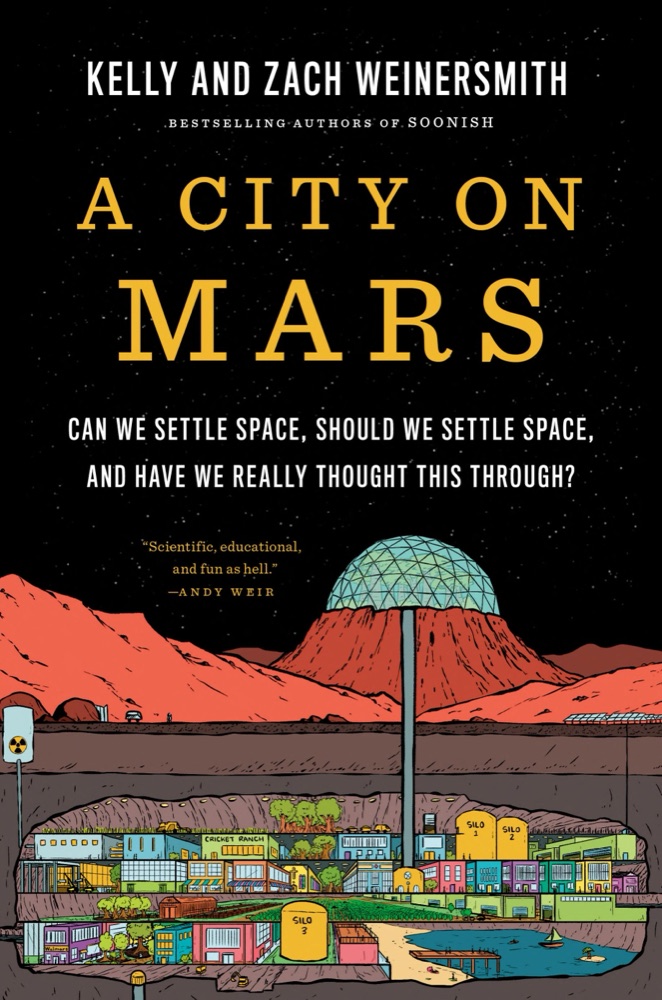
 A City on Mars: Can We Settle Space, Should We Settle Space, and Have We Really Thought This Through?
Quotes from the Book
YOU PROMISED ME MARS COLONIES, AND ALL I GOT WAS ALL OF HUMAN KNOWLEDGE INDEXED AND AVAILABLE TO EVERYONE ON EARTH FOR FREE.
10
The cheapest orbit available is LEO (Low Earth Orbit). People often think that "orbit" means there's no gravity. This is incorrect. In fact, the International Space Station (which is in LEO right now) is usually around 250 miles high and experiences about 90% of the gravity you experience on Earth. So why do the astronauts float around like there's no gravity? Although they are pulled toward the Earth all the time, they always "miss" it. Think of it like this: Imagine you fire a cannonball from the top of a tower. If you fire it softly, the ball will go a little ways then fall to the ground. If you fire it incredibly fast, it will just fly off into space. But between falling right down and going off into space, there are a lot of intermediate regimes. For a given height, there is some speed that is slow enough that it can't leave Earth, but fast enough that you'll never plop to the ground. If you were ridong that cannonball, you'd be falling, because gravity is tugging you down. At the same time, because you're going so fast, you'd be able to see Earth's curve. As you move from a point on the globe in a straight line, Earth curves down and away from you, increasing your distance from the surface. At this particular speed, you have two balanced effects: Gravity wants you down low, but your speed keeps you up high. So you just keep going around and around. You "orbit.
4
Or perhaps you’re familiar with ethanol, which is a chemical that can be metabolized into poor life choices.
4
Why stop at seven margaritas when you can just print a new liver?
2
If you think about it, a room is just a box that keeps nature out and Internet in.
2
Humans, with some exceptions, are a bit more complicated than rabbits.
1
If AR is ubiquitous, your perception of reality is hackable. And so are the perceptions of people and groups around you.
1
The ability to create an object that fits nicely into an envelope, but which can then hop up and walk across the room, has applications ranging from military and security to creating a Dear John letter that gives the recipient a rude gesture.
1
When hydrogen isotopes fuse, they become a different element—helium. This may seem weird, but it’s no weirder than how two pieces of bread make a new thing called a sandwich.
1
Laziness [is] the mother of invention
1
When you put that liquid helium on the conductor, the wobble energy in the copper atoms is transferred to the helium atoms, which then fly away. Now your copper atoms are less wobbly and your electrons experience a lot less resistance. The colder they get, the easier it is for electrons to flow.
1
Dr. Noah Smith, economics columnist for Bloomberg View, tells us, “The real danger of the ‘rise of the robots’ is not that they’ll take all our jobs, but that they’ll cause continually increasing inequality.
1
That said, if we could build giant megalasers, there might be an additional bonus for rocketry. One group at Brown recently suggested that a powerful laser could be used to reduce air drag by as much as 95%. Imagine this: As you are being laser-blasted up, a second laser is being fired into the region ahead of you. This makes the air ahead of you less dense, so there’s less to bump into. Now your astronauts might get a little antsy, since they’re flying at well past the speed of sound with ultrapowerful lasers before and behind them, but you could solve this problem by just calling them cowards.
1
The mosquitoes that carry malaria and transmit it to humans often become resistant to pesticides. Mosquitoes reproduce quickly, which means every generation has a lot of chances to produce mutants who can defeat humanity’s best weapons. Here’s one way we could win the arms race: Female mosquitoes often only mate once. What if we could trick them into mating with a sterile male? This should mean fewer cute little baby mosquitoes,* which means less malaria transmission. An early strategy to make sterile male mosquitoes was to expose them to radiation. This did indeed sterilize the males, but well . . . it turns out that when you expose a guy to a huge dose of radiation, it may increase his chances of sleeping alone.
Currently, when you’re building a house, the city sends people, inspectors, like ten, twelve times at different stages—foundation, the walls, and plumbing, and whatever.
the treaty stipulated that bombs could not be detonated underwater.
The Miller Lab is just beginning to explore this technique, and it’ll be some time before we live in a world of plentiful livers with nice juicy veins. But it’s an important step toward a better tomorrow, where our children can drink twelve beers every night and only worry about the damage done to their friends and family.
Nature, red in tooth and claw, culls the inferior babies.
Dr. Joff Silberg and Dr. Carrie Masiello are a husband-and-wife team of professors at Rice University. He is a synthetic biologist. She is a geologist. But somehow they managed to move past that and find love. Dr. Masiello studies biochar, which is made when plant matter gets baked at a high temperature in the absence of oxygen. The creation of biochar sequesters carbon that would otherwise end up back in the atmosphere, and it is frequently added to soil to increase plant growth. We don’t know precisely why it helps plant growth, but it may be that it alters the composition of microbes in the soil. Dr. Masiello wanted bacteria that could report back to her on what conditions were like for microbes living in soil with and without biochar. She asked Dr. Silberg to make her a synthetic microbe for Valentine’s Day. Yes, really. Dr. Silberg created bacteria that release gases that aren’t commonly found in soil. So by putting the synthetic microbes in soil, then monitoring the gas release, we can “eavesdrop” on microbe behavior instead of grinding them up for analysis.
This sort of thing sometimes causes people undue distress, as in the recent MIT Technology Review cover, featuring moonwalker Buzz Aldrin with the headline “YOU PROMISED ME MARS COLONIES. INSTEAD I GOT FACEBOOK.” But, in fairness, a Mars colony would cost a few trillion dollars, while Facebook is free. And, it’s worth noting that the choice of Facebook is a bit crafty. Imagine if they’d picked Wikipedia: “YOU PROMISED ME MARS COLONIES, AND ALL I GOT WAS ALL OF HUMAN KNOWLEDGE INDEXED AND AVAILABLE TO EVERYONE ON EARTH FOR FREE.
Watch on YouTube
About Kelly Weinersmith
We have collected 42 quotes from 2 books by Kelly Weinersmith on BookQuoters.
More about the author →More by Kelly Weinersmith
A City on Mars: Can We Settle Space, Should We Settle Space, and Have We Really Thought This Through?
About the book
From a top scientist and the creator of the hugely popular web comic Saturday Morning Breakfast Cereal, an illustrated investigation into future technologies
What will the world of tomorrow be like? How does progress happen? And why do we not have a lunar colony already?
In this book, Zach and Kelly Weinersmith give us a snapshot of the transformative technologies that are coming next - from robot swarms to nuclear fusion powered-toasters - and explain how they will change our world in astonishing ways. By weaving together their own research, interviews with pioneering scientists and Zach's trademark comics, the Weinersmiths investigate why these innovations are needed, how they would work, and what is standing in their way.
Book details
- First published
- 2017
- Author
- Kelly Weinersmith
- Genre
- Nonfiction
- Goodreads rating
- 3.94 (6k ratings)
Keep reading
 What If?: Serious Scientific Answers to Absurd Hypothetical Questions
 How To: Absurd Scientific Advice for Common Real-World Problems
 Physics of the Future: How Science Will Shape Human Destiny and Our Daily Lives by the Year 2100
 The Future of Humanity: Terraforming Mars, Interstellar Travel, Immortality and Our Destiny Beyond Earth
 Packing for Mars: The Curious Science of Life in the Void
 Parasite
 Space Chronicles: Facing the Ultimate Frontier
 What Technology Wants
 A Short History of Nearly Everything
 Cryptonomicon
 The Code Breaker: Jennifer Doudna, Gene Editing, and the Future of the Human Race
 On the Steel Breeze
 The Futurological Congress: From the Memoirs of Ijon Tichy
 Earth
Earth
 How We Got to Now: Six Innovations That Made the Modern World
 Echopraxia
 Influx
 Friday
 The Disappearing Spoon: And Other True Tales of Madness, Love, and the History of the World from the Periodic Table of the Elements
A City on Mars: Can We Settle Space, Should We Settle Space, and Have We Really Thought This Through?
The Disappearing Spoon: And Other True Tales of Madness, Love, and the History of the World from the Periodic Table of the Elements
A City on Mars: Can We Settle Space, Should We Settle Space, and Have We Really Thought This Through?
 Saturn's Children
 Grunt: The Curious Science of Humans at War
 The Midwich Cuckoos
 Billions & Billions: Thoughts on Life and Death at the Brink of the Millennium
 The Three-Body Problem
 Hackers & Painters: Big Ideas from the Computer Age
 Humble Pi: A Comedy of Maths Errors
 Stuff Matters: Exploring the Marvelous Materials That Shape Our Man-Made World
 If Anyone Builds It, Everyone Dies: Why Superhuman AI Would Kill Us All
 The Second Ship
 2312
2312
 Elon Musk
 The Rational Optimist: How Prosperity Evolves
 Heaven's River
 The Fifth Science
 Falter: Has the Human Game Begun to Play Itself Out?
 Maelstrom
 The Salmon of Doubt
 Snow Crash
 Physics of the Impossible: A Scientific Exploration Into the World of Phasers, Force Fields, Teleportation, and Time Travel
 Death's End
 Genome
 Pocket Apocalypse
 The Wizard and the Prophet: Two Remarkable Scientists and Their Dueling Visions to Shape Tomorrow's World
 The Lost World
 The Naked Sun
 Distrust That Particular Flavor
 The Mote in God's Eye
 Delta-v
 There Is No Antimemetics Division
 Redemption Ark
 Seveneves
 Ripple
 Prey
Prey
 Rama II
 Artemis
 Vanishing Treasures: A Bestiary of Extraordinary Endangered Creatures
 How I Killed Pluto and Why It Had It Coming
 Elon Musk: Inventing the Future
 The Caves of Steel