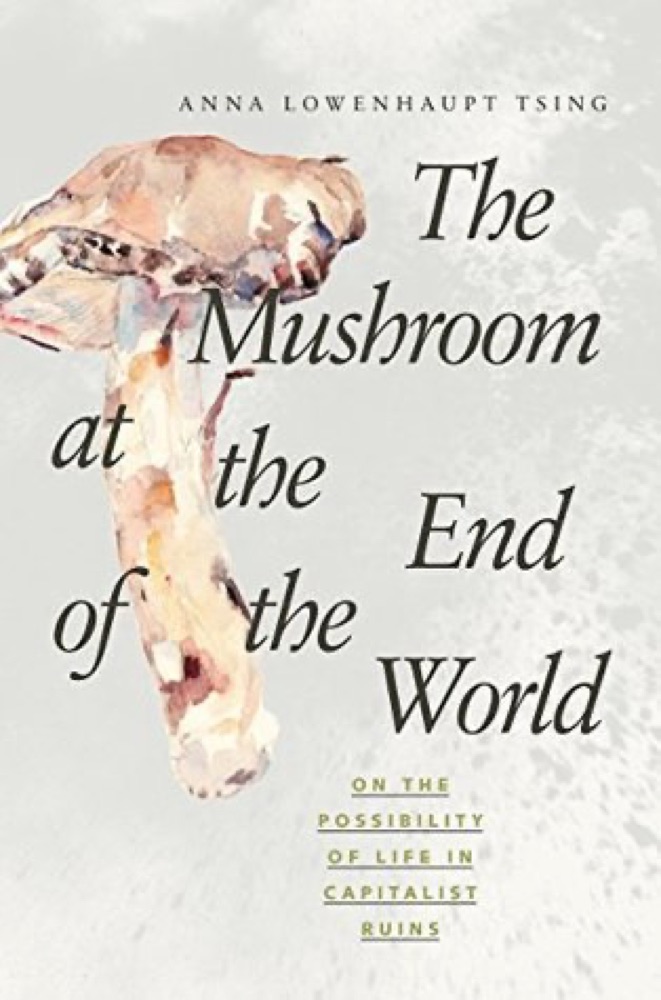

 All We Can Save: Truth, Courage, and Solutions for the Climate Crisis
Quotes from the Book
We are stuck with the problem of living despite economic and ecological ruination. Neither tales of progress nor of ruin tell us how to think about collaborative survival. It is time to pay attention to mushroom picking. Not that this will save us—but it might open our imaginations.
21
Without stories of progress, the world has become a terrifying place. The ruin glares at us with the horror of its abandonment. It’s not easy to know how to make a life, much less avert planetary destruction. Luckily there is still company, human and not human. We can still explore the overgrown verges of our blasted landscapes - the edges of capitalist discipline, scalability, and abandoned resource plantations. We can still catch the scent of the latent commons - and the elusive autumn aroma.
13
To walk attentively through a forest, even a damaged one, is to be caught by the abundance of life: ancient and new; underfoot and reaching into the light. But how does one tell the life of the forest? We might begin by looking for drama and adventure beyond the activities of humans. Yet we are not used to reading stories without human heroes. This is the puzzle that informs this section of the book. Can I show landscape as the protagonist of an adventure in which humans are only one kind of participant? Over the past few decades many kinds of scholars have shown that allowing only human protagonists into our stories is not just ordinary human bias. It is a cultural agenda tied to dreams of progress through modernization. There are other ways of making worlds. Anthropologists have become interested, for example, in how substance hunters recognize other living beings as persons, that is protagonists of stories. Indeed, how could it be otherwise? Yet expectations of progress block this insight. Talking animals are for children and primitives. Their voices silent, we imagine wellbeing without them. We trample over them for our advancement. We forget that collaborative survival requires cross-species coordinations. To enlarge what is possible we need other kinds of stories, including adventures of landscapes.
12
This book argues that staying alive—for every species—requires livable collaborations. Collaboration means working across difference, which leads to contamination. Without collaborations, we all die.
9
Precarity is the condition of being vulnerable to others. Unpredictable encounters transform us; we are not in control, even of ourselves. Unable to rely on a stable structure of community, we are thrown into shifting assemblages, which remake us as well as our others. We can’t rely on the status quo; everything is in flux, including our ability to survive. Thinking through precarity changes social analysis. A precarious world is a world without teleology. Indeterminacy, the unplanned nature of time, is frightening, but thinking through precarity makes it evident that indeterminacy also makes life possible.
7
It's not easy to know how to make a life, much less avert planetary destruction. Luckily there is still company, human and not human.
4
But what is "public property" if not an oxymoron?
4
As contamination changes world-making projects, mutual worlds—and new directions—may emerge.
4
Imagining the human since the rise of capitalism entangles us with ideas of progress and with the spread of techniques of alienation that turn both humans and other beings into resources. Such techniques have segregated humans and policed identities, obscuring collaborative survival. The concept of the Anthropocene both evokes this bundle of aspirations, which one might call the modern human conceit, and raises the hope that we might muddle beyond it. Can we live inside this regime of the human and still exceed it?
4
Capitalism is a translation machine for producing capital from all kinds of livelihoods, human and not human.
3
The contrast between private mushrooms and fungi-forming forest traffic might be an emblem for commoditisation more generally: the continual, never-finished cutting off of entanglement.
3
Freedom is the negotiation of ghosts on a haunted landscape; it does not exorcise the haunting but works to survive and negotiate it with flair.
2
Life lines are entangled: candy cane and matsutake; matsutake and its host trees; host trees and herbs, mosses, insects, soil bacteria, and forest animals; heaving bumps and mushroom pickers. Matsutake pickers are alert to life lines in the forest; searching with all the senses creates this alertness. It is a form of forest knowledge and appreciation without the completeness of classification. Instead, searching brings us to the liveliness of beings experienced as subjects rather than objects.
2
The problem is that progress stopped making sense. More and more of us looked up one day and realized that the emperor had no clothes.
1
The sustainability of nature, he said, never just falls into place; it must be brought out through that human work that also brings out our humanity.
1
Why don’t we use these stories in how we know the world? One reason is that contaminated diversity is complicated, often ugly, and humbling. Contaminated diversity implicates survivors in histories of greed, violence, and environmental destruction.
1
Rather than seeing only the expansion-and-conquest strategies of relentless individuals, we must look for histories that develop through contamination.
1
In its secular forms, then, this cosmological politics exceeds Christianity; to be an American, you must convert, not to Christianity, but to American democracy.
1
Sometimes, indeed, it seemed to me that the really important exchange was the freedom, with the mushroom-and-money trophies as extensions– proofs, as it were– of the performance. After all, it was the feeling of freedom, galvanizing "mushroom fever," that energized buyers to put on their best shows and pressed pickers to get up the next dawn to search for mushrooms again.
1
following in the footsteps of Marx, twentieth-century students of capitalism internalized progress to see only one powerful current at a time, ignoring the rest.
1
First, all that taming and mastering has made such a mess that it is unclear whether life on earth can continue.
1
Over the past few decades many kinds of scholars have shown that allowing only human protagonists into our stories is not just ordinary human bias. It is a cultural agenda tied to dreams of progress through modernization.
1
Watch on YouTube
About Anna Lowenhaupt Tsing
We have collected 22 quotes from 1 book by Anna Lowenhaupt Tsing on BookQuoters.
More about the author →About the book
What a rare mushroom can teach us about sustaining life on a fragile planet.
Matsutake is the most valuable mushroom in the world—and a weed that grows in human-disturbed forests across the northern hemisphere. Through its ability to nurture trees, matsutake helps forests to grow in daunting places. It is also an edible delicacy in Japan, where it sometimes commands astronomical prices. In all its contradictions, matsutake offers insights into areas far beyond just mushrooms and addresses a crucial question: what manages to live in the ruins we have made?
A tale of diversity within our damaged landscapes, The Mushroom at the End of the World follows one of the strangest commodity chains of our times to explore the unexpected corners of capitalism. Here, we witness the varied and peculiar worlds of matsutake commerce: the worlds of Japanese gourmets, capitalist traders, Hmong jung
Book details
- First published
- 2015
- Author
- Anna Lowenhaupt Tsing
- Genre
- Nonfiction
- Goodreads rating
- 3.95 (9k ratings)
Keep reading
All We Can Save: Truth, Courage, and Solutions for the Climate Crisis
 Endgame, Vol. 1: The Problem of Civilization
 The Nutmeg's Curse: Parables for a Planet in Crisis
 The Wizard and the Prophet: Two Remarkable Scientists and Their Dueling Visions to Shape Tomorrow's World
 Under a White Sky: The Nature of the Future
 A Short History of Progress
 Feral: Rewilding the Land, the Sea and Human Life
 The World Without Us
 Falter: Has the Human Game Begun to Play Itself Out?
 The World-Ending Fire: The Essential Wendell Berry
 Sapiens: A Brief History of Humankind
 Four Futures: Life After Capitalism
 The Lost World
 Small Is Beautiful: Economics as if People Mattered
 Underland: A Deep Time Journey
 The Wayfinders: Why Ancient Wisdom Matters in the Modern World
 A Sand County Almanac and Sketches Here and There
 Collapse: How Societies Choose to Fail or Succeed
 Bringing it to the Table: On Farming and Food
 Staying with the Trouble: Making Kin in the Chthulucene
 The One-Straw Revolution
 Civilized to Death: What Was Lost on the Way to Modernity
 On Trails: An Exploration
 The Overstory
 Billions & Billions: Thoughts on Life and Death at the Brink of the Millennium
 A Life on Our Planet: My Witness Statement and a Vision for the Future
 On Fire: The Case for the Green New Deal
 The Ministry for the Future
 Gathering Moss: A Natural and Cultural History of Mosses
 The Story of More: How We Got to Climate Change and Where to Go from Here
 Arctic Dreams
 Ishmael: An Adventure of the Mind and Spirit
 The Mountain in the Sea
 The Coming Insurrection
 Food of the Gods: The Search for the Original Tree of Knowledge
 To Be Taught, If Fortunate
 A Hunter-Gatherer's Guide to the 21st Century: Evolution and the Challenges of Modern Life
 Why Fish Don’t Exist: A Story of Loss, Love, and the Hidden Order of Life
 The Fifth Science
 Ghosts of My Life: Writings on Depression, Hauntology and Lost Futures
 Saving Time: Discovering a Life Beyond the Clock
 2312
2312
 The Culture of Make Believe
 Blue Mars
 The Dark Forest
 Homo Deus: A History of Tomorrow
 Straw Dogs: Thoughts on Humans and Other Animals
 Vanishing Treasures: A Bestiary of Extraordinary Endangered Creatures
 A Language Older Than Words
 The Futurological Congress: From the Memoirs of Ijon Tichy
 The Art of the Commonplace: The Agrarian Essays
 Enlightenment Now: The Case for Reason, Science, Humanism, and Progress
 The State of the Art
 Silent Spring
 Shadows of Forgotten Ancestors
 The Social Conquest of Earth
 The Forest Unseen: A Year’s Watch in Nature
 Creation Lake
 The Story of B: An Adventure of the Mind and Spirit
 Dragons of Eden: Speculations on the Evolution of Human Intelligence