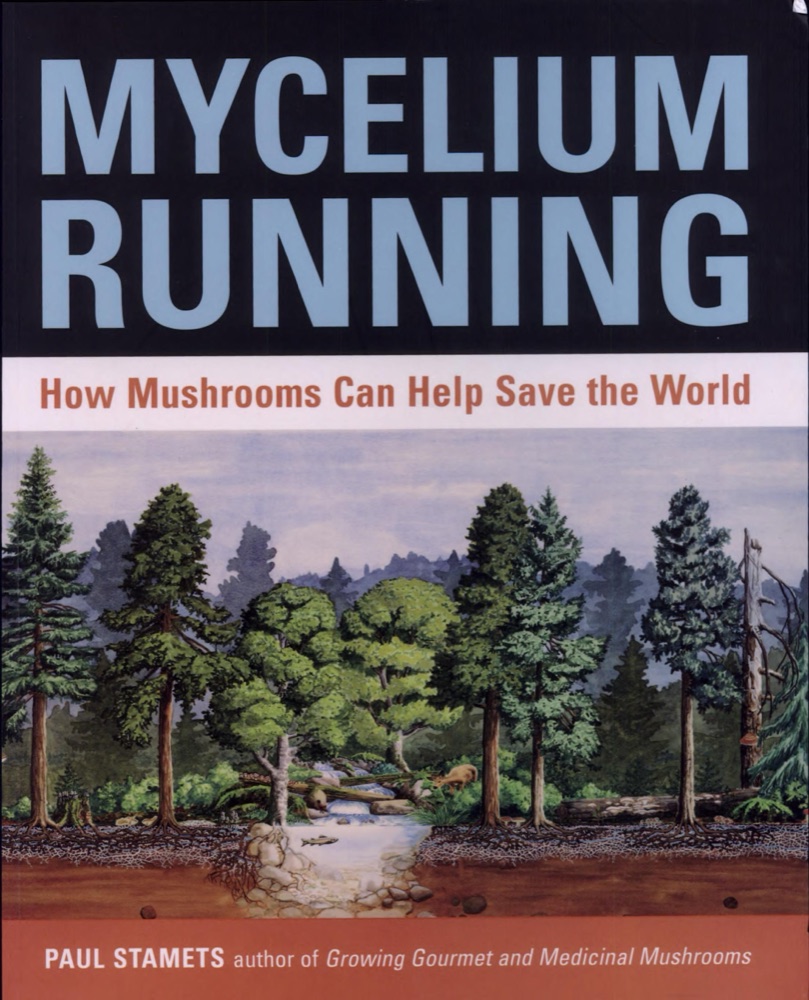
 Mycelium Running: How Mushrooms Can Help Save the World
Quotes from the Book
A mycelial network is a map of a fungus’s recent history and is a helpful reminder that all life-forms are in fact processes not things. The “you” of five years ago was made from different stuff than the “you” of today. Nature is an event that never stops. As William Bateson, who coined the word genetics, observed, “We commonly think of animals and plants as matter, but they are really systems through which matter is continually passing.
48
The authors of a seminal paper on the symbiotic view of life take a clear stance on this point. “There have never been individuals,” they declare. “We are all lichens.
38
Fungi make worlds. They also unmake them. There are lots of ways to catch them in the act. When you cook mushroom soup, or just eat it. When you go out gathering mushrooms, or buy them. When you ferment alcohol, plant a plant, or just bury your hands in the soil; and whether you let a fungus into your mind, or marvel at the way that it might enter the mind of another. Whether you’re cured by a fungus, or watch it cure someone else; whether you build your home from fungi, or start growing mushrooms in your home, fungi will catch you in the act. If you’re alive, they already have.
21
The difference between animals and fungi is simple: Animals put food in their bodies, whereas fungi put their bodies in the food.
20
Science isn’t an exercise in cold-blooded rationality. Scientists are—and have always been—emotional, creative, intuitive, whole human beings, asking questions about a world that was never made to be catalogued and systematized.
17
Some fungi have tens of thousands of mating types, approximately equivalent to our sexes (the record holder is the split gill fungus, Schizophyllum commune, which has more than twenty-three thousand mating types, each of which is sexually compatible with nearly every one of the others). The mycelium of many fungi can fuse with other mycelial networks if they are genetically similar enough, even if they aren’t sexually compatible. Fungal self-identity matters, but it is not always a binary world. Self can shade off into otherness gradually.
14
Anthropomorphism is usually thought of as an illusion that arises like a blister in soft human minds: untrained, undisciplined, unhardened. There are good reasons for this: when we humanise the world, we may prevent ourselves from understanding the lives of other organisms on their own terms. But are there things this stance might lead us to pass over – or forget to notice?
12
A slime-mold enthusiast told me about a test he had performed. He frequently got lost in IKEA stores and would spend many minutes trying to find the exit. He decided to challenge his slime molds with the same problem and built a maze based on the floor plan of his local IKEA. Sure enough, without any signs or staff to direct them, the slime molds soon found the shortest path to the exit. “You see,” he said with a laugh, “they’re cleverer than me.
12
A growing number of studies have made a link between animal behavior and the trillions of bacteria and fungi that live in their guts, many of which produce chemicals that influence animal nervous systems. The interaction between gut microbes and brains—the “microbiome-gut-brain axis”—is far-reaching enough to have birthed a new field: neuromicrobiology.
10
When trying to understand the interactions of nonhuman organisms, it is easy to flip between these two perspectives: that of the inanimate behavior of preprogrammed robots on the one hand, and that of rich, lived human experience on the other. Framed as brainless organisms, lacking the basic apparatus required to have even a simple kind of “experience,” fungal interactions are no more than automatic responses to a series of biochemical triggers. Yet the mycelium of truffle fungi, like that of most fungal species, actively senses and responds to its surroundings in unpredictable ways.
10
Whether one calls slime molds, fungi, and plants “intelligent” depends on one’s point of view. Classical scientific definitions of intelligence use humans as a yardstick by which all other species are measured. According to these anthropocentric definitions, humans are always at the top of the intelligence rankings, followed by animals that look like us (chimpanzees, bonobos, etc.), followed again by other “higher” animals, and onward and downward in a league table—a great chain of intelligence drawn up by the ancient Greeks, which persists one way or another to this day. Because these organisms don’t look like us or outwardly behave like us—or have brains—they have traditionally been allocated a position somewhere at the bottom of the scale. Too often, they are thought of as the inert backdrop to animal life. Yet many are capable of sophisticated behaviors that prompt us to think in new ways about what it means for organisms to “solve problems,” “communicate,” “make decisions,” “learn,” and “remember.” As we do so, some of the vexed hierarchies that underpin modern thought start to soften. As they soften, our ruinous attitudes toward the more-than-human world may start to change. The second field of research that has guided me in this inquiry concerns the way we think about the microscopic organisms—or microbes—that cover every inch of the planet. In the last four decades, new technologies have granted unprecedented access to microbial lives. The outcome? For your community of microbes—your “microbiome”—your body is a planet. Some prefer the temperate forest of your scalp, some the arid plains of your forearm, some the tropical forest of your crotch or armpit. Your gut (which if unfolded would occupy an area of thirty-two square meters), ears, toes, mouth, eyes, skin, and every surface, passage, and cavity you possess teem with bacteria and fungi. You carry around more microbes than your “own” cells. There are more bacteria in your gut than stars in our galaxy. For humans, identifying where one individual stops and another starts is not generally something we
9
The “loss of a sense of self-identity, delusions of self-identity and experiences of ‘alien control,’ ” observed an elder statesman in the field of microbiome research, are all potential symptoms of mental illness. It made my head spin to think of how many ideas had to be revisited, not least our culturally treasured notions of identity, autonomy, and independence. It is in part this disconcerting feeling that makes the advances in the microbial sciences so exciting.
9
There are more bacteria in your gut than stars in our galaxy.
8
90 percent of the serotonin in our bodies—the neurotransmitter that when abundant makes us feel happy, and when depleted makes us feel depressed—is produced in our guts, and gut microbes play a major role in regulating its production (Yano et al. 2015).
8
Many scientific concepts—from time to chemical bonds to genes to species—lack stable definitions but remain helpful categories to think with. From one perspective, “individual” is no different: just another category to guide human thought and behavior. Nonetheless, so much of daily life and experience—not to mention our philosophical, political, and economic systems—depends on individuals that it can be hard to stand by and watch the concept dissolve. Where does this leave “us”? What about “them”? “Me”? “Mine”? “Everyone”? “Anyone”? My response to the discussions at the conference was not just intellectual
8
One study estimated that if a hypha was as wide as a human hand, it would be able to lift an eight-ton school bus.
7
Fungi are veteran survivors of ecological disruption. Their ability to cling on—and often flourish—through periods of catastrophic change is one of their defining characteristics. They are inventive, flexible, and collaborative. With much of life on Earth threatened by human activity, are there ways we can partner with fungi to help us adapt? These may sound like the delirious musings of someone buried up to their neck in decomposing wood chips, but a growing number of radical mycologists think exactly this. Many symbioses have formed in times of crisis. The algal partner in a lichen can’t make a living on bare rock without striking up a relationship with a fungus. Might it be that we can’t adjust to life on a damaged planet without cultivating new fungal relationships
7
Sixty percent of the enzymes used in industry are generated by fungi, and fifteen percent of all vaccines are produced by engineered strains of yeast.
7
all life-forms are in fact processes not things.
6
I have tried to find ways to enjoy the ambiguities that fungi present, but it's not always easy to be comfortable in the space created by open questions. Agoraphobia can set in. It's tempting to hide in small rooms built from quick answers. I have done my best to hold back. page 14
6
Without this fungal web my tree would not exist. Without similar fungal webs no plant would exist anywhere. All life on land, including my own, depended on these networks.
6
Mycelium is ecological connective tissue, the living seam by which much of the world is stitched into relation. In school classrooms children are shown anatomical charts, each depicting different aspects of the human body. One chart reveals the body as a skeleton, another the body as a network of blood vessels, another the nerves, another the muscles. If we made equivalent sets of diagrams to portray ecosystems, one of the layers would show the fungal mycelium that runs through them. We would see sprawling, interlaced webs strung through the soil, through sulfurous sediments hundreds of meters below the surface of the ocean, along coral reefs, through plant and animal bodies both alive and dead, in
6
For Adamatzky, the point of fungal computers is not to replace silicon chips. Fungal reactions are too slow for that. Rather, he thinks humans could use mycelium growing in an ecosystem as a “large-scale environmental sensor.” Fungal networks, he reasons, are monitoring a large number of data streams as part of their everyday existence. If we could plug into mycelial networks and interpret the signals they use to process information, we could learn more about what was happening in an ecosystem.
6
Fungi are equipped with different kinds of bodies. They don’t have noses or brains. Instead, their entire surface behaves like an olfactory epithelium. A mycelial network is one large chemically sensitive membrane: A molecule can bind to a receptor anywhere on its surface and trigger a signaling cascade that alters fungal behavior.
6
Our eyes can distinguish several million colors, our ears can distinguish half a million tones, but our noses can distinguish well over a trillion different odors.
5
The biologist Robin Wall Kimmerer, a member of the Citizen Potawatomi Nation, observes that the indigenous Potawatomi language is rich in verb forms that attribute aliveness to the more-than-human world. The word for “hill,” for example, is a verb: to be a hill. Hills are always in the process of hilling, they are actively being hills.
4
Fungi, like plants, are decentralized organisms. There are no operational centers, no capital cities, no seats of government. Control is dispersed: Mycelial coordination takes place both everywhere at once and nowhere in particular. A fragment of mycelium can regenerate an entire network, meaning that a single mycelial individual—if you’re brave enough to use that word—is potentially immortal.
3
fungal networks form physical connections between plants. It is the difference between having twenty acquaintances and having twenty acquaintances with whom one shares a circulatory system.
3
Further studies on humans have shown that certain probiotic treatments can reduce symptoms of depression, anxiety, and the occurrence of negative thoughts (Mohajeri et al. [2018] and Valles-Colomer et al. [2019]). However, a multibillion-dollar probiotics industry hovers around the field of neuromicrobiology, and a number of researchers have pointed out the tendency to overhype findings. Gut communities are complex, and manipulating them is a challenge.
3
Watch on YouTube
About Merlin Sheldrake
We have collected 29 quotes from 1 book by Merlin Sheldrake on BookQuoters.
More about the author →About the book
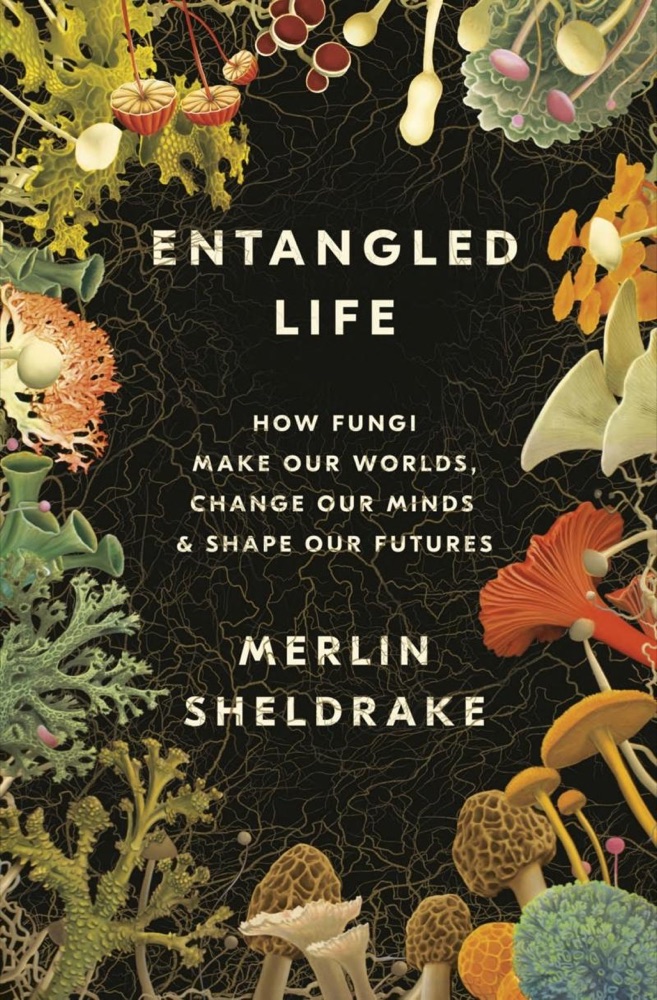
There is a lifeform so strange and wondrous that it forces us to rethink how life works…Neither plant nor animal, it is found throughout the earth, the air and our bodies. It can be microscopic, yet also accounts for the largest organisms ever recorded, living for millennia and weighing tens of thousands of tonnes. Its ability to digest rock enabled the first life on land, it can survive unprotected in space, and thrives amidst nuclear radiation.
In this captivating adventure, Merlin Sheldrake explores the spectacular and neglected world of fungi: endlessly surprising organisms that sustain nearly all living systems. They can solve problems without a brain, stretching traditional definitions of ‘intelligence’, and can manipulate animal behaviour with devastating precision. In giving us bread, alcohol and life-saving medicines, fungi have shaped human history, and their psychedelic pro
Book details
- First published
- 2020
- Author
- Merlin Sheldrake
- Genre
- Nonfiction
- Goodreads rating
- 4.31 (54k ratings)
The buzz
- The New York TimesReview in The New York Timesprofessional review (via Book Marks)
- The New YorkerReview in The New Yorkerprofessional review (via Book Marks)
- The Wall Street JournalReview in The Wall Street Journalprofessional review (via Book Marks)
- The GuardianReview in The Guardianprofessional review (via Book Marks)
- The TimesReview in The Timesprofessional review (via Book Marks)
- New StatesmanReview in New Statesmanprofessional review (via Book Marks)
Keep reading
Mycelium Running: How Mushrooms Can Help Save the World
 The Light Eaters: How the Unseen World of Plant Intelligence Offers a New Understanding of Life on Earth
 The Lives of a Cell: Notes of a Biology Watcher
 The Forest Unseen: A Year’s Watch in Nature
 The Song of the Cell: An Exploration of Medicine and the New Human
 Your Inner Fish: A Journey Into the 3.5-Billion-Year History of the Human Body
 Regenesis: Feeding the World Without Devouring the Planet
 Gathering Moss: A Natural and Cultural History of Mosses
 Other Minds
 The Blind Watchmaker: Why the Evidence of Evolution Reveals a Universe Without Design
 The Future of Humanity: Terraforming Mars, Interstellar Travel, Immortality and Our Destiny Beyond Earth
 The Biology of Belief: Unleashing the Power of Consciousness, Matter and Miracles
 The Tell-Tale Brain: A Neuroscientist's Quest for What Makes Us Human
 Gut: The Inside Story of Our Body's Most Underrated Organ
 Power, Sex, Suicide: Mitochondria and the Meaning of Life
 The Big Picture: On the Origins of Life, Meaning, and the Universe Itself
 The Hidden Life of Trees: What They Feel, How They Communicate: Discoveries from a Secret World
 The Mountain in the Sea
 The Mushroom at the End of the World: On the Possibility of Life in Capitalist Ruins
 A Short History of Nearly Everything
 The Botany of Desire: A Plant's-Eye View of the World
 The Ancestor's Tale: A Pilgrimage to the Dawn of Evolution
 The Earth Moved: On the Remarkable Achievements of Earthworms
 Underland: A Deep Time Journey
 Genome: the Autobiography of a Species in 23 Chapters
 Vanishing Treasures: A Bestiary of Extraordinary Endangered Creatures
 The Secret Life of Plants: A Fascinating Account of the Physical, Emotional and Spiritual Relations Between Plants and Man
 The Soul of an Octopus: A Surprising Exploration into the Wonder of Consciousness
 A Hunter-Gatherer's Guide to the 21st Century: Evolution and the Challenges of Modern Life
 Darwin's Dangerous Idea: Evolution and the Meanings of Life
 Shadows of Forgotten Ancestors
 The Case Against Reality: Why Evolution Hid the Truth from Our Eyes
 Undeniable: Evolution and the Science of Creation
 How the Mind Works
 What a Plant Knows: A Field Guide to the Senses
 The Code Breaker: Jennifer Doudna, Gene Editing, and the Future of the Human Race
 The Violinist's Thumb: And Other Lost Tales of Love, War, and Genius, as Written by Our Genetic Code
 Clean: The New Science of Skin
 A Life on Our Planet: My Witness Statement and a Vision for the Future
 Space Chronicles: Facing the Ultimate Frontier
 Echopraxia
 Darwin's Black Box: The Biochemical Challenge to Evolution
 An Immense World: How Animal Senses Reveal the Hidden Realms Around Us
 The Lost World
 The Social Conquest of Earth
 Genome
 What Technology Wants
 Life 3.0: Being Human in the Age of Artificial Intelligence
 Until the End of Time: Mind, Matter, and Our Search for Meaning in an Evolving Universe
 A Thousand Brains: A New Theory of Intelligence
 Sapiens: A Brief History of Humankind
 The Accidental Universe: The World You Thought You Knew
 The Gene: An Intimate History
 From Bacteria to Bach and Back: The Evolution of Minds
 Astrophysics for People in a Hurry
 Dragons of Eden: Speculations on the Evolution of Human Intelligence
 Ways of Being: Animals, Plants, Machines: The Search for a Planetary Intelligence
 Beyond Words: What Animals Think and Feel
 A Devil's Chaplain: Reflections on Hope, Lies, Science, and Love
 The Overstory