
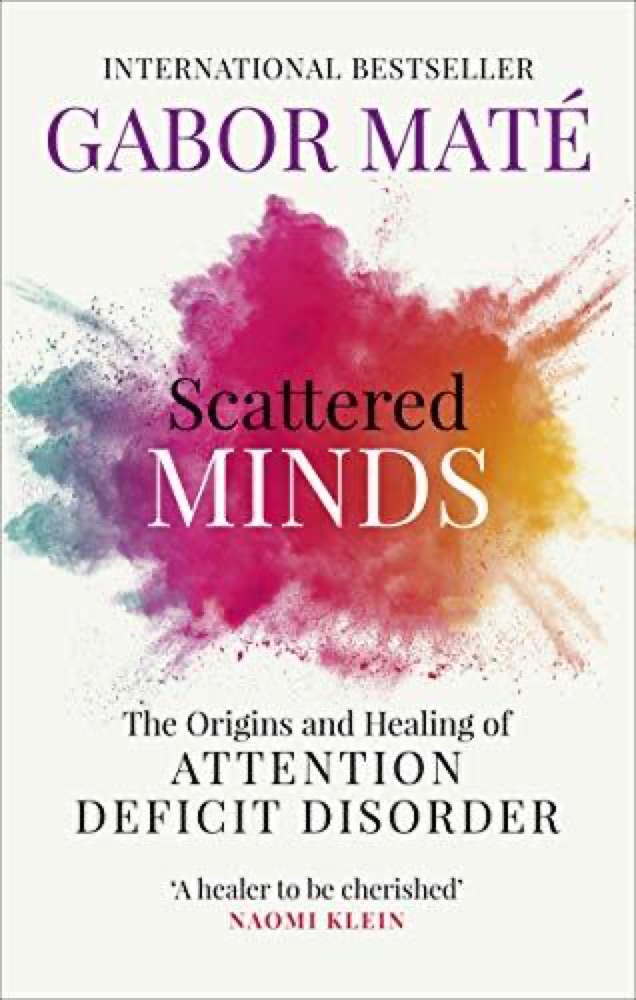
 Scattered Minds: The Origins and Healing of Attention Deficit Disorder
Quotes from the Book
THE SEVEN HABITS OF HIGHLY EFFECTIVE ADD ADULTS 1. Do what you’re good at. Don’t spend too much time trying to get good at what you’re bad at. (You did enough of that in school.) 2. Delegate what you’re bad at to others, as often as possible. 3. Connect your energy to a creative outlet. 4. Get well enough organized to achieve your goals. The key here is “well enough.” That doesn’t mean you have to be very well organized at all—just well enough organized to achieve your goals. 5. Ask for and heed advice from people you trust—and ignore, as best you can, the dream-breakers and finger-waggers. 6. Make sure you keep up regular contact with a few close friends. 7. Go with your positive side. Even though you have a negative side, make decisions and run your life with your positive side.
17
To tell a person who has ADD to try harder is about as helpful as telling someone who is nearsighted to squint harder.
15
My thoughts are like butterflies. They are beautiful, but they fly away.
9
Having ADD makes life paradoxical. You can superfocus sometimes, but also space out when you least mean to. You can radiate confidence and also feel as insecure as a cat in a kennel. You can perform at the highest level, feeling incompetent as you do so. You can be loved by many, but feel as if no one really likes you. You can absolutely, totally, intend to do something, then forget to do it. You can have the greatest ideas in the world, but feel as if you can’t accomplish a thing.
6
People with ADD often have a special “feel” for life, a way of seeing right into the heart of matters, while others have to reason their way along methodically.
6
For all the hoopla you read and hear about the overdiagnosis of ADD and the overuse of medication-indeed, serious problems in certain places—the more costly problem is the opposite: millions of people, especially adults, have ADD but don't know about it and there fore get no help at all.
5
For someone who has ADD, being bored is like being asphyxiated. It cannot be endured for more than a minute or so. When bored, the person with ADD feels compelled to do something immediately to bring the world back up to speed. Adrenaline
3
1. Position one blank sheet of paper to your right and another to your left; then take a pencil in each hand. Simultaneously, draw a vertical line on the right sheet and a circle on the left sheet. Repeat three times, alternating figures on the right and left sheets. 2. Draw a triangle on one sheet while drawing a square on the other. Then switch: draw the square on the first sheet and the triangle on the other. 3. Draw a circle on one sheet while drawing a triangle on the other. Switch figures and do it again. 4. Draw two circles on one sheet while drawing one square on the other. Then switch. 5. Draw two squares on one sheet while drawing one triangle on the other. Then switch. 6. Draw a triangle on one sheet while drawing a square on the other and also tracing a circle on the floor with one leg. Then switch hands (and switch to the other leg). 7. Draw a circle with one hand and a triangle with the other while tracing a square on the floor with one leg. Then switch all. 8. Draw a triangle with one hand and two squares with the other while tracing a circle on the floor with one leg. Then switch all. 9. Draw a triangle with one hand and a square with the other while tracing a circle on the floor with one leg and nodding your head twice forward and twice backward. 10. Draw a triangle with one hand and a square with the other while tracing a vertical line with the leg on the same side as the hand that is drawing the triangle, and a horizontal line with leg on the same side as the hand that is drawing the square. Then switch all.
3
What they don’t understand—and the wide world certainly does not understand—is that these reckless acts do stem from a biological need to alter their inner state. In pain, they feel compelled to seek relief immediately.
3
In the world of ADD, there are only two times: there is now, and then there is not now.
1
All people have their own special skills. Instead of just identifying deficiencies, schools should try to identify and promote those special skills as early on as possible. For
1
The term attention deficit disorder completely misses this point. It is not a deficit of attention that we ADD-ers have, it is that our attention likes to go where it wants to and we can’t always control it.
1
My wife has learned not to take my tuning out personally, and she does say that when I’m there, I’m really there.
A model that explains the “itch” at the core of ADD,
For most of human history, problems with learning, emotion, or behavior have been viewed through the lens of morality, often colored by theology.
You can superfocus sometimes, but also space out when you least mean to. You can radiate confidence and also feel as insecure as a cat in a kennel. You can perform at the highest level, feeling incompetent as you do so. You can be loved by many, but feel as if no one really likes you. You can absolutely, totally, intend to do something, then forget to do it. You can have the greatest ideas in the world, but feel as if you can’t accomplish a thing.
Sometimes, if I am not in a situation where the truth matters, I take the liberty of becoming playful and making up a profession. I’ve said I’m a chef. I’ve said I train astronauts. I’ve said I’m a fisherman. One time I said I was a spy. The person I was talking to became instantly animated and started peppering me with so many questions it would have been easier if I had simply told the truth. As it was, I had to fabricate a wild set of statements based on my uninformed speculation about what a spy does! But such is the mind of a person who has ADHD—in this case, me—that making up stories comes quite naturally. Some people call this lying, but when there is no harm done, I call it playing.
Creativity, after all, does not happen on schedule or on demand. It
As far as I can see, many people who don’t have ADD are charter members of the Society of the Congenitally Boring. And
The ingredients of the mélange may include: • high mental and physical energy (coupled with extreme lassitude at times) • a fast-moving, easily distracted mind (coupled with an amazingly superfocused mind at times) • trouble with remembering, planning, and anticipating • unpredictability and impulsivity • creativity • lack of inhibition as compared to others • disorganization (coupled with remarkable organizational skills in certain domains) • a tendency toward procrastination (coupled with an I-must-do-it-or-have-it-now attitude at times) • a high-intensity attitude alternating with a foggy one • forgetfulness (coupled with an extraordinary recall of certain often irrelevant remote information) • passionate interests (coupled with an inability to arouse interest at other times) • an original, often zany way of looking at the world • irritability (coupled with tenderheartedness) • a tendency to drink too much alcohol, smoke cigarettes, use other drugs, or get involved with addictive activities such as gambling, shopping, spending, sex, food, and the Internet (coupled with a tendency to abstain altogether at times) • a tendency to worry unnecessarily (coupled with a tendency not to worry enough when worry is warranted) • a tendency to be a nonconformist or a maverick • a tendency to reject help from others (coupled with a tendency to want to give help to others) • generosity that can go too far • a tendency to repeat the same mistake many times without learning from it • a tendency to underestimate the time it takes to complete a task or get to a destination • various other ingredients, none of which dominates all the time, and any one of which may be absent in a single individual
If you tell a person that she has a mental disorder, you create a mental disorder—not only in the patient but in those who love her as well. The disorder is fear. Chronic fear holds more people back in life than any other mental infirmity. How ironic—and wrong—that the
Watch on YouTube
About Edward M. Hallowell
We have collected 21 quotes from 1 book by Edward M. Hallowell on BookQuoters.
More about the author →About the book
“If you read only one book about attention deficit disorder, it should be Delivered from Distraction .”—Michael Thompson, Ph.D., New York Times bestselling co-author of Raising Cain
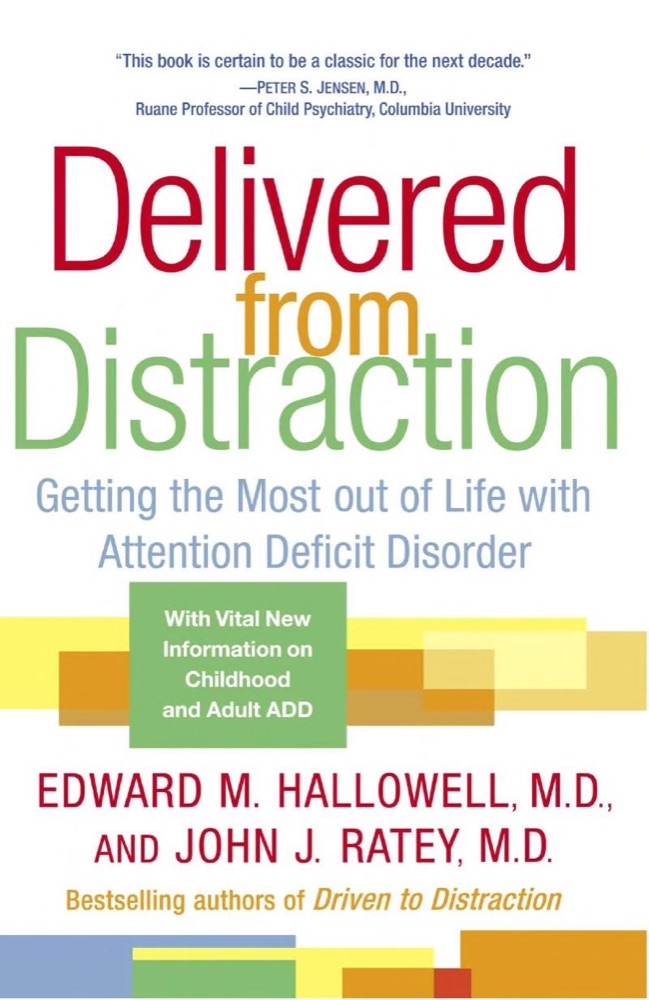
In 1994, Driven to Distraction sparked a revolution in our understanding of attention deficit disorder. Widely recognized as the classic in the field, the book has sold more than a million copies. Now a second revolution is under way in the approach to ADD, and the news is great. Drug therapies, our understanding of the role of diet and exercise, even the way we define the disorder–all are changing radically. And doctors are realizing that millions of adults suffer from this condition, though the vast majority of them remain undiagnosed and untreated. In this new book, Drs. Edward M. Hallowell and John J. Ratey build on the breakthroughs of Driven to Distraction to offer a comprehensive and entirely up-to-da
Book details
- First published
- 2004
- Author
- Edward M. Hallowell
- Genre
- Nonfiction
- Goodreads rating
- 4.11 (5k ratings)
Keep reading
Scattered Minds: The Origins and Healing of Attention Deficit Disorder
 Antifragile: Things That Gain from Disorder
 Stolen Focus: Why You Can't Pay Attention— and How to Think Deeply Again
 How to ADHD: An Insider's Guide to Working with Your Brain
 The Organized Mind: Thinking Straight in the Age of Information Overload
 A Mind for Numbers: How to Excel at Math and Science
 Just Like Someone Without Mental Illness Only More So
 Scarcity Brain: Fix Your Craving Mindset and Rewire Your Habits to Thrive with Enough
 Overwhelmed: Work, Love, and Play When No One Has the Time
 The Social Animal: The Hidden Sources of Love, Character, and Achievement
 Dirty Laundry: Why Adults with ADHD Are So Ashamed and What We Can Do to Help
 Mastery
 The Art of Thinking Clearly
 The Bullet Journal Method: Track Your Past, Order Your Present, Plan Your Future
 Getting Things Done: The Art of Stress-Free Productivity
 Psych: The Story of the Human Mind
 Thinking In Pictures: and Other Reports from My Life with Autism
 The Undoing Project: A Friendship That Changed Our Minds
 A User's Guide to the Brain: Perception, Attention, and the Four Theaters of the Brain
 The Age of Magical Overthinking: Notes on Modern Irrationality
 You Are Now Less Dumb: How to Conquer Mob Mentality, How to Buy Happiness, and All the Other Ways to Outsmart Yourself
 The Willpower Instinct: How Self-Control Works, Why It Matters, and What You Can Do to Get More of It
 Smarter Faster Better: The Secrets of Being Productive in Life and Business
 All Is Not Forgotten
 Made to Stick: Why Some Ideas Survive and Others Die
 Think Like a Freak
 Mastermind: How to Think Like Sherlock Holmes
 The 7 Habits of Highly Effective People: Personal Workbook
 First, We Make the Beast Beautiful: A New Story About Anxiety
 Social Intelligence: The New Science of Human Relationships
 Finding Flow: The Psychology of Engagement with Everyday Life
 Blink: The Power of Thinking Without Thinking
 Procrastination: Why You Do It, What To Do About It
 Hyperfocus: How to Be More Productive in a World of Distraction
 Drive: The Surprising Truth About What Motivates Us
 Make Time: How to Focus on What Matters Every Day
 Why Has Nobody Told Me This Before?
 The Center Cannot Hold: My Journey Through Madness
 How to Fail at Almost Everything and Still Win Big: Kind of the Story of My Life
 Limitless: Upgrade Your Brain, Learn Anything Faster, and Unlock Your Exceptional Life
 The Element: How Finding Your Passion Changes Everything
 The New Psycho-Cybernetics: The Original Science of Self-Improvement and Success That Has Changed the Lives of 30 Million People
 Irresistible: The Rise of Addictive Technology and the Business of Keeping Us Hooked
 The Happiness Equation: Want Nothing + Do Anything = Have Everything
 Tribe Of Mentors: Transformative Wisdom From Icons and Innovators to Help You Navigate Life's Challenges
 You Are Not So Smart
 The Productivity Project: Accomplishing More by Managing Your Time, Attention, and Energy
 Flow: The Psychology of Optimal Experience
 Grit: The Power of Passion and Perseverance
 On Connection
 Stumbling on Happiness
 Ten Steps to Nanette
 What I Mean When I Say I'm Autistic: Unpuzzling a Life on the Autism Spectrum
 Emotional Intelligence: Why It Can Matter More Than IQ
 Creativity: Flow and the Psychology of Discovery and Invention
 The Brain That Changes Itself: Stories of Personal Triumph from the Frontiers of Brain Science
 Zen and the Art of Motorcycle Maintenance
 Thinking, Fast and Slow
 The Sleeping Beauties: And Other Stories of Mystery Illness
 The 4-Hour Workweek