
 The Kindly Ones
Quotes from the Book
The old sporadic fanaticism of religious hatred had been skillfully perverted into the cold, steady fanaticism of national hate.
9
. . . failure is also the stern parent of truth. (p525)
3
For many people it is depressing even to move house. A lost fragment of life always remains. To move to another town, settle in a foreign country, is for everyone a major decision. But, to be suddenly driven forth, within twenty-four hours, from one's home, one's work, the reward of years of steady industry. To become a helpless prey of help. To be sent defenceless out to Asiatic highroads, with several thousand miles of dust, stones, and morass before one. To know that one will never again find a decently human habitation, never again sit down to a proper table. Yet this is all nothing. To be more shackled than any convict. To be counted as outside the law, a vagabond, whom anyone has the right to kill unpunished.
2
La ragion di Stato non si è mai curata di gettare una graziosa volta fra causa ed effetto. La coscienza del mondo, tanto più pigra a pensare quanto più carica di rimorsi, la stampa dei gruppi momentaneamente al potere e il cervello dei suoi lettori castrato da essa, hanno sempre girato e capito la cosa solo come occorreva a loro
1
Everything in this world is primarily a matter of morals, and only very much later one of politics.
1
At first, roll calls were still taken. But, as death and sickness gained the upper hand, as more and more half-dead and corpses, especially children's corpses, were flung into the ditches, this keeping of lists seemed highly onerous, and the onbashi relinquished superfluous scribbling. Who cared to know that Sarkis, Astik, or Hapeth, that Anush, Vartuhi, or Koren, were rotting somewhere in the open? These saptiehs were not all brutes. It is even probable that most of them were good, plain, middling sort of people. But what can a saptieh do? He is under stringent orders to reach such and such a point with his whole convoy by such and such a scheduled hour. His heart may be in perfect sympathy with the screaming mother who tries to snatch her child out of a ditch, flings herself down on the road, and claws the earth. No use to talk to her. She's wasted minutes already, and it's still six miles to the next halt. A convoy held up. All the faces in it twisted with hate. A mad scream from a thousand throats. Why did not these crowds, weak as they were, hurl themselves on the saptieh and his mates, disarm them, and tear them into shreds? Perhaps the policemen were in constant terror of such assault, which would have finished them. And so -- one of them fires a shot. The rest whip out their swords to beat the defenceless cruelly with the blades. Thirty or forty men and women lie bleeding. And, with this blood, another emotion comes to life in the excited saptiehs -- their old itch for the women of the accursed race. In these helpless women you possess more than a human being -- in very truth you possess the God of your enemy. Afterwards, the saptiehs scarcely know how it all had happened.
The bazaar bore him along. That deep surge which knows none of the ebb and flow, the hurry, of a crowd along a European pavement, which rolls on with an irresistible, even motion as time flows on into eternity. He might not have been in this God-forsaken provincial hole, Antakiya, but transported to Aleppo or Damascus, so inexhaustibly did the two opposing streams of the bazaar surge past each other. Turks in European dress, wearing the fez, with stand-up collars and walking-sticks, officials or merchants. Armenians, Greeks, Syrians, these too in European dress, but with different headgear. In and out among them, Kurds and Circassians in their tribal garb. Most displayed weapons. For the government, which in the case of Christian peoples viewed every pocketknife with mistrust, tolerated the latest infantry rifles in the hands of these restless mountaineers; it even supplied them. Arab peasants, in from the neighborhood. Also a few bedouins from the south, in long, many-folded cloaks, desert-hued, in picturesque tarbushes, the silken fringes of which hung over their shoulders. Women in charshaffes, the modest attire of female Moslems. But then, too, the unveiled, the emancipated, in frocks that left free silk-stockinged legs. Here and there, in this stream of human beings, a donkey, under a heavy load, the hopeless proletarian among beasts. To Gabriel it seemed always the same donkey which came stumbling past him in a coma, with the same ragged fellow tugging his bridle. But this whole world, men, women, Turks, Arabs, Armenians, Kurds, with trench-brown soldiers in its midst -- its goats, its donkeys -- was smelted together into an indescribable unity by its gait -- a long stride, slow and undulating, moving onwards irresistibly, to a goal not to be determined.
humility in the face of the unattainable, as well as unease in the face of achievement, are both prerequisites for any mastery in life.
Mentre nei selamlík, nei caffè, nei bagni, nei luoghi di ritrovo della provincia, il mondo moderno (vale a dire tutti quelli che leggevano giornali, che possedevano un modesto tesoro di vocaboli stranieri, che invece della vecchia fantasmagoria turca detta "karegöz", avevano veduto a Smirne o a Stambul un paio di commedie francesi e avevano udito qualche volta il nome di Bismarck e di Sarah Bernhardt), mentre queste persone colte, questo mezzo ceto progredito si faceva incondizionatamente seguace della politica armena di Enver, ben altrimenti avveniva presso gli uomini semplici del popolo turco, contadini o basso ceto cittadino. Spesso il Müdir si stupiva nei suoi giri, quando in un villaggio dove aveva proclamato il bando vedeva radunarsi Turchi ed Armeni per piangere insieme. E si meravigliava, quando davanti a una casa armena si raccoglieva singhiozzando la famiglia dei vicini turchi e agli infelici, che irrigiditi e privi di lagrime uscivano dalla loro vecchia porta senza guardarsi attorno, non solo gridava un «Allàh vi sia misericordioso», ma dava anche provvigioni per il viaggio e regali vistosi, una capra, perfino un mulo. E il Müdir poté anche vedere questa famiglia di vicini accompagnare i dolenti per parecchie miglia. E poté vedere alcuni dei suoi propri compatriotti gettarglisi ai piedi, supplicandolo: «Lasciali con noi! Non hanno la vera fede, ma sono buoni. Sono nostri fratelli. Lasciali qui con noi!
Fra gli Armeni c'è senza dubbio una massa inquietante d'intelligenza. Lei è davvero amico di questo genere d'intelligenza, signor Lepsius? Io no! Noi Turchi ne possediamo poca di questa intelligenza. Ma in cambio siamo l'antica razza eroica, che è chiamata alla fondazione e al dominio del grande impero. Perciò supereremo tutti gli ostacoli (Enver Pascià)
Giovanni Lepsius si è già fatto descrivere minutamente a Berlino Enver Pascià, tuttavia è molto sorpreso che il Marte turco, uno dei sette o nove grandi personaggi che decidono della morte e della vita del mondo, sia così piccolo di statura e così poco appariscente. Egli comprende subito i ritratti di Napoleone e di Federico. Eroi di un metro e sessanta di statura, geniali maniaci di grandezza, che hanno conquistato il loro successo a dispetto delle gambe troppo corte
I miei padri, che rivivono in me e che hanno indicibilmente sofferto, lo sentono. Tutta la mia sostanza vitale lo sente. No, tu non puoi comprendere, Giulietta. Chi non è mai stato odiato a cagione della sua razza non può comprendere
Gabriele non vedeva dinanzi a sé che un inizio, il crocicchio dove le vie si dividevano. Cinque passi più avanti tutto era nebbia e tenebra. Ma avviene in ogni vita così: prima della decisione nulla è più irreale che la meta.
Watch on YouTube
About Franz Werfel
We have collected 13 quotes from 1 book by Franz Werfel on BookQuoters.
More about the author →About the book
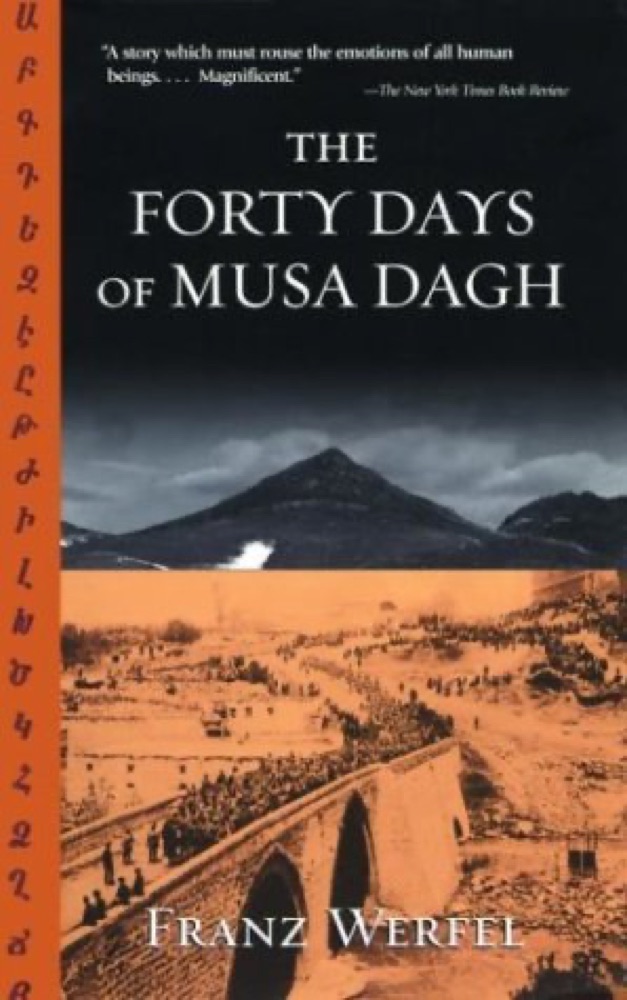
This stirring, poignant novel, based on real historical events that made of actual people true heroes, unfolds the tragedy that befell the Armenian people in the dark year of 1915. The Great War is raging through Europe, and in the ancient, mountainous lands southwest of the Caspian Sea the Turks have begun systematically to exterminate their Christian subjects. Unable to deny his birthright or his people, one man, Gabriel Bagradian—born an Armenian, educated in Paris, married to a Frenchwoman, and an officer doing his duty as a Turkish subject in the Ottoman army—will strive to resist death at the hands of his blood enemy by leading 5,000 Armenian villagers to the top of Musa Dagh, “the mountain of Moses.” There, for forty days, in the face of almost certain death, they will suffer the siege of a Turkish army hell-bent on genocide. A passionate warning against the dangers of racism and
Book details
- First published
- 1933
- Author
- Franz Werfel
- Genre
- Historical
- Goodreads rating
- 4.38 (2k ratings)
Keep reading
The Kindly Ones
 Margherita Dolce Vita
 At the Wolf's Table
 The Last of the Wine
 Kaputt
 The Tartar Steppe
 Brodeck
 Travels with Herodotus
 The Dogs of Riga
 Q
Q
 The Betrothed
 The Prague Cemetery
 Doctor Glas
 My Childhood
 Tonio Kröger
 Heaven and Hell
 The Little Virtues
 If This Is a Man / The Truce
 Dear Theo
 The Golem
 Penguin Island
 God and the State
 Buddenbrooks: The Decline of a Family
 The Leopard
 Babi Yar: A Document in the Form of a Novel
 Paris Spleen
 Letter to a Child Never Born
 The Floating Opera
 The Assistant
 The Charterhouse of Parma
 A Season in Hell
 The Last Day of a Condemned Man
 Ezilenler
 Ocean Sea
 Imperium
 Under Western Eyes
 Red Sorghum
 The Wine of Solitude
 Bosnian Chronicle
 Phaedo
 The Seducer’s Diary
 3,096 Days
 Honor
Honor
 The Autumn of the Patriarch
 An Interrupted Life: The Diaries, 1941-1943; and Letters from Westerbork
 The Genius and the Goddess: a Novel
 Auto-da-Fé
 Gomorrah
 Native Realm: A Search for Self-Definition
 The Double
 Survival in Auschwitz
 A Thousand Plateaus: Capitalism and Schizophrenia
 Diary of a Bad Year
 The Temptation to Exist
 Ferdydurke
 The War of the Poor
 Exodus
 Mutant Message Down Under
 The Dwarf
 The Scent of Time: A Philosophical Essay on the Art of Lingering