
 The Politics of Obedience: The Discourse of Voluntary Servitude
Quotes from the Book
And even if you don't give a shit whether or not the Chinese painter of rocks and birds had some mysterious kinship of the soul with the Landgrave of Hesse, fantasies are nonetheless one path to the truth. History is Philomela, and they raped her, or so they say, and cut her tongue, and she whistles at night from deep in the woods.
2
Why the God of the poor was so strangely on the side of the rich, always with the rich. Why his words about giving up everything issued from the mouths of those who had taken everything.
1
His body will be dragged over the scaffold and thrown to the dogs. Youth is endless, the secret of our equality immortal, and solitude wonderful. Martyrdom is a trap for the oppressed.
1
And so they began to realize they’d been lied to. They had long felt troubled and afflicted; there were many things they didn’t understand. They had a hard time understanding why God, the God of beggars, crucified between two thieves, needed such pomp. Why his ministers needed luxury of such embarrassing proportions. Why the God of the poor was so strangely on the side of the rich, always with the rich. Why his words about giving up everything issued from the mouths of those who had taken everything.
1
Cincuenta años antes, una pasta ardiente había fluido desde Maguncia al resto de Europa, había fluido entre las colinas de cada ciudad, entre las letras de cada nombre, en los canalones, en los recovecos de cada pensamiento, y cada letra, cada pedazo de idea, cada signo de puntuación, había quedado apresado en un trocito de metal. Esos trocitos los habían repartido en un cajón de madera. Las manos habían elegido uno, luego otro, y habían compuesto palabras, líneas, páginas. Los habían mojado en tinta y una fuerza prodigiosa había presionado lentamente las letras sobre el papel. Repitieron la operación decenas y decenas de veces, antes de doblar las hojas en cuatro, en ocho, en dieciséis. Las fueron colocando unas a continuación de otras, las pegaron entre sí, las cosieron, las envolvieron en cuero. De ese modo se formó un libro. La Biblia.
Martyrdom is a trap for the oppressed. Only victory is desirable.
Not to mention that, since the beginning of their existence, they have been trained to feel so much respect, so much fear, that they're still willing to take a prince at his word, at least for a while. We always want to believe what the father says. Our desire is attuned to his register.
Negotiations are a means of combat.
All the kingdoms that follow Babylon will be destroyed, except for one. That one is indestructible, for it is the Kingdom of God. The princes don't really care to hear about the destruction of kingdoms. The idea unsettles them. Nebuchadnezzer's dream is a prophecy of doom.
Leave everything and follow me,' Christ is sup- posed to have said; the commandment is infinite, it demands a new humanity. Enigmatic and naked. It sweeps away the grandeurs of the world. One kind of poverty destroys, another exalts. There is a great mystery in that: to love the poor means to love baneful poverty, to stop despising it. It means to love mankind. For man is poor. Irremediably. We are poverty, buffeted between desire and disgust.
Las palabras quedan dichas de nuevo: «ni mediante el dinero ni mediante el poder de los príncipes», esas mismas palabritas que cambian de forma, de tono, pero no de objetivo, y que, cuando retornan al mundo, siempre pugnan contra el dinero, la fuerza y el poder. Esas palabras van a ser poco a poco las nuestras. Van a tardar tiempo, mucho tiempo en labrarse un camino hasta nosotros.
«¡No son los campesinos quienes se sublevan, sino Dios!», cuentan que dijo Lutero [...]. Pero no era Dios. Eran sin duda los campesinos los que se sublevaban. A no ser que llamemos Dios al hambre, la enfermedad, la humillación, la penuria. No se subleva Dios, se sublevan la servidumbre, los feudos, los diezmos, el decreto de manos muertas, el arriendo, la tala, el viático, la recogida de paja, el derecho de pernada, las narices cortadas, los ojos reventados, los cuerpos quemados, apaleados, atenaceados. Las querellas sobre el más allá nos llevan en realidad a las cosas de este mundo.
For man is poor. Irremediably. We *are* poverty, buffeted between desire and disgust.
Concerning the end of Thomas Müntzer, there exists a legend of cowardice with many variants. Müntzer supposedly fled and hid and they found him and turned him over to Count von Mansfield and he was imprisoned in a dungeon and tortured and supposedly he recanted and implored the princes for money and dictated a contrite letter to the inhabitants of Mühlhausen. I don't believe a word of it.
Müntzer exhorted his men, screamed his confidence in God, tried to grab them by the sleeve, I don't know what he did, probably he shed tears, he raged.
Outside the borders of Saxony, hardly anyone knows Zwickau. It’s just another backwater. Zwicker means pince-nez; Zwickel means gusset; Zwiebel, onion; and zwiebeln, to harass or bully. But Zwickau means nothing, or else it means onionskin, poor slobs, good business, yes, that’s what Zwickau means: poor slobs and good business.
No me creo nada. En esas leyendas infames, la cerviz de los renegados sólo se doblega en el momento en que se les retira la palabra. Esas leyendas sólo pretenden que resuene en nosotros la voz que nos atormenta, la voz del orden, a la que en el fondo nos hallamos tan ligados que cedemos a sus misterios y le entregamos nuestras vidas.
Watch on YouTube
About Éric Vuillard
We have collected 17 quotes from 1 book by Éric Vuillard on BookQuoters.
More about the author →About the book
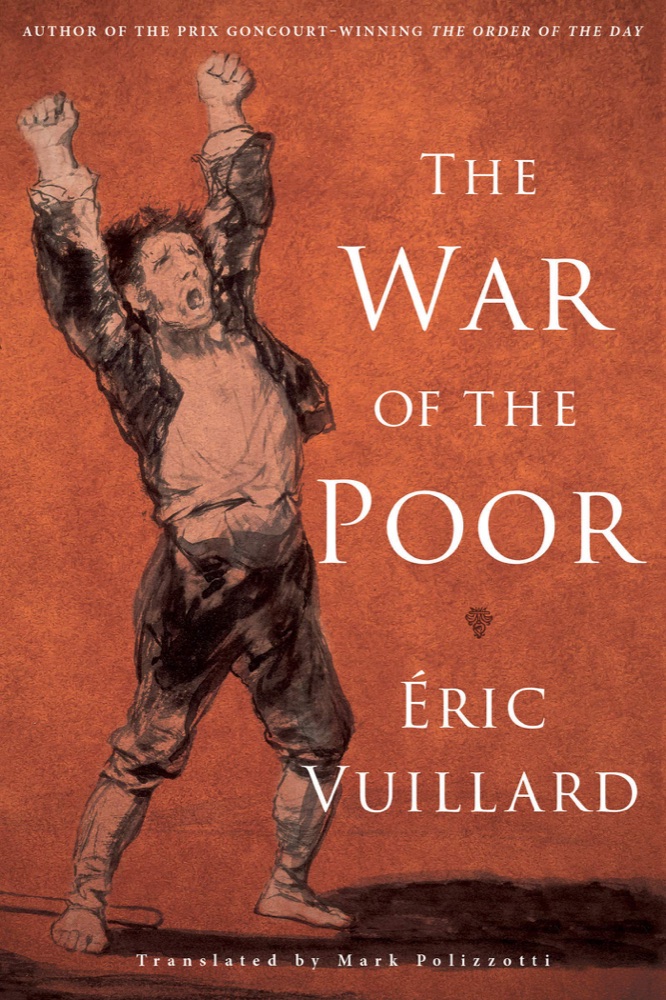
From the award-winning author of The Order of the Day, a powerful account of the German Peasants’ War (1524–25) that shows striking parallels to class conflicts of our time.
In the sixteenth century, the Protestant Reformation launched an attack on privilege and the Catholic Church, but it rapidly became an established, bourgeois authority itself. Rural laborers and the urban poor, who were still being promised equality in heaven, began to question why they shouldn’t have equality here and now on earth.
There ensued a furious struggle between the powerful—the comfortable Protestants—and the others, the wretched. They were led by a number of theologians, one of whom has left his mark on history through his determination and sheer energy. His name was Thomas Müntzer, and he set Germany on fire. The War of the Poor recounts his story—that of an insurrection through the Word.
In hi
Book details
- First published
- 2019
- Author
- Éric Vuillard
- Genre
- History
- Goodreads rating
- 3.39 (3k ratings)
Keep reading
The Politics of Obedience: The Discourse of Voluntary Servitude
 The Revolt of the Angels
 The Grand Inquisitor
 The Persecution and Assassination of Jean-Paul Marat as Performed by the Inmates of the Asylum of Charenton Under the Direction of the Marquis de Sade
 The Anti-Christ
 God and the State
 The Enchantress of Florence
 The Emperor
 Forge of Darkness
 Midnight Tides
 A Canticle for Leibowitz
 The Prague Cemetery
 The Fencing Master
 If This Is a Man / The Truce
 Exodus
 The Iron Heel
 The Divine Invasion
 Toll the Hounds
 Letters and Papers from Prison
 The Dwarf
 A History of the World in 100 Objects
 Eifelheim
 The Winter King
 The Will to Power
 The Mystery of Edwin Drood
 The Hundred Thousand Kingdoms
 Resurrection
 From Sand and Ash
 Jesus and the Disinherited
 The Chrysalids
 The Everlasting Man
 The Kindly Ones
 A Theology of Liberation
 Brodeck
 The Parafaith War
 The Tower of the Swallow
 The Warrior Prophet
 The People of the Abyss
 The Mysterious Stranger
 Dear and Glorious Physician
 The Gospel According to Jesus Christ
 Life of Christ
 Defying Hitler
 The Lily and The Lion
 Sword Song
 Saint Francis
 City of God
 A General Theory of Oblivion
 The Gods Themselves
 Persian Letters
 Perelandra
 Heretics
 Darkness at Noon
 People of the Book
 The White Luck Warrior
 The Book of Mirdad: The Strange Story of a Monastery Which Was Once Called the Ark
 The Story of My Experiments With Truth
 On the Genealogy of Morals/Ecce Homo
 Penguin Island
 Parable of the Talents