

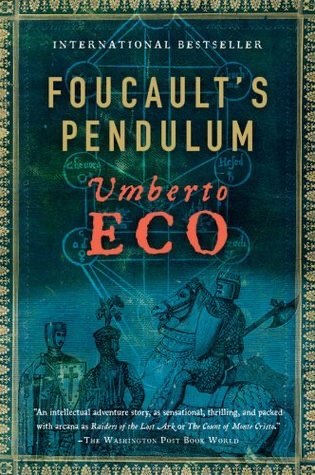
 Foucault's Pendulum
Quotes from the Book
People are never so completely and enthusiastically evil as when they act out of religious conviction.
343
Someone said that patriotism is the last refuge of cowards; those without moral principles usually wrap a flag around themselves, and those bastards always talk about the purity of race.
81
National identity is the last bastion of the dispossessed. But the meaning of identity is now based on hatred, on hatred for those who are not the same.
56
Listening doesn't mean trying to understand. Anything, however trifling, may be of use one day. What matters is to know something that others don't know you know.
40
A mystic is a hysteric who has met her confessor before her doctor.
32
You always want someone to hate in order to feel justified in your own misery. Hatred is the true primordial passion. It is love that’s abnormal. That is why Christ was killed: he spoke against nature. You don’t love someone for your whole life - that impossible hope is the source of adultery, matricide, betrayal of friends … But you can hate someone for your whole life - provided he’s always there to keep your hatred alive. Hatred warms the heart.
30
Libraries are fascinating places; sometimes you feel you are under the canopy of a railway station, and when you read books about exotic places there's a feeling of traveling to distant lands.
28
For the enemy to be recognized and feared, he has to be in your home or on your doorstep.
21
Man's principle trait is a readiness to believe anything. Otherwise, how could the Church have survived for almost two thousand years in the absense of universal gullibility?
21
What does the philosopher say? Odi ergo sum. I hate therefore I am.
20
You cannot change the world with ideas. People with few ideas are less likely to make mistakes; they follow what everyone else does and are no trouble to anyone; they're successful, make money, find good jobs, enter politics, receive honours; they become famous writers, academics, journalists. Can anyone who is so good at looking after their own interests really be stupid? I'm the stupid one, the one who wanted to go tilting at windmills.
15
It takes a little time, but the pleasures of cooking begin before the pleasures of the palate, and preparing means anticipating ...
13
But Paris, all in all, isn't what it used o be, ever since that pencil sharpener, the Eiffel Tower, has been sticking up in the distance, visible from every angle.
11
When a spy sells something entirely new, all he needs to do is recount something you could find in any second-hand book stall.
10
With Germans, as with women, you never get to the point.
9
But the meaning of identity is now based on hatred, on hatred for those who are not the same. Hatred has to be cultivated as a civic passion. The enemy is the friend of the people. You always want someone to hate in order to feel justified in your own misery.
7
Tất cả mọi thứ, kể cả có vẻ tầm phào, một ngày nào đó cũng có thể trở nên hữu ích. Điều quan trọng là biết được điều mà người khác không biết là bạn biết.
7
Es necesario un enemigo para darle al pueblo una esperanza. Alguien ha dicho que el patriotismo es el último refugio de los canallas: los que no tienen principios morales se suelen envolver en una bandera, y los bastardos se remiten siempre a la pureza de su raza. La identidad nacional es el último recurso para los desheredados. Ahora bien, el sentimiento de la identidad se funda en el odio, en el odio hacia los que no son idénticos. Hay que cultivar el odio como pasión civil. El enemigo es el amigo de los pueblos. Hace falta alguien a quien odiar para sentirse justificados en la propia miseria.
6
E nevoie de un dușman ca să-i dai poporului o speranță. Cineva a spus că patriotismul e ultimul refugiu al canaliilor: cine nu are principii morale se înfășoară de obicei într-un steag, iar bastarzii fac întotdeauna apel la puritatea stirpei lor. Identitatea națională este ultima resursă a dezmoșteniților. Or, simțul identității se întemeiază pe ură, ura împotriva celui ce nu-i identic. Trebuie să cultivi ura ca patos cetățenesc. Dușmanul e prietenul popoarelor. E nevoie oricând de cineva demn de a fi urât ca să te simți justificat în propria-ți mizerie. Ura este adevărata pasiune primordială. Iubirea reprezintă o situație anormală.
6
A te închipui un element necesar în ordinea universului echivalează, pentru noi, oamenii cu lecturi serioase, cu ceea ce e superstiția pentru analfabeți. Nu se schimbă lumea cu ideile. Persoanele cu puține idei sunt mai puțin supuse erorii, se iau după ceea ce fac toți și nu deranjează pe nimeni, și reușesc, se îmbogățesc, ajung la poziții solide, deputați, oameni cu decorații, oameni de litere renumiți, academicieni, jurnaliști. Poți să mai fii nerod când îți faci așa de bine propriile afaceri? Prostul sunt eu, care am vrut să mă bat cu morile de vânt.
5
Not that he felt any particular love for himself, but his dislike of others induced him to make the best of his own company.
4
Über die deutsche Sprache: „Sie halten sich für tief, weil ihre Sprache unklar ist, ihr fehlt die clarté der französischen Sprache, sie sagt nie exakt das, was sie sollte, so dass kein Deutscher jemals weiß, was er sagen wollte – und dann verwechselt er diese Undeutlichkeit mit Tiefe. Es ist mit Deutschen wie mit Frauen, man gelangt bei ihnen nie auf den Grund
4
The Frenchman doesn't really know what he wants, but knows perfectly well that he doesn't want what he has. And the only way he knows of saying it is by singing songs.
3
Qualcuno ha detto che il patriottismo è l'ultimo rifugio delle canaglie: chi non ha principi morali si avvolge di solito in una bandiera, e i bastardi si richiamano sempre alla purezza della loro razza. L'identità nazionale è l'ultima risorsa dei diseredati. Ora il senso dell'identità si fonda sull'odio, sull'odio per chi non è identico. Bisogna coltivare l'odio come passione civile. Il nemico è l'amico dei popoli. Ci vuole sempre qualcuno da odiare per sentirsi giustificati nella propria miseria. L'odio è la vera passione primordiale. È l'amore che è una situazione anomala.
3
I hated my mother who had gone without telling me, I hated my father who had done nothing to stop her, I hated God because he had willed such a thing to happen, and I hated my grandfather because he thought it normal for God to will such things.
3
Sensing that I ought to become more closely involved in political matters, I realized the most attractive news to fabricate would be what these idle minds were expecting, rather than what the newspapers reported as solid fact.
2
I could cook something for myself. I find it relaxing to labor away for a few hours preparing some delicacy. For example, côtes de veau Foyot: meat at least four centimeters thick—enough for two, of course—two medium-size onions, fifty grams of bread without the crust, seventy-five of grated gruyère, fifty of butter. Grate the bread into breadcrumbs and mix with the gruyère, then peel and chop the onions and melt forty grams of the butter in a small pan. Meanwhile, in another pan, gently sauté the onions in the remaining butter. Cover the bottom of a dish with half the onions, season the meat with salt and pepper, arrange it on the dish and add the rest of the onions. Cover with a first layer of breadcrumbs and cheese, making sure that the meat sits well on the bottom of the dish, allowing the melted butter to drain to the bottom and gently pressing by hand. Add another layer of breadcrumbs to form a sort of dome, and the last of the melted butter. Add enough white wine and stock until the liquid is no more than half the height of the meat. Put the dish in the oven for around half an hour, basting now and then with the wine and stock. Serve with sautéed cauliflower.
2
Watch on YouTube
About Umberto Eco
We have collected 160 quotes from 9 books by Umberto Eco on BookQuoters.
More about the author →More by Umberto Eco
All books by Umberto Eco →
About the book
19th-century Europe—from Turin to Prague to Paris—abounds with the ghastly and the mysterious. Conspiracies rule history. Jesuits plot against Freemasons. Italian republicans strangle priests with their own intestines. French criminals plan bombings by day and celebrate Black Masses at night. Every nation has its own secret service, perpetrating forgeries, plots, and massacres. From the unification of Italy to the Paris Commune to the Dreyfus Affair to The Protocols of the Elders of Zion, Europe is in tumult and everyone needs a scapegoat. But what if, behind all of these conspiracies both real and imagined, lay one lone man? What if that evil genius created its most infamous document?
Eco takes his readers here on an unforgettable journey through the underbelly of world-shattering events. This is Eco at his most exciting, a book immediately hailed as his masterpiece.
Book details
- First published
- 2010
- Author
- Umberto Eco
- Genre
- Fiction
- Goodreads rating
- 3.51 (31k ratings)
Keep reading
 The Fall of Babel
 Under Western Eyes
 The Mask of Dimitrios
 Persian Letters
 The Secret Agent
 The Story of My Experiments With Truth
 Arguably: Selected Essays
 The Fall
 Night Watch
 Ship of Fools
 Stranger in a Strange Land
 The Enchantress of Florence
 Concrete
 The Adolescent
 The Gadfly
 Complete Works of Oscar Wilde
 Shadow of the Hegemon
 If This Is a Man / The Truce
 Creation Lake
 The Story of the Lost Child
 Human, All Too Human
 White Teeth
 Selected Stories
 The Eighth Life
 The Innocents Abroad
 V.
V.
 Elective Affinities
 Daybreak: Thoughts on the Prejudices of Morality
 Letters to a Young Contrarian
 Hitch-22: A Memoir
 The Anomaly
 Under the Same Stars
 Heretics
 Travels With My Aunt
 What's Wrong with the World
 The Bastard of Istanbul
 The Complete Persepolis
 Arm of the Sphinx
 My Father's House
 Eyeless in Gaza
 Black Lamb and Grey Falcon
 The First Circle
 Antic Hay
 Nemesis
 Shame
Shame
 Cultural Amnesia: Necessary Memories from History and the Arts
 On the Genealogy of Morals
 The Human Stain
 Skinny Legs and All
 The Once and Future King
 Cocaine
 Xenocide
 Europe Central
 Birds Without Wings
 Point Counter Point
 The Man in the Iron Mask
 Senlin Ascends
 The Dwarf