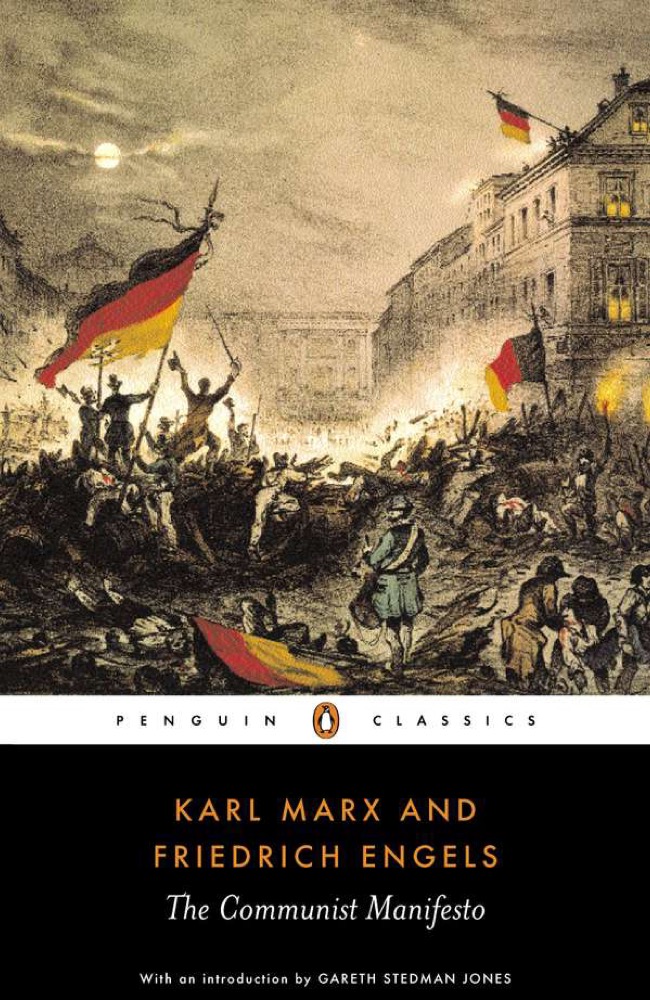
 The Communist Manifesto
Quotes from the Book
Men make their own history, but they do not make it as they please; they do not make it under self-selected circumstances, but under circumstances existing already, given and transmitted from the past. The tradition of all dead generations weighs like a nightmare on the brains of the living. And just as they seem to be occupied with revolutionizing themselves and things, creating something that did not exist before, precisely in such epochs of revolutionary crisis they anxiously conjure up the spirits of the past to their service, borrowing from them names, battle slogans, and costumes in order to present this new scene in world history in time-honored disguise and borrowed language.
585
Hegel remarks somewhere that all great, world-historical facts and personages occur, as it were, twice. He has forgotten to add: the first time as tragedy, the second as farce.
470
The tradition of all dead generations weighs like a nightmare on the brains of the living.
119
Man makes his own history, but he does not make it out of the whole cloth; he does not make it out of conditions chosen by himself, but out of such as he finds close at hand.
19
Every demand for the most simple bourgeois financial reform, for the most ordinary liberalism, for the most commonplace republicanism, for the flattest democracy, is forthwith punished as an "assault upon society," and is branded as "Socialism
17
...it happens that "society is saved" as often as the circle of its ruling class is narrowed, as often as a more exclusive interest asserts itself over the general. Every demand for the most simple bourgeois financial reform, for the most ordinary liberalism, for the most commonplace republicanism, for the flattest democracy is forthwith punished as an "assault upon society" and is branded as "Socialism.
9
The tradition of past generations weighs like the Alps on the brains of the living.
8
The bourgeoisie, in truth, is bound to fear the stupidity of the masses so long as they remain conservative, and the insight of the masses as soon as they become revolutionary.
7
Hic Rhodus, hic salta! Here is the rose, here dance!
6
The Constitution, the National Assembly, the dynastic parties, the blue and the red republicans, the heroes of Africa, the thunder from the platform, the sheet lightning of the daily press, the entire literature, the political names and the intellectual reputations, the civil law and penal code, the liberté, égalité, fraternité and the second of May 1852—all have vanished like a phantasmagoria before the spell of a man whom even his enemies do not make out to be a magician. Universal suffrage seems to have survived only for a moment, in order that with its own hand it may make its last will and testament before the eyes of all the world and declare in the name of the people itself: Everything that exists has this much worth, that it will perish.
5
They cannot represent themselves; they must be represented.
3
passions without truth, truths without passion; heroes without heroic deeds, history without events; development, whose sole driving force seems to be the calendar, wearying with constant repetition of the same tensions and relaxations; antagonisms that periodically seem to work themselves up to a climax only to lose their sharpness and fall away without being able to resolve themselves; pretentiously paraded exertions and philistine terror at the danger of the world’s coming to an end, and at the same time the pettiest intrigues and court comedies played by the world redeemers, who in their laisser aller remind us less of the Day of Judgment than of the times of the Fronde – the official collective genius of France brought to naught by the artful stupidity of a single individual; the collective will of the nation, as often as it speaks through universal suffrage, seeking its appropriate expression through the inveterate enemies of the interests of the masses, until at length it finds it in the self-will of a filibuster. If any section of history has been painted gray on gray, it is this.
3
Nevertheless, for weal or for woe, there is no such thing extant as "Anglo-Saxon"—of all nations, said to be "Anglo-Saxon," in the United States least. What we still have from England, much as appearances may seem to point the other way, is not of our bone-and-marrow, so to speak, but rather partakes of the nature of "importations." We are no more English on account of them than we are Chinese because we all drink tea.
1
Thus does the beginner, who has acquired a new language, keep on translating it back into his own mother tongue; only then has he grasped the spirit of the new language and is able freely to express himself therewith when he moves in it without recollections of the old, and has forgotten in its use his own hereditary tongue.
1
The social revolution of the nineteenth century cannot take its poetry from the past but only from the future.
What makes them representatives of the petty bourgeoisie is the fact that in their minds they do not get beyond the limits which the latter do not get beyond in life, that they are consequently driven, theoretically, to the same problems and solutions to which material interest and social position drive the latter in practice. This is, in general, the relationship between the political and literary representatives of a class and the class they represent.
droit de nommer et de révoquer ses ministres indépendamment de l'Assemblée nationale, ayant en main tous les moyens d'action du pouvoir exécutif, disposant de tous les emplois et disposant ainsi en France de l'existence de plus d'un million et demi d'hommes, car tel est le nombre de tous ceux qui dépendent des 50 000 fonctionnaires et des officiers de tous grades. Il a le commandement de toutes les forces armées du pays. Il jouit du privilège de gracier quelques criminels, de suspendre les gardes nationaux, de révoquer, d'accord avec le Conseil d'État, les conseillers généraux, cantonaux, municipaux, élus par les citoyens eux-mêmes. Il a l'initiative et la direction de toutes les négociations avec l'étranger.
Lorsque le véritable but fut atteint, c'est-à-dire lorsque fut réalisée la transformation bourgeoise de la société anglaise, Locke évinça Habacuc.
Hegel fait quelque part cette remarque que tous les grands événements et personnages historiques se répètent pour ainsi dire deux fois. Il a oublié d'ajouter : la première fois comme tragédie, la seconde fois comme farce. Caussidière pour Danton, Louis Blanc pour Robespierre, la Montagne de 1848 à 1851 pour la Montagne de 1793 à 1795, le neveu pour l'oncle. Et nous constatons la même caricature dans les circonstances où parut la deuxième édition du 18 Brumaire.
la même importance que la loi de la transformation de l'énergie pour les sciences naturelles, lui fournit ici également la clé pour la compréhension de l'histoire de la deuxième République française.
Parmi les ouvrages qui, à peu près à la même époque, traitaient le même sujet, deux seulement méritent d'être mentionnés : Napoléon le Petit, de Victor Hugo, et le Coup d'État, de Proudhon. Victor Hugo se contente d'invectives amères et spirituelles contre l'auteur responsable du coup d'État. L'événement lui-même lui apparaît comme un éclair dans un ciel serein. Il n'y voit que le coup de force d'un individu. Il ne se rend pas compte qu'il le grandit ainsi, au lieu de le diminuer, en lui attribuant une force d'initiative personnelle sans exemple dans l'histoire. Proudhon, lui, s'efforce de représenter le coup d'État comme le résultat d'un développement historique antérieur. Mais, sous sa plume, la construction historique dit coup d'État se transforme en une apologie du héros du coup d'État.
The demands of the Paris proletariat are utopian nonsense, to which an end must be put.
Watch on YouTube
About Karl Marx
We have collected 168 quotes from 7 books by Karl Marx on BookQuoters.
More about the author →More by Karl Marx
All books by Karl Marx →
About the book
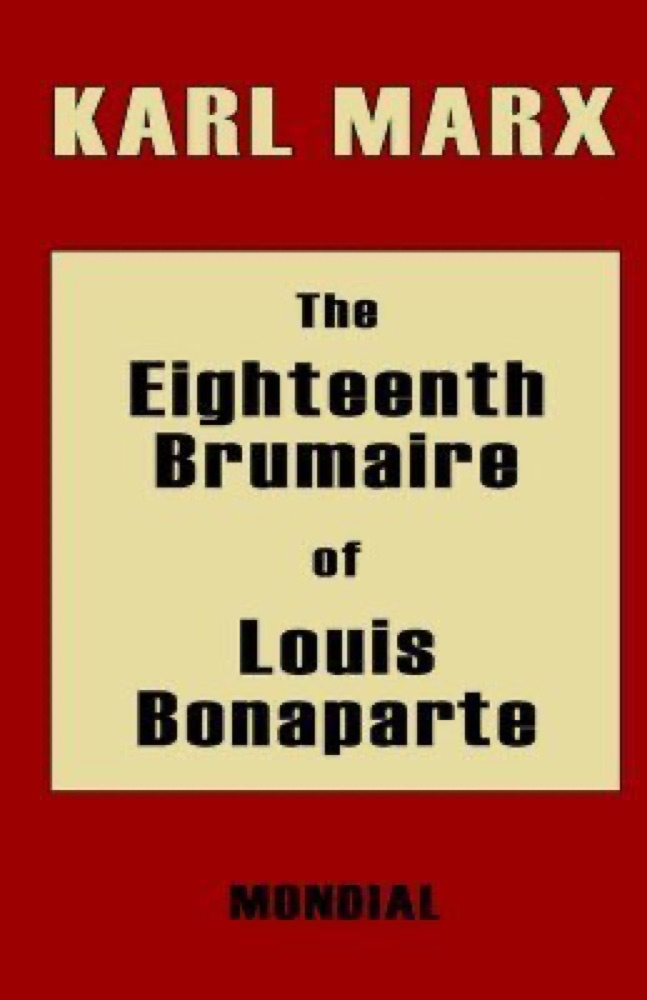
"The Eighteenth Brumaire of Louis Bonaparte" is one of Karl Marx' most profound and most brilliant monographs. It may be considered the best work extant on the philosophy of history. On the 18th Brumaire (Nov. 9th), the post-revolutionary development of affairs in France enabled the first Napoleon to take a step that led with inevitable certainty to the imperial throne. The circumstance that fifty and odd years later similar events aided his nephew, Louis Bonaparte, to take a similar step with a similar result, gives the name to this work-"The Eighteenth Brumaire of Louis Bonaparte."
Keep reading
 The Age of Revolution, 1789–1848
 Reflections on the Revolution in France
 The Old Regime and the French Revolution
 From Dawn to Decadence: 500 Years of Western Cultural Life, 1500 to the Present
 The Black Jacobins: Toussaint L'Ouverture and the San Domingo Revolution
 The Machiavellians: Defenders of Freedom
 Selections from the Prison Notebooks
 The Revolt of the Masses
 History of the Russian Revolution
 The Prague Cemetery
 Defying Hitler
 Cultural Amnesia: Necessary Memories from History and the Arts
 First As Tragedy, Then As Farce
 The Iron Heel
 The Coming Insurrection
 A Distant Mirror: The Calamitous 14th Century
 The Wretched of the Earth
 Modern Times: The World from the Twenties to the Nineties
 The Origins of Totalitarianism
 The Road to Serfdom
 The Right to Be Lazy
 The Secret Agent
 What's Wrong with the World
 The Curtain: An Essay in Seven Parts
 The Historian's Craft: Reflections on the Nature and Uses of History and the Techniques and Methods of Those Who Write It.
 The Proud Tower: A Portrait of the World Before the War, 1890-1914
 Untimely Meditations
 The Lessons of History
 The Republic
 Liberalism: The Classical Tradition
 Ninety-Three
 Civil Disobedience and Other Essays
 The Strange Death of Europe: Immigration, Identity, Islam
 Discourse on Colonialism
 Ill Fares the Land
 It Can't Happen Here
 Discourse on the Origin of Inequality
 Minima Moralia: Reflections on a Damaged Life
The Communist Manifesto
Minima Moralia: Reflections on a Damaged Life
The Communist Manifesto
 Dialectic of Enlightenment: Philosophical Fragments
 The Ides of March
 The Committed
 Arguably: Selected Essays
 Basic Writings of Nietzsche
 The Discovery of India
 Complete Works of Oscar Wilde
 The Crisis of the Modern World
 On the Genealogy of Morals
 On Revolution
 The Archaeology of Knowledge and The Discourse on Language
 Heretics
 Political Theology: Four Chapters on the Concept of Sovereignty
 Darkness at Noon
 Socialism: Utopian and Scientific
 Quotations from Chairman Mao Tsetung
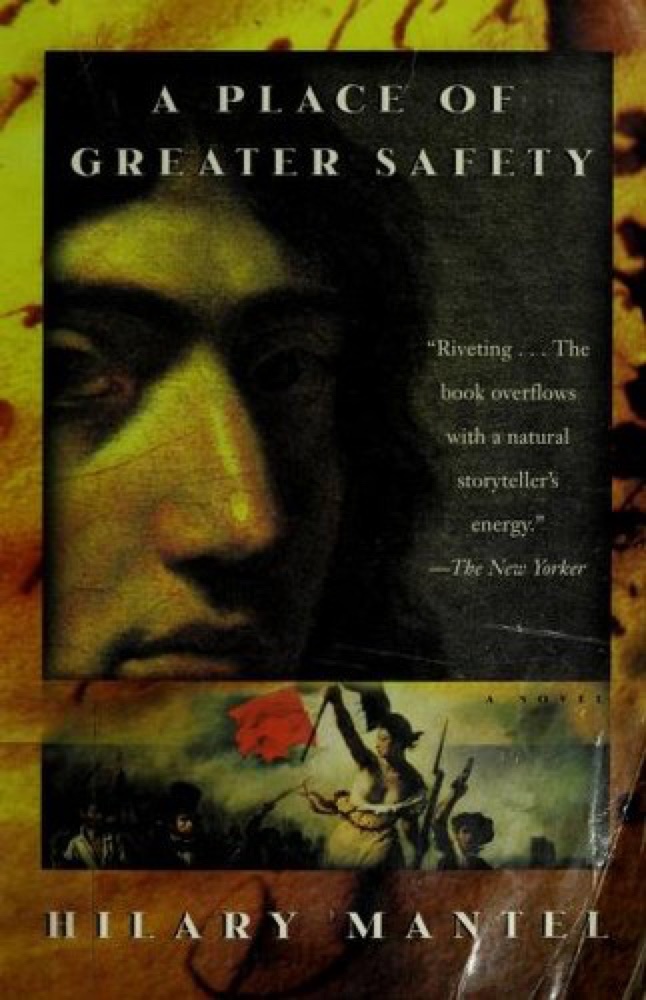 A Place of Greater Safety
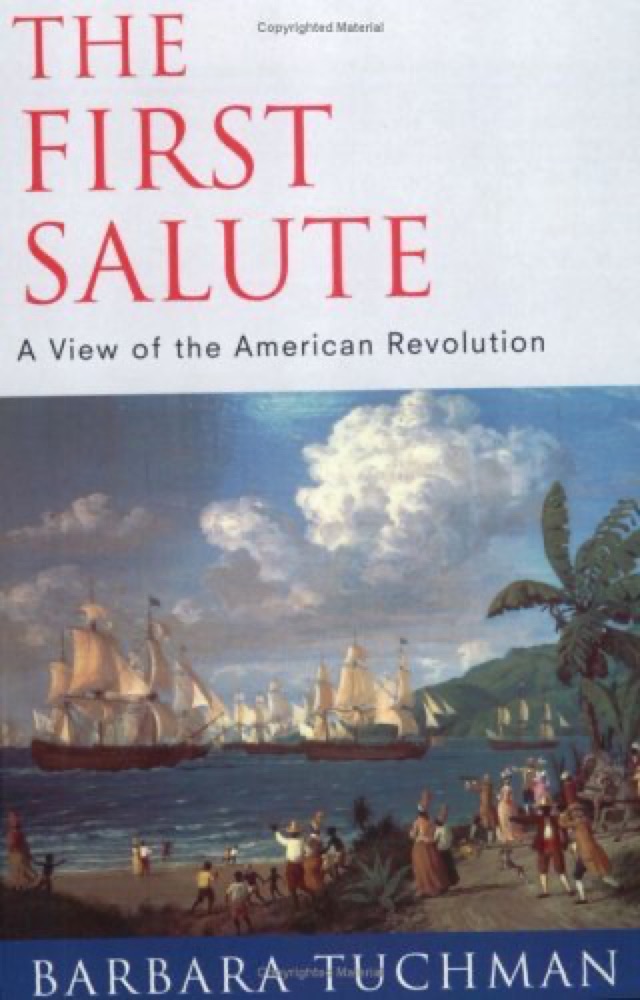 The First Salute : View of the American Revolution
 These Truths: A History of the United States
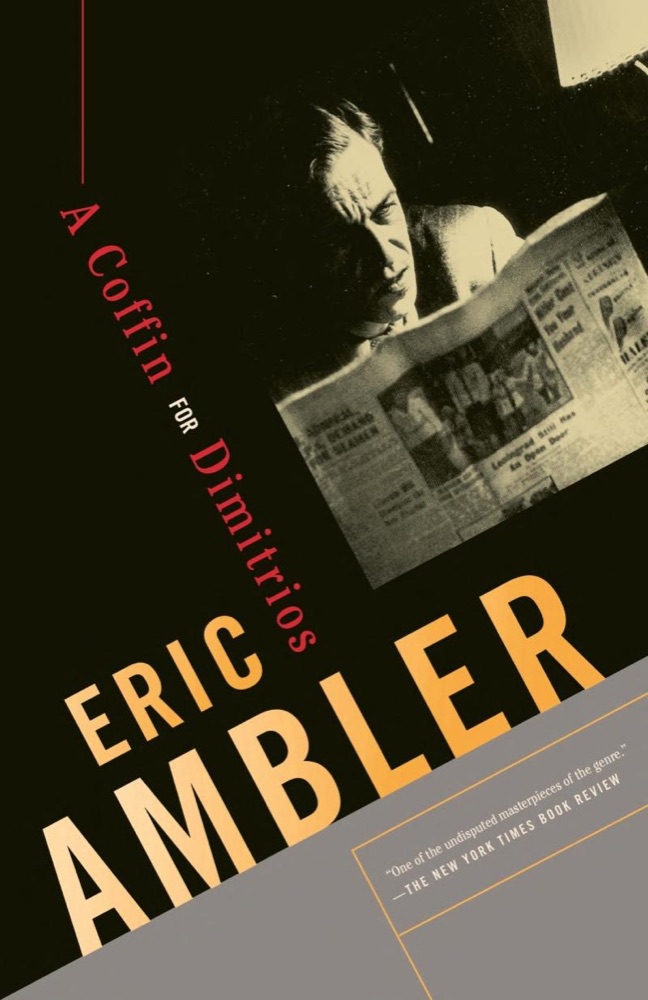 The Mask of Dimitrios
 Erewhon