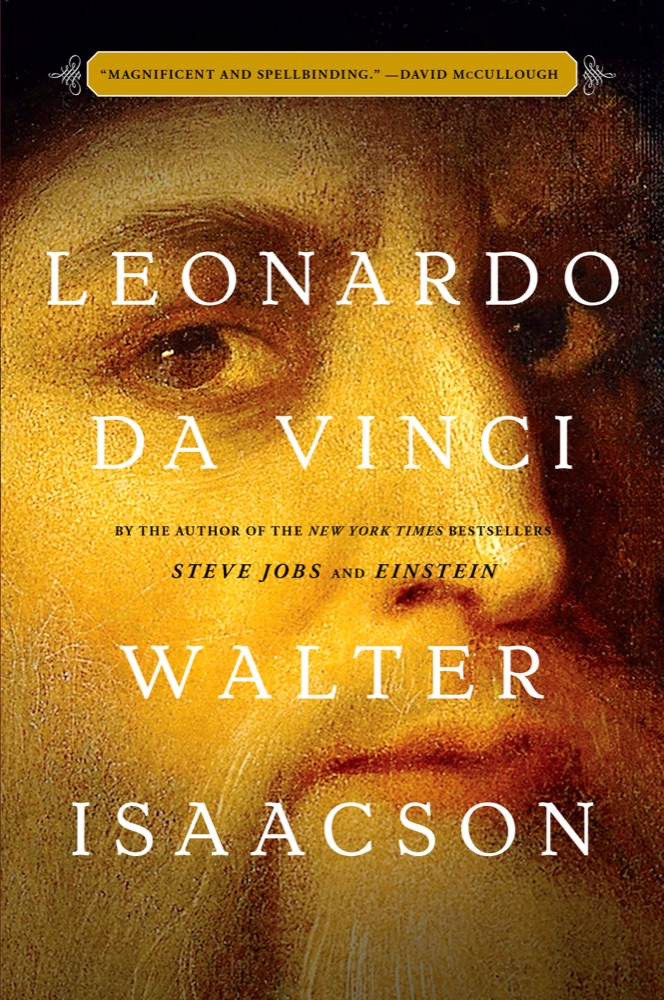

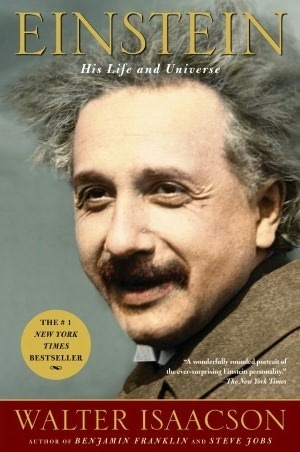
 Einstein: His Life and Universe
Quotes from the Book
Vision without execution is hallucination. .. Skill without imagination is barren. Leonardo [da Vinci] knew how to marry observation and imagination, which made him history’s consummate innovator.
76
Above all, Leonardo’s relentless curiosity and experimentation should remind us of the importance of instilling, in both ourselves and our children, not just received knowledge but a willingness to question it—to be imaginative and, like talented misfits and rebels in any era, to think different.
36
If we want to be more like Leonardo, we have to be fearless about changing our minds based on new information.
33
Leonardo had almost no schooling and could barely read Latin or do long division. His genius was of the type we can understand, even take lessons from. It was based on skills we can aspire to improve in ourselves, such as curiosity and intense observation. He had an imagination so excitable that it flirted with the edges of fantasy, which is also something we can try to preserve in ourselves and indulge in our children.
29
men who desire nothing but material riches and are absolutely devoid of the desire for wisdom, which is the sustenance and truly dependable wealth of the mind.
25
But I did learn from Leonardo how a desire to marvel about the world that we encounter each day can make each moment of our lives richer.
24
The tongue of a woodpecker can extend more than three times the length of its bill. When not in use, it retracts into the skull and its cartilage-like structure continues past the jaw to wrap around the bird’s head and then curve down to its nostril. In addition to digging out grubs from a tree, the long tongue protects the woodpecker’s brain. When the bird smashes its beak repeatedly into tree bark, the force exerted on its head is ten times what would kill a human. But its bizarre tongue and supporting structure act as a cushion, shielding the brain from shock.1 There is no reason you actually need to know any of this. It is information that has no real utility for your life, just as it had none for Leonardo. But I thought maybe, after reading this book, that you, like Leonardo, who one day put “Describe the tongue of the woodpecker” on one of his eclectic and oddly inspiring to-do lists, would want to know. Just out of curiosity. Pure curiosity.
23
In addition to his instinct for discerning patterns across disciplines, Leonardo honed two other traits that aided his scientific pursuits: an omnivorous curiosity, which bordered on the fanatical, and an acute power of observation, which was eerily intense. Like much with Leonardo, these were interconnected. Any person who puts “Describe the tongue of the woodpecker” on his to-do list is overendowed with the combination of curiosity and acuity. His curiosity, like that of Einstein, often was about phenomena that most people over the age of ten no longer puzzle about: Why is the sky blue? How are clouds formed? Why can our eyes see only in a straight line? What is yawning? Einstein said he marveled about questions others found mundane because he was slow in learning to talk as a child. For Leonardo, this talent may have been connected to growing up with a love of nature while not being overly schooled in received wisdom.
21
His lack of reverence for authority and his willingness to challenge received wisdom would lead him to craft an empirical approach for understanding nature that foreshadowed the scientific method developed more than a century later by Bacon and Galileo. His method was rooted in experiment, curiosity, and the ability to marvel at phenomena that the rest of us rarely pause to ponder after we’ve outgrown our wonder years.
20
There have been, of course, many other insatiable polymaths, and even the Renaissance produced other Renaissance Men. But none painted the Mona Lisa, much less did so at the same time as producing unsurpassed anatomy drawings based on multiple dissections, coming up with schemes to divert rivers, explaining the reflection of light from the earth to the moon, opening the still-beating heart of a butchered pig to show how ventricles work, designing musical instruments, choreographing pageants, using fossils to dispute the biblical account of the deluge, and then drawing the deluge. Leonardo was a genius, but more: he was the epitome of the universal mind, one who sought to understand all of creation, including how we fit into it.
15
One mark of a great mind is the willingness to change it. We can see that in Leonardo. As he wrestled with his earth and water studies during the early 1500s, he ran into evidence that caused him to revise his belief in the microcosm-macrocosm analogy. It was Leonardo at his best, and we have the great fortune of being able to watch that evolution as he wrote the Codex Leicester. There he engaged in a dialogue between theories and experience, and when they conflicted he was receptive to trying a new theory. That willingness to surrender preconceptions was key to his creativity.
14
This inability to ground his fantasies in reality has generally been regarded as one of Leonardo’s major failings. Yet in order to be a true visionary, one has to be willing to overreach and to fail some of the time. Innovation requires a reality distortion field. The things he envisioned for the future often came to pass, even if it took a few centuries. Scuba gear, flying machines, and helicopters now exist. Suction pumps now drain swamps. Along the route of the canal that Leonardo drew there is now a major highway.
14
Be curious, relentlessly curious. “I have no special talents,” Einstein once wrote to a friend. “I am just passionately curious.”4 Leonardo actually did have special talents, as did Einstein, but his distinguishing and most inspiring trait was his intense curiosity. He wanted to know what causes people to yawn, how they walk on ice in Flanders, methods for squaring a circle, what makes the aortic valve close, how light is processed in the eye and what that means for the perspective in a painting. He instructed himself to learn about the placenta of a calf, the jaw of a crocodile, the tongue of a woodpecker, the muscles of a face, the light of the moon, and the edges of shadows. Being relentlessly and randomly curious about everything around us is something that each of us can push ourselves to do, every waking hour, just as he did.
12
An object will display the greatest difference of light and shade when it is seen in the strongest light. . . . But this should not be much used in painting, because the works would be crude and ungraceful. An object seen in a moderate light displays little difference in its light and shade, and this is the case towards evening or when the day is cloudy; works painted then are tender, and every kind of face becomes graceful. Thus, in everything extremes are to be avoided: Too much light gives crudeness; too little prevents our seeing.
12
Leonardo da Vinci liked to boast that, because he was not formally educated, he had to learn from his own experiences instead
11
Look longer at the picture. It vibrates with Leonardo’s understanding that no moment is discrete, self-contained, frozen, delineated, just as no boundary in nature is sharply delineated. As with the river that Leonardo described, each moment is part of what just passed and what is about to come. This is one of the essences of Leonardo’s art: from the Adoration of the Magi to Lady with an Ermine to The Last Supper and the Mona Lisa, each moment is not distinct but instead contains connections to a narrative.
11
Kenneth Clark referred to Leonardo’s “inhumanly sharp eye.” It’s a nice phrase, but misleading. Leonardo was human. The acuteness of his observational skill was not some superpower he possessed. Instead, it was a product of his own effort. That’s important, because it means that we can, if we wish, not just marvel at him but try to learn from him by pushing ourselves to look at things more curiously and intensely. In his notebook, he described his method—almost like a trick—for closely observing a scene or object: look carefully and separately at each detail. He compared it to looking at the page of a book, which is meaningless when taken in as a whole and instead needs to be looked at word by word. Deep observation must be done in steps: “If you wish to have a sound knowledge of the forms of objects, begin with the details of them, and do not go on to the second step until you have the first well fixed in memory.
10
So did Einstein, who wrote to another friend, “You and I never cease to stand like curious children before the great mystery into which we were born.”5 We should be careful to never outgrow our wonder years, or to let our children do so.
10
While some may see them as the crazy ones, we see genius. Because the people who are crazy enough to think they can change the world are the ones who do.
10
Those who are in love with practice without theoretical knowledge are like the sailor who goes onto a ship without rudder or compass and who never can be certain whither he is going,” he wrote in 1510. “Practice must always be founded on sound theory.
10
Leonardo became known in Milan not only for his talents but also for his good looks, muscular build, and gentle personal style. “He was a man of outstanding beauty and infinite grace,” Vasari said of him. “He was striking and handsome, and his great presence brought comfort to the most troubled soul.
10
The glory of being an artist, he realized, was that reality should inform but not constrain.
9
While at Windsor Castle looking at the swirling power of the “Deluge drawings” that he made near the end of his life, I asked the curator, Martin Clayton, whether he thought Leonardo had done them as works of art or of science. Even as I spoke, I realized it was a dumb question. “I do not think that Leonardo would have made that distinction,” he replied.
9
He had an imagination so excitable that it flirted with the edges of fantasy, which is also something we can try to preserve in ourselves and indulge in our children.
9
Leonardo’s Vitruvian Man embodies a moment when art and science combined to allow mortal minds to probe timeless questions about who we are and how we fit into the grand order of the universe. It also symbolizes an ideal of humanism that celebrates the dignity, value, and rational agency of humans as individuals. Inside the square and the circle we can see the essence of Leonardo da Vinci, and the essence of ourselves, standing naked at the intersection of the earthly and the cosmic.
9
Men of lofty genius sometimes accomplish the most when they work least,
9
That goes a step too far, I think. Leonardo did not invent the scientific method, nor did Aristotle or Alhazen or Galileo or any Bacon. But his uncanny abilities to engage in the dialogue between experience and theory made him a prime example of how acute observations, fanatic curiosity, experimental testing, a willingness to question dogma, and the ability to discern patterns across disciplines can lead to great leaps in human understanding.
9
In notes for his treatise on painting, Leonardo recommended to young artists this practice of walking around town, finding people to use as models, and recording the most interesting ones in a portable notebook: “Take a note of them with slight strokes in a little book which you should always carry with you,” he wrote. “The positions of the people are so infinite that the memory is incapable of retaining them, which is why you should keep these sketches as your guides.
9
Leonardo had also been wrestling with the question of why the sky appears blue, and around that time he had correctly concluded that it had to do with the water vapor in the air. In the Saint Anne painting, he portrays the sky’s luminous and misty gradations of blue as no other painter had done. The recent cleaning of the painting fully reveals the magical realism, veiled in vapors, of his distant mountains and skyline.
8
When Leonardo was painting The Last Supper (fig. 74), spectators would visit and sit quietly just so they could watch him work. The creation of art, like the discussion of science, had become at times a public event. According to the account of a priest, Leonardo would “come here in the early hours of the morning and mount the scaffolding,” and then “remain there brush in hand from sunrise to sunset, forgetting to eat or drink, painting continually.” On other days, however, nothing would be painted. “He would remain in front of it for one or two hours and contemplate it in solitude, examining and criticizing to himself the figures he had created.” Then there were dramatic days that combined his obsessiveness and his penchant for procrastination. As if caught by whim or passion, he would arrive suddenly in the middle of the day, “climb the scaffolding, seize a brush, apply a brush stroke or two to one of the figures, and suddenly depart.”1 Leonardo’s quirky work habits may have fascinated the public, but they eventually began to worry Ludovico Sforza. Upon the death of his nephew, he had become the official Duke of Milan in early 1494, and he set about enhancing his stature in a time-honored way, through art patronage and public commissions. He also wanted to create a holy mausoleum for himself and his family, choosing a small but elegant church and monastery in the heart of Milan, Santa Maria delle Grazie, which he had Leonardo’s friend Donato Bramante reconstruct. For the north wall of the new dining hall, or refectory, he had commissioned Leonardo to paint a Last Supper, one of the most popular scenes in religious art. At first Leonardo’s procrastination led to amusing tales, such as the time the church prior became frustrated and complained to Ludovico. “He wanted him never to lay down his brush, as if he were a laborer hoeing the Prior’s garden,” Vasari wrote. When Leonardo was summoned by the duke, they ended up having a discussion of how creativity occurs. Sometimes it requires going slowly, pausing, even procrastinating. That allows ideas to marinate, Leonardo explained. Intuition needs nurturing. “Men of lofty genius sometimes accomplish the most when they work least,” he told the duke, “for their minds are occupied with their ideas and the perfection of their conceptions, to which they afterwards give form.
8
Did you know?
- The biography draws extensively on the thousands of surviving pages of Leonardo da Vinci's notebooks.
- The book reached number one on The New York Times Best Seller list in 2017.
- Isaacson devotes significant attention to attribution debates over works such as "Salvator Mundi" and "La Bella Principessa."
- Bill Gates publicly praised the book for its comprehensive scope.
- Film rights were initially acquired by Paramount with Leonardo DiCaprio attached, and later purchased by Universal in 2023.
- Isaacson frames the book around lessons in creativity, including the advice to "be curious, relentlessly curious."
About Walter Isaacson
Walter Isaacson is an American author, journalist, and biographer who has served as chairman and CEO of CNN and editor of Time magazine, and as president of the Aspen Institute. He is known for bestselling biographies of figures including Steve Jobs, Albert Einstein, and Benjamin Franklin.
More about the author →More by Walter Isaacson
Einstein: His Life and Universe
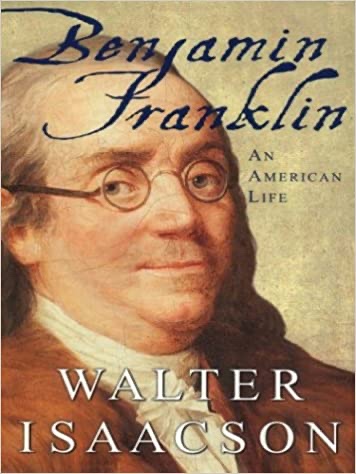 Benjamin Franklin: An American Life
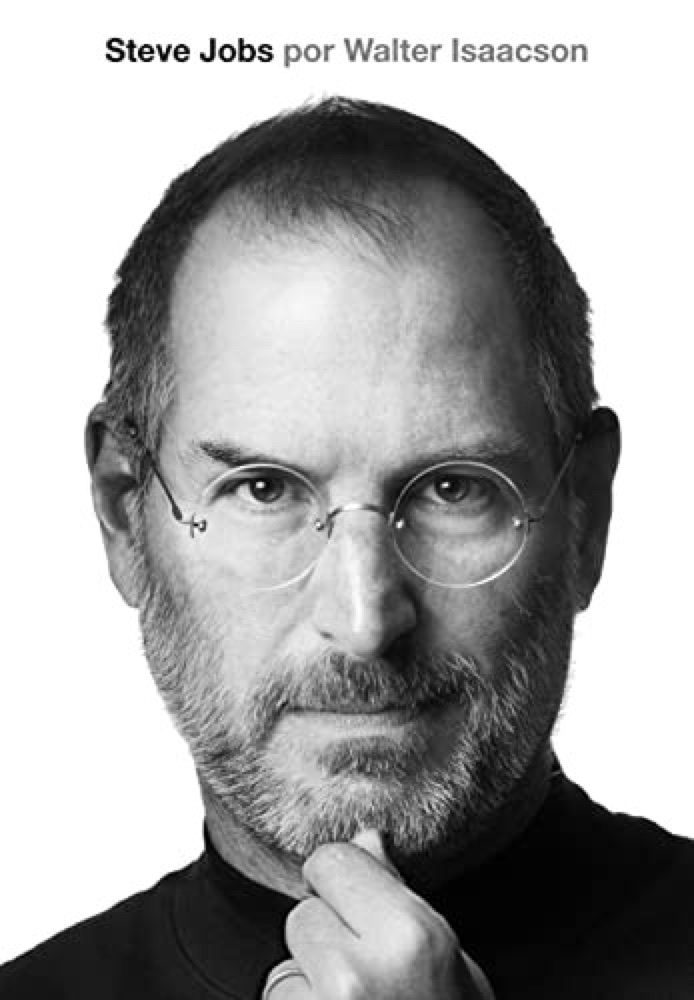 Steve Jobs
 The Innovators: How a Group of Hackers, Geniuses and Geeks Created the Digital Revolution
About the book
Walter Isaacson's "Leonardo da Vinci" is a comprehensive biography of the Renaissance artist and polymath, drawing heavily on the thousands of surviving pages of Leonardo's notebooks. Isaacson traces Leonardo's life from his illegitimate birth in the Tuscan town of Vinci through his career in Florence, Milan, Rome, and France, weaving together his work as a painter with his restless investigations into anatomy, engineering, optics, geology, and flight.
The book's central theme is creativity itself: how Leonardo's relentless curiosity, his refusal to separate art from science, and his powers of observation fueled his genius. Isaacson presents Leonardo not as an untouchable prodigy but as a self-taught, often distractible figure whose habit of leaving works unfinished was bound up with the same questing mind that produced masterpieces such as the "Mona Lisa" and "The Last Supper." He distills practical lessons from this life, urging readers to "be curious, relentlessly curious."
Published in 2017, the book reached number one on The New York Times Best Seller list and drew wide praise for its scope and readability, with admirers including Bill Gates. Some critics, such as Jennifer Senior, found Isaacson's art commentary overly effusive, but the biography was broadly received as an accessible and richly illustrated portrait of one of history's most inventive minds.
Book details
- First published
- 2017
- Length
- 624 pages
- Reading time
- 11 hours
- Author
- Walter Isaacson
- Genre
- Biography
- Goodreads rating
- 4.17 (134k ratings)
Critical reception
- The book debuted at number one on The New York Times Best Seller list in 2017.
- Reviewer Robin McKie described it as "sumptuous, elegantly written and diligently produced."
- Critic Jennifer Senior faulted Isaacson's art criticism as overly enthusiastic, noting frequent use of words like "brilliant" and "wondrous."
Keep reading
 The Ascent of Man
 The Geography of Genius: A Search for the World's Most Creative Places from Ancient Athens to Silicon Valley
 Monday with a Mad Genius
 The Discarded Image: An Introduction to Medieval and Renaissance Literature
 Creativity: Flow and the Psychology of Discovery and Invention
 The Agony and the Ecstasy
 The Courage to Create
 Genius: The Life and Science of Richard Feynman
 The Spinoza Problem
 Galileo
 The Art of Creative Thinking
 The Occult
 Death in Venice and Other Tales
 A Study in Scarlet
 All the Beauty in the World: The Metropolitan Museum of Art and Me
 From Dawn to Decadence: 500 Years of Western Cultural Life, 1500 to the Present
 Last and First Men
 The Collected Tales of Nikolai Gogol
 How to Fly a Horse: The Secret History of Creation, Invention, and Discovery
 The Essays of Ralph Waldo Emerson
 Discourse on Method and Meditations on First Philosophy
 The Last Samurai
 Leonardo's Notebooks
 The Intellectual Life: Its Spirit, Conditions, Methods
 A Philosophical Enquiry into the Origin of Our Ideas of the Sublime and Beautiful
 The Medium is the Massage
 Art as Therapy
 The Abundance
 Kiln People
 Critique of Judgment
 A History of Western Philosophy
 Create Dangerously
 Think Like a Rocket Scientist: Simple Strategies You Can Use to Make Giant Leaps in Work and Life
 Van Gogh Has a Broken Heart: What Art Teaches Us About the Wonder and Struggle of Being Alive
 Basic Writings of Nietzsche
 The Swerve: How the World Became Modern
 Art and Fear: Observations on the Perils (and Rewards) of Artmaking
 How to Live: A Life of Montaigne in One Question and Twenty Attempts at an Answer
Einstein: His Life and Universe
How to Live: A Life of Montaigne in One Question and Twenty Attempts at an Answer
Einstein: His Life and Universe
 Tell Them of Battles, Kings, and Elephants
 The Tell-Tale Brain: A Neuroscientist's Quest for What Makes Us Human
 Lectures on Literature
 Figuring
 Curious: The Desire to Know and Why Your Future Depends On It
 The Meaning of It All: Thoughts of a Citizen-Scientist
 The Will to Power
 The Story of Philosophy: The Lives and Opinions of the World's Greatest Philosophers
 The Gift of Asher Lev
 The Periodic Table
 The Hero's Journey: Joseph Campbell on His Life & Work
 Walk Through Walls: A Memoir
 The Curtain: An Essay in Seven Parts
 Illuminations: Essays and Reflections
 The Socrates Express: In Search of Life Lessons from Dead Philosophers
 Mastermind: How to Think Like Sherlock Holmes
 The Pleasures and Sorrows of Work
 An Essay Concerning Human Understanding
 Sherlock Holmes
 The Discovery of India
 The Mona Lisa Vanishes: A Legendary Painter, a Shocking Heist, and the Birth of a Global Celebrity