
 The Horse and His Boy
Quotes from the Book
There was nothing medieval people liked better, or did better, than sorting out and tidying up. Of all our modern inventions I suspect that they would most have admired the card index.
20
At his most characteristic, medieval man was not a dreamer nor a wanderer. He was an organiser, a codifier, a builder of systems.
12
Answers to leading questions under torture naturally tell us nothing about the beliefs of the accused; but they are good evidence for the beliefs of the accusers.
11
The really important difference is that the medieval universe, while unimaginably large, was also unambiguously finite. And one unexpected result of this is to make the smallness of Earth more vividly felt.
8
It is said that people pointed out Dante in the street not as the man who made the Comedy but as the man who had been in Hell. Even today there are those (some of them critics) who believe every novel and even every lyric to be autobiographical. A man who lacks invention himself does not easily attribute it to others.
8
There are, I know, those who prefer not to go beyond the impression, however accidental, which an old work makes on a mind that brings to it a purely modern sensibility and modern conceptions; just as there are travellers who carry their resolute Englishry with them all over the Continent, mix only with other English tourists, enjoy all they see for its ‘quaintness’, and have no wish to realise what those ways of life, those churches, those vineyards, mean to the natives. They have their reward. I have no quarrel with people who approach the past in that spirit. I hope they will pick none with me. But I was writing for the other sort. C.
6
Hence we may, with proper precautions, regard a certain humility as the overall characteristic of medieval art. Of the art; not always of the artists. Self-esteem may arise within any occupation at any period. A chef, a surgeon, or a scholar, may be proud, even to arrogance, of his skill; but his skill is confessedly the means to an end beyond itself, and the status of the skill depends wholly on the dignity or necessity of that end. I think it was then like that with all the arts. Literature exists to teach what is useful, to honour what deserves honour, to appreciate what is delightful. The useful, honourable, and delightful things are superior to it: it exists for their sake; its own use, honour, or delightfulness is derivative from theirs. In that sense the art is humble even when the artists are proud; proud of their proficiency in the art, but not making for the art itself the high Renaissance or Romantic claims. Perhaps they might not all have fully agreed with the statement that poetry is infima inter omnes doctrinas.17 But it awoke no such hurricane of protest as it would awake today. In this great change something has been won and something lost. I take it to be part and parcel of the same great process of Internalisation18 which has turned genius from an attendant daemon into a quality of the mind. Always, century by century, item after item is transferred from the object’s side of the account to the subject’s. And now, in some extreme forms of Behaviourism, the subject himself is discounted as merely subjective; we only think that we think. Having eaten up everything else, he eats himself up too. And where we ‘go from that’ is a dark question.
5
If I am right, the man of genius then found himself in a situation very different from that of his modern successor. Such a man today often, perhaps usually, feels himself confronted with a reality whose significance he cannot know, or a reality that has no significance; or even a reality such that the very question whether it has a meaning is itself a meaningless question. It is for him, by his own sensibility, to discover a meaning, or, out of his own subjectivity, to give a meaning—or at least a shape—to what in itself had neither. But the Model universe of our ancestors had a built-in significance. And that in two senses; as having ‘significant form’ (it is an admirable design) and as a manifestation of the wisdom and goodness that created it. There was no question of waking it into beauty or life. Ours, most emphatically, was not the wedding garment, nor the shroud. The achieved perfection was already there. The only difficulty was to make an adequate response.
5
In our age I think it would be fair to say that the ease with which a scientific theory assumes the dignity and rigidity of fact varies inversely with the individual's scientific education. In discussion with wholly uneducated audiences I have sometimes found matter which real scientists would regard as highly speculative more firmly believed than many things within our real knowledge; the popular imago of the Cave Man ranked as hard fact, and the life of Caesar or Napoleon as doubtful rumor. ... The mass media which have in our time created a popular scientism, a caricature of the true sciences, did not then exist [in the middle ages]. The ignorant were more aware of their ignorance then than now.
5
The last, and neo-Platonic, wave of Paganism which had gathered up into itself much from the preceding waves, Aristotelian, Platonic, Stoic, and what not, came far inland and made brackish lakes which have, perhaps, never been drained. Not all Christians at all times have detected them or admitted their existence: and among those who have done so there have always been two attitudes. There was then, and is still, a Christian ‘left’, eager to detect and anxious to banish every Pagan element; but also a Christian ‘right’ who, like St Augustine, could find the doctrine of the Trinity foreshadowed in the Platonici,2 or could claim triumphantly, like Justin Martyr, ‘Whatever things have been well said by all men belong to us Christians’.
5
Whatever else a modern feels when he looks at the night sky, he certainly feels that he is looking out--like one looking out from the saloon entrance on to the dark Atlantic or from the lighted porch upon dark and lonely moors. But if you accepted the Medieval Model you would feel like one looking in. The Earth is 'outside the city wall'. When the sun is up he dazzles us and we cannot see inside. Darkness, our own darkness, draws the veil and we catch a glimpse of the high pomps within the vast, lighted concavity filled with music and life. And, looking in, we do not see, like Meredith's Lucifer, 'the army of unalterable law', but rather the revelry of insatiable love. We are watching the activity of creatures whose experience we can only lamely compare to that of one in the act of drinking, his thirst delighted yet not quenched. For in them the highest of faculties is always exercised without impediment on the noblest object; without satiety, since they can never completely make His perfection their own, yet never frustrated, since at every moment they approximate to Him in the fullest measure of which their nature is capable.
5
Medieval art was deficient in perspective, and poetry followed suit. Nature, for Chaucer, is all foreground; we never get a landscape. And neither poets nor artists were much interested in the strict illusionism of later periods. The relative size of objects in the visible arts is determined more by the emphasis the artist wishes to lay upon them than by their sizes in the real world or by their distance. Whatever details we are meant to see will be shown whether they would really be visible or not.
4
To look up at the towering medieval universe is much more like looking at a great building. The ‘space’ of modern astronomy may arouse terror, or bewilderment or vague reverie; the spheres of the old present us with an object in which the mind can rest, overwhelming in its greatness but satisfying in its harmony. That is the sense in which our universe is romantic, and theirs was classical.
4
Eternity is quite distinct from perpetuity, from mere endless continuance in time. Perpetuity is only the attainment of an endless series of moments, each lost as soon as it is attained. Eternity is the actual and timeless fruition of illimitable life.112 Time, even endless time, is only an image, almost a parody, of that plenitude; a hopeless attempt to compensate for the transitoriness of its ‘presents’ by infinitely multiplying them. That
4
The emphasis usually falls on the past splendour rather than on the subsequent decline. Medieval and nineteenth-century man agreed that their present was no very admirable age; not to be compared (said one) with the glory that was, not to be compared (said the other) with the glory that is still to come. The odd thing is that the first view seems to have bred on the whole a more cheerful temper. Historically as well as cosmically, medieval man stood at the foot of a stairway; looking up, he felt delight. The backward, like the upward, glance exhilarated him with a majestic spectacle, and humility was rewarded with the pleasures of admiration. And, thanks to his deficiency in the sense of period, that packed and gorgeous past was far more immediate to him than the dark and bestial past could ever be to a Lecky or a Wells. It differed from the present only by being better. Hector was like any other knight, only braver. The saints looked down on one’s spiritual life, the kings, sages, and warriors on one’s secular life, the great lovers of old on one’s own amours, to foster, encourage, and instruct. There were friends, ancestors, patrons in every age. One had one’s place, however modest, in a great succession; one need be neither proud nor lonely. I
4
To be always looking at the map when there is a fine prospect before you shatters the ‘wise passiveness’ in which landscape ought to be enjoyed. But to consult a map before we set out has no such ill effect. Indeed it will lead us to many prospects; including some we might never have found by following our noses.
3
The reader will no doubt understand that this was no arbitrary fancy, but just such another ‘tool’ as the hypothesis of Copernicus; an intellectual construction devised to accommodate the phenomena observed. We have recently been reminded13 how much mathematics, and how good, went to the building of the Model.
3
Thus, while every falling body for us illustrates the ‘law’ of gravitation, for them it illustrated the ‘kindly enclyning’ of terrestrial bodies to their ‘kindly stede’ the Earth, the centre of the Mundus,
3
Boethius slips in, as axiomatic, the remark that all perfect things are prior to all imperfect things.99 It was common ground to nearly all ancient and medieval thinkers except the Epicureans.100 I have already101 stressed the radical difference which this involves between their thought and the developmental or evolutionary concepts of our own period—a difference which perhaps leaves no area and no level of consciousness unaffected.
3
Hence what we might take to be the difference between a clearly Christian and a possibly Pagan work may really be the difference between a thesis offered, so to speak, to the Faculty of Philosophy and one offered to that of Divinity. This seems to me to be the best explanation of the gulf that separates Boethius’ De Consolatione from the doctrinal pieces which are (I presume, rightly) attributed to him.
3
Everywhere, on both sides, men were turning away from the civic virtues and the sensual pleasures to seek an inner purgation and a supernatural goal. The modern who dislikes the Christian Fathers would have disliked the Pagan philosophers equally, and for similar reasons.
3
It would detain us too long here to trace the steps whereby a man’s genius, from being an invisible, personal, and external attendant, became his true self, and then his cast of mind, and finally (among the Romantics) his literary or artistic gifts. To understand this process fully would be to grasp that great movement of internalisation, and that consequent aggrandisement of man and desiccation of the outer universe, in which the psychological history of the West has so largely consisted.
3
The insignificance (by cosmic standards) of the Earth became as much a commonplace to the medieval, as to the modern, thinker; it was part of the moralists’ stock-in-trade, used, as Cicero uses it (xix), to mortify human ambition.
3
Though literacy was of course far rarer then than now, reading was in one way a more important ingredient of the total culture.
3
Literature exists to teach what is useful, to honour what deserves honour, to appreciate what is delightful. The useful, honourable, and delightful things are superior to it: it exists for their sake; its own use, honour, or delightfulness is derivative from theirs. In that sense, the art is humble even when the artists are proud.
2
One might have expected the High Faries to have been expelled by science; I think they were actually expelled by a darkening of superstition.
2
I thought that in an age when books were few and the intellectual appetite sharp-set, any knowledge might be welcome in any context. But this does not explain why the authors so gladly present knowledge which most of their audience must have possessed. One gets the impression that medieval people, like Professor Tolkien’s Hobbits, enjoyed books which told them what they already knew.
2
His writings are usually regarded as the main channel by which a certain kind of Theology entered the Western tradition. It is the ‘negative Theology’ of those who take in a more rigid sense, and emphasise more persistently than others, the incomprehensibility of God.
2
Watch on YouTube
About C.S. Lewis
We have collected 760 quotes from 29 books by C.S. Lewis on BookQuoters.
More about the author →More by C.S. Lewis
All books by C.S. Lewis →
About the book
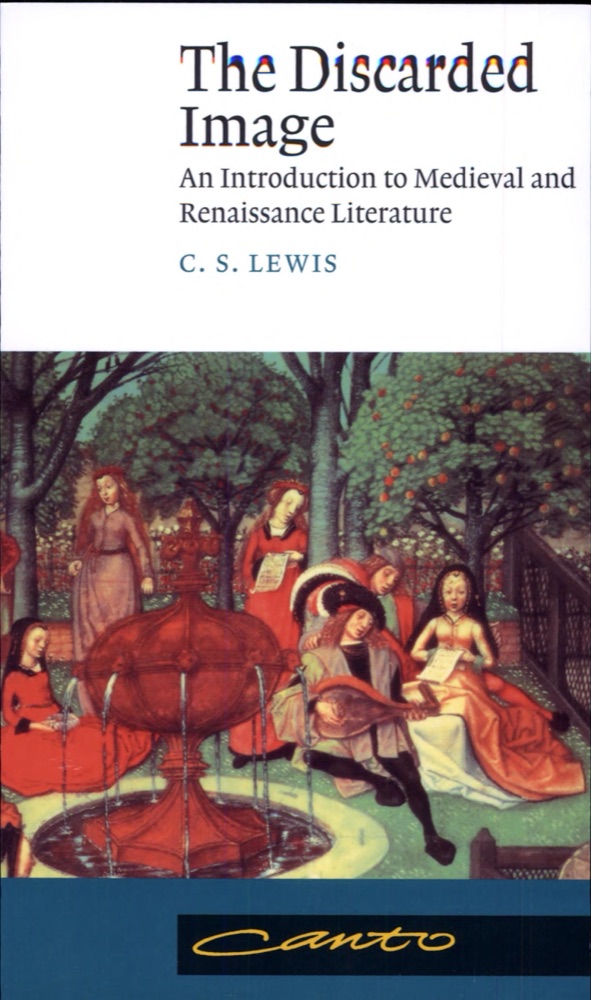
C.S. Lewis' The Discarded Image paints a lucid picture of the medieval world view, as historical and cultural background to the literature of the Middle Ages and Renaissance. It describes the "image" discarded by later ages as "the medieval synthesis itself, the whole organization of their theology, science and history into a single, complex, harmonious mental model of the universe." This, Lewis' last book, was hailed as "the final memorial to the work of a great scholar and teacher and a wise and noble mind."
Book details
- First published
- 1964
- Author
- C.S. Lewis
- Genre
- History
- Goodreads rating
- 4.29 (3k ratings)
Keep reading
 The Occult
 From Dawn to Decadence: 500 Years of Western Cultural Life, 1500 to the Present
 The Mind of the Maker: Dorothy L. Sayers' Witty Classic on the Trinity, Christianity, and Human Creativity
 Last and First Men
 The Everlasting Man
 Orthodoxy
 The Perennial Philosophy
 The Letters of J.R.R. Tolkien
 A History of Western Philosophy
 Twilight of the Idols/The Anti-Christ
 Heretics
 Truth and Method
 Selected Non-Fictions
 The World's Last Night: And Other Essays
 Dialogues Concerning Natural Religion
 The Crisis of the Modern World
 When I Was a Child I Read Books
 The Ascent of Man
 Daybreak: Thoughts on the Prejudices of Morality
 The Swerve: How the World Became Modern
 The Art of the Novel
 The Birth of Tragedy
 A Treatise of Human Nature
 The Curtain: An Essay in Seven Parts
 Discourse on Method and Meditations on First Philosophy
 An Experiment in Criticism
 Myths to Live By
 The Age of Reason
 How Should We Then Live? The Rise and Decline of Western Thought and Culture
 Irrational Man: A Study in Existential Philosophy
 An Essay Concerning Human Understanding
 The Wave in the Mind: Talks and Essays on the Writer, the Reader and the Imagination
 A History of the World in 100 Objects
 The Name of the Rose
 Tolkien On Fairy-stories
 Reflections on the Psalms
 Maldoror and the Complete Works
 The Order of Things: An Archaeology of the Human Sciences
 Labyrinths: Selected Stories and Other Writings
 The Greek Way
 A Philosophical Enquiry into the Origin of Our Ideas of the Sublime and Beautiful
 How to Read Literature
 The Varieties of Religious Experience
 Think: A Compelling Introduction to Philosophy
 The Essays of Ralph Waldo Emerson
 The Master and His Emissary: The Divided Brain and the Making of the Western World
 The World as Will and Representation, Vol 1
 Critique of Pure Reason
 The Meaning of It All: Thoughts of a Citizen-Scientist
 The Wisdom of Life
 Phaedrus
 The Language of the Night: Essays on Writing, Science Fiction, and Fantasy
 How to Live: A Life of Montaigne in One Question and Twenty Attempts at an Answer
 Mystery and Manners: Occasional Prose
 The Futurological Congress: From the Memoirs of Ijon Tichy
 Illuminations: Essays and Reflections
 The Discovery of Heaven
 The Discovery of India
 De Profundis and Other Writings