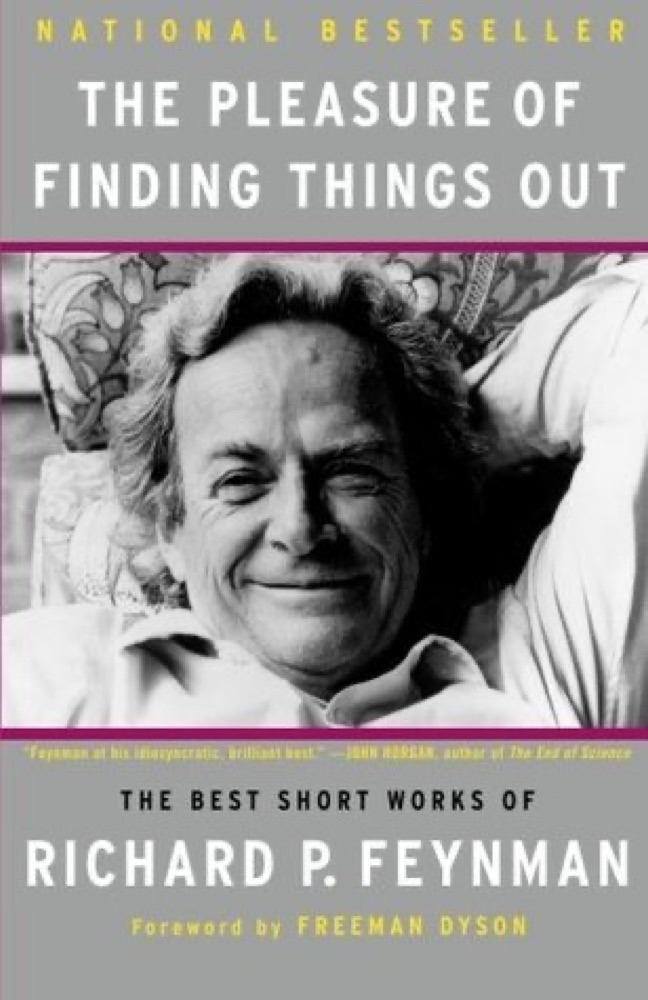
 The Pleasure of Finding Things Out: The Best Short Works of Richard P. Feynman
Quotes from the Book
Words can be meaningless. If they are used in such a way that no sharp conclusions can be drawn.
90
It is surprising that people do not believe that there is imagination in science. It is a very interesting kind of imagination, unlike that of the artist. The great difficulty is in trying to imagine something that you have never seen, that is consistent in every detail with what has already been seen, and that is different from what has been thought of; furthermore, it must be definite and not a vague proposition. That is indeed difficult.
65
I think a power to do something is of value. Whether the result is a good thing or a bad thing depends on how it is used, but the power is a value.
45
It is a great adventure to contemplate the universe, beyond man, to contemplate what it would be like without man, as it was in a great part of its long history and as it is in a great majority of places. When this objective view is finally attained, and the mystery and majesty of matter are fully appreciated, to then turn the objective eye back on man viewed as matter, to view life as part of this universal mystery of greatest depth, is to sense an experience which is very rare, and very exciting. It usually ends in laughter and a delight in the futility of trying to understand what this atom in the universe is, this thing—atoms with curiosity—that looks at itself and wonders why it wonders. Well, these scientific views end in awe and mystery, lost at the edge in uncertainty, but they appear to be so deep and so impressive that the theory that it is all arranged as a stage for God to watch man's struggle for good and evil seems inadequate. Some will tell me that I have just described a religious experience. Very well, you may call it what you will. Then, in that language I would say that the young man's religious experience is of such a kind that he finds the religion of his church inadequate to describe, to encompass that kind of experience. The God of the church isn't big enough.
38
Some people say, How can you live without knowing? I do not know what they mean. I always live without knowing. That is easy. How you get to know is what I want to know.
34
Looking back at the worst times, it always seems that they were times in which there were people who believed with absolute faith and absolute dogmatism in something. And they were so serious in this matter that they insisted that the rest of the world agree with them. And then they would do things that were directly inconsistent with their own beliefs in order to maintain that what they said was true.
21
Once in Hawaii I was taken to see a Buddhist temple. In the temple a man said, "I am going to tell you something that you will never forget." And then he said, "To every man is given the key to the gates of heaven. The same key opens the gates of hell.
17
Western civilization, it seems to me, stands by two great heritages. One is the scientific spirit of adventure—the adventure into the unknown, an unknown that must be recognized as unknown in order to be explored, the demand that the unanswerable mysteries of the universe remain unanswered, the attitude that all is uncertain. To summarize it: humility of the intellect.
17
It is in the admission of ignorance and the admission of uncertainty that there is a hope for the continuous motion of human beings in some direction that doesn't get confined, permanently blocked, as it has so many times before in various periods in the history of man.
16
How you get to know is what I want to know.
15
What looks still to our crude eyes is a wild and dynamic dance.
14
The exception proves that the rule is wrong.” That is the principle of science. If there is an exception to any rule, and if it can be proved by observation, that rule is wrong.
14
Nobody understands the world they’re in, but some people are better off at it than others.
13
I believe that to solve any problem that has never been solved before, you have to leave the door to the unknown ajar.
13
The other great heritage is Christian ethics—the basis of action on love, the brotherhood of all men, the value of the individual, the humility of the spirit. These two heritages are logically, thoroughly consistent.
13
Of course, I am interested, but I would not dare to talk about them. In talking about the impact of ideas in one field on ideas in another field, one is always apt to make a fool of oneself. In these days of specialization there are too few people who have such a deep understanding of two departments of our knowledge that they do not make fools of themselves in one or the other.
13
We are so used to looking at the world from the point of view of living things that we cannot understand what it means not to be alive, and yet most of the time the world had nothing alive on it. And in most places in the universe today there probably is nothing alive.
12
At some time people thought that the potential that people had was not developed because everyone was ignorant, and that education was the solution to the problem, that if all people were educated, we could perhaps all be Voltaires. But it turns out that falsehood and evil can be taught as easily as good.
11
If someone were to propose that the planets go around the sun because all planet matter has a kind of tendency for movement, a kind of motility, let us call it an ‘oomph,’ this theory could explain a number of other phenomena as well. So this is a good theory, is it not? No. It is nowhere near as good as the proposition that the planets move around the sun under the influence of a central force which varies exactly inversely as the square of the distance from the center. The second theory is better because it is so specific; it is so obviously unlikely to be the result of chance. It is so definite that the barest error in the movement can show that it is wrong; but the planets could wobble all over the place, and, according to the first theory, you could say, ‘Well, that is the funny behavior of the ‘oomph.
11
Religion gives inspiration to act well. Not only that, it gives inspiration to the arts and to many other activities of human beings.
9
I dedicate this lecture to showing what ridiculous conclusions and rare statements such a man as myself can make. I wish, therefore, to destroy any image of authority that has previously been generated.
7
This is in the attitude of mind of the populace, that they have to have an answer and that a man who gives an answer is better than a man who gives no answer, when the real fact of the matter is, in most cases, it is the other way around. And
6
Knowledge is of no real value if all you can tell me is what happened yesterday. It is necessary to tell what will happen tomorrow if you do something—not only necessary, but fun. Only you must be willing to stick your neck out.
6
If we were not able or did not desire to look in any new direction, if we did not have a doubt or recognize ignorance, we would not get any new ideas.
6
No government has the right to decide on the truth of scientific principles, nor to prescribe in any way the character of the questions investigated. Neither may a government determine the aesthetic value of artistic creations, nor limit the forms of literary or artistic expression. Nor should it pronounce on the validity of economic, historic,
5
This universe has been described by many, but it just goes on, with its edge as unknown as the bottom of the bottomless sea of the other idea—just as mysterious, just as awe-inspiring, and just as incomplete as the poetic pictures that came before.
4
And the result of this of course is that the politician must give an answer. And the result of this is that political promises can never be kept. It is a mechanical fact; it is impossible. The result of that is that nobody believes campaign promises. And the result of that is a general disparaging of politics, a general lack of respect for the people who are trying to solve problems, and so forth. It’s all generated from the very beginning (maybe—this is a simple analysis). It’s all generated, maybe, by the fact that the attitude of the populace is to try to find the answer instead of trying
3
WE ARE ALL SAD when we think of the wondrous potentialities that human beings seem to have and when we contrast these potentialities with the small accomplishments that we have. Again and again people have thought that we could do much better.
3
In talking about the impact of ideas in one field on ideas in another field, one is always apt to make a fool of oneself. In these days of specialization there are too few people who have such a deep understanding of two departments of our knowledge that they do not make fools of themselves in one or the other.
3
It’s all generated, maybe, by the fact that the attitude of the populace is to try to find the answer instead of trying to find a man who has a way of getting at the answer.
3
Watch on YouTube
About Richard P. Feynman
We have collected 208 quotes from 6 books by Richard P. Feynman on BookQuoters.
More about the author →More by Richard P. Feynman
The Pleasure of Finding Things Out: The Best Short Works of Richard P. Feynman
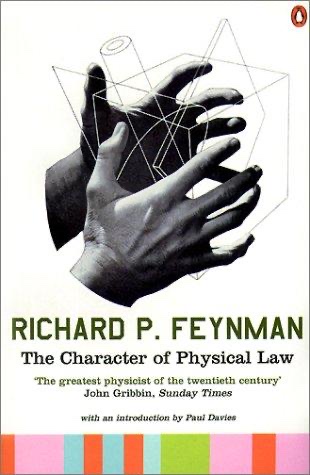 The Character of Physical Law
 Surely You're Joking, Mr. Feynman!
 What Do You Care What Other People Think?
About the book
Many appreciate Richard P. Feynman's contributions to twentieth-century physics, but few realize how engaged he was with the world around him -- how deeply and thoughtfully he considered the religious, political, and social issues of his day. Now, a wonderful book -- based on a previously unpublished, three-part public lecture he gave at the University of Washington in 1963 -- shows us this other side of Feynman, as he expounds on the inherent conflict between science and religion, people's distrust of politicians, and our universal fascination with flying saucers, faith healing, and mental telepathy. Here we see Feynman in top form: nearly bursting into a Navajo war chant, then pressing for an overhaul of the English language (if you want to know why Johnny can't read, just look at the spelling of "friend"); and, finally, ruminating on the death of his first wife from tuberculosis. This
Book details
- First published
- 1998
- Author
- Richard P. Feynman
- Genre
- Nonfiction
- Goodreads rating
- 3.96 (11k ratings)
Keep reading
What Do You Care What Other People Think?
The Pleasure of Finding Things Out: The Best Short Works of Richard P. Feynman
 21 Lessons for the 21st Century
 But What If We're Wrong? Thinking About the Present As If It Were the Past
 Genesis
 The Demon-Haunted World: Science as a Candle in the Dark
 Rationality: From AI to Zombies
 The Varieties of Scientific Experience: A Personal View of the Search for God
 The Big Picture: On the Origins of Life, Meaning, and the Universe Itself
 Breaking the Spell: Religion as a Natural Phenomenon
 Think: A Compelling Introduction to Philosophy
 Walden Two
 Sophie's World
 The Ascent of Man
 God's Debris: A Thought Experiment
 The Lost Symbol
 An Essay Concerning Human Understanding
 An Enquiry Concerning Human Understanding
 Living with a Wild God: A Nonbeliever's Search for the Truth about Everything
 Starry Messenger: Cosmic Perspectives on Civilization
 Existential Physics: A Scientist's Guide to Life's Biggest Questions
 Why Does the World Exist?: An Existential Detective Story
 Eating the Dinosaur
 In the Light of What We Know
 Heretics
 Metaphysics
 Children of Dune
 Black Holes and Baby Universes and Other Essays
 The Occult
 The Everlasting Man
 The Wisdom of Insecurity: A Message for an Age of Anxiety
 Critique of Pure Reason
 A Language Older Than Words
 The Varieties of Religious Experience
 Foucault's Pendulum
 What I Believe
 The Grand Design
 Arcadia
 The Gay Science
 The Fifth Science
 The Discovery of India
 A Universe from Nothing: Why There Is Something Rather Than Nothing
 Gnomon
 Pensées
 The Wisdom of Life
 Letters from an Astrophysicist
 The Three-Body Problem
 Enlightenment Now: The Case for Reason, Science, Humanism, and Progress
 A Devil's Chaplain: Reflections on Hope, Lies, Science, and Love
 The Story of B: An Adventure of the Mind and Spirit
 Why People Believe Weird Things: Pseudoscience, Superstition, and Other Confusions of Our Time
 Travels
 The Future of an Illusion
 Why Fish Don’t Exist: A Story of Loss, Love, and the Hidden Order of Life
 Jurassic Park
 The Story of My Experiments With Truth
 The Shockwave Rider
 What's Wrong with the World
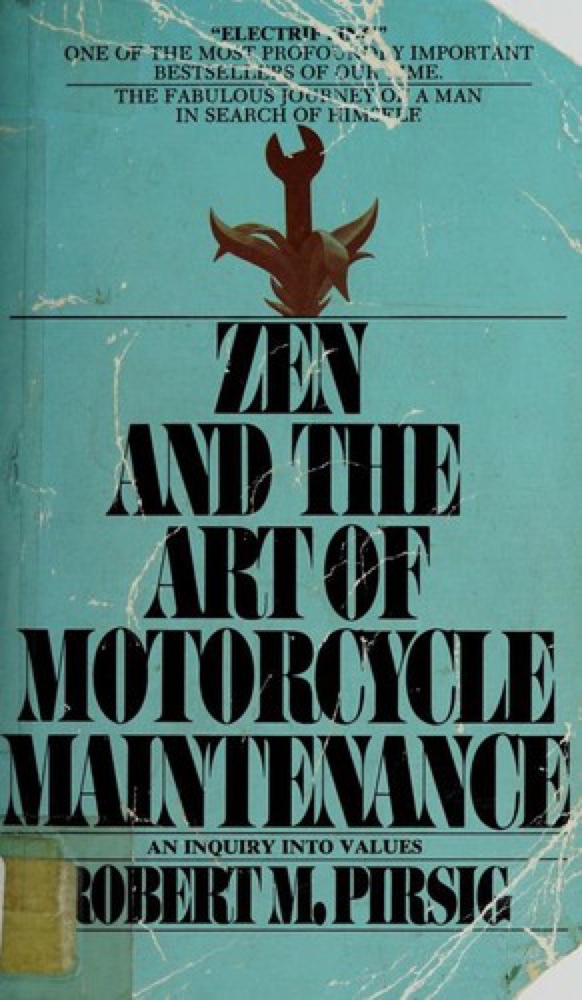 Zen and the Art of Motorcycle Maintenance
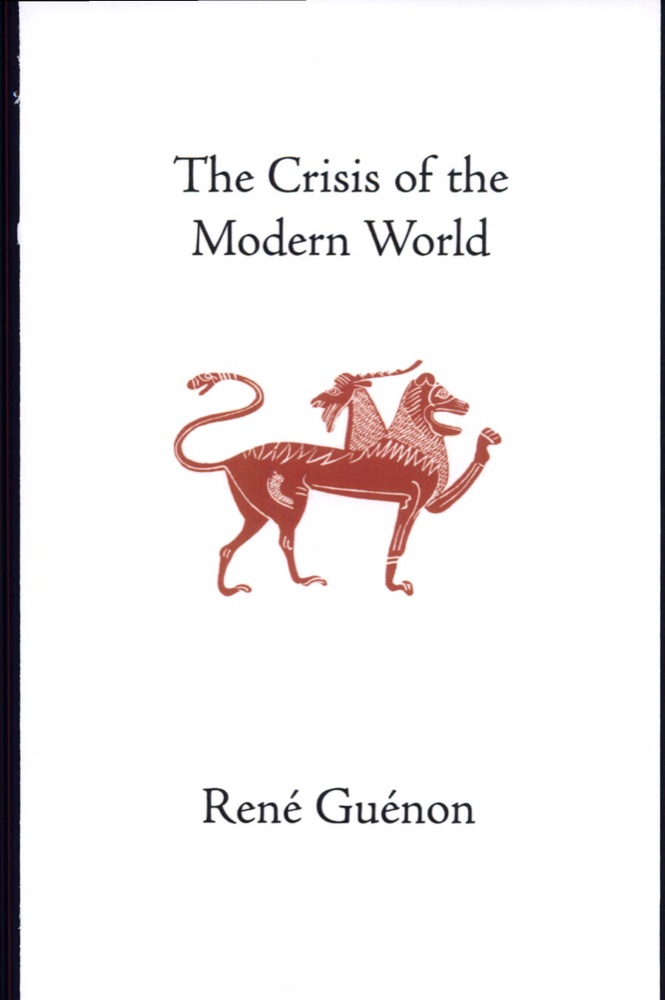 The Crisis of the Modern World