
 The Book of Joy: Lasting Happiness in a Changing World
Quotes from the Book
Meanwhile, spring came, and with it the outpourings of Nature. The hills were soon splashed with wild flowers; the grass became an altogether new and richer shade of green; and the air became scented with fresh and surprising smells -- of jasmine, honeysuckle, and lavender.
18
Only through the development of mutual respect, and in a spirit of truth, can friendship come about. By these means it is possible to move human minds, but never by force.
6
To say 'I want to have sex with this person' is to express a desire which is not intellectually directed in the way that 'I want to eradicate poverty in the world' is an intellectually directed desire. Furthernore, the gratification of sexual desire can only ever give temporary satisfaction. Thus as Nagarjuna, the great Indian scholar said: 'When you have an itch, you scratch. But not to itch at all is better than any amount of scratching.
3
In the end, the innate desire of all people for truth, justice, and human understanding must triumph over ignorance and despair.
3
I believe the most important thing for humankind is its own creativity. I further believe that, in order to be able to exercise this creativity, people need to be free.
3
As for my own religious practice, I try to live my life pursuing what I call the Bodhisattva ideal. According to Buddhist thought, a Bodhisattva is someone on the path to Buddhahood wo dedicates themselves entirely to helping all other sentient beings towards release from suffering. The word Bodhisattva can best be understood by translating the Bodhi and Sattva separately: Bodhi means the understanding or wisdom of the ultimate nature of reality, and a Sattva is someone who is motivated by universal compassion. The Bodhissatva ideal is thus the aspiration to practise infinite compassion with infinite wisdom. releasing sentient beings from suffering.
2
One of the parrots was very friendly with...Master of the Robes. He used to feed it nuts. As it nibbled from his fingers, he used to stroke its head, at which the bird appeared to enter a state of ecstasy. I very much wanted this kind of friendliness and several times tried to get a similar response, but to no avail. So I took a stick to punish it. Of course, thereafter it fled at the sight of me. This was a very good lesson in how to make friends: not by force but by compassion.
2
...[A]ccording to Buddhism in the Tibetan tradition, a being that achieves Buddhahood, although freed from Samsara,the 'wheel of suffering', as the phenomenon of existence is known, will continue to return to work for the benefit of all other sentient beings until such time as each one is similarly liberated.
2
no matter how bad things become, they will eventually get better. In the end, the innate desire of all people for truth, justice and human understanding must triumph over ignorance and despair. So if the Chinese oppressed us, it could only strengthen us
2
Those questions which are unexpected and complicated are the ones I appreciate most. They can help me a great deal. as I am compelled to take an interest in something that might not otherwise have occurred to me.
1
...I discovered a small kitten in the garden, which apparently had been abandoned by its mother. I picked it up and noticed that its hind legs were crippled in just the same way as Tsering's were when she died. I took this creature into my house and looked after it until eventually it was able to walk. Like Tsering, she was also female, but very beautiful and even more gentle. She also got along very well with the two dogs, particularly Sangye, against whose furry chest she liked to lie.
1
Over the years now, the people and Government of India have given an extraordinary amount to us Tibetan refugees, both in terms of financial assistance and in many other ways – this despite their own enormous economic difficulties. I doubt whether any other refugees have been so well treated by their hosts. It is always in my mind whenever the Tibetans have been compelled to ask for more money that, in the meantime, hundreds of thousands of India’s own children lack even basic education.
The first were carpet-weaving workshops set up in Darjeeling,
Whilst on the subject of the spread of Buddhism in the West, I want to say that I have noticed some tendency towards sectarianism amongst new practitioners. This is absolutely wrong. Religion should never become a source of conflict, a further factor of division within the human community.
...[It] is my firm belief that all religions aim at making people better human beings and that, despite philosophical differences, some of them fundamental, they all aim at helping humanity to find happiness. This does not mean that I advocate any kind of world religion or 'super religion.' Rather I look on religion as medicine. For different complaints, doctors will prescribe different remedies. Therefore, because not everyone spiritual 'illness' is the same, different spiritual medicines are requires.
Watch on YouTube
About Dalai Lama XIV
We have collected 244 quotes from 9 books by Dalai Lama XIV on BookQuoters.
More about the author →More by Dalai Lama XIV
The Book of Joy: Lasting Happiness in a Changing World
 The Universe in a Single Atom: The Convergence of Science and Spirituality
 The Art of Happiness
 Ethics for the New Millennium
About the book
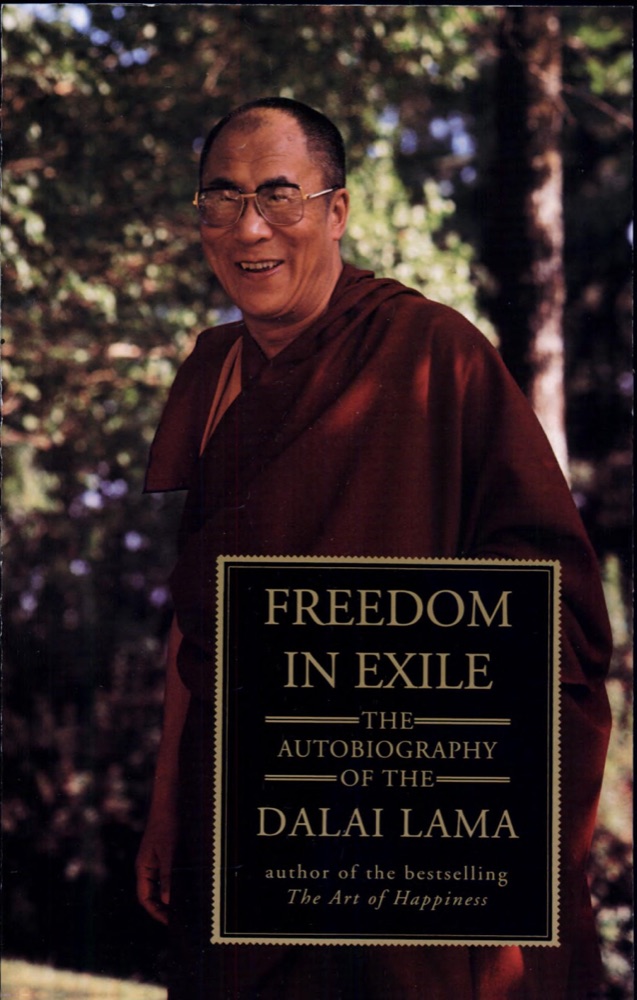
In this astonishingly frank autobiography, the Dalai Lama reveals the remarkable inner strength that allowed him to master both the mysteries of Tibetan Buddhism and the brutal realities of Chinese Communism.
Book details
- First published
- 1990
- Author
- Dalai Lama XIV
- Genre
- Biography
- Goodreads rating
- 4.17 (7k ratings)
Keep reading
 How to Practice: The Way to a Meaningful Life
 My Spiritual Journey: Personal Reflections, Teachings, and Talks
 The Wise Heart: A Guide to the Universal Teachings of Buddhist Psychology
 The World's Religions
 Confession of a Buddhist Atheist
 The Journey Home
 The Way of the Bodhisattva
 Awakening the Buddha Within
 The Story of My Experiments With Truth
 What the Buddha Taught
 The Gay Science
 Total Freedom: The Essential Krishnamurti
 The Dalai Lama's Cat and the Power of Meow
 Tibetan Book of the Dead
 Complete Works of Swami Vivekananda, 9 Vols.
 Happiness Becomes You: A Guide to Changing Your Life for Good
 The Seven Storey Mountain
 The Discovery of India
 How to See Yourself As You Really Are
 The Spinoza Problem
 The Varieties of Religious Experience
 Living Buddha, Living Christ
 Awareness: Conversations with the Masters
 The Perennial Philosophy
 Seven Years in Tibet (Paladin Books)
 How to Know Higher Worlds: A Modern Path of Initiation
 A Calendar of Wisdom: Daily Thoughts to Nourish the Soul
 Against the Stream: A Buddhist Manual for Spiritual Revolutionaries
 Zen and the Art of Saving the Planet
 Breaking the Spell: Religion as a Natural Phenomenon
 Freedom from the Known
 Freedom: The Courage to Be Yourself
 The Book of Wisdom
 Myths to Live By
 The Difficulty of Being Good: On the Subtle Art of Dharma
 The Glass Bead Game
 The Heart of the Buddha's Teaching: Transforming Suffering into Peace, Joy, and Liberation
 The I Ching or Book of Changes
 The Intellectual Life: Its Spirit, Conditions, Methods
 Becoming Wise: An Inquiry into the Mystery and Art of Living
 Buddha's Brain: The Practical Neuroscience of Happiness, Love, and Wisdom
 Daybreak: Thoughts on the Prejudices of Morality
 The Yoga Sutras of Pantanjali
 The Joy of Living: Unlocking the Secret and Science of Happiness
 The Fairy Tales of Hermann Hesse
 Demian
 Think on These Things
 The Convoluted Universe, Book 1
 In Love with the World: A Monk's Journey Through the Bardos of Living and Dying
 Twilight of the Idols
 The Secret Piano: From Mao's Labor Camps to Bach's Goldberg Variations
 Lovingkindness: The Revolutionary Art of Happiness
 Big Sur and the Oranges of Hieronymus Bosch
 The Rosicrucian cosmo-conception: or, Mystic Christianity; an elementary treatise upon man's past evolution, present constitution and future development
 Long Walk to Freedom
 Wings of Fire: An Autobiography
 Buddhist Boot Camp
 Living Beautifully with Uncertainty and Change
 The Immortals of Meluha