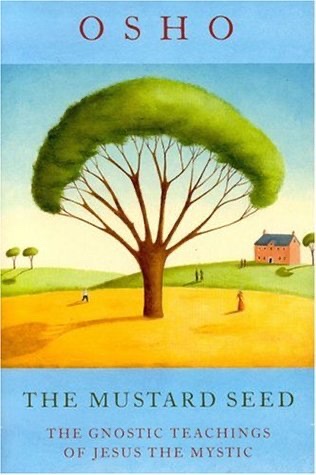
 The Mustard Seed: The Gnostic Teachings of Jesus The Mystic
Quotes from the Book
(...) darkness is beautiful. It has tremendous depth, silence, infinity. Light comes and goes; darkness always remains, it is more eternal than light. For light you need some fuel; for darkness no fuel is needed - it is simply there.
18
You come alone, you die alone. Between birth and death, of course you can deceive yourself that someone is with you—your wife, your father, your mother, your husband, your friend—but this is just make-believe. You come alone, you go alone; you are alone between birth and death.
3
the third dimension is the ultimate of freedom—which is knowing that you are not the body, knowing that you are not the mind, knowing that you are only pure consciousness. That knowledge comes through meditation. It separates you from the body, it separates you from the mind, and ultimately only you are there as pure consciousness, as pure awareness. That is spiritual freedom.
2
Truth cannot be borrowed. It cannot be studied in books. Nobody can inform you about it. You have to sharpen your intelligence yourself, so that you can look into existence and find it.
2
The only way out of this mess is to silently start growing your own consciousness, which they cannot prevent by any force. In fact, they cannot even know what is going on inside you.
1
The freedom to do anything you want is not freedom either, because wanting, desiring to “do” something, arises out of the mind— and mind is your bondage.
1
Y en el momento que eres tú mismo, empiezas a crecer, reverdeces. Empiezan a abrirse flores, y hay una gran fragancia en torno a ti.
1
The father has to teach, the mother has to teach, and the child has to simply absorb. If doubt arises prematurely, assimilation will be stopped.
Independence enters only through the door of no; through the door of yes, only dependence. So in this stage of the camel, there is dependence, helplessness. The other is more important than your own being: God is more important, father is more important, mother is more important, society is more important, the priest is more important, the politician is more important. Except you, everybody is important; the other is important, you are still not there. It is a very unconscious state.
The state of the camel is the state of assimilation. The camel does not know how to say no. The camel is not acquainted with the no. He has not heard the word and he has not tasted the joys of saying no. He only knows yes. His yes cannot be very deep, because without knowing “no” your yes cannot be very deep; it has to remain superficial. The man who has not known no, how can he really know yes? His yes will be impotent. The camel’s yes is impotent. The camel does not know what is happening; he only goes on saying yes because that is the only word that he has been taught.
The first childhood is a false childhood; the second childhood is the real childhood. That second childhood is called the stage of the child or the stage of the sage— it means the same. Unless a man becomes utterly innocent, free from past, so free that he is not even against the past.
man is the only animal who can assimilate the past. Once the past is assimilated you are free from it. You can move in freedom and you can use your past. Otherwise you will have to pass through so many experiences; your life will be wasted.
freedom to create, freedom to be, freedom to express, to sing your song, to dance your dance. That is the third state: creativity.
Remember, freedom has two aspects: first, freedom from, and second, freedom for. Many people attain only to the first kind of freedom, freedom from—free from the parents, free from the church, free from the organization, free from this and that, free from all kinds of prisons. But for what?
The caterpillar is assimilation, complete; the work done.
Truth is realized through three states: assimilation, independence, and creativity. Remember these three words, they are very seminal. Assimilation—that is the function of the larva.
A larva is static: it knows no movement, it remains stuck at one space, at one place, at one stage. Very few people grow into caterpillars. The caterpillar starts moving; dynamism enters. The larva is static; the caterpillar moves. With movement life is stirred. Again, many remain caterpillars: they go on moving horizontally, on the same plane, in one dimension. Rarely, a man like Buddha—or Jalaluddin Rumi or Jesus or Kabir—takes the final quantum leap and becomes a butterfly. Then the vertical enters in.
Moving horizontally, you will remain without a soul. When the vertical penetrates you, you become a soul. “Soul” means the vertical has penetrated into the horizontal.
Truth becomes a cross; life becomes heavy. Truth becomes poison to a Socrates. Truth becomes death to al-Hillaj Mansoor. Truth becomes crucifixion to Jesus Christ. And you pray, “God, give me truth. Give me qualities which are divine, godly.” But God is deaf on purpose—so that your prayers cannot be heard and you can enjoy both, your miserable life and your beautiful prayers. The prayers will not be heard—you can remain jealous, angry, full of hate, full of egoism, and go on praying to God, “Make me humble; and because ‘blessed are the meek,’ make me meek”—but on purpose.
Your prayer will create your troubles, because in prayers you will be so romantic, asking great things which you cannot live by, which will become very heavy and will interfere in your so-called life—which is going on smoothly, although in misery.
I am afraid that my prayer may be granted.
Freedom means tremendous responsibility; you are on your own and alone.
You may like to be free, but the cage has certain securities, safeties. In the cage the parrot has no need to worry about food, has no need to worry about enemies, has no need to worry about a thing in the world. It is cozy, it is golden. No other parrot has such a valuable cage. Your power, your riches, your prestige—all are your cages. Your soul wants to be free, but freedom is dangerous. Freedom has no insurance. Freedom has no security, no safety.
The cage has certain securities, safeties. In the cage the parrot has no need to worry about food, has no need to worry about enemies, has no needto worry about a thing in the world. It is cozy, it is golden.
Why should one feel ashamed to hope for freedom?— because nobody is preventing you. You can be free this very moment. But those attachments…they have gone very deep in you; they have become almost your very existence. They may be bringing misery to you but they also bring moments of happiness. They may be creating chains for your feet, but they also give you moments of dance.
His roots are deep in the earth. His split is that he is attached to his imprisonment, and his deepest longing is for freedom. He is divided against himself.
Such people don’t speak about themselves; they speak about the very heart of all mankind.
I don’t want to be a believer; I want to be a knower. I don’t want to be knowledgeable; I want to be innocent enough so that existence reveals its mysteries to me. I don’t want to be worshiped as a saint.
Watch on YouTube
About Osho
We have collected 305 quotes from 15 books by Osho on BookQuoters.
More about the author →More by Osho
The Mustard Seed: The Gnostic Teachings of Jesus The Mystic
 Love, Freedom, and Aloneness: The Koan of Relationships
 Intimacy: Trusting Oneself and the Other
 Awareness: The Key to Living in Balance
About the book
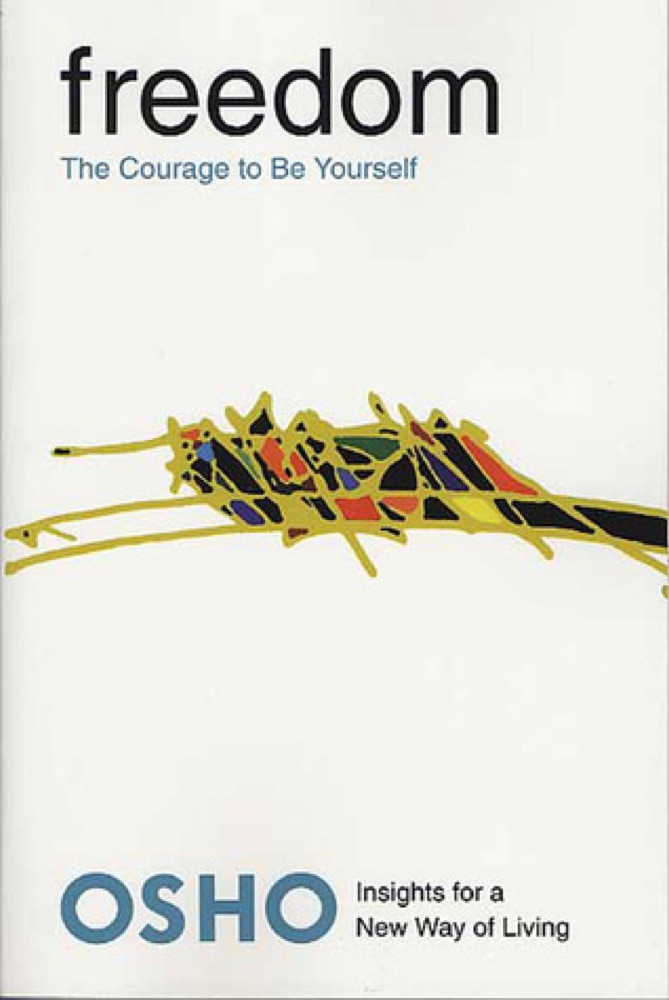
Learn how to set yourself free with the philosophies of one of the twentieth century’s greatest spiritual teachers in The Courage to Be Yourself .
In Freedom , Osho outlines three stages of freedom. The first is “freedom from,” which is a freedom that comes from breaking out of what he calls the “psychological slavery” imposed by outside forces such as parents, society, or religion. The next stage is “freedom for,” a positive freedom that comes from embracing and creating something―a fulfilling relationship, for example, or an artistic or humanitarian vision. And lastly there is “just freedom,” the highest and ultimate freedom. This last freedom is more than being for or against something; it is the freedom of simply being oneself and responding truthfully to each moment.
This book helps readers to identify the obstacles to their freedom, both circumstantial and self-imposed, to choose
Book details
- First published
- 2004
- Author
- Osho
- Genre
- Philosophy
- Goodreads rating
- 4.09 (4k ratings)
Keep reading
 Freedom from the Known
 Living on Your Own Terms: What Is Real Rebellion?
 Total Freedom: The Essential Krishnamurti
 Awareness: Conversations with the Masters
 Courage: The Joy of Living Dangerously
 Conversations with God: An Uncommon Dialogue, Book 1
 The Book of Secrets: Unlocking the Hidden Dimensions of Your Life
 The Tibetan Book of Living and Dying
Intimacy: Trusting Oneself and the Other
The Tibetan Book of Living and Dying
Intimacy: Trusting Oneself and the Other
 Striking Thoughts: Bruce Lee's Wisdom for Daily Living
 The Book: On the Taboo Against Knowing Who You Are
 The Heart of the Buddha's Teaching: Transforming Suffering into Peace, Joy, and Liberation
 Escape from Freedom
 The Power of Now: A Guide to Spiritual Enlightenment
 The Way to Love: The Last Meditations of Anthony de Mello
 Messages from the Masters: Tapping into the Power of Love
 Man's Search for Ultimate Meaning
 Awakening the Buddha Within
 The Art of Being
 A Joseph Campbell Companion: Reflections on the Art of Living
 The Dispossessed
 The Convoluted Universe, Book 1
 The Disappearance of the Universe: Straight Talk about Illusions, Past Lives, Religion, Sex, Politics, and the Miracles of Forgiveness
 Be Here Now
 The Four Agreements: A Practical Guide to Personal Freedom
 Demian
 The Gay Science
 No Death, No Fear: Comforting Wisdom for Life
 When Nietzsche Wept
 Twilight of the Idols
 Think on These Things
 The Zahir
 The Journey Home
 The Red Book: Liber Novus
 The Story of My Experiments With Truth
 Thoughts in Solitude
 If You Meet the Buddha on the Road, Kill Him! The Pilgrimage of Psychotherapy Patients
 Cutting Through Spiritual Materialism
 The Upanishads
 Daybreak: Thoughts on the Prejudices of Morality
 Hippie
 The Yoga Sutras of Patanjali
 Sacred Journey of the Peaceful Warrior
 The Wise Heart: A Guide to the Universal Teachings of Buddhist Psychology
 Surrender: 40 Songs, One Story
 The Myth of Sisyphus
 Autobiography of a Yogi
 The Book of Chuang Tzu
 Finding Meaning in the Second Half of Life: How to Finally, Really Grow Up
 The Ego and Its Own
 Tao Te Ching
 Tibetan Book of the Dead
 The Wisdom of Insecurity: A Message for an Age of Anxiety
 Parable of the Sower
 The Second Mountain
 Myths to Live By
 Demons
 A Return to Love: Reflections on the Principles of "A Course in Miracles"
 The Fall