
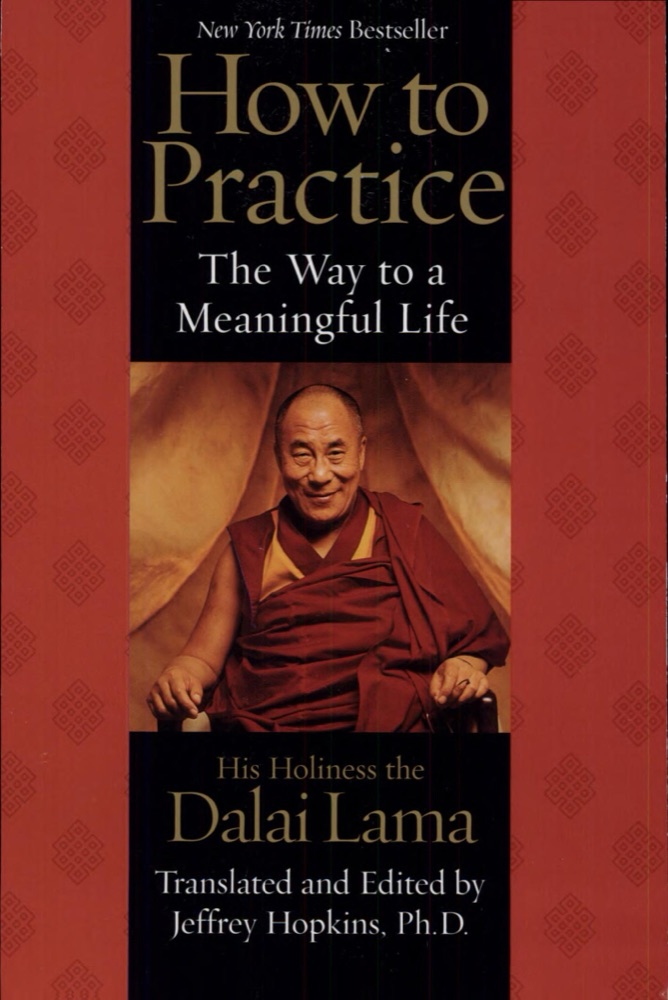
 How to Practice: The Way to a Meaningful Life
Quotes from the Book
If there is a remedy, then what is the use of frustration? If there is no remedy, then what is the use of frustration?
26
Those desiring speedily to be A refuge for themselves and others Should make the interchange of "I" and "other," And thus embrace a sacred mystery.
18
We are the authors of our own destiny; and being the authors, we are ultimately, perhaps frighteningly, free.
16
All the joy the world contains Has come through wishing happiness for others. All the misery the world contains Has come through wanting pleasure for oneself.
12
So take advantage of this human boat. Free yourself from sorrow’s mighty stream! This vessel will be later hard to find. The time that you have now, you fool, is not for sleep!
8
And therefore I’ll dispel the pain of others, For it is simply pain, just like my own. And others I will aid and benefit, For they are living beings, like my body.
7
When the urge arises in your mind To feelings of desire or angry hate, Do not act! Be silent, do not speak! And like a log of wood be sure to stay.
7
19. May I be an isle for those who yearn for land, A lamp for those who long for light; For all who need a resting place, a bed; For those who need a servant, may I be their slave.
7
The source of sorrow is the pride of saying “I,” It’s fostered and increased by false belief in self. To this you may believe that there is no redress, But meditation on no-self will be the supreme way.
7
What we see and what we touch Is stuff of dreams and mirages.
4
All the joy the world contains Has come through wishing happiness for others. All the misery the world contains Has come through wanting pleasure for oneself. (8.129)
3
People scorn the poor who have no wealth, They also criticize the rich who have it. What pleasure can derive from keeping company With people such as these, so difficult to please?
3
28. Anger, lust, these enemies of mine, Are limbless and devoid of faculties. They have no bravery, no cleverness; How then have they reduced me to such slavery?
3
We should at once cast far away Our mind’s attachments: Tinder for the fiery flames of hate.
3
Although it is their sticks that hurt me, I am angry at the ones who wield them, striking me. But they in turn are driven by their hatred; Therefore with their hatred I should take offence.
3
In solitude, the mind and body Are not troubled by distraction. Therefore leave this worldly life And totally abandon mental wandering.
2
After all, suffering, though of course unwanted, has its uses. Without it we would be like the gods, never longing for release from saṃsāra.
2
May beings everywhere who suffer Torment in their minds and bodies Have, by virtue of my merit, Joy and happiness in boundless measure.
2
The work of bringing benefit to beings Will not, then, make me proud and self-admiring. The happiness of others is itself my satisfaction; I do not expect another recompense.
2
Beings suffer injury alike From lifeless things as well as living beings. So why be angry only with the latter? Rather let us simply bear with harm. 67. Some do evil things because of ignorance, Some respond with anger, being ignorant. Which of them is faultless in such acts? To whom shall error be ascribed? 68. Instead, why did they act in times gone by That they are now so harmed at others’ hands? Since everything depends on karma, Why should I be angry at such things? 69. This I see and therefore, come what may, I’ll hold fast to the virtuous path And foster in the hearts of all An attitude of mutual love.
2
ground gained must be retained at all cost and never yielded. Once attention has been caught, and interest kindled, the task is one of consolidation: the original impulse and fervor must be safeguarded and never allowed to disappear.
2
And now as long as space endures, As long as there are beings to be found, May I continue likewise to remain To drive away the sorrows of the world. The pains and sorrows of all wandering beings— May they ripen wholly on myself. And may the virtuous company of Bodhisattvas Always bring about the happiness of beings.
1
Thus we are counseled at length to be careful about the company we keep, recognizing the simple fact that an unexamined lifestyle, in which we are immersed in the materialistic values and behavior of worldly friends, will get us nowhere. Only frustration and inanity will be the result. Shāntideva advises us to fight shy of those whose values are contrary to the Dharma—people he habitually refers to as “those who are like children” (in other words, in terms designed to stimulate feelings of concern rather than resentment). Thus Shāntideva prescribes solitude, a flight from the world—not of course in a puritanical, world-denying sense, but in a spirit of inner freedom. Tranquillity of mind, he says significantly, is “found by people who are happy to be free from worldly ties,” and who for that reason, “never turns . . . a backward glance” (8.4, 8.26). And he is lyrical in his celebration of retreat in the wilderness.
1
The Tathagatas have said that a fool is no one's friend, because the affection of a fool does not arise without self-interest.
1
But if, through seeking happiness, my deeds are wrong, No matter where I turn my steps, The knives of misery will cut me down, The wage and retribution of a sinful life.
1
My wealth of merit gathered in, With reverence but without conceptual target, When shall I reveal this truth of emptiness To those who go to ruin through belief in real existence?
1
All form, therefore, is like a dream, And who will be attached to it, who thus investigates? The body, in this way, has no existence; What, therefore, is male and what is female?
1
Do not be downcast, but marshal all your powers; Make an effort; be the master of yourself! Practice the equality of self and other; Practice the exchange of self and other.
1
Thus the state of Buddhahood depends On beings and on Buddhas equally. What kind of practice is it then That honors only Buddhas but not beings?
1
For I am one who strives for freedom. I must not be caught by wealth and honors. How could I be angry with the ones Who work to free me from my fetters?
1
About Śhāntideva
About the book
One of the great classics of Mahayana Buddhism, The Way of the Bodhisattva (Bodhicharyavatara) is a guide to cultivating the mind of enlightenment, and to generating the qualities of love, compassion, generosity, and patience. Presented in the form of a personal meditation in verse, it outlines the path of the bodhisattvas—those beings who renounce the peace of an individual salvation and vow to work for the deliverance of all beings, and to attain enlightenment for their sake. The text is beloved by Buddhists of all traditions.
Originally written in India in Sanskrit, the text first appeared in Tibetan translation in the eighth century. The fact that it has been expounded, studied, and practiced in Tibet in an unbroken tradition lends the Tibetan version of the Bodhicharyavatara a particular authority. The present version has therefore been translated from the Tibetan, following a c
Book details
- First published
- 700
- Author
- Śhāntideva
- Genre
- Philosophy
- Goodreads rating
- 4.27 (8k ratings)
Keep reading
How to Practice: The Way to a Meaningful Life
 The Bhagavad Gita
 The Wise Heart: A Guide to the Universal Teachings of Buddhist Psychology
 The Gay Science
 Awakening the Buddha Within
 The Consolation of Philosophy
 How to See Yourself As You Really Are
 The Upanishads
 The Dhammapada
 Bhagavad-Gita As It Is
 The Journey Home
 The Yoga Sutras of Patanjali
 De Profundis
 Yayati: A Classic Tale of Lust
 The Treasured Writings of Kahlil Gibran
 The Seven Storey Mountain
 The Red Book: Liber Novus
 The Portable Nietzsche
 A Calendar of Wisdom: Daily Thoughts to Nourish the Soul
 Against the Stream: A Buddhist Manual for Spiritual Revolutionaries
 When Nietzsche Wept
 Buddha's Brain: The Practical Neuroscience of Happiness, Love, and Wisdom
 Daybreak: Thoughts on the Prejudices of Morality
 Tibetan Book of the Dead
 The Ego and Its Own
 The Brothers Karamazov
 Demian
 The Wisdom of No Escape: How to Love Yourself and Your World
 The Art of Being
 The Story of My Experiments With Truth
 Autobiography of a Yogi
 The Tibetan Book of Living and Dying
 Comfortable with Uncertainty: 108 Teachings on Cultivating Fearlessness and Compassion
 The Varieties of Religious Experience
 Lovingkindness: The Revolutionary Art of Happiness
 Happiness: A Guide to Developing Life's Most Important Skill
 Ethics for the New Millennium
 My Gita
 This Here Flesh: Spirituality, Liberation, and the Stories That Make Us
 Reveries of the Solitary Walker
 The Heart of the Buddha's Teaching: Transforming Suffering into Peace, Joy, and Liberation
 Daniel Deronda
 Thoughts in Solitude
 Self-Reliance and Other Essays
 The World's Religions
 The Way to Love: The Last Meditations of Anthony de Mello
 The Difficulty of Being Good: On the Subtle Art of Dharma
 Anger: Wisdom for Cooling the Flames
 Discourses and Selected Writings
 Sacred Journey of the Peaceful Warrior
 The Book of Wisdom
 Either/Or: A Fragment of Life
 The Yoga Sutras of Pantanjali
 Meditations
 Siddhartha
 Complete Works of Swami Vivekananda, 9 Vols.
 Self-Reliance: An Excerpt from Collected Essays, First Series
 Total Freedom: The Essential Krishnamurti
 Shōgun