
 The Filter Bubble: What the Internet is Hiding From You
Quotes from the Book
The implications of such marginalization are profound. The insights about sexist and racist biases... are important because information organizations, from libraries to schools and universities to governmental agencies, are increasingly reliant on being displaced by a variety of web-based "tools" as if there are no political, social, or economic consequences of doing so.
11
This monopoly of information is a threat to democracy...
11
...large technologies such as Google need to be broken up and regulated, because their consolidated power and cultural influence make competition largely impossible. This monopoly in the information sector is a threat to democracy...
8
Google Search is in fact an advertising platform, not intended to solely serve as a public information resource in the way that, say, a library might. Google creates advertising algorithms, not information algorithms.
6
...artificial intelligence will become a major human rights issue in the twenty-first century.
6
algorithmic oppression is not just a glitch in the system but, rather, is fundamental to the operating system of the web.
5
Where men shape technology, they shape it to the exclusion of women, especially Black women.
3
We need people designing technologies for society to have training and an education on the histories of marginalized people, at a minimum, and we need them working alongside people with rigorous training and preparation from the social sciences and humanities.
3
I do not think it a coincidence that when women and people of color are finally given opportunity to participate in limited spheres of decision making in society, computers are simultaneously celebrated as a more optimal choice for making social decisions.
3
The notion that Google/ Alphabet has the potential to be a democratizing force is certainly laudable, but the contradictions inherent in its projects must be contextualized in the historical conditions that both create and are created by it.
3
From claims of Twitter’s racist trolling that drives people from its platform to charges that Airbnb’s owners openly discriminate against African Americans who rent their homes to racial profiling at Apple stores in Australia and Snapchat’s racist filters, there is no shortage of projects to take on in sophisticated ways by people far more qualified than untrained computer engineers, whom, through no fault of their own, are underexposed to the critical thinking and learning about history and culture afforded by the social sciences and humanities in most colleges of engineering nationwide. The lack of a diverse and critically minded workforce on issues of race and gender in Silicon Valley impacts its intellectual output.
2
If Google isn’t responsible for its algorithm, then who is?
2
Rather than prioritize the dominant narratives, Internet search platforms and technology companies could allow for greater expression and serve as a democratizing tool for the public.
1
some of the very people who are developing search algorithms and architecture are willing to promote sexist and racist attitudes openly at work and beyond, while we are supposed to believe that these same employees are developing “neutral” or “objective” decision-making tools.
1
The spectacles of zoos, circuses, and world's fairs and expositions are important sites that predate the Internet by more than a century, but it can be argued and is in fact argued here that these traditions of displaying native bodies extend to the information age and are replicated in a host of problematic ways in the indexing, organization, and classification of information about Black and Brown bodies--especially on the commercial web.
1
Google’s enviable position as the monopoly leader in the provision of information has allowed its organization of information and customization to be driven by its economic imperatives and has influenced broad swaths of society to see it as the creator and keeper of information culture online, which I am arguing is another form of American imperialism that manifests itself as a “gatekeeper”18 on the web.
1
To review, in the ecosystem, Black people provide the most gruelling labor for blood minerals, and they do the most dangerous, toxic work of dismantling e-waste in places such as Ghana, where huge garbage piles of poisonous waste from discarded electronics from the rest of the world is shipped.
Men, intending to or not, have used their control and monopoly over the domain of technology to further consolidate their social, political, and economic power in society and rarely give up these privileges to create structural shifts in these inheritances. Where men shape technology, they shape it to the exclusion of women, especially Black women.
We must trouble the notion of Google as a public resource, particularly as institutions become more reliant on Google when looking for high-quality, contextualized, and credible information. This shift from public institutions such as libraries and schools as brokers of information to the private sector, in projects such as Google Books, for example, is placing previously public assets in the hands of a multinational corporation for private exploitation. Information is a new commodity, and search engines can function as private enclosures.
From claims of Twitter's racist trolling that drives people from its platform to charges that Airbnb's owners openly discriminate against African Americans who rent their homes to racial profiling at Apples stores in Australia and Snapchat's racist filters, there is no shortage of projects to take on in sophisticated ways by people far more qualified than untrained computer engineers, whom, through no fault of their own, are underexposed to critical thinking and learning about history and culture afforded by the social sciences and humanities in most colleges nationwide. The lack of a diverse and critically minded workforce on issues of race and gender in Silicon Valley impacts its intellectual output.
The near-ubiquitous use of algorithmically driven software, both visible and invisible to everyday people, demands a closer inspection of what values are prioritized in such automated decision-making systems.
There is no algorithm that can replace human dignity. They created a system that simulates a value, based on their own algorithm...
In this case, the clicks of users, coupled with the commercial processes that allow paid advertising to be prioritized in search results, mean that representations of women are ranked on a search engine page in ways that underscore women’s historical and contemporary lack of status in society—a direct mapping of old media traditions into new media architecture.
Michael Omi and Howard Winant, two key scholars of race in the United States, distinguish the ways that racial rule has moved “from dictatorship to democracy” as a means of masking domination over racialized groups in the United States.11 In the context of the web, we see the absolving of workplace practices such as the low level of employment of African Americans in Silicon Valley and the products that stem from it, such as algorithms that organize information for the public, not as matters of domination that persist in these realms but as democratic and fair projects, many of which mask the racism at play.
Watch on YouTube
About Safiya Umoja Noble
We have collected 24 quotes from 1 book by Safiya Umoja Noble on BookQuoters.
More about the author →About the book
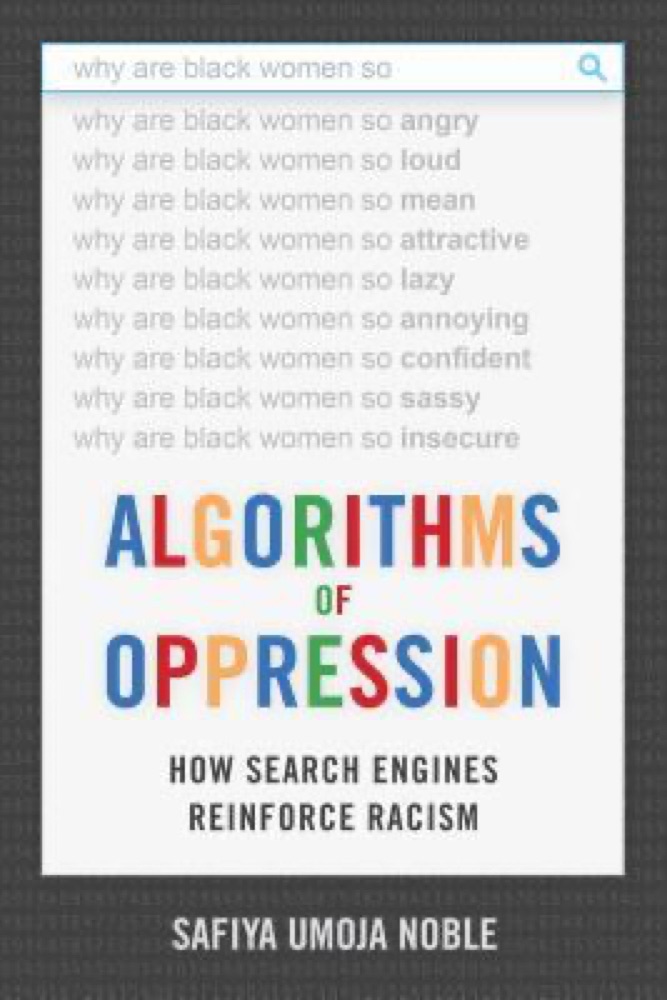
Run a Google search for "black girls" - what will you find? "Big Booty" and other sexually explicit terms are likely to come up as top search terms. But, if you type in "white girls," the results are radically different. The suggested porn sites and un-moderated discussions about "why black women are so sassy" or "why black women are so angry" presents a disturbing portrait of black womanhood in modern society.
In Algorithms of Oppression, Safiya Umoja Noble challenges the idea that search engines like Google offer an equal playing field for all forms of ideas, identities, and activities. Data discrimination is a real social problem; Noble argues that the combination of private interests in promoting certain sites, along with the monopoly status of a relatively small number of Internet search engines, leads to a biased set of search algorithms that privilege whiteness and discriminate
Book details
- First published
- 2018
- Author
- Safiya Umoja Noble
- Genre
- Nonfiction
- Goodreads rating
- 3.89 (4k ratings)
Keep reading
The Filter Bubble: What the Internet is Hiding From You
 You Are Not a Gadget
 Who Owns the Future?
 Weapons of Math Destruction: How Big Data Increases Inequality and Threatens Democracy
 The Technological Republic: Hard Power, Soft Belief, and the Future of the West
 Dataclysm: Who We Are
 Here Comes Everybody: The Power of Organizing Without Organizations
 Trust Me, I'm Lying: Confessions of a Media Manipulator
 Technopoly: The Surrender of Culture to Technology
 Elite Capture: How the Powerful Took Over Identity Politics
 Permanent Record
 What's Our Problem?: A Self-Help Book for Societies
 Automating Inequality: How High-Tech Tools Profile, Police, and Punish the Poor
 The Madness of Crowds: Gender, Race and Identity
 I Hate the Internet
 What White People Can Do Next: From Allyship to Coalition – An Empowering Guide to Interrogating Whiteness and Creating Justice
 Power and Progress: Our Thousand-Year Struggle Over Technology and Prosperity
 Distrust That Particular Flavor
 The World Is Flat: A Brief History of the Twenty-first Century
 In the Beginning...Was the Command Line
 Hackers & Painters: Big Ideas from the Computer Age
 Because Internet: Understanding the New Rules of Language
 Cynical Theories: How Activist Scholarship Made Everything about Race, Gender, and Identity—and Why This Harms Everybody
 Parasitic Mind: How Infectious Ideas Are Killing Common Sense
 The Identity Trap: A Story of Ideas and Power in Our Time
 The Utopia of Rules: On Technology, Stupidity, and the Secret Joys of Bureaucracy
 Invisible Women: Data Bias in a World Designed for Men
 The Attention Merchants: The Epic Scramble to Get Inside Our Heads
 Ways of Being: Animals, Plants, Machines: The Search for a Planetary Intelligence
 The Evolution of Everything: How New Ideas Emerge
 Chaos Monkeys: Obscene Fortune and Random Failure in Silicon Valley
 Co-Intelligence: Living and Working with AI
 Physics of the Future: How Science Will Shape Human Destiny and Our Daily Lives by the Year 2100
 The View From Flyover Country: Essays by Sarah Kendzior
 Capital and Ideology
 Wealth, Poverty and Politics: An International Perspective
 A Hunter-Gatherer's Guide to the 21st Century: Evolution and the Challenges of Modern Life
 The Disordered Cosmos: A Journey into Dark Matter, Spacetime, and Dreams Deferred
 Opinions: A Decade of Arguments, Criticism, and Minding Other People’s Business
 The Most Human Human: What Talking with Computers Teaches Us About What It Means to Be Alive
 Whose Story Is This? Old Conflicts, New Chapters
 Freakonomics: A Rogue Economist Explores the Hidden Side of Everything
 Black Feminist Thought: Knowledge, Consciousness, and the Politics of Empowerment
 Don't Make Me Think, Revisited: A Common Sense Approach to Web Usability
 Revenge of the Tipping Point
 Minority Rule: Adventures in the Culture War
 The Death of Expertise: The Campaign Against Established Knowledge and Why It Matters
 The Information: A History, a Theory, a Flood
 That Librarian: The Fight Against Book Banning in America
 Artificial Intelligence: A Guide for Thinking Humans
 How to Argue With a Racist: What Our Genes Do (and Don't) Say About Human Difference
 The Blank Slate: The Modern Denial of Human Nature
 The Sum of Us: What Racism Costs Everyone and How We Can Prosper Together
 Manufacturing Consent: The Political Economy of the Mass Media
 Where Good Ideas Come From: The Natural History of Innovation
 Amusing Ourselves to Death: Public Discourse in the Age of Show Business
 What Technology Wants
 The Influencing Machine: Brooke Gladstone on the Media
 From Dawn to Decadence: 500 Years of Western Cultural Life, 1500 to the Present
 Uncanny Valley