 Tribes: We Need You to Lead Us
Quotes from the Book
Change the language in the tribe, and you have changed the tribe itself.
10
Without the leaders building the tribe, a culture of mediocrity will prevail. Without an inspired tribe, leaders are impotent.
4
[Don Beck] said, after hearing about the three stages of epiphany, "There's a word in the Bantu languages that [Archbishop Desmond] Tutu has used to help bring the entire country of South Africa together: ubuntu, meaning 'Today I share with you because tomorrow you share with me.'" The word can also be translated "I am because we are.
4
It is literally true, Burke’s groundbreaking arguments suggests, that if people change their words (or, more accurately, their words and their words’ relationships to one another), they change their perception of reality. As they change their reality their behavior changes automatically. Instead of people using their words, they are used by their words, and this fact is unrecognized.
3
The first clean kill awakens the whole herd.
1
I asked my staff why they weren’t doing anything differently, and then it became clear: because I wasn’t doing anything differently. I was still the lone ranger.
1
Agreement is shared intellectual understanding. Tribes are clusters of people, and people are complex and nonrational at times. If a tribe is united only by agreement, as soon as times change, agreement has to be reestablished.
1
The single most important takeaway from Stage Four is that Tribal Leaders follow the core values of the tribe no matter what the cost.
1
We see Stage Two mostly when people believe they cannot act creatively, where jobs are so mechanized that they feel like part of a machine.
1
Know the values, current projects, and aspirations of each person in your tribe. Use Reid Hoffman’s “theory of small gifts” to build your relationship with people in your tribe as preparation for triading. Form a triad by introducing two people to each other on the basis of current projects and shared values.
1
We see the world and our words in one impression, as if we're looking at a forest through a green filter. We can't see what's really green and what's not. If we were to walk around with the filter in our eye long enough, we'd forget it was there, and life would just be green.
1
Tribal Leaders focus their efforts on building the tribe—or, more precisely, upgrading the tribal culture. If they are successful, the tribe recognizes them as the leaders, giving them top effort, cultlike loyalty, and a track record of success. Divisions and companies run by Tribal Leaders set the standard of performance in their industries, from productivity and profitability to employee retention.
People at Stage Three rely on themselves. The issue that they need to address, especially later in the stage, is that their effectiveness is capped by their time, which is a limited resource. The more the person can accept help from others, the more he will see that help from others is not only helpful but necessary to his becoming a fully developed leader. Once he begins to form strategies that rely on others, and in which others rely on him, he will have taken a big step into Stage Four.
over the long term, culture and strategic performance correlate, with the higher factor falling to the level of the lower. Thus, a company with a great culture and low strategic performance will, over time, find that its culture erodes: good people leave, and a “my life sucks” language begins to dominate
we hypothesized that there are four common cultures: (1) a negative tone with an individual focus, (2) a negative tone with a group focus, (3) a positive tone with an individual focus, and (4) a positive tone with a group focus. For each one, we expected to find a consistent “web of words” that became the basis of a culture, and a reality.
We developed a belief, based on our research of three hundred thousand people, that a person’s strengths are at the very base of it all. We believe any individual can be extremely valuable or even has a shot at being a world leader if they will pull it off using their own strengths instead of trying to become a Jack Welch or a Ted Turner,” Clifton argues. The core value we heard in his statement is “potential,” and everything the organization has done is based on unlocking it—in individuals, clients, and even the entire world.
Once values and a noble cause are set, tribal strategy involves three conversations. The first is “what we want,” or outcomes. The second is “what we have,” or assets. The third is “what we will do,” or behaviors. Many strategies go sideways by having two or even all three conversations at the same time—or skipping one of them completely. It’s imperative that the Tribal Leader keep these three discussions separate. Explorati’s original outcome was “we will have created a playable proof-of-concept demonstration that uses Improvisational Computing by July 2001.
Stage Four, people assume trust; they don’t earn it. At Stage Three, trust is earned. When lost, it has to be re-earned. At Stage Four, we observed a different phenomenon: people granted trust from the beginning. In fact, when we tried to set up meetings with people at Stage Three, many rebuffed us because they didn’t know who we were. By contrast, many of the remarkable people interviewed for this book—those at Stages Four and Five—assumed we were who we said we were and granted us an interview because they said the project sounded important. The principle is this: where trust is an issue, there is no trust. Stage Four assumes trust. Stage Three says trust must be earned.
best descriptions of Tribal Leaders we’ve ever heard: using words to get the best out of people, to change everything.
The process of an oil change is for the group to talk through three questions: (1) what is working well, (2) what is not working well, and (3) what the team can do to make the things that are not working well, work. Tribes
This Tribal Leader makes it clear that violating rules has consequences and that he will enforce them—and we’ve seen him follow the adage on his wall with such unwavering conviction and resolution that it has shocked people around him. Sample has done the same, as have hundreds of other Tribal Leaders we’ve met. Glen Esnard, a Tribal Leader whom we’ll meet in Chapter 8, told us, “You have to publicly execute people who disobey the rules, otherwise everyone thinks you don’t mean what you say, and then there’s no leadership, only bulls---.” What Machiavelli refers to as atrocities, Sample calls “decisions you have to make for the good of the institution.” Glen,
is the part of the epiphany that is most remarkable to us: its work is automatic. Tobias said, “It was so obvious I couldn’t believe I didn’t see it before. The more the group succeeds, the more I succeed.” As transformational expert Werner Erhard told us, “Let it use you; don’t try to use it.
The people who use the stage-specific leverage points to upgrade the tribal culture emerge as Tribal Leaders.
Alignment, to us, means bringing pieces into the same line - the same direction. The metaphor is that a magnet will make pieces of iron point toward it. Agreement is shared intellectual understanding. Tribes are clusters of people, and people are complex and nonrational at times. If a tribe is united only by agreement, as soon as times change, agreement has to be reestablished. If people learn new ideas or see a problem from a new perspective, they no longer agree, so tribes based on agreement often discourage learning, questioning, and independent thought. Tribes based on alignment want to maximize each person's contribution, provided that they stay pointed in the same direction like magnetized iron filings.
Watch on YouTube
About Dave Logan
We have collected 24 quotes from 1 book by Dave Logan on BookQuoters.
More about the author →About the book
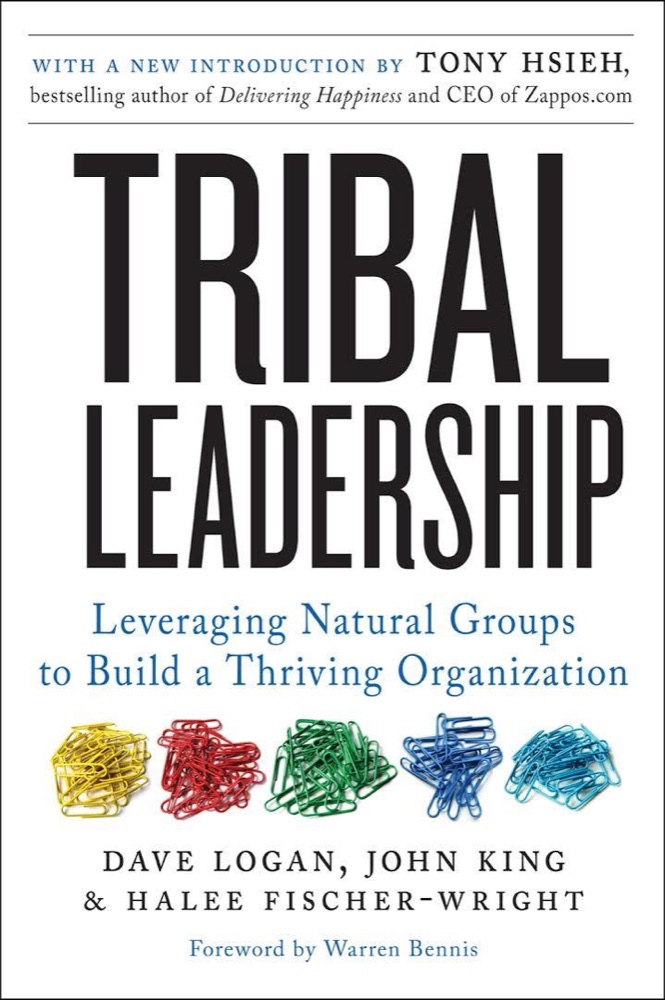
It's a fact of birds flock, fish school, people "tribe." Every company, indeed every organization, is a tribe, or if it's large enough, a network of tribes—groups of 20 to 150 people in which everyone knows everyone else, or at least knows of everyone else. Tribes are more powerful than teams, companies, or even CEOs, and yet their key leverage points have not been mapped—until now. In Tribal Leadership , Dave Logan, John King, and Halee Fischer-Wright show leaders how to assess their organization's tribal culture on a scale from one to five and then implement specific tools to elevate the stage to the next. The result is unprecedented success. In a rigorous eight-year study of approximately 24,000 people in over two dozen corporations, Logan, King, and Fischer-Wright refine and define a common the success of a company depends on its tribes, the strength of its tribes is determined by th
Book details
- First published
- 2008
- Author
- Dave Logan
- Genre
- Nonfiction
- Goodreads rating
- 3.98 (10k ratings)
Keep reading
Tribes: We Need You to Lead Us
 Turn the Ship Around!: A True Story of Turning Followers into Leaders
 Legacy: What the All Blacks Can Teach Us About the Business of Life
 Beyond Civilization: Humanity's Next Great Adventure
 The Fifth Discipline: The Art & Practice of The Learning Organization
 Leaders Eat Last: Why Some Teams Pull Together and Others Don't
 Above the Line: Lessons in Leadership and Life from a Championship Season
 Revenge of the Tipping Point
 The Five Dysfunctions of a Team
 Loonshots: How to Nurture the Crazy Ideas That Win Wars, Cure Diseases, and Transform Industries
 Boundaries for Leaders: Results, Relationships, and Being Ridiculously in Charge
 The 7 Habits of Highly Effective People: Personal Workbook
 The Score Takes Care of Itself: My Philosophy of Leadership
 Radical Candor: Be a Kickass Boss Without Losing Your Humanity
 The 360 Degree Leader: Developing Your Influence from Anywhere in the Organization
 The Ride of a Lifetime: Lessons Learned from 15 Years as CEO of the Walt Disney Company
 Please Understand Me II: Temperament, Character, Intelligence
 Managing Humans: Biting and Humorous Tales of a Software Engineering Manager
 Winning
 The Leader Who Had No Title: A Modern Fable on Real Success in Business and in Life
 It Worked for Me: In Life and Leadership
 Pour Your Heart Into It: How Starbucks Built a Company One Cup at a Time
 Leadership on the Line: Staying Alive through the Dangers of Leading
 Built to Last: Successful Habits of Visionary Companies
 Conscious Capitalism
 The Price of Tomorrow: Why Deflation is the Key to an Abundant Future
 QBQ! The Question Behind the Question: Practicing Personal Accountability in Work and in Life
 Start with Why: How Great Leaders Inspire Everyone to Take Action
 Wooden on Leadership: How to Create a Winning Organization
 Chaos Monkeys: Obscene Fortune and Random Failure in Silicon Valley
 Originals: How Non-Conformists Move the World
 Hit Refresh: The Quest to Rediscover Microsoft's Soul and Imagine a Better Future for Everyone
 The E-myth Revisited
 Great by Choice: Uncertainty, Chaos, and Luck—Why Some Thrive Despite Them All
 The Elephant in the Brain: Hidden Motives in Everyday Life
 Influencer: The Power to Change Anything
 The Second Mountain
 Emergent Strategy: Shaping Change, Changing Worlds
 Getting More: How to Negotiate to Achieve Your Goals in the Real World
 A Whole New Mind: Why Right-Brainers Will Rule the Future
 Delivering Happiness: A Path to Profits, Passion, and Purpose
 Becoming Kin: An Indigenous Call to Unforgetting the Past and Reimagining Our Future
 The Culture Map: Breaking Through the Invisible Boundaries of Global Business
 Eleven Rings: The Soul of Success
 Smartcuts: How Hackers, Innovators, and Icons Accelerate Success
 Things a Little Bird Told Me: Confessions of the Creative Mind
 The Art of Impossible: A Peak Performance Primer
 The Blue Sweater: Bridging the Gap Between Rich and Poor in an Interconnected World
 Leading: Learning from Life and My Years at Manchester United
 Amp It Up: Leading for Hypergrowth by Raising Expectations, Increasing Urgency, and Elevating Intensity
 Give and Take: A Revolutionary Approach to Success
 Peopleware: Productive Projects and Teams
 Surrounded by Idiots
 The Tipping Point: How Little Things Can Make a Big Difference
 Call Sign Chaos: Learning to Lead
 Made to Stick: Why Some Ideas Survive and Others Die
 The Effective Executive: The Definitive Guide to Getting the Right Things Done
 Smarter Faster Better: The Secrets of Being Productive in Life and Business
 The Starfish and the Spider: The Unstoppable Power of Leaderless Organizations