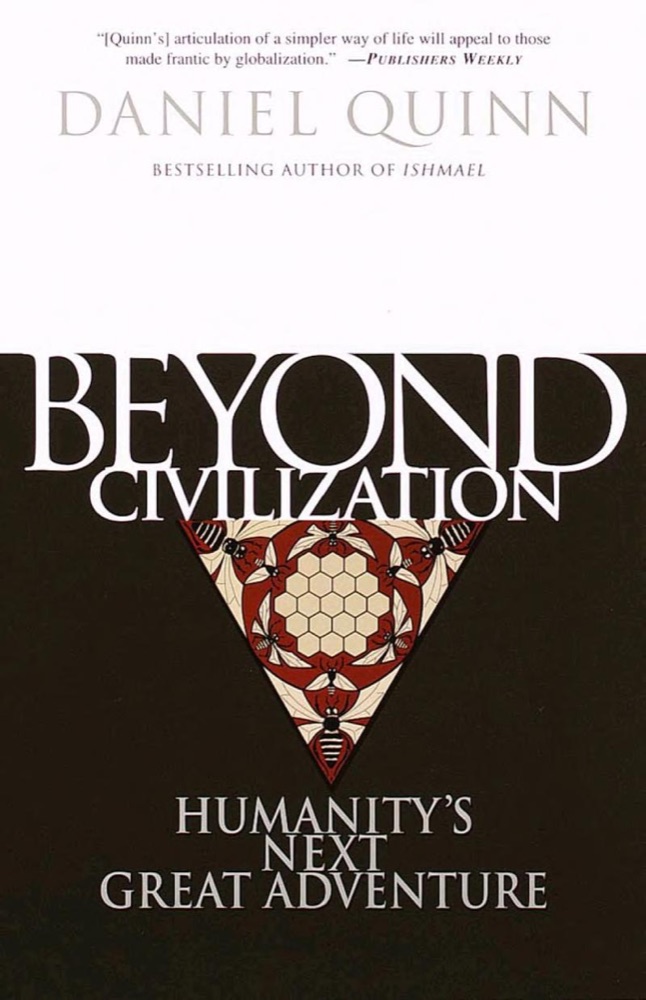

 Ishmael: An Adventure of the Mind and Spirit
Quotes from the Book
The greatest discovery any alien anthropologist could make about our culture is our overriding response to failure: If it didn't work last year, do it AGAIN this year (and if possible do it MORE)
26
A castaway in the sea was going down for the third time when he caught sight of a passing ship. Gathering his last strength, he waved frantically and called for help. Someone on board peered at him scornfully and shouted back, "Get a boat!
24
Diversity, not uniformity, is what works.
6
Making food a commodity to be owned was one of the great innovations of our culture. No other culture in history has ever put food under lock and key—and putting it there is the cornerstone of our economy, for if the food wasn't under lock and key, who would work?
5
Pharaohs It took Khufu twenty-three years to build his Great Pyramid at Giza, where some eleven hundred stone blocks, each weighing about two and a half tons, had to be quarried, moved, and set in place every day during the annual building season, roughly four months long. Few commentators on these facts can resist noting that this achievement is an amazing testimonial to the pharaoh’s iron control over the workers of Egypt. I submit, on the contrary, that pharaoh Khufu needed to exercise no more control over his workers at Giza than pharaoh Bill Gates exercises over his workers at Microsoft. I submit that Egyptian workers, relatively speaking, got as much out of building Khufu’s pyramid as Microsoft workers will get out of building Bill Gates’s pyramid (which will surely dwarf Khufu’s a hundred times over, though it will not, of course, be built of stone). No special control is needed to make people into pyramid builders—if they see themselves as having no choice but to build pyramids. They’ll build whatever they’re told to build, whether it’s pyramids, parking garages, or computer programs. Karl Marx recognized that workers without a choice are workers in chains. But his idea of breaking chains was for us to depose the pharaohs and then build the pyramids for ourselves, as if building pyramids is something we just can’t stop doing, we love it so much.
5
The tribal life wasn't something humans sat down and figured out. It was the gift of natural selection, a proven success—not perfection but hard to improve on. Hierarchalism, on the other hand, has proven to be not merely imperfect but ultimately catastrophic for the earth and for us. When the plane's going down and someone offers you a parachute, you don't demand to see the warranty.
4
You never change things by fighting the existing reality. To change something, build a new model that makes the existing model obsolete. BUCKMINSTER FULLER
4
Engineers can't afford to fail as consistently as politicians and bureaucrats, so they prefer accedence to resistance (as I do). For example, they know that no structure can be made rigid enough to resist an earthquake. So, rather than defy the earthquake's power by building rigid structures, they accede to it by building flexible ones. To accede is not merely to give in but rather to give in while drawing near; one may accede not only to an argument but to a throne. Thus the earthquakeproof building survives not by defeating the earthquake's power but by acknowledging it—by drawing it in and dealing with it.
3
In hierarchal organizations, the boss is a supreme being. In tribal organizations, the boss is just another worker.
3
We are inclined to think of hunters and gatherers as poor because they don't have anything; perhaps better to think of them for that reason as free. MARSHALL SAHLINS
3
I can confidently predict that if the world is saved, it will not be because some old minds came up with some new programs. Programs never stop the things they're launched to stop. No program has ever stopped poverty, drug abuse, or crime, and no program ever will stop them. And no program will ever stop us from devastating the world.
2
No, the founders of our culture didn't just fall into a lifestyle of total dependence on agriculture, they had to whip themselves into it, and the whip they used was this meme: Growing all your own food is the best way to live. Nothing less could imaginably have done this amazing trick.
2
Because the tribe is its members, the tribe is what its members want it to be—nothing more and nothing less.
2
The civilized want people to make their living individually, and they want them to live separately, behind locked doors—one family to a house, each house fully stocked with refrigerators, television sets, washing machines, and so on.
2
Diversity, not uniformity, is what works. Our problem is not that people are living a bad way but rather that they're all living the same way. The earth can accommodate many people living in a voraciously wasteful and pollutive way, it just can't accommodate all of us living that way.
2
The tribal life doesn't turn people into saints; it enables ordinary people to make a living together with a minimum of stress year after year, generation after generation.
2
Karl Marx recognized that workers without a choice are workers in chains. But his idea of breaking chains was for us to depose the pharaohs and then build the pyramids for ourselves, as if building pyramids is something we just can't stop doing, we love it so much.
2
a tribe is nothing more than a coalition of people working together as equals to make a living.
2
Anthropologist Marshall Sahlins has written: “The world's most primitive people have few possessions, but they are not poor. Poverty is not a certain small amount of goods, nor is it just a relation between means and ends; above all it is a relation between people. Poverty is a social status. As such it is the invention of civilization.
1
Every year, without fail, we outlaw more things, catch more people doing them, and put more of them in jail. The outlawed behavior never goes away, because, directly or indirectly, it's supported by the strong, invisible, unrelenting force called vision. This explains why police officers are much more likely to take up crime than criminals are to take up law enforcement. It's called 'going with the flow.
1
Watch on YouTube
About Daniel Quinn
We have collected 81 quotes from 4 books by Daniel Quinn on BookQuoters.
More about the author →More by Daniel Quinn
Ishmael: An Adventure of the Mind and Spirit
 The Story of B: An Adventure of the Mind and Spirit
 My Ishmael
About the book
In Beyond Civilization , Daniel Quinn thinks the unthinkable. We all know there's no one right way to build a bicycle, no one right way to design an automobile, no one right way to make a pair of shoes, but we're convinced that there must be only one right way to live -- and the one we have is it, no matter what.
Beyond Civilization makes practical sense of the vision of Daniel Quinn's best-selling novel Ishmael . Examining ancient civilizations such as the Maya and the Olmec, as well as modern-day microcosms of alternative living like circus societies, Quinn guides us on a quest for a new model for society, one that is forward-thinking and encourages diversity instead of suppressing it. Beyond Civilization is not about a "New World Order" but a "New Personal World Order" that would allow people to assert control over their own destiny and grant them the freedom to create their own way
Book details
- First published
- 1999
- Author
- Daniel Quinn
- Genre
- Nonfiction
- Goodreads rating
- 3.90 (3k ratings)
Keep reading
 A Short History of Progress
 Sapiens: A Brief History of Humankind
 Endgame, Vol. 1: The Problem of Civilization
Ishmael: An Adventure of the Mind and Spirit
Endgame, Vol. 1: The Problem of Civilization
Ishmael: An Adventure of the Mind and Spirit
 Civilized to Death: What Was Lost on the Way to Modernity
 Collapse: How Societies Choose to Fail or Succeed
 The Culture of Make Believe
The Story of B: An Adventure of the Mind and Spirit
The Culture of Make Believe
The Story of B: An Adventure of the Mind and Spirit
 The Ministry for the Future
 Humankind: A Hopeful History
 The Rational Optimist: How Prosperity Evolves
 The Dawn of Everything: A New History of Humanity
 Revolution
 A History of the World in 100 Objects
 The Evolution of Everything: How New Ideas Emerge
 The Wayfinders: Why Ancient Wisdom Matters in the Modern World
 Freedom
 The World Is Flat: A Brief History of the Twenty-first Century
 Walden Two
 The Wizard and the Prophet: Two Remarkable Scientists and Their Dueling Visions to Shape Tomorrow's World
 Green Mars
 The Social Conquest of Earth
 Human Action: A Treatise on Economics
 The Art of the Commonplace: The Agrarian Essays
 The Soul of Man Under Socialism
 Utopia for Realists: How We Can Build the Ideal World
 Homo Deus: A History of Tomorrow
 Blue Mars
 Enlightenment Now: The Case for Reason, Science, Humanism, and Progress
 Banker to the Poor: Micro-Lending and the Battle Against World Poverty
 Walkaway
 The Utopia of Rules: On Technology, Stupidity, and the Secret Joys of Bureaucracy
 Four Futures: Life After Capitalism
 What's Our Problem?: A Self-Help Book for Societies
 Small Is Beautiful: Economics as if People Mattered
 Corpalism
 Seeing Like a State: How Certain Schemes to Improve the Human Condition Have Failed
 The Lost World
 The World-Ending Fire: The Essential Wendell Berry
 What's Wrong with the World
 A Language Older Than Words
 The Wretched of the Earth
 Billions & Billions: Thoughts on Life and Death at the Brink of the Millennium
 The Price of Tomorrow: Why Deflation is the Key to an Abundant Future
 Straw Dogs: Thoughts on Humans and Other Animals
 The Coming Insurrection
 A Hunter-Gatherer's Guide to the 21st Century: Evolution and the Challenges of Modern Life
 Saving Time: Discovering a Life Beyond the Clock
 The Dispossessed
 God Emperor of Dune
 On the Steel Breeze
 Sacred Economics: Money, Gift, and Society in the Age of Transition
 Talking to My Daughter About the Economy: or, How Capitalism Works—and How It Fails
 Creation Lake
 On Fire: The Case for the Green New Deal
 A People's History of the United States
 Tribal Leadership: Leveraging Natural Groups to Build a Thriving Organization
 Across That Bridge: A Vision for Change and the Future of America
 Tribes: We Need You to Lead Us
 The Biggest Secret: The Book That Will Change the World