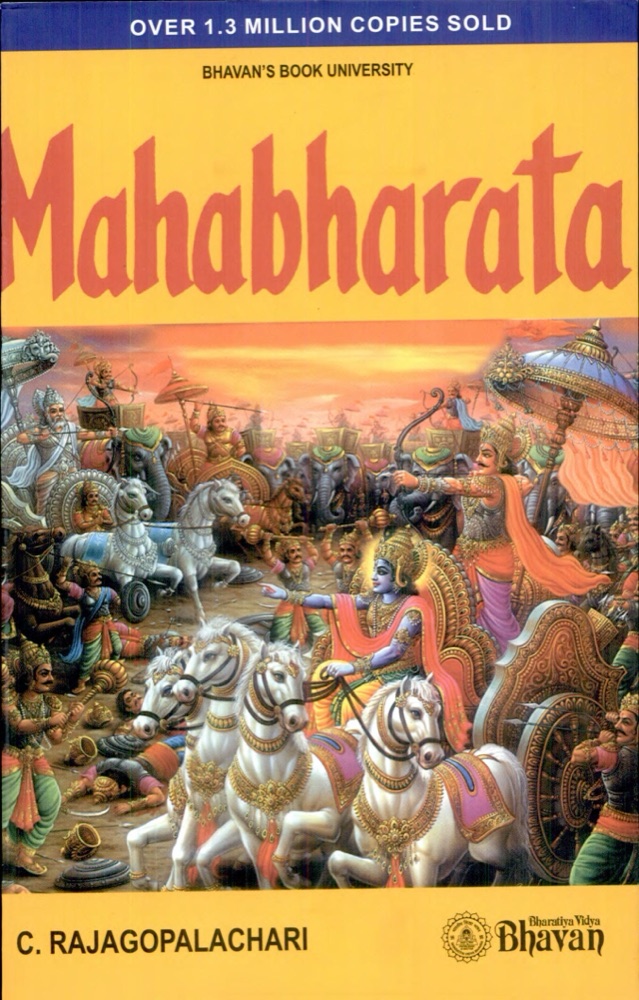
 Mahabharata
Quotes from the Book
It is better to live your own destiny imperfectly than to live an imitation of somebody else's life with perfection.
A gift is pure when it is given from the heart to the right person at the right time and at the right place, and when we expect nothing in return
No one who does good work will ever come to a bad end, either here or in the world to come
Curving back within myself I create again and again.
Anyone who is steady in his determination for the advanced stage of spiritual realization and can equally tolerate the onslaughts of distress and happiness is certainly a person eligible for liberation.
The happiness which comes from long practice, which leads to the end of suffering, which at first is like poison, but at last like nectar - this kind of happiness arises from the serenity of one's own mind.
The peace of God is with them whose mind and soul are in harmony, who are free from desire and wrath, who know their own soul.
Perform all thy actions with mind concentrated on the Divine, renouncing attachment and looking upon success and failure with an equal eye. Spirituality implies equanimity. [Trans. Purohit Swami]
He who has let go of hatred who treats all beings with kindness and compassion, who is always serene, unmoved by pain or pleasure, free of the "I" and "mine," self-controlled, firm and patient, his whole mind focused on me --- that is the man I love best.
कालो ऽस्मि लोकक्षयकृत्प्रवृद्धो..... ( I am Time, the great destroyer of the world ~Bhagavad Gita 11.32)
The man who sees me in everything and everything within me will not be lost to me, nor will I ever be lost to him. He who is rooted in oneness realizes that I am in every being; wherever he goes, he remains in me. When he sees all being as equal in suffering or in joy because they are like himself, that man has grown perfect in yoga.
You have the right to work, but never to the fruit of work. You should never engage in action for the sake of reward, nor should you long for inaction. Perform work in this world, Arjuna, as a man established within himself - without selfish attachments, and alike in success and defeat.
I have become Death, the destroyer of worlds.
The nonpermanent appearance of happiness and distress, and their disappearance in due course, are like the appearance and disappearance of winter and summer seasons.They arise from sense perception,and one must learn to tolerate them without being disturbed.
They say that life is an accident, driven by sexual desire, that the universe has no moral order, no truth, no God. Driven by insatiable lusts, drunk on the arrogance of power, hypocritical, deluded, their actions foul with self-seeking, tormented by a vast anxiety that continues until their death, convinced that the gratification of desire is life's sole aim, bound by a hundred shackles of hope, enslaved by their greed, they squander their time dishonestly piling up mountains of wealth. "Today I got this desire, and tomorrow I will get that one; all these riches are mine, and soon I will have even more. Already I have killed these enemies, and soon I will kill the rest. I am the lord, the enjoyer, successful, happy, and strong, noble, and rich, and famous. Who on earth is my equal?
For the senses wander, and when one lets the mind follow them, it carries wisdom away like a windblown ship on the waters.
He is the source of light in all luminous objects. He is beyond the darkness of matter and is unmanifested. He is knowledge, He is the object of knowledge, and He is the goal of knowledge. He is situated in everyone's heart.
Set thy heart upon thy work, but never on its reward.
The wise grieve neither for the living nor for the dead. There was never a time when you and I and all the kings gathered here have not existed and nor will there be a time when we will cease to exist.
The embodied soul is eternal in existence, indestructible, and infinite, only the material body is factually perishable, therefore fight O Arjuna.
I enter into each planet, and by My energy they stay in orbit. I become the moon and thereby supply the juice of life to all vegetables.
The Lord said: "Time [death] I am, the destroyer of the worlds, who has come to annihilate everyone. Even without your taking part all those arrayed in the [two] opposing ranks will be slain!
Perform all work carefully, guided by compassion.
We behold what we are, and we are what we behold.
Then, O King! the God, so saying, Stood, to Pritha's Son displaying All the splendour, wonder, dread Of His vast Almighty-head. Out of countless eyes beholding, Out of countless mouths commanding, Countless mystic forms enfolding In one Form: supremely standing Countless radiant glories wearing, Countless heavenly weapons bearing, Crowned with garlands of star-clusters, Robed in garb of woven lustres, Breathing from His perfect Presence Breaths of every subtle essence Of all heavenly odours; shedding Blinding brilliance; overspreading- Boundless, beautiful- all spaces With His all-regarding faces; So He showed! If there should rise Suddenly within the skies Sunburst of a thousand suns Flooding earth with beams undeemed-of, Then might be that Holy One's Majesty and radiance dreamed of!
O Krishna, the mind is restless
It is Nature that causes all movement. Deluded by the ego, the fool harbors the perception that says "I did it".
Performing the duty prescribed by (one's own) nature, one incurreth no sin.
Feelings of heat and cold, pleasure and pain, are caused by the contact of the senses with their objects. They come and they go, never lasting long. You must accept them.
Watch on YouTube
About Krishna-Dwaipayana Vyasa
We have collected 68 quotes from 2 books by Krishna-Dwaipayana Vyasa on BookQuoters.
More about the author →More by Krishna-Dwaipayana Vyasa
Mahabharata
Book details
- Author
- Krishna-Dwaipayana Vyasa
- Genre
- Classics
- Goodreads rating
- 4.19 (84k ratings) →
Keep reading
 Autobiography of a Yogi
 The Upanishads
 Bhagavad-Gita As It Is
 The Dhammapada
 The Journey Home
 The Yoga Sutras of Patanjali
 Siddhartha
Mahabharata
Siddhartha
Mahabharata
 The Way of the Bodhisattva
 My Gita
 Complete Works of Swami Vivekananda, 9 Vols.
 Awakening the Buddha Within
 The Gay Science
 Be Here Now
 Report to Greco
 Faust
Faust
 A Joseph Campbell Companion: Reflections on the Art of Living
 The Oath of the Vayuputras
 Demian
 The Game of Life and How to Play It
 Ben-Hur: A Tale of the Christ
 Tao Te Ching
 Tibetan Book of the Dead
 The Lathe of Heaven
 Cuckold
 Perelandra
 Fragments
 De Profundis
 Sacred Journey of the Peaceful Warrior
 When Nietzsche Wept
 The Glass Bead Game
 365 Tao: A Study of Taoist Wisdom for Daily Life
 The Ramayana: A Shortened Modern Prose Version of the Indian Epic
 The Red Book: Liber Novus
 The I Ching or Book of Changes
 Self-Reliance: An Excerpt from Collected Essays, First Series
 Self-Reliance and Other Essays
 Yayati: A Classic Tale of Lust
 Island
 The Story of My Experiments With Truth
 Sita: An Illustrated Retelling of the Ramayana
 A Course in Miracles
 Walden
 The World's Religions
 The Prophet
 Wings of Fire: An Autobiography
 Conversations with God: An Uncommon Dialogue, Book 1
 The Consolation of Philosophy
 The Wise Heart: A Guide to the Universal Teachings of Buddhist Psychology
 The Disappearance of the Universe: Straight Talk about Illusions, Past Lives, Religion, Sex, Politics, and the Miracles of Forgiveness
 Raja-Yoga
 Prince Lestat
 The Imitation of Christ
 The Seven Storey Mountain
 The Immortals of Meluha
 The Ego and Its Own
 Sacred Hunger
 Shōgun
 Ethics