
 Whose Body?
Quotes from the Book
Has it ever struck you as odd, or unfortunate, that today, when the proportion of literacy is higher than it has ever been, people should have become susceptible to the influence of advertisement and mass propaganda to an extent hitherto unheard of and unimagined?
32
For we let our young men and women go out unarmed, in a day when armour was never so necessary. By teaching them all to read, we have left them at the mercy of the printed word. By the invention of the film and the radio, we have made certain that no aversion to reading shall secure them from the incessant battery of words, words, words. They do not know what the words mean; they do not know how to ward them off or blunt their edge or fling them back; they are a prey to words in their emotions instead of being the masters of them in their intellects.
12
Is not the great defect of our education today—a defect traceable through all the disquieting symptoms of trouble that I have mentioned—that although we often succeed in teaching our pupils “subjects,” we fail lamentably on the whole in teaching them how to think: they learn everything, except the art of learning.
11
They do not know what the words mean; they do not know how to ward them off or blunt their edge or fling them back; they are a prey to words in their emotions instead of being the masters of them in their intellects.
7
When we think about the remarkably early age at which the young men went up to the University in, let us say, Tudor times, and thereafter were held fit to assume responsibility for the conduct of their own affairs, are we altogether comfortable about that artificial prolongation of intellectual childhood and adolescence into the years of physical maturity which is so marked in our own day? To postpone the acceptance of responsibility to a late date brings with it a number of psychological complications which, while they may interest the psychiatrist, are scarcely beneficial either to the individual or to society.
6
By teaching them all to read, we have left them at the mercy of the printed word. By the invention of the film and the radio, we have made certain that no aversion to reading shall secure them from the incessant battery of words, words, words.
5
To learn six subjects without remembering how they were learnt does nothing to ease the approach to a seventh; to have learnt and remembered the art of learning makes the approach to every subject an open door.
4
the practical utility of Formal Logic to-day lies not so much in the establishment of positive conclusions as in the prompt detection and exposure of invalid inference.
4
although we often succeed in teaching our pupils "subjects," we fail lamentably on the whole in teaching them how to think? They learn everything, except the art of learning.
4
Theology is the mistress-science, without which the whole educational structure will necessarily lack its final synthesis.
4
the key-exercise will be Formal Logic. It is here that our curriculum shows its first sharp divergence from modern standards. The disrepute into which Formal Logic has fallen is entirely unjustified; and its neglect is the root cause of nearly all those disquieting symptoms which we have noted in the modern intellectual constitution. Logic has been discredited, partly because we have fallen into a habit of supposing that we are conditioned almost entirely by the intuitive and the unconscious.
3
For they amount to this: that if we are to produce a society of educated people, fitted to preserve their intellectual freedom amid the complex pressures of our modern society, we must turn back the wheel of progress some four or five hundred years,
3
I will say at once, quite firmly, that the best grounding for education is the Latin grammar. I say this, not because Latin is traditional and mediaeval, but simply because even a rudimentary knowledge of Latin cuts down the labor and pains of learning almost any other subject by at least fifty percent. It is the key to the vocabulary and structure of all the Teutonic languages, as well as to the technical vocabulary of all the sciences and to the literature of the entire Mediterranean civilization, together with all its historical documents.
2
We dole out lip-service to the importance of education—lip-service and, just occasionally, a little grant of money; we postpone the school-leaving age, and plan to build bigger and better schools; the teachers slave conscientiously in and out of school hours; and yet, as I believe, all this devoted effort is largely frustrated, because we have lost the tools of learning, and in their absence can only make a botched and piecemeal job of it.
2
The modern boy and girl are certainly taught more subjects—but does that always mean that they actually know more?
2
in the first part, the master-faculties are Observation and Memory, so in the second, the master-faculty is the Discursive Reason.
2
It will, doubtless, be objected that to encourage young persons at the Pert age to browbeat, correct, and argue with their elders will render them perfectly intolerable. My answer is that children of that age are intolerable anyhow; and that their natural argumentativeness may just as well be canalized to good purpose as allowed to run away into the sands. It may, indeed, be rather less obtrusive at home if it is disciplined in school; and anyhow, elders who have abandoned the wholesome principle that children should be seen and not heard have no one to blame but themselves.
One cannot learn the theory of grammar without learning an actual language,
Cannot”—does this mean that our behavior is determined irreversibly, or merely that such an action would be very difficult in view of the opposition it would provoke?
The whole of the Trivium was, in fact, intended to teach the pupil the proper use of the tools of learning.
The doors of the storehouse of knowledge should now be thrown open for them to browse about as they will.
They are doing for their pupils the work which the pupils themselves ought to do. For the sole true end of education is simply this: to teach men how to learn for themselves; and whatever instruction fails to do this is effort spent in vain.
Watch on YouTube
About Dorothy L. Sayers
We have collected 267 quotes from 11 books by Dorothy L. Sayers on BookQuoters.
More about the author →More by Dorothy L. Sayers
All books by Dorothy L. Sayers →
About the book
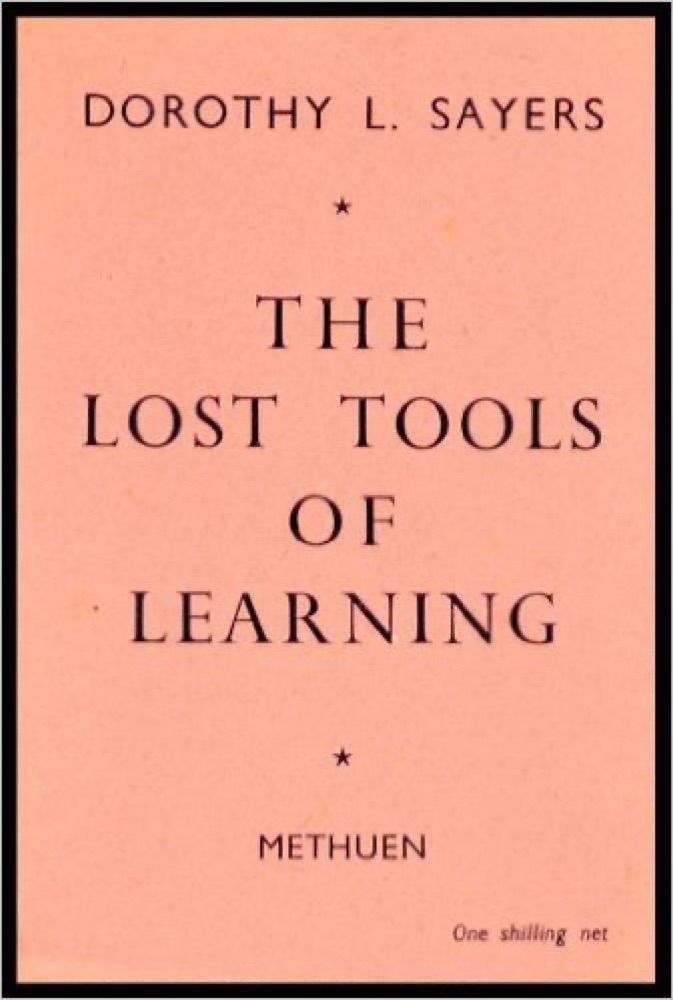
In 1947, Dorothy Sayers first delivered this speech at Oxford University. It has since been republished countless times due to its sheer eloquence and unanswered articulation of the 3 "lost tools" in classical education: grammar, logic and rhetoric.
Book details
- First published
- 1947
- Author
- Dorothy L. Sayers
- Genre
- Nonfiction
- Goodreads rating
- 4.46 (2k ratings)
Keep reading
 The Core
 Dumbing Us Down: The Hidden Curriculum of Compulsory Education
 Deschooling Society
 Experience and Education
 Emile or On Education
 How Children Fail
 How to Read a Book: The Classic Guide to Intelligent Reading
 The Vanishing American Adult: Our Coming-of-Age Crisis—and How to Rebuild a Culture of Self-Reliance
 The Element: How Finding Your Passion Changes Everything
 Creative Schools: The Grassroots Revolution That's Transforming Education
 Education of a Wandering Man: A Memoir
 Reader, Come Home: The Reading Brain in a Digital World
 Free to Learn: Why Unleashing the Instinct to Play Will Make Our Children Happier, More Self-Reliant, and Better Students for Life
 How Children Learn
 The Absorbent Mind
 An Appetite for Wonder: The Making of a Scientist
 The Closing of the American Mind
 The Republic
 From Dawn to Decadence: 500 Years of Western Cultural Life, 1500 to the Present
 Summerhill: A Radical Approach to Child Rearing
 The Social Animal: The Hidden Sources of Love, Character, and Achievement
 The Education of Henry Adams
 The Read-Aloud Handbook
 The Abolition of Man
 Not for Profit: Why Democracy Needs the Humanities
 How We Learn: Why Brains Learn Better Than Any Machine . . . for Now
 Letters from an Astrophysicist
 Excellent Sheep: The Miseducation of the American Elite and the Way to a Meaningful Life
 The New Drawing on the Right Side of the Brain
 The Master and His Emissary: The Divided Brain and the Making of the Western World
 Amusing Ourselves to Death: Public Discourse in the Age of Show Business
 The Medium is the Massage
 An Essay Concerning Human Understanding
 We Make the Road by Walking: Conversations on Education and Social Change
 Slow Learner
 A History of Western Philosophy
 Proust and the Squid: The Story and Science of the Reading Brain
 The Death and Life of the Great American School System: How Testing and Choice Are Undermining Education
 Against Method
 The Ascent of Man
 Mastery
 Shop Class as Soulcraft: An Inquiry Into the Value of Work
 The Wave in the Mind: Talks and Essays on the Writer, the Reader and the Imagination
 An Enquiry Concerning Human Understanding
 Critique of Pure Reason
 Understanding Media: The Extensions of Man
 Curious: The Desire to Know and Why Your Future Depends On It
 Stones Into Schools: Promoting Peace With Books, Not Bombs, in Afghanistan and Pakistan
 Educating Esmé: Diary of a Teacher's First Year
 The Story of Philosophy: The Lives and Opinions of the World's Greatest Philosophers
 Cultivating Genius: An Equity Framework for Culturally and Historically Responsive Literacy
 Children of Dune
 Walden Two
 From Bacteria to Bach and Back: The Evolution of Minds
 The History Boys
 The Smartest Kids in the World: And How They Got That Way
 The Art of Rhetoric
 The Ides of March
 Burning Questions: Essays and Occasional Pieces, 2004 to 2021
 Philosophical Investigations