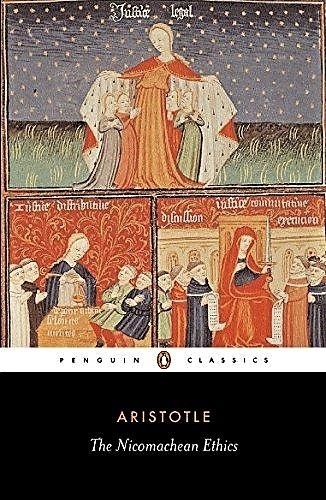
 The Nicomachean Ethics
Quotes from the Book
What makes a man a 'sophist' is not his faculty, but his moral purpose. (1355b 17)
22
There are, then, these three means of effecting persuasion. The man who is to be in command of them must, it is clear, be able (1) to reason logically, (2) to understand human character and goodness in their various forms, and (3) to understand the emotions-that is, to name them and
12
Now the proofs furnished by the speech are of three kinds. The first depends upon the moral character of the speaker, the second upon putting the hearer into a certain frame of mind, the third upon the speech itself, in so far as it proves or seems to prove. [4]
8
[...] e coloro che sono innamorati hanno sempre piacere sia a parlare dell'oggetto amato, sia a disegnarlo, sia a comporre qualcosa: ricordandosene infatti con tutti questi mezzi, ritengono quasi di avvertire la presenza dell'amato. E questa è per tutti l'origine dell'amore, quando non solo si prova piacere nella presenza dell'amato, ma anche quando, ricordandosi di lui quando non c'è, si aggiunge il dolore per il fatto che sia assente.
6
All that is done on compulsion is bitterness to the soul.
5
Rhetoric then may be defined as the faculty of discovering the possible means of persuasion in reference to any subject whatever.
5
But there is a difference: in Rhetoric, one who acts in accordance with sound argument, and one who acts in accordance with moral purpose,are both called rhetoricians; but in Dialectic it is the moral purpose that makes the sophist, the dialectician being one whose arguments rest, not on moral purpose but on the faculty. Let
5
Further, the orator should be able to prove opposites, as in logical arguments;
5
Dialectic as a whole, or of one of its parts, to consider every kind of syllogism in a similar manner, it is clear that he who is most capable of examining the matter and forms of a syllogism will be in the highest degree a master of rhetorical argument,
5
means of succeeding in the object we set before us. We must make as it were a fresh start, and before going further define what rhetoric is. Rhetoric may be defined as the faculty of observing in any given case the available means of persuasion. This is not a function of any other art. Every other art can instruct or persuade about its own particular subject-matter; for instance, medicine about what is healthy and unhealthy, geometry about the properties of magnitudes, arithmetic about numbers, and the same is true of the other arts and sciences. But rhetoric we look upon as the power of observing the means of persuasion on almost any subject presented to us;
5
rhetoric was to be surveyed from the standpoint of philosophy.
5
How can a man who, for a significant phase of his formation, shared his master’s opposition to rhetoric have in maturity composed a masterpiece of the formal study of rhetoric? This
5
It was at this point that the transition was first made to the conception that rhetoric was a teachable skill, that it could, usually in return for a fee, be passed from one skilled performer on to others, who might thereby achieve successes in their practical life that would otherwise have eluded them.
5
The peculiar circumstances arising out of the fall of the Syracusan tyranny seem to have produced the first practitioners of the art of rhetorical
5
the fact that it took the rise of democracies and otherwise open societies at Athens and elsewhere to create the climate in which public eloquence became a political indispensability.
5
To say this, however, is not to claim that it was the object of theoretical study.
5
If there are two definitive features of ancient Greek civilization, they are loquacity and competition.
5
Bad men, who are to weak for toil, are in love with death
4
The orator persuades by moral character when his speech is delivered in such a manner as to render him worthy of confidence; for we feel confidence in a greater degree and more readily in persons of worth in regard to everything in general, but where there is no certainty and there is room for doubt, our confidence is absolute. But this confidence must be due to the speech itself, not to any preconceived idea of the speaker’s character;
4
For instance, it is not the function of medicine to restore a patient to health, but only to promote this end as far as possible; for even those whose recovery is impossible may be properly treated.
4
It is thus evident that Rhetoric does not deal with any one definite class of subjects, but, like Dialectic, [is of general application]; also, that it is useful; and further, that its function is not so much to persuade, as to find out in each case the existing means of persuasion.
4
However, it is not the same with the subject matter, but, generally speaking, that which is true and better is naturally always easier to prove and more likely to persuade.
4
not that we should do both (for one ought not to persuade people to do what is wrong), but that the real state of the case may not escape us, and that we ourselves may be able to counteract false arguments, if another makes an unfair use of them.
4
even if we possessed the most accurate scientific knowledge, we should not find it easy to persuade them by the employment of such knowledge. For scientific discourse is concerned with instruction, but in the case of such persons instruction is impossible; our proofs and arguments must rest on generally accepted principles, as we said in the Topics, when speaking of converse with the multitude.
4
Nevertheless, Rhetoric is useful, because the true and the just are naturally superior to their opposites, so that, if decisions are improperly made, they must owe their defeat to their own advocates; which is reprehensible.
4
wherefore one who divines well in regard to the truth will also be able to divine well in regard to probabilities. It
4
since we are most strongly convinced when we suppose anything to have been demonstrated; that rhetorical demonstration is an enthymeme,
4
The present work is, then, the masterpiece of one particular literary genre that flourished in the fourth century BC in Greece, that of the rhetorical manual, and it is a remarkable fact that it should have fallen to Aristotle to write it. It
4
Let us now turn to their circumstances and their victims. People do wrong, then, when they think that the deed can be done, and can be done by them — which is to say that they think either† (a) they can get away with it, or (b) that if they are caught they will avoid punishment, or (c) that if they are punished the penalty paid by themselves or those they care for will be less than their profits.
3
Watch on YouTube
About Aristotle
We have collected 146 quotes from 6 books by Aristotle on BookQuoters.
More about the author →
About the book
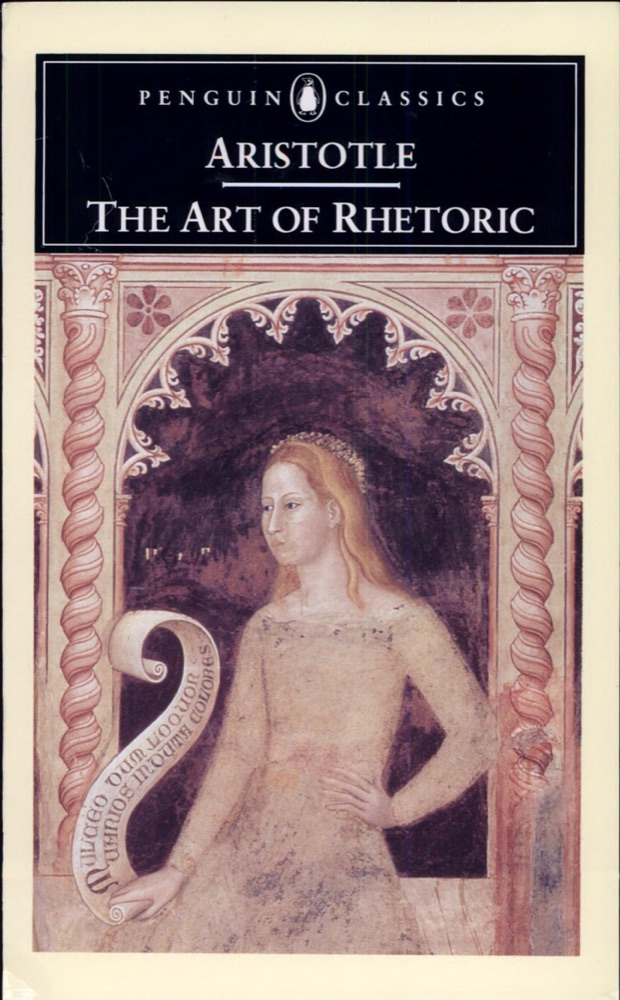
With the emergence of democracy in the city-state of Athens in the years around 460 BC, public speaking became an essential skill for politicians in the Assemblies and Councils – and even for ordinary citizens in the courts of law. In response, the technique of rhetoric rapidly developed, bringing virtuoso performances and a host of practical manuals for the layman. While many of these were little more than collections of debaters’ tricks, the Art of Rhetoric held a far deeper purpose. Here Aristotle establishes the methods of informal reasoning, provides the first aesthetic evaluation of prose style and offers detailed observations on character and the emotions. Hugely influential upon later Western culture, the Art of Rhetoric is a fascinating consideration of the force of persuasion and sophistry, and a compelling guide to the principles behind oratorical skill.
Book details
- First published
- 1992
- Author
- Aristotle
- Genre
- Philosophy
- Goodreads rating
- 3.87 (7k ratings)
Keep reading
 The Rhetoric & The Poetics of Aristotle
 Gorgias
 The Art of Always Being Right
 An Enquiry Concerning Human Understanding
 Philosophical Dictionary
 The Greek Way
 From Dawn to Decadence: 500 Years of Western Cultural Life, 1500 to the Present
 Complete Works
 Elements of the Philosophy of Right
 Phaedrus
 An Essay Concerning Human Understanding
 A History of Western Philosophy
 Discourse on Method and Meditations on First Philosophy
 A Treatise of Human Nature
 The Education of Henry Adams
 Discourse on Method
 Critique of Pure Reason
 On Duties
 After Virtue
 Introductory Lectures on Psychoanalysis
 The Art of Public Speaking
 The Abolition of Man
 Truth and Method
 On Truth and Lies in a Nonmoral Sense
 The Muqaddimah: An Introduction to History
 Lives of the Stoics: The Art of Living from Zeno to Marcus Aurelius
 Imperium: A Novel of Ancient Rome
 Thank You for Arguing: What Aristotle, Lincoln, and Homer Simpson Can Teach Us About the Art of Persuasion
 On the Genealogy of Morals
 On Liberty
 Think: A Compelling Introduction to Philosophy
 Daybreak: Thoughts on the Prejudices of Morality
 What the Dog Saw and Other Adventures
 The Story of Philosophy: The Lives and Opinions of the World's Greatest Philosophers
 Poetics
 Philosophical Investigations
 Galileo
 Selections from the Prison Notebooks
 Children of Dune
 Discourse on the Origin of Inequality
 The Argumentative Indian: Writings on Indian History, Culture and Identity
 Leviathan
 The Mind of the Maker: Dorothy L. Sayers' Witty Classic on the Trinity, Christianity, and Human Creativity
 The Master and His Emissary: The Divided Brain and the Making of the Western World
 Emile or On Education
 Metaphysics
 The Essays of Ralph Waldo Emerson
 Essays
 The Historian's Craft: Reflections on the Nature and Uses of History and the Techniques and Methods of Those Who Write It.
 Rules for Radicals: A Pragmatic Primer for Realistic Radicals
 On Certainty
 Please Understand Me II: Temperament, Character, Intelligence
 Ethics
 Plutarch's Lives
 Pensées
 Arguably: Selected Essays
 Dialogues Concerning Natural Religion
 The Story of My Experiments With Truth
 A Defence of Poetry
 The Ides of March