
 Twilight of the Elites: America After Meritocracy
Quotes from the Book
White fear emanates from knowing that white privilege exists and the anxiety that it might end.
23
There are fundamentally two ways you can experience the police in America: as the people you call when there's a problem, the nice man in uniform who pats a toddler's head and has an easy smile for the old lady as she buys her coffee. For others, the police are the people who are called on them. They are the ominous knock on the door, the sudden flashlight in the face, the barked orders. Depending on who you are, the sight of an officer can produce either a warm sense of safety and contentment or a plummeting feeling of terror.
10
Years later Nixon aide John Ehrlichman seemed to offer up a smoking gun when he told a reporter: The Nixon campaign in 1968, and the Nixon White House after that, had two enemies: the antiwar left and black people. You understand what I’m saying? We knew we couldn’t make it illegal to be either against the war or black, but by getting the public to associate the hippies with marijuana and blacks with heroin, and then criminalizing both heavily, we could disrupt those communities. We could arrest their leaders, raid their homes, break up their meetings, and vilify them night after night on the evening news. Did we know we were lying about the drugs? Of course we did.
7
Despite the fact nonwhite people are disproportionately the victims of crime, the criminal justice system as a whole is disproportionately built on the emotional foundation of white fear. But then, that isn’t surprising. American history is the story of white fear, of the constant violent impulses it produces and the management and ordering of those impulses. White fear keeps the citizens of the Nation wary of the Colony, and fuels their desire to keep it separate.
5
Ultimately the gun is the backstop that prevents the entire social order from being upended. Had it not been for the superior firepower of fearful whites, who knows what would have transpired in American history? You can understand why, in a such a situation, certain kinds of white southerners would cling to their guns. Today Americans still rely on the gun, [...],to preserve the social order [...].
3
Presented with a challenge to its power, an illegitimate regime will often overreact, driven by the knowledge that all they have is force.
3
As a theory, “broken windows” played a perfect explanatory role for politicians and policy makers. If disorder leads to crime, well then, we need to crack down on disorder.
2
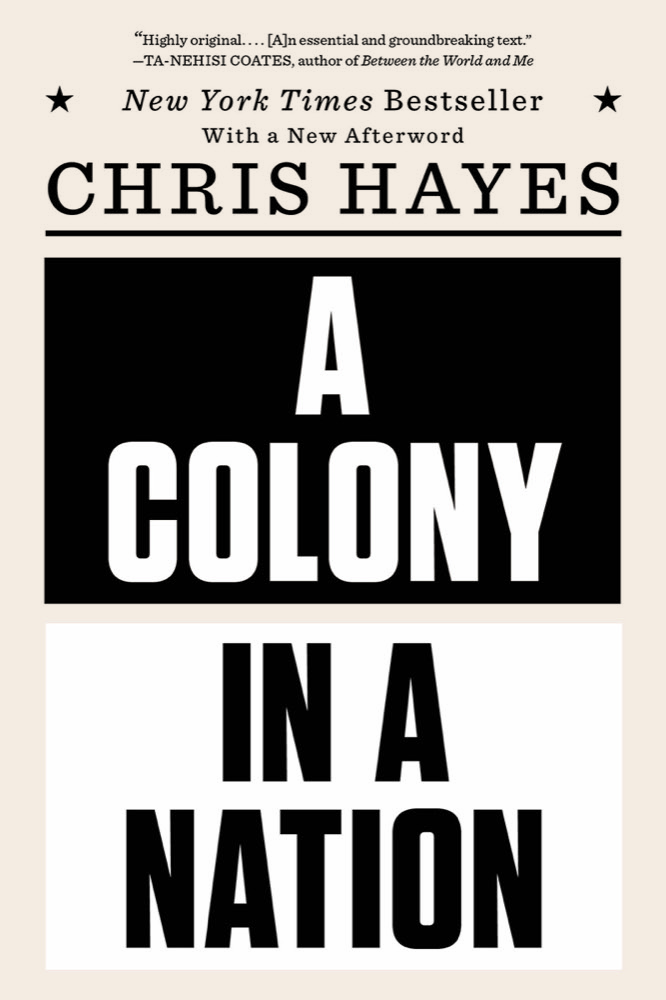
This book makes a simple argument: that American criminal justice isn’t one system with massive racial disparities but two distinct regimes. One (the Nation) is the kind of policing regime you expect in a democracy; the other (the Colony) is the kind you expect in an occupied land.
2
The Thanksgiving tradition we celebrate today with a feast actually commemorates a betrayal that happened two years after the first arrival of the colonists. In 1622, Myles Standish, an English military officer working for the Pilgrims, heard that Indians planned to raid the newly established white settlement of Wessagussett. Standish organized a militia to repel the attack, but no Indians appeared. So he decided to preemptively attack by luring two Indians to Wessagussett under the pretense of sharing a meal. When they entered the house, Standish and his men killed them.
2
There’s an old saying,” retired NYPD cop turned author Steve Osborne once told me, “that in police work, a cop ` s mouth is his greatest weapon. To go into a chaotic situation where everybody is yelling and screaming, sometimes there ` s alcohol, there ` s drugs involved—to be able to talk everybody down. When you see a real experienced cop do that, it’s a magical thing.” But as true as that is, the fact is that most cops are going to encounter these scenarios with little more training than I did—and I talk for a living! The typical cadet training involves sixty hours on how to use a gun and fifty-one hours on defensive tactics, but just eight hours on how to calm situations without force.
2
But whatever the academic debate on the topic, Nixon was correct that black Americans “don’t want to be a colony in a nation.” And yet he helped bring about that very thing. Over the half-century since he delivered those words, we have built a colony in a nation, not in the classic Marxist sense but in the deep sense we can appreciate as a former colony ourselves: A territory that isn’t actually free. A place controlled from outside rather than within. A place where the mechanisms of representation don’t work enough to give citizens a sense of ownership over their own government. A place where the law is a tool of control rather than a foundation for prosperity. A political regime like the one our Founders inherited and rejected. An order they spilled their blood to defeat. THIS
2
In the Nation, there is law; in the Colony, there is only a concern with order. In the Nation, you have rights; in the Colony, you have commands. In the Nation, you are innocent until proven guilty; in the Colony, you are born guilty.
1
We have built a colony in a nation, not in the classic Marxist sense but in the deep sense we can appreciate as a former colony ourselves: A territory that isn't actually free. A place controlled from outside rather than within. A place where the mechanisms of representation don't work enough to give citizens a sense of ownership over their own government. A place where the law is a tool of control rather than a foundation for prosperity.
1
Part of the genius of the rhetoric of law and order is that as a principle (rather than a practice), it can be sold as the ultimate call for equality: We all deserve the law. We all deserve order. All lives matter.
1
But if there’s one thing I’ve come to believe, it is that much of the cause of our current state of affairs lies in our tasking police with preserving order rather than with ensuring safety. Order is a slippery thing: it’s in the eyes of the beholder and the judgments of the powerful. Safety is clearer: it’s freedom from violence and intrusion.
1
reserved for lords and for peasants. Thus the system of punishment that developed found equality in a race to the bottom: everyone got punished harshly as an expression of a core belief that no
1
it is the strong anti-aristocratic strain in the American legal tradition that has made our punishment system so remorseless and harsh.
1
Mass incarceration also played some role in reducing crime. A society that put, say, every man aged 18 to 24 under carceral supervision could expect to see a reduction in violent crime, since that population commits a disproportionate amount of it.
1
Simple demographics played a large role: The baby boom meant that beginning in the late 1960s, a huge number of men entered into their peak crime-committing years.
1
THE DROP IN CRIME in the United States from 1992 through today is one of the most stunning statistical and sociological mysteries of our time.
1
But city after city has experienced versions of the same thing: drops in crime, spikes in real estate prices, and a process of gentrification that has pushed up rents for poor and working-class people, creating a nationwide affordability crisis. In 1984 poor Americans spent 35 percent of their income on rent. By 2014 that was 41 percent, with fully half of renters below the poverty line spending most of their total income to keep a roof over their head.
1
The liberal theory of the causes of crime—that it was born of racism, segregation, oppression, poverty, and disinvestment—painted a picture of the problem that required a set of solutions far above what the local beat cops could provide.
1
Yet in the modern vocabulary of policing theory, “broken windows” has become shorthand for the polar opposite: aggressive, community-antagonistic, clean-’em-up vigilantism. The problem with “community policing,” then and now, is that so often the cops being called to enforce community norms are not part of the community. And
1
This is the central component of the white fear that sustains the Colony: the simple inability to recognize, deeply, fully totally, the humanity of those on the other side.
1
White fear is both a social fact and something burned into our individual neural pathways.
1
Prosecutors have tremendous discretion over which cases to bring and which to drop, whether to throw the book or slap the wrist. “You have to focus as much on the culture as the law,
1
To be outnumbered and afraid in a land not your own, and to attempt to bring it under your control—this is the great recurring theme of the American project, and it is shot through at every moment by fear and violence and subjugation
1
dig a little deeper into the history, and it turns out the spark of the revolution was not so much taxation as the enforcement of a particular tax regime—in other words, policing.
1
So, to take just one example: during the great Ebola panic of 2014, only one person died in the United States, but a poll in November of that year found Americans identifying it as a more urgent priority than any other disease, “including cancer or heart disease, which together account for nearly half of all U.S. deaths each year.” In fact, in a typical year more Americans are literally killed by their own furniture than are killed by terrorists, but when you ask them, they will tell you they are far more scared of terrorism than of nearly any other threat.
1
Watch on YouTube
About Christopher L. Hayes
We have collected 58 quotes from 2 books by Christopher L. Hayes on BookQuoters.
More about the author →More by Christopher L. Hayes
Twilight of the Elites: America After Meritocracy
About the book
New York Times best-selling author and Emmy Award–winning news anchor Chris Hayes argues that there are really two Americas: a Colony and a Nation.
America likes to tell itself that it inhabits a postracial world, yet nearly every empirical measure―wealth, unemployment, incarceration, school segregation―reveals that racial inequality has barely improved since 1968, when Richard Nixon became our first “law and order” president. With the clarity and originality that distinguished his prescient bestseller, Twilight of the Elites, Chris Hayes upends our national conversation on policing and democracy in a book of wide-ranging historical, social, and political analysis.
Hayes contends our country has fractured in two: the Colony and the Nation. In the Nation, we venerate the law. In the Colony, we obsess over order, fear trumps civil rights, and aggressive policing resembles occupation.
Book details
- First published
- 2017
- Author
- Christopher L. Hayes
- Genre
- Nonfiction
- Goodreads rating
- 4.18 (6k ratings)
The buzz
- The New York TimesReview in The New York Timesprofessional review (via Book Marks)
- The Washington PostReview in The Washington Postprofessional review (via Book Marks)
- Kirkus ReviewsReview in Kirkus Reviewsprofessional review (via Book Marks)
- Publishers WeeklyReview in Publishers Weeklyprofessional review (via Book Marks)
- BooklistReview in Booklistprofessional review (via Book Marks)
- CsmonitorReview in Csmonitorprofessional review (via Book Marks)
Keep reading
 Becoming Abolitionists: Police, Protests, and the Pursuit of Freedom
 A People's History of the United States
 The New Jim Crow: Mass Incarceration in the Age of Colorblindness
 White Rage: The Unspoken Truth of Our Racial Divide
 We Were Eight Years in Power: An American Tragedy
 We Do This 'til We Free Us: Abolitionist Organizing and Transforming Justice
 Where Do We Go from Here: Chaos or Community?
 White Trash: The 400-Year Untold History of Class in America
 Why We Can't Wait
 You Can't Be Neutral on a Moving Train: A Personal History of Our Times
 America: The Farewell Tour
 The Sum of Us: What Racism Costs Everyone and How We Can Prosper Together
 The Truths We Hold: An American Journey
 The Utopia of Rules: On Technology, Stupidity, and the Secret Joys of Bureaucracy
 Ghettoside: A True Story of Murder in America
 Between the World and Me
 We Gon' Be Alright: Notes on Race and Resegregation
 Uncomfortable Conversations With a Black Man
Twilight of the Elites: America After Meritocracy
Uncomfortable Conversations With a Black Man
Twilight of the Elites: America After Meritocracy
 No Name in the Street
 Notes from No Man's Land
 The View From Flyover Country: Essays by Sarah Kendzior
 Elite Capture: How the Powerful Took Over Identity Politics
 What White People Can Do Next: From Allyship to Coalition – An Empowering Guide to Interrogating Whiteness and Creating Justice
 Four Hundred Souls: A Community History of African America, 1619-2019
 Assata: An Autobiography
 Behold a Pale Horse
 Conspirators' Hierarchy: The Story of the Committee of 300
 White Like Me: Reflections On Race From A Privileged Son
 When They Call You a Terrorist: A Black Lives Matter Memoir
 The Force
 The Message
 Dark Days
 Nobody Knows My Name
 The Small and the Mighty: Twelve Unsung Americans Who Changed the Course of History, from the Founding to the Civil Rights Movement
 Stamped: Racism, Antiracism, and You
 The Blood of Emmett Till
 What's Our Problem?: A Self-Help Book for Societies
 Imperial Ambitions: Conversations on the Post-9/11 World
 Tears We Cannot Stop: A Sermon to White America
 On Tyranny: Twenty Lessons from the Twentieth Century
 Dear America: Notes of an Undocumented Citizen
 Are Prisons Obsolete?
 The Wretched of the Earth
 Blood Done Sign My Name: A True Story
 Dead Fall
 Black Rednecks and White Liberals
 Edge of Eternity
 They Called Us Enemy
 Doing Justice: A Prosecutor's Thoughts on Crime, Punishment, and the Rule of Law
 Persist
 Freedom
 Just Us: An American Conversation
 Coming Apart: The State of White America, 1960-2010
 The Fire This Time: A New Generation Speaks About Race
 Wealth, Poverty and Politics: An International Perspective
 Green Mars
 Go Back to Where You Came From: And Other Helpful Recommendations on How to Become American
 United: Thoughts on Finding Common Ground and Advancing the Common Good
 The 1619 Project: A New Origin Story