
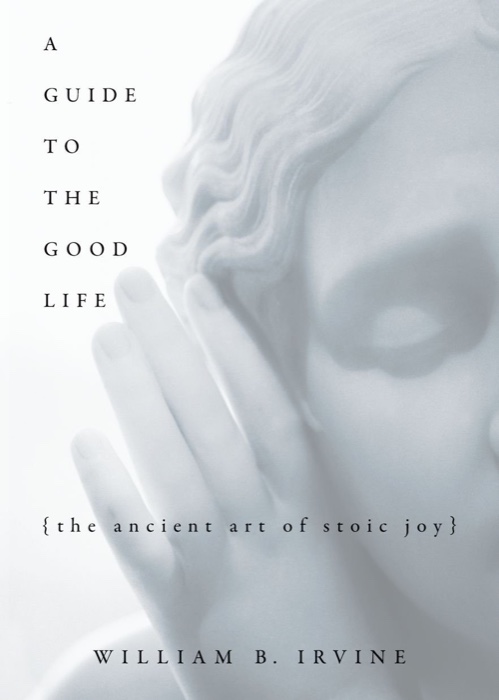
 A Guide to the Good Life: The Ancient Art of Stoic Joy
Quotes from the Book
Men are disturbed not by events but by their opinions about them.
8
However, the majority of people mistakenly judge external things to be ‘good’ and therefore experience feelings of desire for things beyond their control, leading to frustration and suffering.
3
Throughout the day, practise bringing your attention back to the present moment, rather than allowing it to wander off into daydreams, rumination about the past, or worry about the future. ✽ If you have to think about something else, that’s okay, but try to keep one eye on the present moment, by noticing how you’re using your body and mind – try to be aware of each second that passes. ✽ If it helps, imagine that you’re seeing the world for the first time, or that this is your last day of life, and concentrate your attention on how you actually think and act, from moment to moment. ✽ Remind yourself that the past and future are ‘indifferent’ to you, and that the supreme good, and eudaimonia, can only exist within you, right now, in the present moment.
2
the wise man needs nothing and yet he can make good use of anything, whereas the fool ‘needs’ countless things but can make good use of none of them.
2
As human nature is essentially rational, it follows that the highest form of excellence, and the key to living harmoniously, is the perfection of reason or wisdom, and the greatest vice is folly or ignorance.
2
✽ Many people find the concept of ‘mindfulness’ in Buddhism appealing but a similar practice, called prosochê or ‘attention’ to one’s conscious ‘ruling faculty’, was central to ancient Stoicism. ✽ Epictetus’ Stoic Handbook opens with the fundamental practice of evaluating our impressions using the ‘Stoic fork’, the distinction between what’s ‘up to us’ and what isn’t, reminding ourselves that external things are inherently ‘indifferent’ with regard to virtue and eudaimonia. ✽ Planning the day ahead and reviewing the day gone by can help you maintain a structured routine of living wisely, and following Stoic principles.
1
2.18). Epictetus begins by explaining that, just like physical abilities, the passions tend to become more habitual and automatic the more we indulge them, until we don’t even notice them anymore because they’ve become part of our character. In general, therefore, if you want to do something make a habit of it; if you want not to do something, refrain from doing it, and accustom yourself to something else instead. (Discourses, 2.18)
1
Focus on what you can control, and accept what you can’t. 2 Choose your role models wisely, a lesson he takes from Plutarch’s Parallel Lives. 3 Keep track of your thoughts and behaviour by, for example, monitoring them in a personal therapy journal.
1
The early Stoics made it clear that their goal was not to be cold-hearted like a stone or statue and their ideal community was founded on mutual love and friendship.
1
Even if we’ve never met them in person but only heard about them in stories, we are drawn to the wise and good, and make moral progress by emulating their example.
1
Wild beasts run away from dangers when they see them. Once they have escaped, they are free of anxiety. But we are tormented by both the future and the past.
1
the famous Hymn to Zeus written by Cleanthes said: ‘The willing are led by fate, the reluctant dragged’.
1
Whether we realize it or not, we are all living out the lives fated for us, either willingly or reluctantly. Zeno illustrated this with a striking metaphor: the wise man is like a dog tethered to a cart, running alongside and smoothly keeping pace with it, whereas a foolish man is like a dog that struggles against the leash but finds himself dragged alongside the cart anyway.
1
Take a piece of paper and draw a table with two columns. 2 At the top of the first column write the word ‘praiseworthy’. Underneath make a list of things you find most praiseworthy in other people, what you genuinely admire about them. Consider your heroes, real or fictional, living or dead, your family, friends, colleagues, etc. 3 Once you’ve finished, write the word ‘desired’ at the top of the second column. Underneath list all the things you most desire in life. Consider the things you take most pleasure in, and those you most fear losing, as well as the things you spend most time and energy pursuing. 4 Finally, ask yourself to what extent these two columns differ from each other. Are the things you most desire and seek out in life the same as the things you find most praiseworthy in others? Why are they not the same?
1
This mainly involves repeating a word in your mind each time you exhale. It seems that any word will do, you could just repeat the number ‘one’. However, you may wish to repeat a word that relates to your Stoic practice. The Stoics particularly
Whenever you meet someone, say to yourself from the outset, ‘What are his assumptions concerning what is fundamentally good and bad in life?’ When someone acts like your enemy, insults or opposes you, remember that he was only doing what seemed to him the right thing, he didn’t know any better, and tell yourself: ‘It seemed so to him’. (Encheiridion, 42)
1 ‘Joy’ or ‘delight’ (chara) is a feeling of rational ‘elation’ (positive emotion) over virtue, as the truly good, which is the alternative to irrational pleasure; healthy ‘joy’ can take the form of delight, good cheer or peace of mind (tranquillity). 2 ‘Caution’ or ‘discretion’ (eulabeia) is a feeling of rational aversion towards vice as truly bad and harmful, which is the alternative to irrational fear; healthy ‘caution’ can take the form of a sense of dignity and self-respect or a sense of purity and sanctity. 3 ‘Wishing’ or ‘willing’ (boulêsis) is feeling of rational desire for virtue as genuinely good and beneficial, which is the alternative to irrational craving; healthy ‘wishing’ can take the form of affection, kind-heartedness, and benevolence, presumably the wish for oneself and others to flourish in accord with virtue Seneca explains that Stoic joy comes from reflecting on our own virtuous actions, something we are all capable of experiencing albeit in glimpses compared to the secure joy that takes root within the perfect Sage (Letters, 76).
In times of peace, prepare for war. For the Stoics, this preparation was lifelong, and both physical and mental:
Recent psychological research tends to show that people who are able to accept unpleasant thoughts and feelings, without being overwhelmed by them, are more resilient than people who try to distract themselves or avoid such experiences, through strategies such as positive thinking (Hayes, Strosahl, & Wilson, 2012; Robertson, 2012).
The cardinal virtue that most obviously deals with the social sphere, with our relationships, is ‘justice’ (dikaiosunê). The Stoics use this word to encompass both dealing fairly with others and acting with benevolence towards them, wishing for them to flourish in accord with virtue, Fate permitting.
As long as I have the sense that things are going against me, that I’m failing to get what I desire or getting things I’m averse to, that shows that I’m enslaved to my passions and still barely a novice. The Sage, by contrast, has perfect freedom because he only desires what is within his control, and so he’s never thwarted, and his life goes smoothly.
Seek not for events to happen as you wish but rather wish for events to happen as they do and your life will go smoothly. (Encheiridion, 8)
In other words, the majority of ordinary people lack fulfilment and peace of mind because their values are confused and internally conflicted. We waste our lives chasing after an illusion of Happiness, based on a mixture of hedonism, materialism and egotism – crazy, self-defeating values absorbed from the foolish world around us.
Philosophical eudaimonia is a condition in which a person of excellent character is living optimally well, flourishing, doing admirably, and steadily enjoying the best mindset that is available to human beings. The Stoics in particular took the complete attainment of such a condition to be well-nigh impossible, yet so worth striving for that no human being who grasped its attractions would wish to settle for less. (Long, 2002, p. 193)
The willing are led by fate, the reluctant dragged’. Epictetus
people have sometimes compared it to Buddhism for that reason. Providing a Western equivalent, in some respects, for the kind of philosophical ‘way of life’ that’s found in many Eastern religions, is part of its appeal for many modern readers. It follows from the premise that our essential nature is rational that the greatest virtue is wisdom and the greatest vice folly or ignorance.
On no occasion call yourself a philosopher, and do not, for the most part, talk among laymen about your philosophical principles, but rather do what follows from your principles. (Enchiridion, 46)
Your job is to ‘take it all in’ properly, and really appreciate the opportunity. Study the whole spectacle unfolding around you, in a detached and philosophical manner, as if seeing it all for the first time. The majority of people may be absorbed in pursuing wealth, seeking reputation, or indulging in empty pleasures. If occasionally they’re rowdy or bump into you, that’s inevitable – it’s just part of the natural hustle and bustle. There’s no point complaining, now you’re here, if you don’t like the programme of events – don’t be a resentful or ‘fault-finding’ spectator. Just be where you are and take each moment as it comes. Right now, this is all there is. In a
Legend has it that Pythagoras coined the term ‘philosopher’ or lover of wisdom, which he reputedly explained using the allegory of human life as a crowded ‘festival’, like the ancient Olympic Games. There are athletes competing for glory, stallholders selling their wares for profit, and spectators who simply want to take in the whole experience that surrounds them. According to Pythagoras, these illustrate three ways of life: 1 The ambitious (competitors), who seek public acclaim and reputation as the chief good in life. 2 The greedy (traders), who cherish wealth and material gain above all. 3 The philosophers or ‘lovers of wisdom’ (spectators), who prize truth and knowledge, seeking to understand life in its entirety.
In general, therefore, if you want to do something make a habit of it; if you want not to do something, refrain from doing it, and accustom yourself to something else instead. (Discourses, 2.18)
Watch on YouTube
About Donald J. Robertson
We have collected 30 quotes from 1 book by Donald J. Robertson on BookQuoters.
More about the author →About the book
This new guide to finding a happier way of life draws on the ancient wisdom of the stoics to reveal lasting truths and proven strategies for enhanced wellbeing. By learning what stoicism is, you can revolutionise your life, learning how to - properly - 'seize the day', how to cope in the face of adversity, and how to come to terms with whatever situation you're in.
Book details
- First published
- 2013
- Author
- Donald J. Robertson
- Genre
- Philosophy
- Goodreads rating
- 4.13 (2k ratings)
Keep reading
A Guide to the Good Life: The Ancient Art of Stoic Joy
 The Daily Stoic: 366 Meditations on Wisdom, Perseverance, and the Art of Living
 The Socrates Express: In Search of Life Lessons from Dead Philosophers
 The Art of Living: The Classical Manual on Virtue, Happiness and Effectiveness
 The Happiness Hypothesis: Finding Modern Truth in Ancient Wisdom
 Lives of the Stoics: The Art of Living from Zeno to Marcus Aurelius
 The Art of Happiness
 The Consolations of Philosophy
 How to Be Perfect: The Correct Answer to Every Moral Question
 Finding Flow: The Psychology of Engagement with Everyday Life
 How to Be a Stoic: Using Ancient Philosophy to Live a Modern Life
 Happiness: A Guide to Developing Life's Most Important Skill
 A Calendar of Wisdom: Daily Thoughts to Nourish the Soul
 Stillness Is the Key
 The Antidote: Happiness for People Who Can't Stand Positive Thinking
 The I Ching or Book of Changes
 How to Use Your Enemies
 The Path: What Chinese Philosophers Can Teach Us About the Good Life
 Letters from a Stoic
 Buddha's Brain: The Practical Neuroscience of Happiness, Love, and Wisdom
 12 Rules for Life: An Antidote to Chaos
 How to Be Free: An Ancient Guide to the Stoic Life
 Discourses and Selected Writings
 The Nicomachean Ethics
 Twilight of the Idols
 The Wise Heart: A Guide to the Universal Teachings of Buddhist Psychology
 The Book of Chuang Tzu
 Daybreak: Thoughts on the Prejudices of Morality
 The Laws of Human Nature
 How Adam Smith Can Change Your Life: An Unexpected Guide to Human Nature and Happiness
 The Wisdom of Life
 The Story of Philosophy: The Lives and Opinions of the World's Greatest Philosophers
 Untimely Meditations
 365 Tao: A Study of Taoist Wisdom for Daily Life
 The Tao of Pooh
 Reasons Not to Worry: How to Be Stoic in Chaotic Times―A Practical Guide to Stoicism for Self-Improvement and Personal Growth
 The Philosopher and the Wolf
 The Intellectual Life: Its Spirit, Conditions, Methods
 The Things You Can See Only When You Slow Down: How to Be Calm in a Busy World
 Your Erroneous Zones: Step-By-Step Advice for Escaping the Trap of Negative Thinking and Taking Control of Your Life
 Travels with Epicurus: A Journey to a Greek Island in Search of a Fulfilled Life
 Everyday Zen: Love & Work
 How to Live: A Life of Montaigne in One Question and Twenty Attempts at an Answer
 The Daily Laws: 366 Meditations
 The Social Animal: The Hidden Sources of Love, Character, and Achievement
 The Book of Wisdom
 The Art of Happiness
 Ethics for the New Millennium
 Self-Reliance: An Excerpt from Collected Essays, First Series
 Striking Thoughts: Bruce Lee's Wisdom for Daily Living
 The Schopenhauer Cure
 Change Your Thoughts - Change Your Life: Living the Wisdom of the Tao
 Resilience: Hard-Won Wisdom for Living a Better Life
 The Spinoza Problem
 Think: A Compelling Introduction to Philosophy
 The 7 Habits of Highly Effective People: Personal Workbook
 Way of the Peaceful Warrior: A Book That Changes Lives
 Toward a Psychology of Being
 The Difficulty of Being Good: On the Subtle Art of Dharma