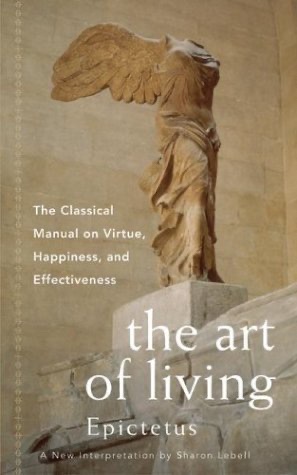
 The Art of Living: The Classical Manual on Virtue, Happiness and Effectiveness
Quotes from the Book
It is better to starve to death in a calm and confident state of mind than to live anxiously amidst abundance. And
7
If you are told that someone is talking badly of you, don’t defend yourself against the story but reply: “Obviously he didn’t know my other faults, or he would have mentioned them as well.
6
Whenever you do something you have decided ought to be done, never try to avoid being seen doing it, even if people in general may disapprove of it. If, of course, your action is wrong, just don't do it at all; but if it's right, why be afraid of people whose criticism is off the mark?
3
And when you call on some high official, imagine that you will not find him at home, that you will be shut out, that the door will be slammed in your face, and that he will ignore you. But if, in spite of all this, you really have to go, accept it and go without ever telling yourself, "it was not worth all that". That's what an ordinary person would do, someone upset by mere circumstances.
3
Don't ask for things to happen as you would like them to, but wish them to happen as they actually do, and you will be all right.
3
Our master is anyone who has the power to implement or prevent the things that we want or don't want. Whoever wants to be free, therefore, should wish for nothing or avoid nothing that is up to other people. Failing that, one is bound to be a slave.
2
Wherever I go, I will be fine, because I was already fine here-not on account of the place but as a result of my principles, and I am going to take them with me. No one can take them away from me; they are my only possessions, irremovable ones that are enough for me wherever I am and whatever I do.
2
Good introduced human beings to be students of himself and his works, and not merely students but also interpreters of these things. It is wrong, therefore, for us to begin and end where the nonrational animals do. We should rather begin where they do but end where nature has ended in our case. Nature ended at studying and paying attention to things and a way of life in harmony with itself. See to it then, that you do not die without having studied these things.
2
Don't we recall that no one does injury or benefit to another, but that the cause of each of these things is a judgement.
2
A companion's crudeness is bound to rub off on the one he is with, no matter how refined that person may be.
2
If someone is the street were entrusted with your body, you would be furious. Yet you entrust your mind to anyone around who happens to insult you, and allow it to be troubled and confused. Aren't you ashamed of that?
2
Keep in mind that what injures you is not people who are rude or agressive but your opinion that they are injuring you. So whenever someone provokes you, be aware that the provocation really comes from your own judgment. Start, then, by trying not to get carried away by the impression. Once you pause and give yourself time, you will more easily control yourself.
2
But to myself all predictions are favorable if I wish them to be, since it is up to me to benefit from the outcome, whatever it may be.
2
These inferences are invalid: “I am richer than you, therefore I am better than you,” and “I am more eloquent than you, therefore I am better than you.” But the following inferences are more cogent: “I am richer than you, therefore my property is better than yours,” or “I am more eloquent than you, therefore my diction is better than yours.” But you yourself are neither property nor diction.
2
30. *Appropriate actions are largely set by our social relationships. In the case of one’s father, this involves looking after him, letting him have his way in everything, and not making a fuss if he is abusive or violent. “But what if he’s a bad father? ” Do you think you have a *natural affinity only to a good father? “No, just to a father.” Suppose your brother treats you badly. In that case, maintain your fraternal relationship to him. Don’t think about why he behaves that way but about what you need to do to keep your will in harmony with nature. No one else, in fact, will harm you without your consent; you will be harmed only when you think you are being harmed. So make a habit of studying your social relationships – with neighbors, citizens, or army officers – and then you will discover the appropriate thing to do.
2
If on the other hand, they identify their good and interests with things that are external and outside the sphere of will, they are bound to be impeded and frustrated, subservient to those who have authority over the things that you have admired and feared. They are also bound to be utterly irreverent since they think that God has a grudge against them, and to be unfair, since they always grab more for themselves; and they are bound to lack self-respect and generosity.
1
Do not desire anything that is not your own, because nothing is your own that is not up to you to procure or to secure whenever you want. Keep your hands right off it, but first and foremost keep your desire well away. Otherwise you are giving yourself up to slavery and submitting your neck to the yoke, if ever you admire what is not your own and feel strongly for things that are dependent on others and are perishable.
1
It is the mark of a cude disposition to spend most of one's time on bodily functions such as exercise, eating, drinking, defecating and copulating. These are the things to be done just incidentally. All your attention should be on your mind.
1
Watch on YouTube
About Epictetus
We have collected 83 quotes from 4 books by Epictetus on BookQuoters.
More about the author →More by Epictetus
The Art of Living: The Classical Manual on Virtue, Happiness and Effectiveness
 Discourses and Selected Writings
 The Enchiridion & Discourses of Epictetus
About the book
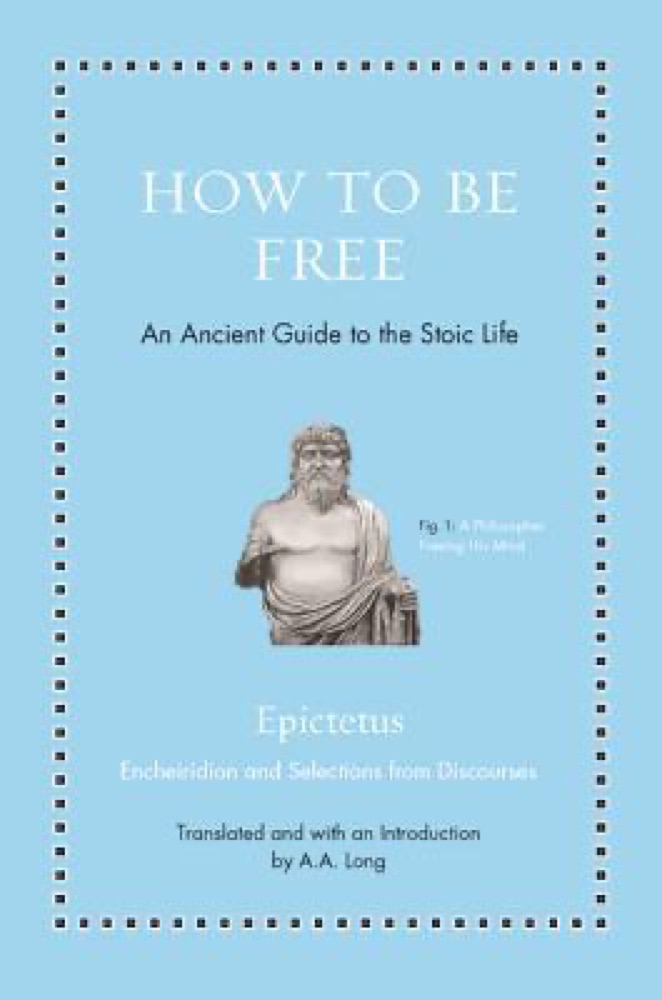
A superb new edition of Epictetus's famed handbook on Stoicism--translated by one of the world's leading authorities on Stoic philosophy
Born a slave, the Roman Stoic philosopher Epictetus (c. 55-135 AD) taught that mental freedom is supreme, since it can liberate one anywhere, even in a prison. In How to Be Free, A. A. Long--one of the world's leading authorities on Stoicism and a pioneer in its remarkable contemporary revival--provides a superb new edition of Epictetus's celebrated guide to the Stoic philosophy of life (the Encheiridion) along with a selection of related reflections in his Discourses.
Freedom, for Epictetus, is not a human right or a political prerogative but a psychological and ethical achievement, a gift that we alone can bestow on ourselves. We can all be free, but only if we learn to assign paramount value to what we can control (our motivations and reactions
Book details
- First published
- 2018
- Author
- Epictetus
- Genre
- Philosophy
- Goodreads rating
- 4.07 (3k ratings)
Keep reading
The Art of Living: The Classical Manual on Virtue, Happiness and Effectiveness
Discourses and Selected Writings
 The Four Agreements: A Practical Guide to Personal Freedom
 The Daily Stoic: 366 Meditations on Wisdom, Perseverance, and the Art of Living
 How to Use Your Enemies
 Your Erroneous Zones: Step-By-Step Advice for Escaping the Trap of Negative Thinking and Taking Control of Your Life
 Letters from a Stoic
 12 Rules for Life: An Antidote to Chaos
 Self-Reliance: An Excerpt from Collected Essays, First Series
 Self-Reliance and Other Essays
 A Calendar of Wisdom: Daily Thoughts to Nourish the Soul
 Mind Platter
 Meditations
 The Ego and Its Own
 How I Found Freedom in an Unfree World: A Handbook for Personal Liberty
 How to Stop Worrying and Start Living
 The 48 Laws of Power
 Ancillary Justice
 The Courage to Be Disliked: How to Free Yourself, Change Your Life and Achieve Real Happiness
 Awareness: Conversations with the Masters
 Twilight of the Idols
 Children of Dune
 The Book of Chuang Tzu
 The Art of Being
 The Laws of Human Nature
 Living on Your Own Terms: What Is Real Rebellion?
 Demian
 The Story of My Experiments With Truth
 Wouldn't Take Nothing for My Journey Now
 You Learn by Living: Eleven Keys for a More Fulfilling Life
 Gorgias
 Change Your Thoughts - Change Your Life: Living the Wisdom of the Tao
 The 7 Habits Of Highly Effective Teens
 Letters to a Young Contrarian
 Bonds That Make Us Free: Healing Our Relationship, Coming to Ourselves
 How Do You Live?
 Stoicism and the Art of Happiness
 How to Be Perfect: The Correct Answer to Every Moral Question
 The Analects
 Illusions: The Adventures of a Reluctant Messiah
 Hagakure: The Book of the Samurai
 The Socrates Express: In Search of Life Lessons from Dead Philosophers
 Be Water, My Friend: The Teachings of Bruce Lee
 Buddha's Brain: The Practical Neuroscience of Happiness, Love, and Wisdom
 Mentors: How to Help and Be Helped
 Daybreak: Thoughts on the Prejudices of Morality
 Riding the Elephant: A Memoir of Altercations, Humiliations, Hallucinations, and Observations
 The Art of Thinking Clearly
 Feeding the Soul (Because It's My Business): Finding Our Way to Joy, Love, and Freedom
 Atlas Shrugged
 The Emperor's Handbook
 Freedom from the Known
 The Daily Laws: 366 Meditations
 The Wisdom of Life
 The Fountainhead
 The Gay Science
 Intimacy: Trusting Oneself and the Other
 Emile or On Education