
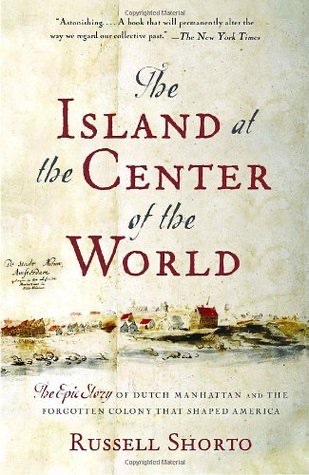
 The Island at the Center of the World: The Epic Story of Dutch Manhattan and the Forgotten Colony That Shaped America
Quotes from the Book
We are graced with a godlike ability to transcend time and space in our minds but are chained to death.
12
Embedded in this outlook is an idea of the body as a machine, so that illness is seen as a breakdown of the machine, healing involves repairing the broken parts, and a doctor is a kind of mechanic with medications as his or her tools.
4
They had applied their doubts to the very head that had introduced doubt as a tool for advancing knowledge. And in the end they gave the head a nod.
4
In asking for a relic of Descartes, the chevalier de Terlon was standing at the crossroads of the ancient and modern. He was applying to a modern thinker - the inventor of analytic geometry, no less - a primitive tradition that extends back not only to the institutionalization of Christianity in the fourth century, when Christians first broke into the tombs of saints to gather relics, but farther still, beyond the horizon of recorded history. The request is all the stranger for the fact that the man whose remains were treated in this quasisaintlike way would go down in history as the progenitor of materialism, rationalism, and a whole tradition that looked on such veneration as nonsense.
2
Relying on physical remedies alone was often seen as downright ungodly: in England, Puritan minister John Sym advised “caution” that people “dote not upon, nor trust, or ascribe too much to physical means; but that we carefully look and pray to God for a blessing by the warrantable use of them.” To do otherwise—to rely on a physic or powder alone—would be to put the material above the spiritual. That was why a strictly mechanical approach to medicine was considered dangerously atheistic.
2
He developed his revolutionary philosophy, with its grounding not in the Bible or ancient writers but in human reason, and became famous and infamous for it.
2
devote what time I may still have to live to no other occupation than that of endeavoring to acquire some knowledge of Nature, which shall be of such a kind as to enable us there from to deduce rules in medicine of greater certainty than those in present use.
1
Descartes and his followers had set themselves in opposition to the Scholastic notion of matter. According to the traditional way of thinking about these things, the sky has blueness in it, water has wetness, garlic has its odor.
Catholic tradition in the early modern period emphasized the physical. Bodily remains were keys to the deepest of mysteries, links in the chain between life and death, and, as the Council of Trent said, the bones of prophets, saints, and others “now living with Christ . . . are to be venerated by the faithful.
Some, like Gysbert Voetius at Utrecht, believed the materialism in the new philosophy was a direct attack on Christianity.
A rumor sprang up, which circulated for decades, that he had been poisoned.
Europe’s greatest intellectuals were as aware of his medical focus as they were of his philosophical and mathematical discoveries.
The crisis is a loss of meaning, and the quest is a search for truth, for something to believe in.
Watch on YouTube
About Russell Shorto
We have collected 17 quotes from 2 books by Russell Shorto on BookQuoters.
More about the author →More by Russell Shorto
The Island at the Center of the World: The Epic Story of Dutch Manhattan and the Forgotten Colony That Shaped America
About the book
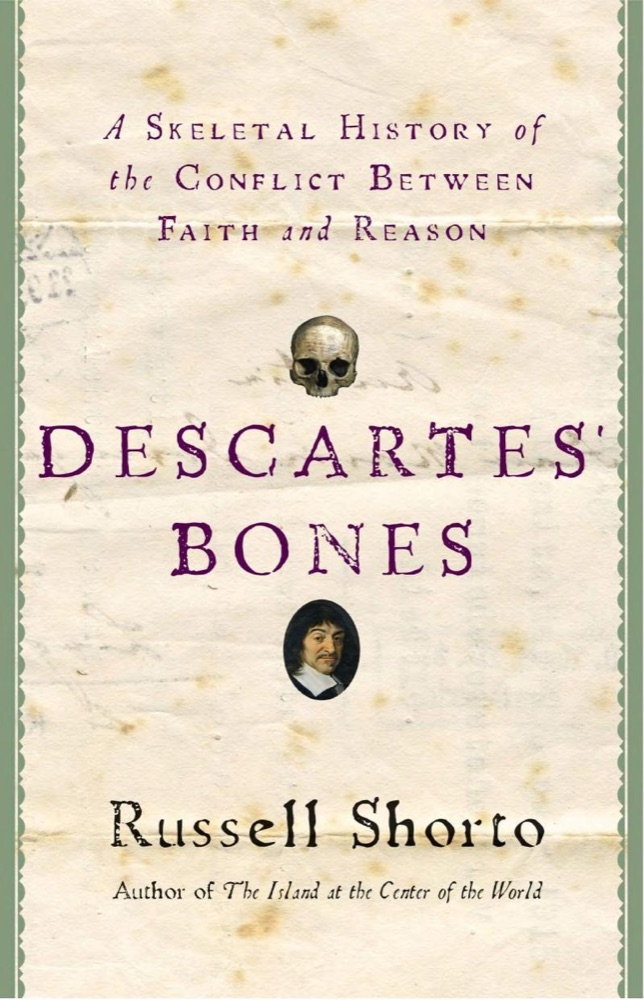
On a brutal winter's day in 1650 in Stockholm, Frenchman René Descartes, the most influential & controversial thinker of his time, was buried after a lonely death far from home. 16 years later, the French Ambassador Hugues de Terlon secretly unearthed Descartes' bones & transported them to France. Why would this devoutly Catholic official care so much about the remains of a philosopher who was hounded from country to country on charges of atheism? Why would Descartes' bones take such a strange, serpentine path over the next 350 years—a path intersecting some of the grandest events imaginable: the birth of science, the rise of democracy, the mind-body problem, the conflict between faith & reason? Their story involves people from all walks of life—Louis XIV, a Swedish casino operator, poets & playwrights, philosophers & physicists, as these people used the bones in scientific studies, stol
Book details
- First published
- 2008
- Author
- Russell Shorto
- Genre
- History
- Goodreads rating
- 3.74 (2k ratings)
Keep reading
 A History of Western Philosophy
 The Swerve: How the World Became Modern
 An Enquiry Concerning Human Understanding
 The Secret Teachings of All Ages
 The Occult
 Living with a Wild God: A Nonbeliever's Search for the Truth about Everything
 Saint Thomas Aquinas
 The Story of Philosophy: The Lives and Opinions of the World's Greatest Philosophers
 The Ascent of Man
 Last and First Men
 From Dawn to Decadence: 500 Years of Western Cultural Life, 1500 to the Present
 Philosophical Dictionary
 Critique of Pure Reason
 Madness and Civilization: A History of Insanity in the Age of Reason
 Dialogues Concerning Natural Religion
 The Resurrectionist: The Lost Work of Dr. Spencer Black
 Irrational Man: A Study in Existential Philosophy
 Quicksilver
 Consilience: The Unity of Knowledge
 The Case for God
 When We Cease to Understand the World
 The Meaning of It All: Thoughts of a Citizen-Scientist
 Why People Believe Weird Things: Pseudoscience, Superstition, and Other Confusions of Our Time
 The Everlasting Man
 A Pilgrimage to Eternity: From Canterbury to Rome in Search of a Faith
 The Perennial Philosophy
 The Man Without Qualities
 Erewhon
 The Education of Henry Adams
 An Essay Concerning Human Understanding
 Breaking the Spell: Religion as a Natural Phenomenon
 The Schopenhauer Cure
 The Age of Reason
 On the Genealogy of Morals
 The Crisis of the Modern World
 The Magic Mountain
 The World as Will and Representation, Vol 1
 Songs of Distant Earth
 The Discovery of India
 The Varieties of Religious Experience
 36 Arguments for the Existence of God: A Work of Fiction
 The Discarded Image: An Introduction to Medieval and Renaissance Literature
 Small Gods
 Discourse on Method and Meditations on First Philosophy
 The Fall of Hyperion
 Enlightenment Now: The Case for Reason, Science, Humanism, and Progress
 Think: A Compelling Introduction to Philosophy
 The Upright Thinkers: The Human Journey from Living in Trees to Understanding the Cosmos
 The Physician
 Genius: The Life and Science of Richard Feynman
 The Spinoza Problem
 The Empusium
 The Will to Power
 Basic Writings of Nietzsche
 Julian Comstock: A Story of 22nd-Century America
 Myths to Live By
 Introductory Lectures on Psychoanalysis
 Miracles: What They Are, Why They Happen, and How They Can Change Your Life
 The Mind of the Maker: Dorothy L. Sayers' Witty Classic on the Trinity, Christianity, and Human Creativity