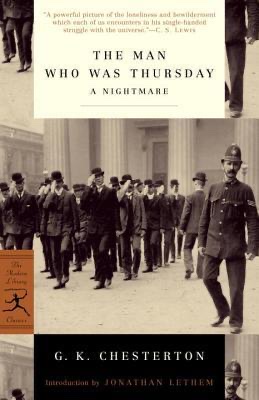
 The Man Who Was Thursday
Quotes from the Book
It was the outstanding fact about St. Thomas [Aquinas] that he loved books and lived on books ... When asked for what he thanked God most, he answered simply, ‘I have understood every page I ever read’.
35
Buddhism and Christianity are in one sense parallel and equal; as a mound and a hollow, as a valley and a hill. There is a sense in which that sublime despair is the only alternative to that divine audacity. It is even true that the truly spiritual and intellectual man sees it as sort of dilemma; a very hard and terrible choice. There is little else on earth that can compare with these for completeness. And he who does not climb the mountain of Christ does indeed fall into the abyss of Buddha.
20
But as St. Francis did not love humanity but men, so he did not love Christianity but Christ.
19
The good Bishop of Assisi expressed a sort of horror at the hard life which the Little Brothers lived at the Portiuncula, without comforts, without possessions, eating anything they could get and sleeping anyhow on the ground. St. Francis answered him with that curious and almost stunning shrewdness which the unworldly can sometimes wield like a club of stone. He said, 'If we had any possessions, we should need weapons and laws to defend them.
18
If grass grows and withers, it can only mean that it is part of a greater thing, which is even more real; not that the grass is less real than it looks. St. Thomas (Aquinas) has a really logical right to say, in the words of the modern mystic, A. E.: "I begin by the grass to be bound again to the Lord.
12
The Saint is a medicine because he is an antidote. Indeed that is why the saint is often a martyr; he is mistaken for a poison because he is an antidote.
10
Nobody can understand the greatness of the thirteenth century, who does not realize that it was a great growth of new things produced by a living thing. In that sense it was really bolder and freer than what we call the renaissance, which was a resurrection of old things discovered in a dead thing... and the Gospel according to St. Thomas... was a new thrust like the titanic thrust of Gothic engineering; and its strength was in a God that makes all things new.
10
To him, even the momentary was momentous.
10
worst moment for the atheist is when he is really thankful and has nobody to thank.
8
Now for St. Francis nothing was ever in the background. We might say that his mind had no background, except perhaps that divine darkness out of which the divine love had called up every colored creature one by one. He saw everything as dramatic, distinct from its setting, not all of a piece like a picture but in action like a play. A bird went by him like an arrow; something with a story and a purpose, though it was a purpose of life and not a purpose of death. A bush could stop him like a brigand; and indeed he was as ready to welcome the brigand as the bush.
8
The adoration of Christ had been a part of the man's passionate nature for a long time past. But the imitation of Christ, as a sort of plan or ordered scheme of life, in that sense may be said to begin here.
7
The moment sex ceases to be a servant it becomes a tyrant.
7
The modern mind is hard to please; and it generally calls the way of Godfrey ferocious and the way of Francis fanatical. That is, it calls any moral method unpractical, when it has just called any practical method immoral.
7
I can hardly conceive of any educated man believing in God at all without believing that God contains in Himself every perfection including eternal joy; and does not require the solar system to entertain Him like a circus.
7
The objection to an aristocracy is that it is a priesthood without a god.
6
I beseech you, little brothers, that you be as wise as brother Daisy and brother dandelion; for never do they lie awake thinking of tomorrow, yet they have gold crowns like kings and emperors or like Charlemagne in all his glory.
6
it needed ten times more courage to look after a leper than to fight for the crown of Sicily
5
The transition from the good man to the saint is a sort of revolution; by which one for whom all things illustrate and illuminate God becomes one for whom God illustrates and illuminates all things.
5
this clumsy collision of two very impatient forms of ignorance was known as the quarrel of Science and Religion.
5
One of the Franciscans says later, "A monk should own nothing but his harp"; meaning, I suppose, that he should value nothing but his song, the song with which it was his business as a minstrel to serenade every castle and cottage, the song of the joy of the Creator in His creation and the beauty of the brotherhood of men.
5
He was, to the last agonies of asceticism, a Troubadour. He was a Lover. He was a lover of God and he was really and truly a lover of men; possibly a much rarer mystical vocation.
4
He liked as he liked; he seems to have liked everybody, but especially those whom everybody disliked him for liking.
4
The truth is people who worship health cannot remain healthy on the point.
4
We might even say that the one thing which separates a saint from ordinary men is his readiness to be one with ordinary men. In this sense the word ordinary must be understood in its native and noble meaning; which is connected with the word order.
4
A saint is long past any desire for distinction; he is the only sort of superior man who has never been a superior person.
4
The author challenges how much sanctity has to do with sameness, as he says saints are as different from each other as those in any group -- even murderers.
4
You will not be able rationally to read the Gospel and regard the Crucifixion as an afterthought or an anti-climax or an accident in the life of Christ; it is obviously the point of the story like the point of a sword, the sword that pierced the heart of the Mother of God. And you will not be able rationally to read the story of a man presented as a Mirror of Christ without understanding his final phase as a Man of Sorrows,
3
It is no good to tell an atheist that he is an atheist; or to charge a denier of immortality with the infamy of denying it; or to imagine that one can force an opponent to admit he is wrong, by proving that he is wrong on somebody else's principles, but not on his own. After the great example of St. Thomas, the principle stands, or ought always to have stood established; that we must either not argue with a man at all, or we must argue on his grounds and not ours.
3
What had happened to the human imagination, as a whole, was that the whole world was coloured by dangerous and rapidly deteriorating passions; by natural passions becoming unnatural passions.
3
The Fear of the Lord, that is the beginning of wisdom, and therefore belongs to the beginnings, and is felt in the first cold hours before the dawn of civilisation; the power that comes out of the wilderness and rides on the whirlwind and breaks the gods of stone; the power before which the eastern nations are prostrate like a pavement; the power before which the primitive prophets run naked and shouting, at once proclaiming and escaping from their god; the fear that is rightly rooted in the beginnings of every religion, true or false: the fear of the Lord, that is the beginning of wisdom; but not the end.
3
Watch on YouTube
About G.K. Chesterton
We have collected 364 quotes from 14 books by G.K. Chesterton on BookQuoters.
More about the author →More by G.K. Chesterton
All books by G.K. Chesterton →
About the book
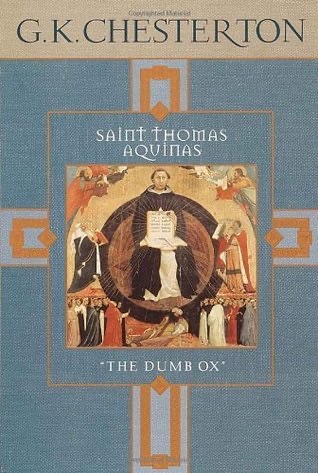
G.K. Chesterton's brilliant sketch of the life and thought of Thomas Aquinas is as relevant today as when it was published in 1933. Then it earned the praise of such distinguished writers as Etienne Gilson, Jacques Martain, and Anton Pegis as the best book ever written on the great thirteenth-century Dominican. Today Chesterton's classic stands poised to reveal Thomas to a new generation.
Chesterton's Aquinas is a man of mystery. Born into a noble Neapolitan family, Thomas chose the life of a mendicant friar. Lumbering and shy -- his classmates dubbed him "the Dumb Ox" -- he led a revolution in Christian thought. Possessed of the rarest brilliance, he found the highest truth in the humblest object. Having spent his life amid the vast intricacies of reason, he asked on his deathbed to have read aloud the Song of Songs, the most passionate book in the Bible.
As Albert the Great, Thomas's
Book details
- First published
- 1923
- Author
- G.K. Chesterton
- Genre
- Biography
- Goodreads rating
- 4.01 (12k ratings)
Keep reading
 A Pilgrimage to Eternity: From Canterbury to Rome in Search of a Faith
 Life of Christ
 Lord of the World
 The Anti-Christ
 The Everlasting Man
 Heretics
 The Devil's Advocate
 The Seven Storey Mountain
 Saint Francis
 City of God
 Orthodoxy
 Studies in the Sermon on the Mount
 The Revolt of the Angels
 Summa Theologica
 Ben-Hur: A Tale of the Christ
 Letters and Papers from Prison
 Reflections on the Psalms
 The Imitation of Christ
 Bonhoeffer: Pastor, Martyr, Prophet, Spy
 The Age of Reason
 The Case for God
 The Kingdom of God Is Within You
 The Will to Power
 The Darkening Age: The Christian Destruction of the Classical World
 A Severe Mercy: A Story of Faith, Tragedy and Triumph
 Shadow of the Almighty: The Life and Testament of Jim Elliot
 The Jesus I Never Knew
 Twilight of the Idols/The Anti-Christ
 The Long Loneliness: The Autobiography of the Legendary Catholic Social Activist ― A Memoir about the Worker Movement and Spiritual Conversion
 Father Joe: The Man Who Saved My Soul
 The Power and the Glory
 The Man Without Qualities
 Philosophical Dictionary
 On the Incarnation
 The Devils of Loudun
 The World's Last Night: And Other Essays
 Eifelheim
 Fear and Trembling
 Persian Letters
 The Cloister Walk
 The Story of My Experiments With Truth
 The Perennial Philosophy
 Tears and Saints
 A Canticle for Leibowitz
 The Once and Future King
 Why I Am An Atheist: An Autobiographical Discourse
 The Good Man Jesus and the Scoundrel Christ
 The History of Tom Jones, a Foundling
 The Enchantress of Florence
 Julian
 On Christian Doctrine
 Introduction to the Devout Life
 Laurus
 The Bondage of the Will
 The Swerve: How the World Became Modern
 War in Heaven
 The Cross of Christ
 Bad Religion: How We Became a Nation of Heretics
 A Morbid Taste for Bones