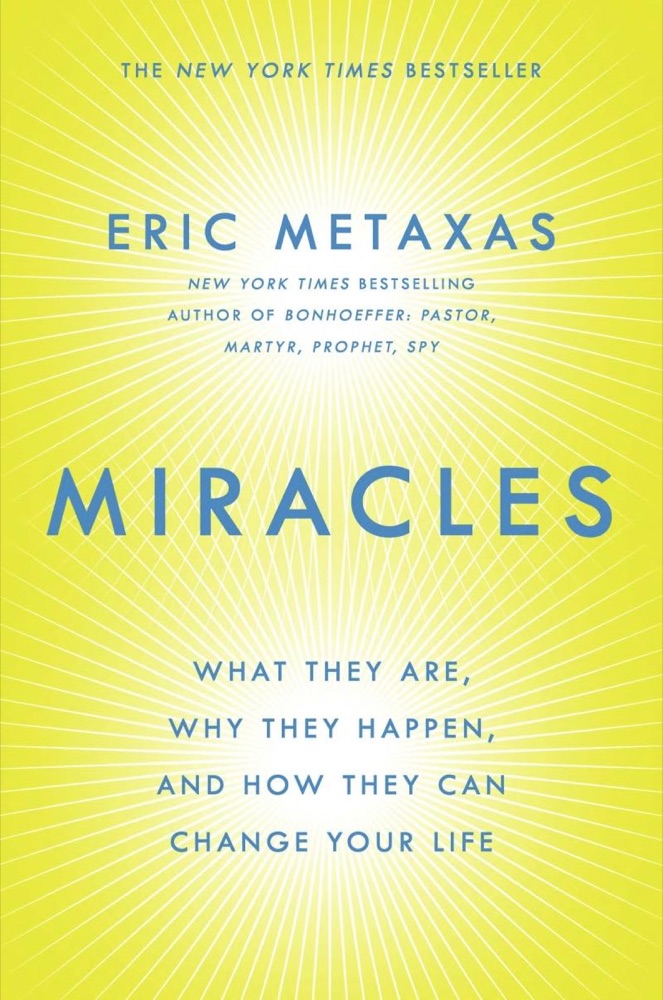

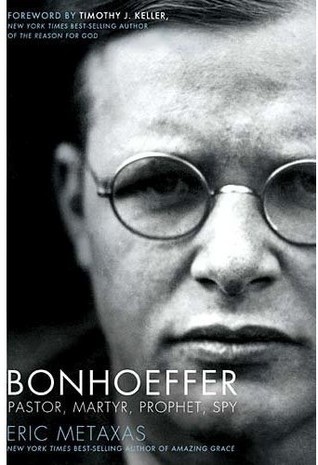
 Bonhoeffer: Pastor, Martyr, Prophet, Spy
Quotes from the Book
Just ten years ago, probably the most prominent atheist of the twentieth century, Antony Flew, concluded that a God must have designed the universe. It was shocking news and made international headlines. Flew came to believe that the extraordinarily complex genetic code in DNA simply could not be accounted for naturalistically. It didn’t make logical sense to him that it had happened merely by chance, via random mutations. It is a remarkable thing that Flew had the humility and intellectual honesty to do a public about-face on all he had stood for and taught for five decades.
14
True faith is not a leap in the dark; it’s a leap into the light.
5
During my first few years as a believer I not only couldn’t shut up about my faith, I was sometimes judgmental toward some of those who didn’t share it. But on the other side of that equation, I remember having powerful feelings of love and empathy toward total strangers, a sense of God’s love for them, and a desire to do anything I could to show them his love, to bless them, to help them. It was all somewhat overwhelming, but I’m happy to say that most of it was on the positive side of this equation. I was often hardest on those who were already in the Christian world but whom I felt were not as zealous as they could be in reaching those who didn’t know God. As is typical, I was hardest on my own—my family and my childhood church, the Greek Orthodox Church.
2
what we desperately do want to avoid is not merely suffering but suffering without meaning.
2
Another version of the “Prosperity Gospel” or “Name It and Claim It” teaching has to do with finding a verse in the Bible and then “claiming” that verse. Proponents of this thinking believe that God must fulfill his promise to us in whatever verse we are “claiming” because what God says in his Word, the Bible, is true, and we can trust it to be true. So someone might pray: God, your Word says in Isaiah that by your stripes we are healed and I know you are not a liar and that your Word is true and I claim that Scripture in Jesus’s name and therefore I will be healed of this stomachache! We need to have faith in what the Bible says, but we have to be careful that we aren’t trying to force God to do what we want. That is arrogance rather than humility.God loves us, but we cannot demand things of him as though our faith is in charge rather than God. If someone believes it is our faith that heals us and forgets that it is God who does it, we should ask that person how much faith Lazarus had. Remember, he was decomposing in a tomb when Jesus raised him from death. His faith obviously didn’t matter. It was all God. It is God and God’s grace that heals, not our prayers and not our “faith.” Though we are exhorted by God to pray to him, we cannot compel him to do what we wish.
2
That’s the point of miracles—to point us beyond our world to another world. They are clues that that other world is not in our imaginations but is actually out there, wherever “out there” actually is. Peggy Noonan once wrote that she thought miracles existed “in part as gifts and in part as clues that there is something beyond the flat world we see.” If miracles exist at all, they exist not for their own sake but for us, to point us toward something beyond. To someone beyond.
2
Part of the miracle of the resurrection is that it so empowered a ragtag band of fishermen and tax collectors that they were emboldened to stand against all earthly authority and power, and ultimately would upend the once inviolable order of the mighty Roman Empire. History tells us that this happened. So what better explanation can be offered for how it happened? Unless we have missed something, there exists none. And if there exists none, we are invited to submit to the logic of what we now know: that this most celebrated and most scorned miracle of miracles actually happened—and, perhaps most miraculously of all, can even be understood to have happened.
2
Einstein himself said, “You can speak of the ethical foundations of science, but you cannot speak of the scientific foundations of ethics.
2
What if all the myths and fairy tales were pointing to something that was not only true but also truer than anything we knew in this world, to a realm that was truer and more real?
2
If the whole universe has no meaning, we should never have found out that it has no meaning: just as, if there were no light in the universe and therefore no creatures with eyes, we should never know it was dark. Dark would be without meaning. —C. S. LEWIS
2
What matters is the idea that some things are so sacred, that they cannot bear unveiling. Because we live in a culture where mystery has lost its value, where to hide something is often thought of as merely repressive, we don’t understand this idea of “the sacred.” We seem to have accepted the fashionable idea that all things once thought sacred and mysterious—sexuality most notably—must be freed from their mystery and “sanctity.” But in most cultures throughout history the opposite has been true. Most cultures have a pronounced reverence for the sacred, which they veil out of deepest reverence and respect.
1
One study calculated that people spend 3,680 hours in their lifetime looking for lost items, which works out to 150 twenty-four-hour days.
1
We need to be brave enough to dissect a frog now and then, to see what’s inside.
1
Science without religion is lame; religion without science is blind.
1
the idea that the God of the universe would humble himself to touch the lives of any of us is, in the end, far beyond our full comprehension.
1
If someone believes it is our faith that heals us and forgets that it is God who does it, we should ask that person how much faith Lazarus had. Remember, he was decomposing in a tomb when Jesus raised him from death. His faith obviously didn’t matter. It was all God. It is God and God’s grace that heals, not our prayers and not our “faith.” Though we are exhorted by God to pray to him, we cannot compel him to do what we wish. DO
1
Even though prayers are not offered only to get a desired result, there is little doubt that most miracles are the result of prayer. God wants us to pray to him and ask him for things, just as any loving father and mother want their children to come to them with whatever is on their minds. But if our focus is solely on getting the outcome we want, the prayer will fail, precisely because our belief is placed in the wrong place. It’s a great irony. If all we care about is the result, then we are effectively making that result our God, rather than God himself. So if we are praying to our “God”—the God of results—rather than to God himself, then we are praying to a “God” who is not God, and who is therefore powerless to help us.
1
If we remove the idea of a supernatural God who is free to act in miraculous ways, we fall into the slough of despond inhabited by the scientistic naturalists. We essentially remove God himself from the Bible.
1
The Greek word for miracle is “simaios,” which means “sign.” Miracles are signs, and like all signs, they are never about themselves; they’re about whatever they are pointing toward
God wants more than anything to let us know he is with us. He sees what we are going through and he cares. Furthermore, he is such a big God that he can afford to deal with us on an intimate level, to encourage us and to wink at us and to hold our hands when we need him to do that.
the burning desire to tell the story of my dream was such that an hour seemed like an eternity.
In his famous Letters and Papers from Prison, the German theologian Dietrich Bonhoeffer wrote: . . . how wrong it is to use God as a stop-gap for the incompleteness of our knowledge. If in fact the frontiers of knowledge are being pushed further and further back (and that is bound to be the case), then God is being pushed back with them, and is therefore continually in retreat. We are to find God in what we know, not in what we don’t know.
Miracles are not in contradiction to nature. They are only in contradiction with what we know of nature.—SAINT AUGUSTINE
It’s only logical that if God always answered our prayers as we wanted him to, those answers to our prayers could hardly be considered miraculous. They would only be part of a predictable system that we could manipulate, if only we knew how. It really makes God not God, but a “God” or a god whom we are ultimately able to control through our efforts, whether via prayer or via our “moral” actions designed to elicit a favorable response.
To postulate a trillion-trillion other universes, rather than one God, in order to explain the orderliness of our universe, seems the height of irrationality.
If we can accept a single singularity of the Big Bang, on what basis can we reasonably claim no other such singularities are possible?
...many atheistic scientists insist there is never any reason to speculate beyond the universe of matter and energy, because there is nothing beyond that. They insist that the universe is all that is. The problem is that they cannot by any means prove this scientifically, so for them to make this claim at all is itself "unscientific." Ironically, in doing so, such scientists are themselves reaching beyond the world of science.
Every culture and era flatters itself that we are finally seeing what previous eras and cultures could not see because of their own blinders and ideological lenses.
Aleksandr Solzhenitsyn, who suffered for twenty years in the hellish prison camps he describes in that book, wrote: “Bless you prison, bless you for being in my life. For there, lying upon the rotting prison straw, I came to realize that the object of life is not prosperity as we are made to believe, but the maturity of the human soul.
Watch on YouTube
About Eric Metaxas
We have collected 83 quotes from 4 books by Eric Metaxas on BookQuoters.
More about the author →More by Eric Metaxas
Bonhoeffer: Pastor, Martyr, Prophet, Spy
 Martin Luther: The Man Who Rediscovered God and Changed the World
 Seven Women: And the Secret of Their Greatness
About the book
An inspiring and eye-opening exploration of the phenomenon of miracles from the New York Times #1 bestselling author of Bonhoeffer. What are miracles, and why do so many people believe in them? What do they tell us about ourselves? And what do we do with experiences that we cannot explain? In Miracles, Eric Metaxas offers compelling -- sometimes electrifying -- evidence that there’s something real to be reckoned with, whatever one has thought of the topic before. Miracles is also a timely, thoughtful, and civil answer to the books of the "New Atheists" -- Richard Dawkins, Christopher Hitchens, and Sam Harris -- who have passionately asserted not just the impossibility of miracles and the supernatural, but the outright harmfulness of belief in them. Metaxas -- whom ABC News has called a "witty ambassador for faith" -- provides the measured and wide-ranging treatment the subject deserv
Book details
- First published
- 2014
- Author
- Eric Metaxas
- Genre
- Nonfiction
- Goodreads rating
- 4.05 (2k ratings)
Keep reading
 Finding God in the Waves: How I Lost My Faith and Found It Again Through Science
 The Portable Atheist: Essential Readings for the Nonbeliever
 The Language of God: A Scientist Presents Evidence for Belief
 Reasonable Faith
 The Varieties of Scientific Experience: A Personal View of the Search for God
 The Case for Faith: A Journalist Investigates the Toughest Objections to Christianity
 The God Delusion
 Breaking the Spell: Religion as a Natural Phenomenon
 My Bright Abyss: Meditation of a Modern Believer
 The Knowledge of the Holy
 What We Talk about When We Talk about God
 Why There Is No God: Simple Responses to 20 Common Arguments for the Existence of God
 The Reason for God: Belief in an Age of Skepticism
 Why Does the World Exist?: An Existential Detective Story
 The God Who Weeps: How Mormonism Makes Sense of Life
 The Orthodox Way
 The World's Last Night: And Other Essays
 The Everlasting Man
 The Age of Reason
 What's So Great About Christianity
 Outgrowing God: A Beginner’s Guide to Atheism
 The Crucible of Doubt: Reflections On the Quest for Faith
 A Course in Miracles
 The Bible Jesus Read
 The Case for a Creator: A Journalist Investigates Scientific Evidence That Points Toward God
 The Divine Conspiracy: Rediscovering Our Hidden Life in God
 There Is a God: How the World's Most Notorious Atheist Changed His Mind
 Orthodoxy
 The Meaning of It All: Thoughts of a Citizen-Scientist
 A Severe Mercy: A Story of Faith, Tragedy and Triumph
 The Perennial Philosophy
 Father Joe: The Man Who Saved My Soul
 Letter to a Christian Nation
 Man Seeks God: My Flirtations with the Divine
 Everything Belongs: The Gift of Contemplative Prayer
 Searching for God Knows What
 Proof of Heaven: A Neurosurgeon's Journey into the Afterlife
 The World's Religions
 Velvet Elvis: Repainting the Christian Faith
 The Varieties of Religious Experience
 The Divine Dance: The Trinity and Your Transformation
 A Universe from Nothing: Why There Is Something Rather Than Nothing
 God in Search of Man: A Philosophy of Judaism
 The Hope of Glory: Reflections on the Last Words of Jesus from the Cross
 The Seven Storey Mountain
 The Explicit Gospel
 When Bad Things Happen to Good People
 Children of God
 The Mind of the Maker: Dorothy L. Sayers' Witty Classic on the Trinity, Christianity, and Human Creativity
 Letters to Malcolm: Chiefly on Prayer
 Jesus Among Other Gods: The Absolute Claims of the Christian Message
 Prayer in the Night: For Those Who Work or Watch or Weep
 The Story of B: An Adventure of the Mind and Spirit
 The End of Faith: Religion, Terror, and the Future of Reason
 We Who Wrestle with God: Perceptions of the Divine
 The Weight of Glory
 Simply Christian
 I Don't Have Enough Faith to Be an Atheist
 What Is the Bible?: How an Ancient Library of Poems, Letters, and Stories Can Transform the Way You Think and Feel About Everything