
 Predictably Irrational: The Hidden Forces That Shape Our Decisions
Quotes from the Book
Stressful conditions tax our cognitive bandwidth, reducing our ability to think clearly and exercise executive control. Stress also hurts our ability to make rational long-term decisions that require delayed gratification. Living in a community in which we feel a sense of trust and support acts as a buffer against the detrimental impact of scarcity. However, a higher level of income inequality in our community can fray our sense of social trust.
4
The personality elements of the funnel of misbelief Personality—broadly understood as individual differences—plays a role in explaining why some of us are more susceptible to misbelief than others. It is extremely difficult to do personality research on misbelievers, since they instinctively mistrust the motives of the researchers. However, some common traits have been observed. Being more prone to misremembering, falling into the trap of false recall and false recognition, feeds misbelief. Seeing patterns where none exist is linked to misbelief. Overtrusting our intuitions is linked to misbelief. Decision-making biases such as the conjunction fallacy, illusory correlations, and the hindsight bias are more pronounced in misbelievers. Narcissism plays a role in misbelief. Personality cannot be easily changed, but knowing which traits correlate with misbelief can help us to identify risky points.
2
In the long run my observations have convinced me that some men, reasoning preposterously, first establish some conclusion in their minds which, either because of its being their own or because of their having received it from some person who has their entire confidence, impresses them so deeply that one finds it impossible ever to get it out of their heads. Such arguments in support of their fixed idea as they hit upon themselves or hear set forth by others, no matter how simple and stupid these may be, gain their instant acceptance and applause. On the other hand whatever is brought forward against it, however ingenious and conclusive, they receive with disdain or with hot rage—if indeed it does not make them ill. Beside themselves with passion, some of them would not be backward even about scheming to suppress and silence their adversaries. —GALILEO GALILEI, DIALOGUE CONCERNING THE TWO CHIEF WORLD SYSTEMS (1632)
2
Would you enthusiastically recommend that a friend purchase something you'd never tested yourself? Probably not. But you may be unwittingly doing this with information every day.
2
In some cases, those who express extreme views start believing the things they share even if their initial goal was only to increase their standing within a group. And then there are cases where the theories being shared are so outlandish or unlikely that we have to wonder: Do they really believe these things? If we were to sit the person down for a polygraph test and quiz them about whether they truly think the earth is flat, the grieving parents who lost their children to gun violence are just actors, or Hillary Clinton is a pedophile, what would we find? Would they (or the lie detector machine) reveal that perhaps their beliefs are not quite so literal? If so, why are they spreading such lies? Understanding the mechanics of social groups—especially those connected by shared beliefs, such as religious groups, sects, and cults—can help shed light on this question. As Jonathan Haidt suggested, the deliberate sharing of a lie can act as a shibboleth—a kind of linguistic password that identifies people within a group. “Many who study religion have noted that it’s the very impossibility of a claim that makes it a good signal of one’s commitment to the faith,” he wrote. “You don’t need faith to believe obvious things. Proclaiming that the election was stolen surely does play an identity-advertising role in today’s America.
1
The main thing that I learned about conspiracy theory is that conspiracy theorists actually believe in a conspiracy because that is more comforting. The truth of the world is that it is chaotic. The truth is that it is not the Jewish Banking Conspiracy or the Gray Aliens or the twelve-foot reptiloids from another dimension that are in control. The truth is far more frightening: Nobody is in control. The world is rudderless. —ALAN MOORE, THE MINDSCAPE OF ALAN MOORE (2003)
1
[M]isbelief is enormously engaging and even fun for those who become deeply involved in its cleverly constructed alternate worlds. People who work in the gaming industry have drawn striking parallels between the structure of a conspiracy theory such as QAnon and the structure of popular alternate-reality multiplayer games.
1
How can science - which is slow and methodical, providing only an occasional breakthrough - compete with creative minds unfettered by facts?
1
The individual journey that people take down the funnel of misbelief reflects a societal journey into mistrust. No matter where you are on the political spectrum, and no matter where you are in the world (with the possible exception of Scandinavia), it is hard to escape the ways in which our society's level of trust is decreasing, with alarming consequences.
1
These days, it seems as though we’ve all gotten used to having people like that in our lives—friends, family members, or colleagues with whom we carefully restrict our conversations. Perhaps they’re just casual acquaintances on social media, but they may also be people we know intimately. I’d be willing to bet that almost everyone reading this knows someone who has undergone a dramatic shift in their deep beliefs about health, the media, the government, the pharmaceutical industry, and more over the last few years. They may not suddenly believe that the earth is flat (though a surprising number of people do). But they may well deny the existence of Covid-19 or think it’s a bioweapon. They may refuse to admit the legitimacy of the 2020 US presidential election or think that Antifa staged the storming of the Capitol. They may insist on telling the real story behind the assassination of John F. Kennedy, climate change, the events of 9/11, or the death of Princess Diana. Some may confidently declare that all vaccines are evil. Others think that antivaxxers are actually lizard people who came up with an ingenious plot to destroy humanity. (Okay, the last one was made up by the folks behind the ScienceSaves campaign to promote vaccines. But you get my point.) It sometimes seems that the growing tide of misinformation and false beliefs has left no community or family unscathed. And jokes about lizard people aside, it’s no longer something we laugh about. When you hear the words conspiracy theory, what comes to mind probably isn’t tinfoil hats or little green men; it’s much more serious and more personal. Anytime I mention this topic, I see pained expressions. People shake their heads and tell me about their friend, their cousin, their parents, their in-laws, their kids. The ones they’re afraid to invite to parties or family events. The ones they can’t talk to at all. They just can’t wrap their minds around how that person ended up believing those things.
Hanlon’s razor, “Never attribute to malice that which can be adequately explained by human fallibility,
A higher level of income inequality in our community can fray our sense of social trust.
Watch on YouTube
About Dan Ariely
We have collected 72 quotes from 3 books by Dan Ariely on BookQuoters.
More about the author →More by Dan Ariely
Predictably Irrational: The Hidden Forces That Shape Our Decisions
 The Honest Truth About Dishonesty: How We Lie to Everyone - Especially Ourselves
About the book
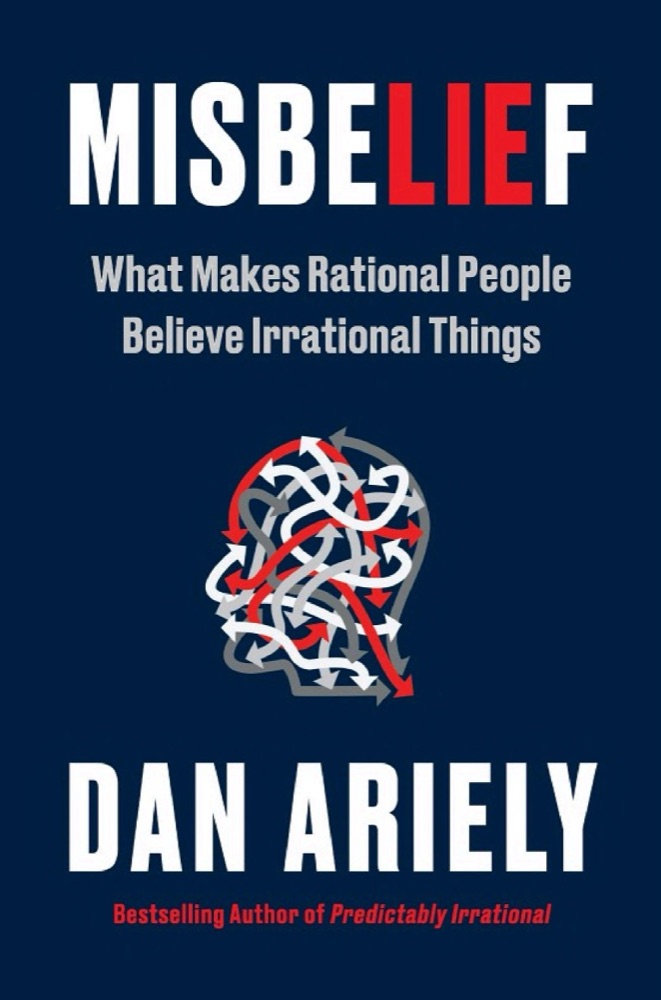
The renowned social scientist, professor, and bestselling author of Predictably Irrational delivers his most urgent and compelling book—an eye-opening exploration of the human side of the misinformation crisis—examining what drives otherwise rational people to adopt deeply irrational beliefs.
Misinformation affects all of us on a daily basis—from social media to larger political challenges, from casual conversations in supermarkets, to even our closest relationships. While we recognize the dangers that misinformation poses, the problem is complex—far beyond what policing social media alone can achieve—and too often our limited solutions are shaped by partisan politics and individual interpretations of truth.
In Misbelief, preeminent social scientist Dan Ariely argues that to understand the irrational appeal of misinformation, we must first understand the behavior of “misbelief”—the
Book details
- First published
- 2023
- Author
- Dan Ariely
- Genre
- Nonfiction
- Goodreads rating
- 3.90 (3k ratings)
Keep reading
 You Are Not So Smart
 The Age of Magical Overthinking: Notes on Modern Irrationality
 You Are Now Less Dumb: How to Conquer Mob Mentality, How to Buy Happiness, and All the Other Ways to Outsmart Yourself
 What's Our Problem?: A Self-Help Book for Societies
 21 Lessons for the 21st Century
 Mistakes Were Made (But Not by Me): Why We Justify Foolish Beliefs, Bad Decisions, and Hurtful Acts
 But What If We're Wrong? Thinking About the Present As If It Were the Past
 The Black Swan: The Impact of the Highly Improbable
 Being Wrong: Adventures in the Margin of Error
 Rationality: From AI to Zombies
 The Demon-Haunted World: Science as a Candle in the Dark
 The Art of Thinking Clearly
 God's Debris: A Thought Experiment
 The Influencing Machine: Brooke Gladstone on the Media
 Alchemy: The Surprising Power of Ideas That Don't Make Sense
 The Elephant in the Brain: Hidden Motives in Everyday Life
 Eating the Dinosaur
 The Righteous Mind: Why Good People Are Divided by Politics and Religion
 Fooled by Randomness: The Hidden Role of Chance in Life and in the Markets
 Think Again: The Power of Knowing What You Don't Know
 The Meaning of It All: Thoughts of a Citizen-Scientist
 Why People Believe Weird Things: Pseudoscience, Superstition, and Other Confusions of Our Time
 Humankind: A Hopeful History
 Parasitic Mind: How Infectious Ideas Are Killing Common Sense
 The Drunkard's Walk: How Randomness Rules Our Lives
 The Undoing Project: A Friendship That Changed Our Minds
 The Death of Expertise: The Campaign Against Established Knowledge and Why It Matters
 Starry Messenger: Cosmic Perspectives on Civilization
 Brave New World Revisited
 Homo Deus: A History of Tomorrow
 Foundation and Earth
 Superforecasting: The Art and Science of Prediction
 Black Box Thinking: Why Some People Never Learn from Their Mistakes - But Some Do
 Think Like a Rocket Scientist: Simple Strategies You Can Use to Make Giant Leaps in Work and Life
 The Moral Landscape: How Science Can Determine Human Values
 The Laws of Human Nature
 Letters to a Young Contrarian
 Religion Explained: The Evolutionary Origins of Religious Thought
 Endgame, Vol. 1: The Problem of Civilization
 Bright-Sided: How the Relentless Promotion of Positive Thinking Has Undermined America
 Trust Me, I'm Lying: Confessions of a Media Manipulator
 The Blank Slate: The Modern Denial of Human Nature
 Travels
 Doppelganger: A Trip into the Mirror World
 Breaking the Spell: Religion as a Natural Phenomenon
 The Biggest Secret: The Book That Will Change the World
 Think: A Compelling Introduction to Philosophy
 Think Like a Freak
 The Future of an Illusion
 Civilized to Death: What Was Lost on the Way to Modernity
 House Corrino
 A Devil's Chaplain: Reflections on Hope, Lies, Science, and Love
 The Signal and the Noise: Why So Many Predictions Fail—But Some Don't
 What Do You Care What Other People Think?
 Tactics: A Game Plan for Discussing Your Christian Convictions
 A Language Older Than Words
 The End of Faith: Religion, Terror, and the Future of Reason
 Bad Science
 Mary Toft; or, The Rabbit Queen