
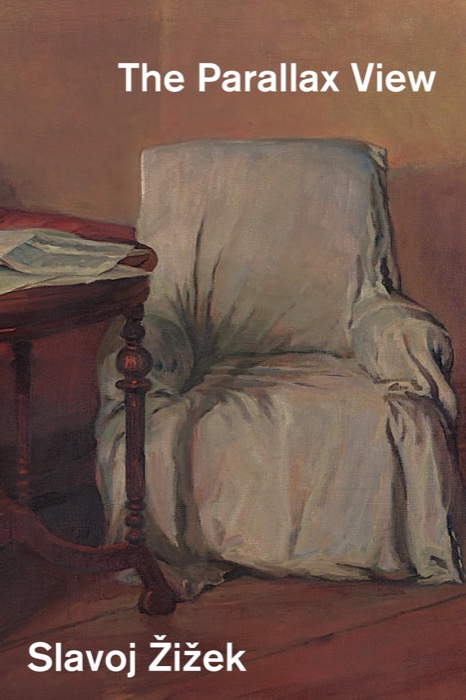
 The Parallax View
Quotes from the Book
(...) even if we do not take things seriously, even if we keep an ironical distance, we are still doing them.
7
Money is precisely an object whose status depends on how we 'think' about it: if people no longer treat this piece of metal as money, if they no longer 'believe' in it as money, it no longer is money.
7
To articulate more precisely the way in which the Lacanian phallic signifier entails the impossibility of metalanguage, let us return to the poststructuralist understanding of the idea that 'there is no metalanguage'. Its starting point is the fact that the zero level of all metalanguages - natural, ordinary language - is simultaneously the last interpretative framework of all of them: it is the ultimate metalanguage. Ordinary language is its own metalanguage. It is self-referential; the place of an incessant auto-reflexive movement. In this conceptualization one does not mention the object too much. Usually, one gets rid of it simply by pointing out how 'reality' is already structured through the medium of language. In this way post-structuralists can calmly abandon themselves to the infinite self-interpretative play of language. 'There is no metalanguange' is actually taken to mean its exact opposite: that there is no pure object-language, any language that would function as a purely transparent medium for the designation of pre-given reality. Every 'objective' statement about things includes some kind of self-distance, a rebounding of the signifier from its 'literal meaning'. In short, language is always saying, more or less, something other than what it means to say.
3
The theoretical intelligence of the form of dreams does not consist in penetrating from the manifest content to its 'hidden kernel', to the latent dream-thoughts; it consists in the answer to the question: why have the latent dream-thoughts assumed such a form, why were they transposed into the form of a dream? … Herein, then, lies the basic misunderstanding: if we seek the 'secret of the dream' in the latent content hidden by the manifest text, we are doomed to disappointment: all we find is some entirely 'normal' - albeit usually unpleasant - thought, the nature of which is mostly non-sexual and definitely not 'unconscious.’ … This is why we should not reduce the interpretation of dreams, or symptoms in general, to the retranslation of the 'latent dream-thought' into the 'normal', everyday common language of inter-subjective communication ... The structure is always triple; there are always three elements at work: the manifest dream-text, the latent dream-content or thought and the unconscious desire articulated in a dream. This desire attaches itself to the dream, it intercalates itself in the interspace between the latent thought and the manifest text; it is therefore not 'more concealed, deeper' in relation to the latent thought, it is decidedly more ‘on the surface', consisting entirely of the signifier's mechanisms, of the treatment to which the latent thought is submitted. In other words, its only place is in the form of the 'dream': the real subject matter of the dream (the unconscious desire) articulates itself in the dream-work, in the elaboration of its 'latent content'. As is often the case with Freud, what he formulates as an empirical observation … announces a fundamental, universal principle: 'The form of a dream or the form in which it is dreamt is used with quite surprising frequency for representing its concealed subject matter'. … This, then, is the basic paradox of the dream: the unconscious desire, that which is supposedly its most hidden kernel, articulates itself precisely through the dissimulation work of the 'kernel' of a dream, its latent thought, through the work of disguising this content-kernel by means of translation into the dream-rebus.
1
Bodenheimer articulates this dimension apropos of the child's question, to the father: 'Father, why is the sky blue?' - the child is not really interested in the sky as such; the real stake of the question is to expose father's incapacity to substantiate this fact, to present the whole chain of reasons leading to it. The blue of the sky thus becomes not only the father's problem, but in a way even his fault: 'The sky is blue, and you're just staring at it like an idiot, incapable of doing anything about it!' A question, even if it refers only to a given state of things, always makes the subject formally responsible for it, although only in a negative way - responsible, that is, for his impotence in face of the fact.
What we must bear in mind here is the radical ontological status of symptom: symptom, conceived as sinthome, is literally our only substance, the only positive support of our being, the only point that gives consistency to the subject. In other words, symptom is the way we - the subjects - 'avoid madness', the way we 'choose something (the symptom-formation) instead of nothing (radical psychotic autism, the destruction of the symbolic universe)' through the binding of our enjoyment to a certain signifying, symbolic formation which assures a minimum of consistency to our being-in-the-world. If the symptom in this radical dimension is unbound, it means literally 'the end of the world' - the only alternative to the symptom is nothing: pure autism, a psychic suicide, surrender to the death drive, even to the total destruction of the symbolic universe. That is why the final Lacanian definition of the end of the psychoanalytic process is *identification with the symptom*. The analysis achieves its end when the patient is able to recognize, in the Real of his symptom, the only support of his being. that is how we must read Freud's *wo es war, soll ich werden*: you, the subject, must identify yourself with the place where your symptom already was; in its 'pathological' particularity you must recognize the element which gives consistency to your being.
Watch on YouTube
About Slavoj Žižek
We have collected 42 quotes from 4 books by Slavoj Žižek on BookQuoters.
More about the author →More by Slavoj Žižek

About the book
In this provocative book, Slavoj Zizek takes a look at the question of human agency in a postmodern world. From the sinking of the Titanic to Hitchcock’s Rear Window, from the operas of Wagner to science fiction, from Alien to the Jewish joke, Zizek’s acute analyses explore the ideological fantasies of wholeness and exclusion that make up human society.
Linking key psychoanalytical and philosophical concepts to social phenomena such as totalitarianism and racism, the book explores the political significance of these fantasies of control.
Book details
- First published
- 1989
- Author
- Slavoj Žižek
- Genre
- Philosophy
- Goodreads rating
- 4.08 (6k ratings)
Keep reading
 The Master and His Emissary: The Divided Brain and the Making of the Western World
 Literary Theory: An Introduction
 Anti-Oedipus: Capitalism and Schizophrenia
 Phenomenology of Perception
 The Politics of Experience/The Bird of Paradise
 A Language Older Than Words
 Maps of Meaning: The Architecture of Belief
 The Stuff of Thought: Language as a Window into Human Nature
 Man and His Symbols
 Understanding Media: The Extensions of Man
 Philosophical Investigations
 Science and Sanity: An Introduction to Non-Aristotelian Systems and General Semantics
 Myths to Live By
 Stories of Your Life and Others
 Memories, Dreams, Reflections
 The Origin of Consciousness in the Breakdown of the Bicameral Mind
 The Divided Self: An Existential Study in Sanity and Madness
 Eyeless in Gaza
 The Doors of Perception & Heaven and Hell
 The Fourth Way
 Twilight of the Idols/The Anti-Christ
 On Truth and Lies in a Nonmoral Sense
 Undoing Gender
 Identity
 The Occult
 The Elementary Particles
 The Sorrows of an American
 Think: A Compelling Introduction to Philosophy
 Truth and Method
 Ghosts of My Life: Writings on Depression, Hauntology and Lost Futures
 Irrational Man: A Study in Existential Philosophy
 Genesis
 The Wisdom of Insecurity: A Message for an Age of Anxiety
 Love and Will
 Introductory Lectures on Psychoanalysis
 The Birth and Death of Meaning: An Interdisciplinary Perspective on the Problem of Man
 The Book: On the Taboo Against Knowing Who You Are
 The Sane Society
 Daybreak: Thoughts on the Prejudices of Morality
 Simulacra and Simulation
 The Medium is the Massage
 Under the Net
 Moravagine
 Elizabeth Costello
 Drive Your Plow Over the Bones of the Dead
 Girl with Curious Hair
 Slowness
 The Crisis of the Modern World
 The Argonauts
 Sexual Personae: Art and Decadence from Nefertiti to Emily Dickinson
 Sexus
Sexus
 Minima Moralia: Reflections on a Damaged Life
 The Source of Self-Regard: Selected Essays, Speeches, and Meditations
 The Will to Meaning: Foundations and Applications of Logotherapy
 Consider the Lobster and Other Essays
 The Art of the Novel
 The Big Picture: On the Origins of Life, Meaning, and the Universe Itself
 Love's Executioner and Other Tales of Psychotherapy