
 The Triumph of Christianity: How a Forbidden Religion Swept the World
Quotes from the Book
It wasn’t just the fact that Christians were ignorant about philosophical theories that annoyed Celsus; it was that Christians actually reveled in their ignorance.
19
Utter trash. —the Greek intellectual Celsus evaluates the Old Testament
12
One day in March AD 415, Hypatia set out from her home to go for her daily ride through the city. Suddenly, she found her way blocked by a “multitude of believers in God.”32 They ordered her to get down from her chariot. Knowing what had recently happened to her friend Orestes, she must have realized as she climbed down that her situation was a serious one. She cannot possibly have realized quite how serious. As soon as she stood on the street, the parabalani, under the guidance of a Church magistrate called Peter—“a perfect believer in all respects in Jesus Christ”33—surged round and seized “the pagan woman.” They then dragged Alexandria’s greatest living mathematician through the streets to a church. Once inside, they ripped the clothes from her body and, using broken pieces of pottery as blades, flayed her skin from her flesh. Some say that, while she still gasped for breath, they gouged out her eyes. Once she was dead, they tore her body into pieces and threw what was left of the “luminous child of reason” onto a pyre and burned her.
12
Roman emperors wanted obedience, not martyrs. They had absolutely no wish to open windows into men’s souls or to control what went on there. That would be a Christian innovation.
7
It was the Church, they told me, that had kept alive the Latin and Greek of the classical world in the benighted Middle Ages, until it could be picked up again by the wider world in the Renaissance. On holidays, we would visit museums and libraries where the same point was made. As a young child, I looked at the glowing gold of the illuminated manuscripts and believed in a more metaphorical illumination in ages of intellectual darkness. And, in a way, my parents were right to believe this, for it is true. Monasteries did preserve a lot of classical knowledge. But it is far from the whole truth. In fact, this appealing narrative has almost entirely obscured an earlier, less glorious story. For before it preserved, the Church destroyed. In a spasm of destruction never seen before—and one that appalled many non-Christians watching it—during the fourth and fifth centuries, the Christian Church demolished, vandalized and melted down a simply staggering quantity of art. Classical statues were knocked from their plinths, defaced, defiled and torn limb from limb. Temples were razed to their foundations and mutilated. A temple widely considered to be the most magnificent in the entire empire was leveled. Many of the Parthenon sculptures were attacked, faces were mutilated, hands and limbs were hacked off, and gods were decapitated. Some of the finest statues on the whole building were almost certainly smashed off then ground into rubble that was then used to build churches. Books—which were often stored in temples—suffered terribly. The remains of the greatest library in the ancient world, a library that had once held perhaps 700,000 volumes, were destroyed in this way by Christians. It was over a millennium before any other library would even come close to its holdings. Works by censured philosophers were forbidden and bonfires blazed across the empire as outlawed books went up in flames.
6
But look for a moment at the spread of Christianity from the other side and what emerges is a far less easy picture. It is neither triumphant, nor joyful. It is a story of forced conversion and government persecution. It is a story in which great works of art are destroyed, buildings are defaced and liberties are removed. It is a story in which those who refused to convert were outlawed and, as the persecution deepened, were hounded and even executed by zealous authorities. The brief and sporadic Roman persecutions of Christians would pale in comparison to what the Christians inflicted on others—not to mention on their own heretics. If this seems implausible, then consider one simple fact. In the world today, there are over two billion Christians. There is not one single, true “pagan.” Roman persecutions left a Christianity vigorous enough not only to survive but to thrive and to take control of an empire. By contrast, by the time the Christian persecutions had finally finished, an entire religious system had been all but wiped from the face of the earth.
5
There was, however, one group of people who even the great Galen found himself unable to convince. This was a group who did not form their beliefs by basing them on experiments or on observations, but on faith alone—and who, worse still, were actually proud of this fact. These peculiar people were for Galen the epitome of intellectual dogmatism. When he wished to adequately convey the blockheadedness of another group of physicians, Galen used these people as an analogy to express the depths of his irritation. They were the Christians.
5
A tenth-century copy of Archimedes’s Method of Mechanical Theorems. In it, Archimedes had ingeniously applied mechanical laws, such as the law of the lever, to find the volume and area of geometric shapes. Two thousand years before Newton, he had come tantalizingly close to deriving calculus. However, in the thirteenth century this work was scraped off and overwritten with a prayer book.
4
We see the same stars, the sky is shared by all, the same world surrounds us. What does it matter what wisdom a person uses to seek for the truth? —the “pagan” author Symmachus That all superstition of pagans and heathens should be annihilated is what God wants, God commands, God proclaims! —St. Augustine
3
For those who wish to be intolerant, monotheism provides very powerful weapons. Nietzsche and Engels would later equate Christianity and its values with slaves and slave morality.
2
For every classical work that sat comfortably with Christian minds and morals, there was another that grated unbearably on them. ‘Carmen 16’ by the poet Catullus was a particular thorn. This poem opens with the infamously bracing line: ‘I will bugger you and I will fuck your mouths’ – hardly the sort of thing to gladden the heart of Basil. ‘Epigram 1.90’ of Martial was little better: this little verse attacks a woman for having affairs with other women. Or, as Martial put it: 'You improvised, by rubbing cunts together, And using that bionic clit of yours To counterfeit the thrusting of a male.
2
[I]n the years that followed the persecutions, Christianity came to see itself, with great pride, as a persecuted Church. Its greatest heroes were not those who did good deeds but those who died in the most painful way. If you were willing to die an excruciating end in the arena then, whatever your previous holiness or lack thereof, you went straight to heaven: martyrdom wiped out all sins on the point of death. As well as getting there faster, martyrs enjoyed preferential terms in paradise, getting to wear the much-desired martyr’s crown. Tempting celestial terms were offered: it was said that the scripture promised ‘multiplication, even to a hundred times, of brothers, children, parents, land and homes’. Precisely how this celestial sum had been calculated is not clear but the general principle was: those who died early, publicly and painfully would be best rewarded. In many of the martyr tales the driving force is less that the Romans want to kill – and more that the Christians want to die. Why wouldn’t they? Paradoxically, martyrdom held considerable benefits for those willing to take it on. One was its egalitarian entry qualifications. As George Bernard Shaw acidly observed over a millennium later, martyrdom is the only way a man can become famous without ability. More than that, in a socially and sexually unequal era it was a way in which women and even slaves might shine. Unlike most positions of power in the highly socially stratified late Roman Empire, this was a glory that was open to all, regardless of rank, education, wealth or sex. The sociologist Rodney Stark has pointed out that – provided you believe in its promised rewards – martyrdom is a perfectly rational choice. A martyr could begin the day of their death as one of the lowliest people in the empire and end it as one of the most exalted in heaven. So tempting were these rewards that pious Christians born outside times of persecution were wont to express disappointment at being denied the opportunity of an agonizing death. When the later Emperor Julian pointedly avoided executing Christians in his reign, one Christian writer far from being grateful, sourly recorded that Julian had ‘begrudged the honour of martyrdom to our combatants’.
2
As one twentieth-century historian put it: “In an age of anxiety any ‘totalist’ creed exerts a powerful attraction: one has only to think of the appeal of communism to many bewildered minds in our own day.
2
The Christians’ belief in their forthcoming heavenly realm made them dangerously indifferent to the needs of their earthly one.
2
La falta de educación, sostenía Celso, hacía que los oyentes fueran vulnerables al dogma. Si los cristianos hubieran leído un poco más y creyeran un poco menos, sería menos probable que se consideraran únicos.
2
Centuries later, an Arab traveler would visit a town on the edge of Europe and reflect on what had happened in the Roman Empire. “During the early days of the empire of the Rum,” he wrote—meaning the Roman and Byzantine Empire—“the sciences were honoured and enjoyed universal respect. From an already solid and grandiose foundation, they were raised to greater heights every day, until the Christian religion made its appearance among the Rum; this was a fatal blow to the edifice of learning; its traces disappeared and its pathways were effaced.
2
As soon as she stood on the street, the parabalani, under the guidance of a Church magistrate called Peter—“a perfect believer in all respects in Jesus Christ”33—surged round and seized “the pagan woman.” They then dragged Alexandria’s greatest living mathematician through the streets to a church. Once inside, they ripped the clothes from her body and, using broken pieces of pottery as blades, flayed her skin from her flesh. Some say that, while she still gasped for breath, they gouged out her eyes. Once she was dead, they tore her body into pieces and threw what was left of the “luminous child of reason” onto a pyre and burned her.
2
Many Roman and Greek intellectuals had shown profound distaste for such an involved deity. The idea that a divine being was watching every move of every human being was, to these observers, not a sign of great love but a “monstrous” absurdity. The Christian God in their writings was frequently described as a prurient busybody, a peculiar “nuisance” who was “restless, shamelessly curious, being present at man’s every act.”6 Why was He so interested in the every doing of mere mortals? Even before Christianity, sophisticated Roman thinkers had poured scorn on such an idea. As Pliny the Elder had put it: “that [a] supreme being, whate’er it be, pays heed to man’s affairs is a ridiculous notion. Can we believe that it would not be defied by so gloomy and so multifarious a duty?”7 Didn’t a god have better things to do?
2
There were simply not that many years of imperially ordered persecution in the Roman Empire. Fewer than thirteen—in three whole centuries of Roman rule.
1
For the first hundred-odd years of Christianity’s existence, there are no mentions of Christianity in Roman writings.
1
Un mártir podía empezar el día de su muerte como una de las personas de más baja categoría en el imperio y acabar como una de las más eminentes en el cielo.
1
Some monks lost their minds—if they had ever been in full possession of them. When Apollo of Scetis, a shepherd who later became a monk, spotted a pregnant woman in a field, he said to himself: “I should like to see how the child lies in her womb.” He ripped the woman open and saw the fetus. The child and the mother died.
1
The tens of thousands of books, the remnants of the greatest library in the world, were all lost, never to reappear. Perhaps they were burned. As the modern scholar, Luciano Canfora, observed: ‘the burning of books was part of the advent and imposition of Christianity’. A war against pagan temples was also a war against the books that had all too often been stored inside them for safekeeping – a concept that from now on could only be recalled with irony. If they were burned then this was a significant moment in what Canfora has called ‘the melancholy experiences of the war waged by Christianity against the old culture and its sanctuaries: which meant, against the libraries’. Over a thousand years later, Edward Gibbon raged at the waste: ‘The appearance of the empty shelves excited the regret and indignation of every spectator, whose mind was not wholly darkened with religious prejudice.
1
Christians want to die. Why wouldn’t they? Paradoxically, martyrdom held considerable benefits for those willing to take it on. One was its egalitarian entry qualifications. As George Bernard Shaw acidly observed over a millennium later, martyrdom is the only way a man can become famous without ability. More than that, in a socially and sexually unequal era it was a way in which women and even slaves might shine.
1
Ninety percent of all classical literature fades away.
1
The punishments could be terrible. If a nurse aided and abetted an affair of a young woman in her charge, she would be punished by having molten lead poured down her throat.
1
The feast of the Liberalia was on March 17, a now sadly forgotten festival at which Roman citizens celebrated a boy’s first ejaculation.
1
We know that Porphyry too found himself baffled as to why God had waited so long to save mankind: “If Christ declares Himself to be the Way of salvation, the Grace and the Truth . . . what has become of men who lived in the many centuries before Christ came?” he asked. “What, then, has become of such an innumerable multitude of souls, who were in no wise blameworthy” who were born earlier? Why “did He who is called the Saviour withhold Himself for so many centuries of the world?
1
Watch on YouTube
About Catherine Nixey
We have collected 28 quotes from 1 book by Catherine Nixey on BookQuoters.
More about the author →About the book
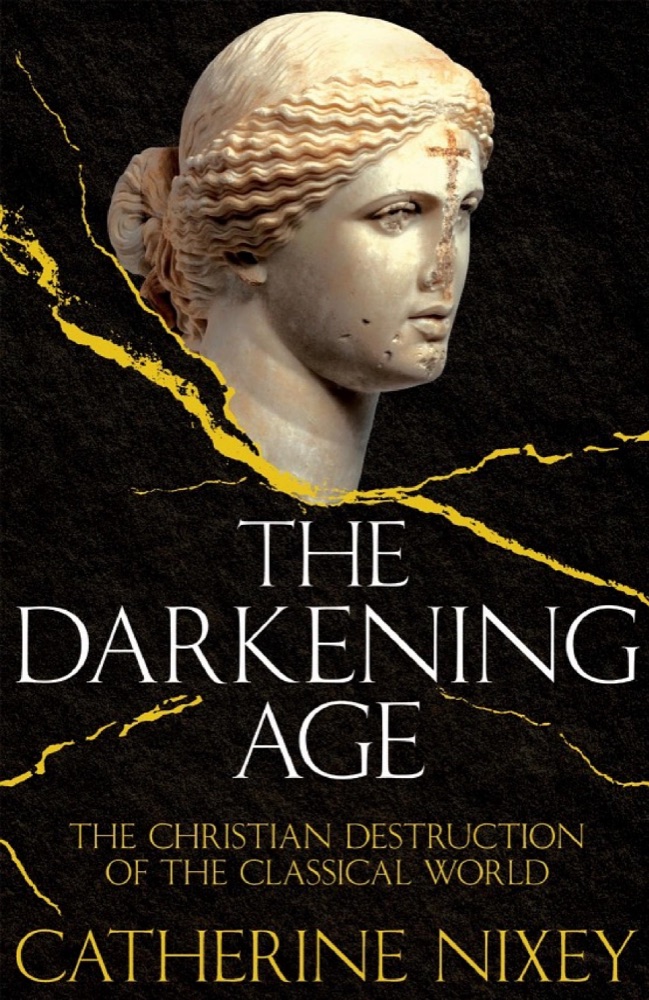
The Darkening Age is the largely unknown story of how a militant religion deliberately attacked and suppressed the teachings of the Classical world, ushering in centuries of unquestioning adherence to 'one true faith'.
Despite the long-held notion that the early Christians were meek and mild, going to their martyr's deaths singing hymns of love and praise, the truth, as Catherine Nixey reveals, is very different. Far from being meek and mild, they were violent, ruthless and fundamentally intolerant. Unlike the polytheistic world, in which the addition of one new religion made no fundamental difference to the old ones, this new ideology stated not only that it was the way, the truth and the light but that, by extension, every single other way was wrong and had to be destroyed. From the 1st century to the 6th, those who didn't fall into step with its beliefs were pursued in every possib
Book details
- First published
- 2017
- Author
- Catherine Nixey
- Genre
- History
- Goodreads rating
- 4.06 (7k ratings)
The buzz
- The GuardianReview in The Guardianprofessional review (via Book Marks)
- NytiReview in Nytiprofessional review (via Book Marks)
- The TimesReview in The Timesprofessional review (via Book Marks)
- Kirkus ReviewsReview in Kirkus Reviewsprofessional review (via Book Marks)
- BooklistReview in Booklistprofessional review (via Book Marks)
- FtReview in Ftprofessional review (via Book Marks)
Keep reading
The Triumph of Christianity: How a Forbidden Religion Swept the World
 Forged: Writing in the Name of God—Why the Bible's Authors Are Not Who We Think They Are
 The Immortality Key: Uncovering the Secret History of the Religion with No Name
 Saint Thomas Aquinas
 Godless: How an Evangelical Preacher Became One of America's Leading Atheists
 The Age of Reason
 The Order
 The Anti-Christ
 The Case for God
 Bad Religion: How We Became a Nation of Heretics
 Life of Christ
 The Revolt of the Angels
 The History of the Church: From Christ to Constantine
 How Jesus Became God: The Exaltation of a Jewish Preacher from Galilee
 A Pilgrimage to Eternity: From Canterbury to Rome in Search of a Faith
 The Case for Christ
 The Rage Against God: How Atheism Led Me to Faith
 The History of the Decline and Fall of the Roman Empire Volume I
 Caesar and Christ
 The Everlasting Man
 How the Irish Saved Civilization
 A History of God: The 4,000-Year Quest of Judaism, Christianity, and Islam
 The Messiah Matrix
 The Portable Atheist: Essential Readings for the Nonbeliever
 A Little History of Religion
 Zealot: The Life and Times of Jesus of Nazareth
 The Benedict Option: A Strategy for Christians in a Post-Christian Nation
 The Parafaith War
 Lord of the World
 Paul: A Biography
 What's So Great About Christianity
 The Discarded Image: An Introduction to Medieval and Renaissance Literature
 Bonhoeffer: Pastor, Martyr, Prophet, Spy
 The War of the Poor
 Tortured for Christ
 The Better Angels of Our Nature: Why Violence Has Declined
 Misogyny: The World's Oldest Prejudice
 Persian Letters
 Orthodoxy
 That All Shall Be Saved: Heaven, Hell, and Universal Salvation
 The End of Faith: Religion, Terror, and the Future of Reason
 Letters from the Earth: Uncensored Writings
 How Should We Then Live? The Rise and Decline of Western Thought and Culture
 The Dream of Scipio
 A History of the World in 100 Objects
 Jesus and the Disinherited
 The Reason for God: Belief in an Age of Skepticism
 Julian
 The Decline and Fall of the Roman Empire
 On the Genealogy of Morals/Ecce Homo
 Letter to a Christian Nation
 The World's Last Night: And Other Essays
 Twilight of the Idols/The Anti-Christ
 The Kingdom of God Is Within You
 A Canticle for Leibowitz
 Resident Aliens: Life in the Christian Colony
 Tears and Saints
 Letters and Papers from Prison
 Under the Banner of Heaven: A Story of Violent Faith