 The Spirit of the Laws
Quotes from the Book
What unhappy beings men are! They constantly waver between false hopes and silly fears, and instead of relying on reason they create monsters to frighten themselves with, and phantoms which lead them astray.
66
They who love to inform themselves, are never idle. Though I have no business of consequence to take care of, I am nevertheless continually employed. I spend my life in examining things: I write down in the evening whatever I have remarked, what I have seen, and what I have heard in the day: every thing engages my attention, and every thing excites my wonder: I am like an infant, whose organs, as yet tender, are strongly affected by the slightest objects.
54
I can assure you that no kingdom has ever had as many civil wars as the kingdom of Christ.
51
History is full of religious wars; but, we must take care to observe, it was not the multiplicity of religions that produced these wars, it was the intolerating spirit which animated that one which thought she had the power of governing.
23
Every man is capable of doing good to another, but to contribute to the happiness of an entire society is to become akin to the gods
17
In vain do we seek tranquility in the desert; temptations are always with us; our passions, represented by the demons, never let us alone: those monsters created by the heart, those illusions produced by the mind, those vain specters that are our errors and our lies always appear before us to seduce us; they attack us even in our fasting or our mortifications, in other words, in our very strength.
16
With truths of a certain kind, it is not enough to make them appear convincing: one must also make them felt. Of such kind are moral truths.
15
Nature, in her wisdom, seems to have arranged it so that men's stupidity should be ephemeral, and books make them immortal. A fool ought to be content having exacerbated everyone around him, but he insists tormenting future generations.
12
Not to be loved is a misfortune, but it is an insult to be loved no longer.
10
We are so blind that we know neither when to mourn, nor when to rejoice; our mirth and our sadness are nearly always false.
7
Rhedi: I am always afraid that they will eventually succeed in discovering some secret which will provide a quicker way of making men die, and exterminate whole countries and nations. Usbek: No, if such a fateful invention came to be discovered, it would soon be banned by international law; by the unanimous consent of every country the discovery would be buried.
7
MOST legislators have been men of inferior capacity whom chance exalted over their fellows, and who took counsel almost exclusively of their own prejudices and whims. It would seem that they had not even a sense of the greatness and dignity of their work: they amused themselves by framing childish institutions, well devised indeed to please small minds, but discrediting their authors with people of sense. They flung themselves into useless details; and gave their attention to individual interests: the sign of the narrow genius, which grasps things piecemeal and cannot take a general view. Some of them have been so affected as to employ another language than the vernacular-a ridiculous thing in a framer of laws; for how can they be obeyed if they are not known? They have often abolished needlessly those which were already established-that is to say, they have plunged nations into the confusion which always accompanies change. It is true that, by reason of some extravagance springing rather from the nature than from the mind of man, it is sometimes necessary to change certain laws. But the case is rare; and when it happens it requires the most delicate handling; much solemnity ought to be observed, and endless precautions taken, in order to lead the people to the natural conclusion that the laws are most sacred, since so many formalities are necessary to their abrogation. Often they have made them too subtle, following logical instead of natural equity. As a consequence such laws have been found too severe; and a spirit of justice required that they should be set aside; but the cure was as bad as the disease. Whatever the laws may be, obedience to them is necessary; they are to be regarded as the public conscience, with which all private consciences ought to be in conformity. (Letter #79)
6
My dear Usbek, when women feel, as they lose their attractiveness, that their end is coming in advance, they would like to go backwards to youth again. How could they possibly not attempt to deceive other people? - they make every effort to deceive themselves, and to escape from the most distressing thought we can have.
6
The right of conquest is not a right. A society can be founded only with the consent of its members. If it is destroyed by conquest, the nation becomes free again; it is not a new society, and if the conquerer tries to create one it will be a dictatorship.
5
The desire for glory is no different from that instinct for preservation that is common to all creatures. It is as if we enhance our being if we can gain a place in the memory of others; it is a new life that we acquire, which becomes as precious to us as the one we received from Heaven.
5
Zeal for the advancement of religion is different from a due attachment to it; and that in order to love it and fulfill its behests, it is not necessary to hate and persecute those who are opposed to it.
4
Another much-discussed question is, whether women are intended by nature to be subject to men.“No,” said a very gallant philosopher to me the other day; “nature never dictated any such law.The dominion which we exercise over them is tyrannical; they yield themselves to men only because they are more tender-hearted, and consequently more human and more rational.These advantages, which, had we been reasonable, would, without doubt, have been the cause of their subordination, because we are irrational. “Now, if it is true that it is a tyrannical power which we have over women, it is none the less true that they exercise over us a natural dominion- that of beauty, which nothing can resist.Our power does not extend to all countries, but that of beauty is universal.Why, then, should we have any privilege?Is it because we are stronger than they?But that would be the height of injustice.We use every possible means to discourage them.Our powers would be found equal if we were educated alike.Try women in those gifts which education has not weakened, and we soon will see which is the abler sex.
4
I have read descriptions of Paradise that would make any sensible person stop wanting to go there.
4
We were born in a flourishing realm, but we did not believe that its boundaries were those of our knowledge.
3
A fool ought to be satisfied with having bored all his own contemporaries, but he also seeks to torment those as yet unborn; he wants his stupidity to triumph over oblivion, which he might, like the tomb, have enjoyed; but no, he wants posterity to be notified that he has lived, and he wants her to know, for all eternity, that he was an idiot.
2
The Jewish religion is an ancient tree, from which have sprung two branches that cover the whole earth: Muhammadanism and Christianity; or rather, it is a mother who bore two daughters who have wounded her in a thousand places:
2
I have seen descriptions of Paradise sufficient to make all sensible people give up their hopes of it.
2
But there is not a single person employed in any way at the court, in Paris, or in the provinces, who is not acquainted with some woman through whose hands pass all the favours and sometimes all the wrongs which he may wish done. These women are all in each other’s secrets, and form a sort of republic, the members of which are always busy aiding and serving each other; it is like a state within a state; and anyone at court, in Paris, or in the provinces who sees the activity of the ministers, the magistrates, and the prelates, if he does not know the women who govern them, is like a man who sees a machine at work, but who is ignorant of the springs that move it.
2
They maintain that all unlimited power must be unlawful, because it cannot have had a lawful origin. For, we cannot, say they, give to another more power over us than we ourselves have : now, we have not unlimited power over ourselves ; for example, we have no right to take our own lives: no one upon earth then, they conclude, had such a power.
2
As with their fashions, so is it with their customs and style of living: French manners change with the age of the king. The monarch could even succeed in making his people solemn if he chose to try. He impresses his own characteristics upon the court, the court upon the city, and the city on the provinces. The soul of the sovereign is a mould in which all the others are formed.
2
If a human creature is composed of two beings, and if the acknowledgment of the necessity of preserving their union is the chief mark of submission to the decrees of our Creator, that necessity should be made a religious law; and if the enforced preservation of this union will make men more responsible for their actions, it should be made a civil law.
2
One of them said to me once, “I believe in the immortality of the soul for six months at a time; my opinions depend entirely upon my bodily condition: I am a Spinozist, a Socinian, a Catholic, ungodly or devout, according to the state of my animal spirits, the quality of my digestion, the rarity or heaviness of the air I breathe, the lightness or solidity of the food I eat. When the doctor is at my bedside, the confessor has me at a disadvantage. I know very well how to prevent religion from annoying me when I am in good health; but I allow myself to be consoled by it when I am ill: when I have nothing more to hope for here below, religion offers itself, and gains me by its promises; I am glad to give myself up to it, and to die with hope on my side.
2
Watch on YouTube
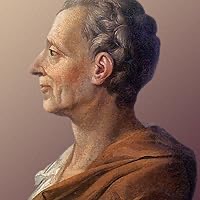
About Montesquieu
We have collected 43 quotes from 2 books by Montesquieu on BookQuoters.
More about the author →More by Montesquieu
The Spirit of the Laws
About the book
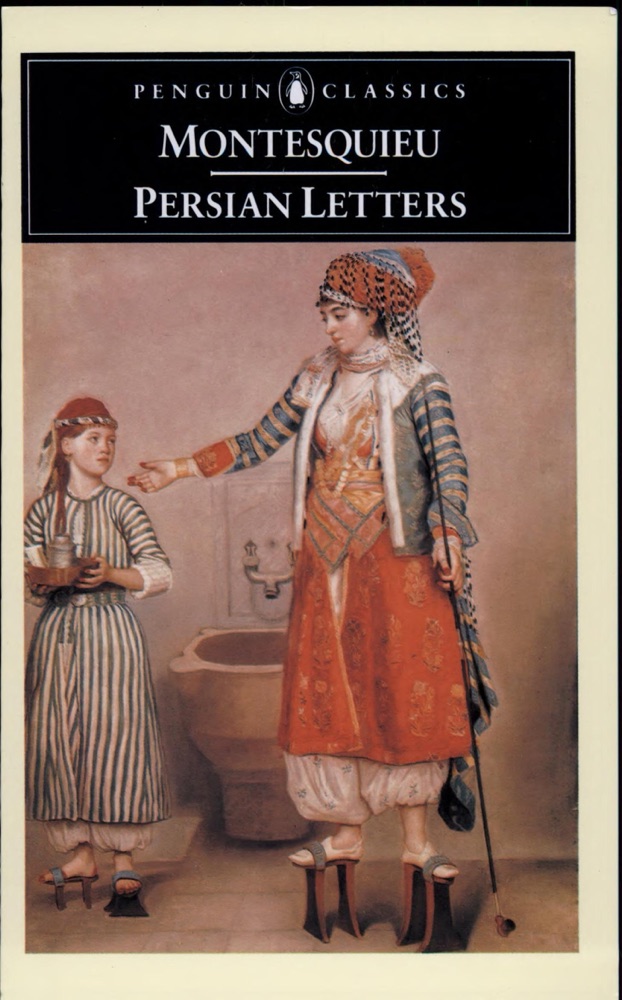
This richly evocative novel-in-letters tells the story of two Persian noblemen who have left their country—the modern Iran—to journey to Europe in search in wisdom. As they travel, they write home to wives and eunuchs in the harem and to friends in France and elsewhere. Their colorful observations on the culture differences between West and East conjure up Eastern sensuality, repression, and cruelty in contrast to the freer, more civilized West—but here also unworthy nobles and bishops, frivolous women in fashion, and conceited people of all kinds are satirized. Storytellers as well as letter-writers, Montesquieu’s Usbek and Rica are disrespectful and witty, but also serious moralists. Persian Letters was a succès de scandale in Paris society, and encapsulates the libertarian, critical spirit of the early eighteenth century.
C. J. Betts’s translation conveys the color of the original,
Book details
- First published
- 1721
- Author
- Montesquieu
- Genre
- Classics
- Goodreads rating
- 3.62 (8k ratings)
Keep reading
 Heretics
 Human, All Too Human
 Daybreak: Thoughts on the Prejudices of Morality
 The Story of My Experiments With Truth
 The Gay Science
 Philosophical Dictionary
 The Home and the World
 Too Like the Lightning
 The Fall of Babel
 The Ides of March
 The Everlasting Man
 The Fall
 The White Luck Warrior
 Civilization and Its Discontents
 The Seven Storey Mountain
 The Varieties of Religious Experience
 The Once and Future King
 Daniel Deronda
 Erewhon
 Man and Superman
 The Consolation of Philosophy
 The World's Last Night: And Other Essays
 Julian
 The Fresco
 Seven Surrenders
 The Napoleon of Notting Hill
 The Discovery of India
 Letters from the Earth: Uncensored Writings
 The Wisdom of Life
 The Letters of J.R.R. Tolkien
 The Grace of Kings
 The Revolt of the Angels
 The Republic
 Utopia
 The Future of an Illusion
 Maldoror and the Complete Works
 The Essays of Ralph Waldo Emerson
 The Rebel Angels
 The Midwich Cuckoos
 Two Years Eight Months and Twenty-Eight Nights
 Parable of the Talents
 City of God
 Shōgun
 The Enchantress of Florence
 In Search of Lost Time
 East of Eden
 The History of Tom Jones, a Foundling
 The Weight of Glory
 God Emperor of Dune
 The Screwtape Letters
 Our Oriental Heritage
 Demian
 The Blithedale Romance
 When I Was a Child I Read Books
 The Muqaddimah: An Introduction to History
 Common Sense
 Villa Incognito
 Letters and Papers from Prison
 Complete Works of Oscar Wilde
 The Laws of Plato