 The Story of Philosophy: The Lives and Opinions of the World's Greatest Philosophers
Quotes from the Book
Rome remained great as long as she had enemies who forced her to unity, vision, and heroism. When she had overcome them all she flourished for a moment and then began to die.
59
The older Romans used temples as their banks, as we use banks as our temples;
12
But the new generation had tasted the wine of philosophy; and from this time onward the rich youth of Rome went eagerly to Athens and Rhodes to exchange their oldest faith for the newest doubts.
8
but now and then liberty, in the slogans of the strong, means freedom from restraint in the exploitation of the weak.
8
The form of Christianity that developed in Europe and later spread to America and the rest of the world was the last great creation of the ancient pagan world.
7
Nevertheless, the movement of intelligence over western and southern Europe was as rapid in Caesar’s day as at any time before the railway. In 54 B.C.. Caesar’s letter from Britain reached Cicero at Rome in twenty-nine days; in 1834 Sir Robert Peel, hurrying from Rome to London, required thirty days.
5
The principle of democracy is freedom, the principle of war is discipline; each requires the absence of the other.
4
In Christ and Peter Christianity was Jewish; in Paul it became half Greek; in Catholicism it became half Roman. In Protestantism the Judaic element and emphasis were restored.
3
Self Government by extravagance and incompetence brings its own end.
3
Knowledge is of value only as a tool of the good life.
2
The ancient [pagan] faith was diseased at the bottom and at the top. The deification of the emperors revealed not how much the upper classes thought of their rulers, but how little they thought of their gods.
2
Be lavish in your promises,” Quintus advised; “men prefer a false promise to a flat refusal. . . . Contrive to get some new scandal aired against your rivals for crime, corruption, or immorality.
2
Sumptuary laws were passed by the Senate limiting expenditure on banquets and clothing, but as the senators ignored these regulations, no one bothered to observe them. “The citizens,” Cato mourned, “no longer listen to good advice, for the belly has no ears.”9 The individual became rebelliously conscious of himself as against the state, the son as against the father, the woman as against the man. Usually the power of woman rises with the wealth of a society, for when the stomach is satisfied hunger leaves the field to love. Prostitution flourished. Homosexualism was stimulated by contact with Greece and Asia; many rich men paid a talent ($3600) for a male favorite; Cato complained that a pretty boy cost more than a farm.10 But women did not yield the field to these Greek and Syrian invaders. They took eagerly to all those supports of beauty that wealth now put within their reach. Cosmetics became a necessity, and caustic soap imported from Gaul tinged graying hair into auburn locks.11 The rich bourgeois took pride in adorning his wife and daughter with costly clothing or jewelry and made them the town criers of his prosperity. Even in government the role of women grew. Cato cried out that “all other men rule over women; but we Romans, who rule all men, are ruled by our women.”12 In 195 B.C.. the free women of Rome swept into the Forum and demanded the repeal of the Oppian Law of 215, which had forbidden women to use gold ornaments, varicolored dresses, or chariots. Cato predicted the ruin of Rome if the law should be repealed. Livy puts into his mouth a speech that every generation has heard:
2
Rome had freed the Greeks, but on condition that both war and class war should end. Freedom without war was a novel and irksome life for the city-states that made up Hellas; the upper classes yearned to play power politics against neighboring cities, and
2
In the early centuries Rome’s dead had been cremated; now, usually, they were buried, though some obstinate conservatives preferred combustion. In either case, the remains were placed in a tomb that became an altar of worship upon which pious descendants periodically placed some flowers and a little food. Here, as in Greece and the Far East, the stability of morals and society was secured by the worship of ancestors and by the belief that somewhere their spirits survived and watched. If they were very great and good, the dead, in Hellenized Roman mythology, passed to the Elysian Fields, or the Islands of the Blessed; nearly all, however, descended into the earth, to the shadowy realm of Orcus and Pluto. Pluto, the Roman form of the Greek god Hades, was armed with a mallet to stun the dead; Orcus (our ogre) was the monster who then devoured the corpse. Because Pluto was the most exalted of the underground deities, and because the earth was the ultimate source of wealth and often the repository of accumulated food and goods, he was worshiped also as the god of riches and plutocrats; and his wife Proserpina—the strayed daughter of Ceres—became the goddess of the germinating corn. Sometimes the Roman Hell was conceived as a place of punishment;72 in most cases it was pictured as the abode of half-formless shades that had been men, not distinguished from one another by reward or punishment, but all equally suffering eternal darkness and final anonymity. There at last, said Lucian, one would find democracy.
2
Old age was not then the abandoned desolation that so often darkens it in an individualistic age. The young never questioned their duty to care for the old; the old remained to the end the first consideration and the last authority; and after their death their graves were honored as long as a male descendant survived. Funerals
2
In summary, the typical educated Roman of this age was orderly, conservative, loyal, sober, reverent, tenacious, severe, practical. He enjoyed discipline, and would have no nonsense about liberty. He obeyed as a training for command. He took it for granted that the government had a right to inquire into his morals as well as his income, and to value him purely according to his services to the state. He distrusted individuality and genius. He had none of the charm, vivacity, and unstable fluency of the Attic Greek. He admired character and will as the Greek admired freedom and intellect; and organization was his forte. He lacked imagination, even to make a mythology of his own. He could with some effort love beauty, but he could seldom create it. He had no use for pure science, and was suspicious of philosophy as a devilish dissolvent of ancient beliefs and ways. He could not, for the life of him, understand Plato, or Archimedes, or Christ. He could only rule the world.
2
There his chief enterprises are reading and doing nothing.
2
Men could not then enjoy the lavish abundance of useful products now poured forth by our machines; but they could, if they cared enough, gradually surround themselves with objects whose zealously finished form gave to all who lived with them the subtle and quiet happiness of beautiful things.
1
She was too beautiful to be monogamous, but Septimius was too busy to be jealous.
1
Withdraw into yourself and look. And if you do not find yourself beautiful, yet act as does the creator of a statue ... he cuts away here, he smooths there, he makes this line lighter, the other purer, until a lovely face has grown upon his work. So do you also: cut away all that is excessive, straighten all that is crooked . . . and never cease chiseling your statue until . . . you see the perfect goodness established in the stainless shrine.
1
It is refreshing to find a philosopher who is wise enough to be happy.
1
We cannot condemn Tacitus for not succeeding in what he did not attempt;
1
Life is only lent to man; he cannot keep it forever. By his death he pays his debt to Nature.
1
Most Romans were like our neighbors and ourselves: they rose reluctantly, ate too much, worked too much, played too little, loved much, seldom hated, quarreled a bit, talked a great deal, dreamed waking dreams, and slept.
1
the chief charm of the past is that we know we need not live it again.
1
Watch on YouTube
About Will Durant
We have collected 110 quotes from 5 books by Will Durant on BookQuoters.
More about the author →More by Will Durant
The Story of Philosophy: The Lives and Opinions of the World's Greatest Philosophers
 Our Oriental Heritage
 The Story of Civilization
 The Lessons of History
About the book
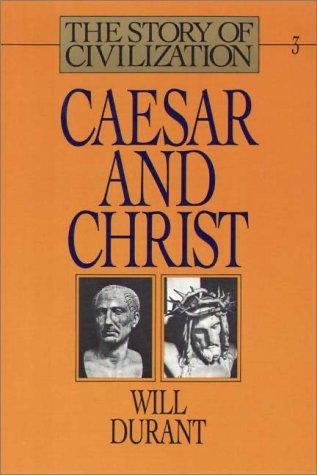
Volume 3 of the monumental Story of Civilization, CAESAR AND CHRIST depicts the rise of Rome from a crossroads town to empire. The world's first republic, Rome spread its civilization over the Mediterranean and western European world. Its long, slow crumbling and final collapse plunged Europe into darkness and chaos.
The Pax Romana broke some heads. Jews felt the scourge in Judea, where Jesus of Nazareth met a dissident's death. His agony foreshadowed the Empire's over the next few centuries.
"Lively, stimulating and accurate." (Saturday Review of Literature)
Book details
- First published
- 1944
- Author
- Will Durant
- Genre
- History
- Goodreads rating
- 4.41 (2k ratings)
Keep reading
 The History of the Decline and Fall of the Roman Empire Volume I
 SPQR: A History of Ancient Rome
 The Decline and Fall of the Roman Empire
 The Histories
 How the Irish Saved Civilization
 Imperium: A Novel of Ancient Rome
 Rubicon: The Last Years of the Roman Republic
 Dictator
 The Dream of Scipio
 Claudius the God and His Wife Messalina
 The Ides of March
 Plutarch's Lives
 Augustus
 The Discourses
 A History of the World in 100 Objects
 Lives of the Stoics: The Art of Living from Zeno to Marcus Aurelius
 A Distant Mirror: The Calamitous 14th Century
 Persian Letters
 The Memoirs of Cleopatra
 From Dawn to Decadence: 500 Years of Western Cultural Life, 1500 to the Present
 Julian
 The Enchantress of Florence
 Black Lamb and Grey Falcon
 The Sixteen Satires
 Walden & Civil Disobedience
 Mythology
 The Swerve: How the World Became Modern
 The Greek Way
 The Once and Future King
 Parallel Lives
 Reflections on the Revolution in France
 Ben-Hur: A Tale of the Christ
 The Darkening Age: The Christian Destruction of the Classical World
The Lessons of History
The Darkening Age: The Christian Destruction of the Classical World
The Lessons of History
 Forge of Darkness
 Romola
 The Fall of the Roman Empire: A New History of Rome and the Barbarians
 Utopia
Our Oriental Heritage
Utopia
Our Oriental Heritage
 Julian Comstock: A Story of 22nd-Century America
 Sailing to Sarantium
 A Canticle for Leibowitz
 The Everlasting Man
 The Republic
 History of the Peloponnesian War
 Heretics
 Philosophical Dictionary
 The Fall of Hyperion
 On the Genealogy of Morals
 Childhood's End
 The Education of Henry Adams
The Story of Philosophy: The Lives and Opinions of the World's Greatest Philosophers
The Education of Henry Adams
The Story of Philosophy: The Lives and Opinions of the World's Greatest Philosophers
 Ninety-Three
 Foundation and Empire
 The Discovery of India
 The March of Folly: From Troy to Vietnam
 The Proud Tower: A Portrait of the World Before the War, 1890-1914
 Victory City
 Consider Phlebas
 Where Angels Fear to Tread