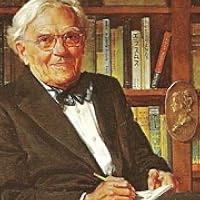
 Martin Luther: The Man Who Rediscovered God and Changed the World
Quotes from the Book
When God in his sheer mercy and without any merit of mine has given me such unspeakable riches, shall I not then freely, joyously, wholeheartedly, unprompted do everything that I know will please him? I will give myself as a sort of Christ to my neighbor as Christ gave himself for me.
6
A simple layman armed with Scripture is to be believed above a pope or a council without it.
5
October 21, 1525, Luther confided to a friend, “My Katherine is fulfilling Genesis 1:28.
1
God has called men to labor because he labors.
1
But he is not therefore to be lazy or loose. Good works do not make a man good, but a good man does good works. A bishop is not a bishop because he consecrates a church, but he consecrates a church because he is a bishop. Unless a man is already a believer and a Christian, his works have no value at all.
1
was more devastating than anything that had preceded; and when Erasmus read the tract, he ejaculated, “The breach is irreparable.” The reason was that the pretensions of the Roman Catholic Church rest so completely upon the sacraments as the exclusive channels of grace and upon the prerogatives of the clergy, by whom the sacraments are exclusively administered.
1
Christianity, said Erasmus, has been made to consist not in loving one’s neighbor but in abstaining from butter and cheese during Lent.
1
Not through thoughts, wisdom, and will does the faith of Christ arise in us, but through an uncommon incomprehensible and hidden operation of the Spirit, which is given by faith in Christ only at the hearing of the Word and without any other work ours.
1
God works by contraries so that a man feels himself to be lost in the very moment when he is on the point of being saved. When God is about to justify a man, he damns him. Whom he would make alive he must first kill.
You are not a bad Christian if you deny the decretal. But if you deny the gospel, you are a heretic. I damn and detest this decretal
As God, Christ, the Virgin, the prince of the apostles, and the shepherds labored, even so must we labor in our callings. God has no hands and feet of his own. He must continue his labors through human instruments. The lowlier the task the better. The milkmaid and the carter of manure are doing a work more pleasing to God than the psalm singing of a Carthusian. Luther never tired of defending those callings which for one reason or another were disparaged. The mother was considered lower than the virgin. Luther replied that the mother exhibits the pattern of the love of God, which overcomes sins just as her love overcomes dirty diapers.
Erasmus characterized his own position in these words: "The wise navigator will steer between Scylla and Charybdis. I have sought to be a spectator of this tragedy." Such a role was not permitted to him, and between the confessional millstones his type was crushed. Where again does one find precisely his blend of the cultivated Catholic scholar: tolerant, liberal, dedicated to the revival of the classical Christian heritage in the unity of Christendom? The leadership of Protestantism was to pass to the Neo-Scholastics and of the Catholics to the Jesuits.
If thou shouldst wish to look upon
Before the chapter Luther defended the Augustinian view that even outwardly upright acts may be mortal sins in the eyes of God.
If there is any sense remaining of Christian civilization in the West, this man Luther in no small measure deserves the credit.
The scene lends itself to a dramatic portrayal. Here was Charles, heir of a long line of Catholic sovereigns--of Maximilian the romantic, of Ferdinand the Catholic, of Isabella the orthodox--scion of the house of Hapsburg, lord of Austria, Burgundy, the Low Countries, Spain, and Naples, Holy Roman Emperor, ruling over a vaster domain than any save Charlemagne, symbol of the medieval unities, incarnation of a glorious if vanishing heritage; and here before him stood a simple monk, a miner's son, with nothing to sustain him save his own faith in the Word of God. Here the past and the future were met. Some would see at this point the beginning of modern times. The contrast is real enough. Luther himself was sensible of it in a measure. He was well aware that he had not been reared as the son of Pharaoh's daughter, but what overpowered him was not as much that he stood in the presence of the emperor as this, that he and the emperor alike were called upon to answer before Almighty God.
Who can understand this? Philosophy is unequal to it. Only faith can grasp so high a mystery. This is the foolishness of the cross which is hid from the wise and prudent. Reason must retire. She cannot understand that "God hides his power in weakness, his wisdom in folly, his goodness in severity, his justice in sins, his mercy in anger." How amazing that God in Christ should do all this; that the Most High, the Most Holy should be All Loving too; that the ineffable Majesty should stoop to take upon himself our flesh, subject to hunger and cold, death and desperation. We see him lying in the feedbag of a donkey, laboring in a carpenter's shop, dying a derelict under the sins of the world. The gospel is not so much a miracle as a marvel, and every line is suffused with wonder.
Let it be understood that when I say the authority of the Roman pontiff rests on a human decree I am not counseling disobedience. But we cannot admit that all the sheep of Christ were committed to Peter. What, then, was given to Paul? When Christ said to Peter, “Feed my sheep,” he did not mean, did he, that no one else can feed them without Peter’s permission?
These are Luther’s own words: I greatly longed to understand Paul’s Epistle to the Romans and nothing stood in the way but that one expression, “the justice of God,” because I took it to mean that justice whereby God is just and deals justly in punishing the unjust. My situation was that, although an impeccable monk, I stood before God as a sinner troubled in conscience, and I had no confidence that my merit would assuage him. Therefore I did not love a just and angry God, but rather hated and murmured against him. Yet I clung to the dear Paul and had a great yearning to know what he meant. Night and day I pondered until I saw the connection between the justice of God and the statement that “the just shall live by his faith.” Then I grasped that the justice of God is that righteousness by which through grace and sheer mercy God justifies us through faith. Thereupon I felt myself to be reborn and to have gone through open doors into paradise. The whole of Scripture took on a new meaning, and whereas before the “justice of God” had filled me with hate, now it became to me inexpressibly sweet in greater love. This passage of Paul became to me a gate to heaven. . . . If you have a true faith that Christ is your Saviour, then at once you have a gracious God, for faith leads you in and opens up God’s heart and will, that you should see pure grace and overflowing love. This it is to behold God in faith that you should look upon his fatherly, friendly heart, in which there is no anger nor ungraciousness. He who sees God as angry does not see him rightly but looks only on a curtain, as if a dark cloud had been drawn across his face. Luther
Luther probed every resource of contemporary Catholicism for assuaging the anguish of a spirit alienated from God. He tried the way of good works and discovered that he could never do enough to save himself. He endeavored to avail himself of the merits of the saints and ended with a doubt, not a very serious or persistent doubt for the moment, but sufficient to destroy his assurance.
My mother caned me for stealing a nut, until the blood came. Such strict discipline drove me to the monastery, although she meant it well.” This saying is reinforced by two others: “My father once whipped me so that I ran away and felt ugly toward him until he was at pains to win me back.” “[At school] I was caned in a single morning fifteen times for nothing at all. I was required to decline and conjugate and hadn’t learned my lesson.” Unquestionably the young were roughly handled
The world and the masses are and always will be unchristian, although they are baptized and nominally Christian. Hence a man who would venture to govern an entire community or the world with the gospel would be like a shepherd who should place in one fold wolves, lions, eagles, and sheep. The sheep would keep the peace, but they would not last long. The world cannot be ruled with a rosary.
Galatians in 1519 declared that he would have been happier to have waited for a commentary from the pen of Erasmus. The first letter of Luther to Erasmus was adulatory. The prince of the Humanists was called “Our delight and our hope. Who has not learned from him?” In the years 1517-1519 Luther was so sensible of his affinity with the Humanists as to adopt their fad of Hellenizing vernacular names. He called himself Eleutherius, the free man. Luther and Erasmus did have much in common. Both insisted that the Church of their day had relapsed into the Judaistic legalism castigated by the apostle Paul.
Luther set himself to learn and expound the Scriptures. On August 1, 1513, he commenced his lectures on the book of Psalms. In the fall of 1515 he was lecturing on St. Paul’s Epistle to the Romans. The Epistle to the Galatians was treated throughout 1516-17. These studies proved to be for Luther the Damascus road.
I would have you know that I come to Wittenberg with a higher protection than that of Your Grace. I do not ask you to protect me. I will protect you more than you will protect me. If I thought you would protect me, I would not come. This is not a case for the sword but for God, and since you are weak in the faith you cannot protect me.
Union of the flesh does nothing. There must also be union of manners and mind." Christ said we must become as little children to enter the kingdom of heaven. Dear God, this is too much. How we got to become such idiots?
The first love is drunken. When the intoxication wears off, then comes the real marriage love.
Spalatin asked Luther what he thought of long engagements. He replied, "Don't put off till tomorrow! By delay Hannibal lost Rome. By delay Esau forfeited his birth right. Christ said, 'Ye shall seek me, and ye shall not find.' Thus Scripture, experience, and all creation testify that the gifts of God must be taking on the wing.
Divine majesty does not speak directly to men. God is a consuming fire, and the dreams and visions of the Saints are terrible… .Prove the spirits; and if you are not able to do so, then take the advice of Gamaliel and wait.
When I am told God became man, I can follow the idea, but I just do not understand what it means. For what man, if left to his natural promptings, if he were God, would humble himself to lie in the feedbox of a donkey or to hang upon a cross? God laid upon Christ the iniquities of us all. This is that ineffable and infinite mercy of God which the slender capacity of a man's heart cannot comprehend and much less utter-that unfathomable depth and burning zeal of God's love toward us. And truly the magnitude of God's mercy engenders in us not only a hardness to believe but also incredulity itself.
Watch on YouTube
About Roland H. Bainton
We have collected 30 quotes from 1 book by Roland H. Bainton on BookQuoters.
More about the author →About the book
Martin Luther shattered the structure of the medieval church, speaking out against corrupt religious practices and igniting the great Reformation. This stunning biography looks at the German religious reformer and his influence on Western civilization.
Book details
- First published
- 1950
- Author
- Roland H. Bainton
- Genre
- Biography
- Goodreads rating
- 3.88 (7k ratings)
Keep reading
Martin Luther: The Man Who Rediscovered God and Changed the World
 Studies in the Sermon on the Mount
 Life of Christ
 The Prodigal God: Recovering the Heart of the Christian Faith
 The Cross of Christ
 Jesus of Nazareth: The Infancy Narratives
 All of Grace
 On Christian Liberty
 On the Incarnation
 The Holiness of God
 Encounters with Jesus: Unexpected Answers to Life's Biggest Questions
 King's Cross: The Story of the World in the Life of Jesus
 Seeking Allah, Finding Jesus: A Devout Muslim Encounters Christianity
 Systematic Theology: An Introduction to Biblical Doctrine
 Bonhoeffer: Pastor, Martyr, Prophet, Spy
 Simply Christian
 The Divine Conspiracy: Rediscovering Our Hidden Life in God
 The Normal Christian Life
 Life Together: The Classic Exploration of Christian Community
 The Bruised Reed
 The Jesus I Never Knew
 The Kingdom of God Is Within You
 Discipline: The Glad Surrender
 Letters and Papers from Prison
 The Cost of Discipleship
 Jesus Among Other Gods: The Absolute Claims of the Christian Message
 The Ragamuffin Gospel
 The Attributes of God: A Journey Into the Father's Heart
 Paul: A Biography
 The Sovereignty of God
 Leaving Church: A Memoir of Faith
 The Devil's Advocate
 The Spirit of the Disciplines: Understanding How God Changes Lives
 Institutes of the Christian Religion, 2 Vols
 He Chose the Nails: What God Did to Win Your Heart
 The Crucible of Doubt: Reflections On the Quest for Faith
 On Christian Doctrine
 The Case for Faith: A Journalist Investigates the Toughest Objections to Christianity
 The Bible Jesus Read
 The Challenge of Jesus: Rediscovering Who Jesus Was & Is
 Saint Thomas Aquinas
 Tortured for Christ
 The Attributes of God
 No God but One: Allah or Jesus?: A Former Muslim Investigates the Evidence for Islam and Christianity
 The History of the Church: From Christ to Constantine
 Pastrix: The Cranky, Beautiful Faith of a Sinner & Saint
 The Explicit Gospel
 The Age of Reason
 The Great Omission: Reclaiming Jesus's Essential Teachings on Discipleship
 To Live Is Christ: Joining Paul's Journey of Faith
 A Little Book on the Christian Life
 Living the Cross Centered Life: Keeping the Gospel the Main Thing
 Sinners in the Hands of a Loving God: The Scandalous Truth of the Very Good News
 The Politics of Jesus
 Lord of the World
 Shameless: A Case for Not Feeling Bad About Feeling Good
 What's So Amazing About Grace?
 The Furious Longing of God
 The Rare Jewel of Christian Contentment
 The Bondage of the Will