
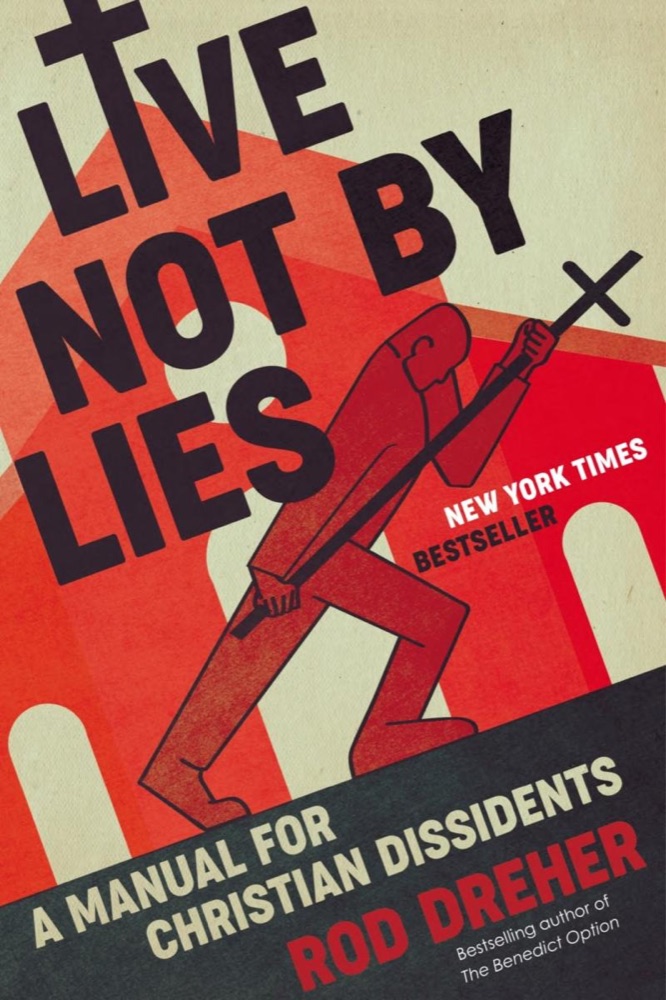
 Live Not by Lies: A Manual for Christian Dissidents
Quotes from the Book
A church that looks and talks and sounds just like the world has no reason to exist.
26
I am a college-educated American. In all my years of formal schooling, I never read Plato or Aristotle, Homer or Virgil. I knew nothing of Greek and Roman history and barely grasped the meaning of the Middle Ages. Dante was a stranger to me, and so was Shakespeare. The fifteen hundred years of Christianity from the end of the New Testament to the Reformation were a blank page, and I knew only the barest facts about Luther's revolution. I was ignorant of Descartes and Newton. My understanding of Western history began with the Enlightenment. Everything that came before it was lost behind a misty curtain of forgetting. Nobody did this on purpose. Nobody tried to deprive me of my civilizational patrimony. But nobody felt any obligation to present it to me and my generation in an orderly, coherent fashion. Ideas have consequences - and so does their lack.
17
Christians often talk about “reaching the culture” without realizing that, having no distinct Christian culture of their own, they have been co-opted by the secular culture they wish to evangelize.
9
Though Donald Trump won the presidency in part with the strong support of Catholics and Evangelicals, the idea that someone as robustly vulgar, fiercely combative, and morally compromised as Trump will be an avatar for the restoration of Christian morality and social unity is beyond delusional. He is not a solution to the problem of America’s cultural decline, but a symptom of it. The
7
Ideology is the enemy of joyful community life, and the most destructive ideology is the belief that creating utopia is possible.
5
If there is going to be authentic renewal, it will have to happen in families and local church communities.
5
If we are going to be for the world as Christ meant for us to be, we are going to have to spend more time away from the world, in deep prayer and substantial spiritual training—just as Jesus retreated to the desert to pray before ministering to the people. We cannot give the world what we do not have.
4
The overweight person diets not to punish him- or herself for being heavy but to become healthier. The athlete works out not because he feels guilty for sitting around watching TV but to train his body for competition. So it is with monks and their asceticism—and so it must be with us lay Christians.
4
If you are going to put down spiritual roots, taught Benedict, you need to stay in one place long enough for them to go deep. The Rule requires monks to take a vow of “stability”—meaning that barring unusual circumstances, including being sent out as a missionary, the monk will remain for the rest of his life in the monastery where he took his vows.
3
Love is the only way we will make it through what is to come. Love is not romantic ectasy. It has to be a kind of love that has been honed and intensified through regular prayer, fasting, and repentance and, for many Christians, through receiving the holy sacraments. And it must be a love that has been refined through suffering. There is no other way.
3
I began to wonder what, exactly, mainstream conservatism was conserving. It dawned on me that some of the causes championed by my fellow conservatives—chiefly an uncritical enthusiasm for the market—can in some circumstances undermine the thing that I, as a traditionalist, considered the most important institution to conserve: the family. I
3
Developing the cognitive control that leads to a more contemplative Christian life is the key to living as free men and women in post-Christian America. The man whose desires are under the control of his reason is free. The man who does whatever occurs to him is a slave. Untold
3
But American Christians are going to have to come to terms with the brute fact that we live in a culture, one in which our beliefs make increasingly little sense. We speak a language that the world more and more either cannot hear or finds offensive to its ears.
3
The moment the Benedict Option becomes about anything other than communion with Christ and dwelling with our neighbors in love, it ceases to be Benedictine,” he said. “It can’t be a strategy for self-improvement or for saving the church or the world.
2
Once, during my Catholic days, I was complaining with a Catholic friend about how terrible the teaching was in parish life. A priest listening to us said that everything we griped about was true, but we didn't have to resign ourselves and our children to this fate. 'You could go online to Amazon.com tonight and have sent to you within a week a theological library that Aquinas would have envied,' he said. 'My parents raised me in the seventies, which was the beginning of the catechesis nightmare. They knew that if they were going to raise Catholic kids, they would have to do a lot of it themselves, and they did. So do you.
2
To rediscover Christian asceticism is urgent for believers who want to train their hearts, and the hearts of their children, to resist the hedonism and consumerism at the core of contemporary culture. And it is necessary to teach us in our bones how God uses suffering to purify us for His purposes.
2
This kind of thing is why more and more Christian parents are concluding that they cannot afford to keep their children in public schools. Some tell themselves that their children need to remain there to be "salt and light" to the other kids. As popular culture continues its downward slide, however, this rationale begins to sound like a rationalization. It brings to mind a father who tosses his child into a whitewater river in the hopes that she'll save another drowning child.
2
Jesus Christ promised that the gates of Hell would not prevail against His church, but He did not promise that Hell would not prevail against His church in the West. That depends on us, and the choices we make right here, right now.
2
the church can’t just be the place you go on Sundays—it must become the center of your life.
2
Stability Along those lines, a tree that is repeatedly uprooted and transplanted will be hard pressed to produce healthy fruit. So it is with people and their spiritual lives. Rootlessness is not a new problem. In the first chapter of the Rule, Saint Benedict denounced the kind of monk he called a “gyrovague.” “They spend their whole lives tramping from province to province,” he wrote, adding that “they are always on the move, with no stability, they indulge their own wills”—and are even worse, the saint said, than the hedonistic monks whose only law is desire. If you are going to put down spiritual roots, taught Benedict, you need to stay in one place long enough for them to go deep. The Rule requires monks to take a vow of “stability”—meaning that barring unusual circumstances, including being sent out as a missionary, the monk will remain for the rest of his life in the monastery where he took his vows.
1
We live liturgically, telling our sacred Story in worship and song. We fast and we feast. We marry and give our children in marriage, and though in exile, we work for the peace of the city. We welcome our newborns and bury our dead. We read the Bible and we tell our children about the saints. And we also tell them in the orchard and by the fireside about Odysseus, Achilles, and Aeneas, of Dante and Don Quixote, and Frodo and Gandalf and all the tales that bear what it means to be men and women of the West. We work, we pray, we confess our sins, we show mercy, we welcome the stranger, and we keep the commandments. When we suffer, especially for Christ's sake, we give thanks, because that is what Christians do. Who knows what God, in turn, will do with our faithfulness? It is not for us to say. Our command is, in the words of the Christian poet W.H. Auden, to "stagger onward rejoicing
1
It is not feasible for most of us to abandon the Internet entirely. But at the very least we can impose on ourselves a discipline similar to the Benedictine monks, who, observing the Rule, strictly limit themselves to particular tasks during certain hours. We can also do more things with our hands. Put that way, it sounds almost childish, but there’s a serious point here. Technology enables us to treat interaction with the material world—people, places, things—as an abstraction. Getting our hands dirty, so to speak, with gardening, cooking, sewing, exercise, and the like, is a crucial way of restoring our sense of connection with the real world. So is doing things face to face with other people.
1
The medieval conception of reality is an old idea, one that predates Christianity. In his final book The Discarded Image, C. S. Lewis, who was a professional medievalist, explained that Plato believed that two things could relate to each other only through a third thing. In what Lewis called the medieval “Model,” everything that existed was related to every other thing that existed, through their shared relationship to God. Our relationship to the world is mediated through God, and our relationship to God is mediated through the world.
1
History gives us no clean, straight causal lines binding events and giving them clear order. History is a poem, not a syllogism.
1
faith that’s primarily intellectual—that is, a matter of mastering information—is deceptively fragile.
1
a church that is a church only on Sunday and at other formal gatherings of the congregation is not only failing to be the church Christ calls us all to be; it is also not going to be a church with the strength and the focus to endure the trials ahead.
1
Better to be a plumber with a clean conscience than a corporate lawyer with a compromised one.
They will have shown you that traditional Christianity is not dead, and that Truth, Beauty, and Goodness can be found and brought to life again, though doing so will cost you nothing less than everything.
religion has always understood that directing human attention toward what is holy is supremely important. This is why medieval Christendom was filled with prayers, rituals, fasts, and feasts: to keep life, both public and private, ordered around things divine.
The lesson here is that in an era in which logical reason is doubted and even dismissed, and the heart’s desire is glorified by popular culture, the most effective way to evangelize is by helping people experience beauty and goodness. From that starting point, we help them to grasp the truth that all goodness and beauty emanate from the eternal God, who loves us and wants to be in relationship with us. For Christians, this might mean witnessing to others through music, theater, or some other form of art. Mostly, though, it will mean showing love to others through building and sustaining genuine friendships and through the example of service to the poor, the weak, and the hungry. As Brother Ignatius of Norcia reminds us, everything is evangelical.
Watch on YouTube
About Rod Dreher
We have collected 60 quotes from 2 books by Rod Dreher on BookQuoters.
More about the author →More by Rod Dreher
Live Not by Lies: A Manual for Christian Dissidents
About the book
In a radical new vision for the future of Christianity, NYT bestselling author and conservative columnist Rod Dreher calls on American Christians to prepare for the coming Dark Age by embracing an ancient Christian way of life.
The light of the Christian faith is flickering out all over the West, and only the willfully blind refuse to see it. From the outside, American churches are beset by challenges to religious liberty in a rapidly secularizing culture. From the inside, they are being hollowed out by the departure of young people and a watered-down pseudo-spirituality. Political solutions have failed, as the triumph of gay marriage and the self-destruction of the Republican Party indicate, and the future of religious freedom has never been in greater doubt. The center is not holding. The West, cut off from its Christian roots, is falling into a new Dark Age.
The bad news is th
Book details
- First published
- 2017
- Author
- Rod Dreher
- Genre
- Nonfiction
- Goodreads rating
- 3.79 (7k ratings)
Keep reading
 Resident Aliens: Life in the Christian Colony
 The Spirit of the Disciplines: Understanding How God Changes Lives
 Simply Christian
 Bad Religion: How We Became a Nation of Heretics
 Total Truth: Liberating Christianity from its Cultural Captivity
 Jesus for President: Politics for Ordinary Radicals
 Rediscover Catholicism
 The Reason for God: Belief in an Age of Skepticism
 Amazing Grace: A Vocabulary of Faith
 Ethics
 The Cloister Walk
 Christless Christianity: The Alternative Gospel of the American Church
 The Prodigal God: Recovering the Heart of the Christian Faith
 unChristian: What a New Generation Really Thinks about Christianity... and Why It Matters
 Studies in the Sermon on the Mount
 Shameless: A Case for Not Feeling Bad About Feeling Good
 A Pilgrimage to Eternity: From Canterbury to Rome in Search of a Faith
 Celebration of Discipline: The Path to Spiritual Growth
 The Gospel in a Pluralist Society
 A Generous Orthodoxy
 The Secret Thoughts of an Unlikely Convert: An English Professor's Journey Into Christian Faith
 The Irresistible Revolution: Living as an Ordinary Radical
 The Explicit Gospel
 Discipline: The Glad Surrender
 The Life You've Always Wanted: Spiritual Disciplines for Ordinary People
 Practicing the Way: Be with Jesus, Become Like Him, Do As He Did
 Leaving Church: A Memoir of Faith
 Holy Envy: Finding God in the Faith of Others
 The Holy Longing: The Search for a Christian Spirituality
 Radical: Taking Back Your Faith from the American Dream
 Surprised by Hope: A Study of Christian Hope and Resurrection
 Velvet Elvis: Repainting the Christian Faith
 The Crucible of Doubt: Reflections On the Quest for Faith
 Disciplines of a Godly Man
 Life Together: The Classic Exploration of Christian Community
 The Deeply Formed Life: Five Transformative Values to Root Us in the Way of Jesus
 Searching for God Knows What
 A Long Obedience in the Same Direction: Discipleship in an Instant Society
 For the Life of the World: Sacraments and Orthodoxy
 The Kingdom of God Is Within You
 The Great Omission: Reclaiming Jesus's Essential Teachings on Discipleship
 The Divine Conspiracy: Rediscovering Our Hidden Life in God
 Letters and Papers from Prison
 Jesus Among Other Gods: The Absolute Claims of the Christian Message
 Instruments in the Redeemer's Hands: People in Need of Change Helping People in Need of Change
 Searching for Sunday: Loving, Leaving, and Finding the Church
 King's Cross: The Story of the World in the Life of Jesus
 Soul Survivor: How Thirteen Unlikely Mentors Helped My Faith Survive the Church
 Freedom of Simplicity: Finding Harmony in a Complex World
 Out of Sorts: Making Peace with an Evolving Faith
 40 Days of Decrease: A Different Kind of Hunger. A Different Kind of Fast.
Live Not by Lies: A Manual for Christian Dissidents
40 Days of Decrease: A Different Kind of Hunger. A Different Kind of Fast.
Live Not by Lies: A Manual for Christian Dissidents
 Liturgy of the Ordinary: Sacred Practices in Everyday Life
 Misreading Scripture with Western Eyes: Removing Cultural Blinders to Better Understand the Bible
 Everything Belongs: The Gift of Contemplative Prayer
 Jesus and the Disinherited
 The World's Last Night: And Other Essays
 What We Talk about When We Talk about God