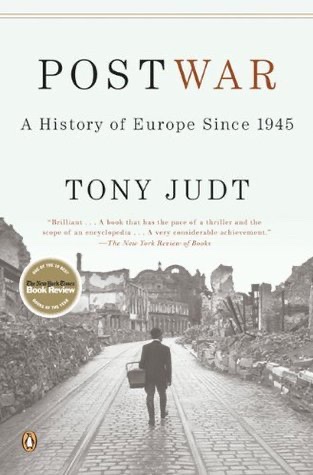
 Postwar: A History of Europe Since 1945
Quotes from the Book
Very few western Europeans or southeast Asians would have preferred to live in the type of Communist states that were created in eastern parts of their continental neighborhoods. And although the legacy of US interventions in Asia is usually roundly condemned, a majority of Europeans were and are convinced that the US military presence within their own borders helped keep the peace and develop democracies. The very fact that the Cold War confrontation between the Superpowers ended peacefully was of course of supreme importance: With enough nuclear weapons in existence to destroy the world several times over, we all depended on moderation and wisdom to avoid an atomic Armageddon.
1
The concept of “The West” was therefore meaningless before the 1950s. There were plenty of public references to a common heritage: Greece, Rome, Christianity, and badly disguised remarks about race. But there were no instruments of cohesion before military, economic, political, and cultural interaction sped up in the postwar era. These placed the United States at the center of western Europe’s consumer revolution, through its music, movies, and fashion as much as through its political ideals. An imagined America made it possible for many western Europeans to escape from restrictions of class, gender, or religion. The United States was therefore part of a European revolution that was in many ways as deep, and more lasting, than the Soviet impact in the eastern half of the continent.
1
The processes that ended the Cold War were manifold and complex, just like its origins had been. The end of the global conflict created enormous opportunities for good, as witnessed in southern Africa or southeast Asia. But not all issues were resolved, and some regional legacies lingered, such as in Korea, in the Middle East, or in the Balkans. Sometimes the outcome was contradictory. The economic hardships imposed on many Latin Americans often outweighed the celebrations over the return to more democratic and responsive forms of government. And some of the ideologies that overtook the Cold War dichotomy, religious fanaticism or nationalist self-obsession first among them, were as dangerous for the people caught up in them as the ideological struggles between capitalism and socialism had been. Still, the end of the Cold War opened up new possibilities for people everywhere. In some cases they made use of them to make a better world.
1. In the nuclear age, mankind must develop a new political thinking and a new concept of the world that provides sound guarantees for the survival of mankind. 2. The world we have inherited belongs to present and future generations alike—hence we must give priority to universal human values. 3. Human life must be acknowledged [as] the supreme value. 4. Non-violence must become the basis of human co-existence.
77 millones de chinos murieron por causas no naturales a consecuencia de las guerras o de los asesinatos de masas por motivos políticos entre las décadas de 1920 y 1980, y la inmensa mayoría de ellos murieron a manos de compatriotas suyos.
Watch on YouTube
About Odd Arne Westad
About the book
From a Bancroft Prize-winning scholar, a new global history of the Cold War and its ongoing impact around the world
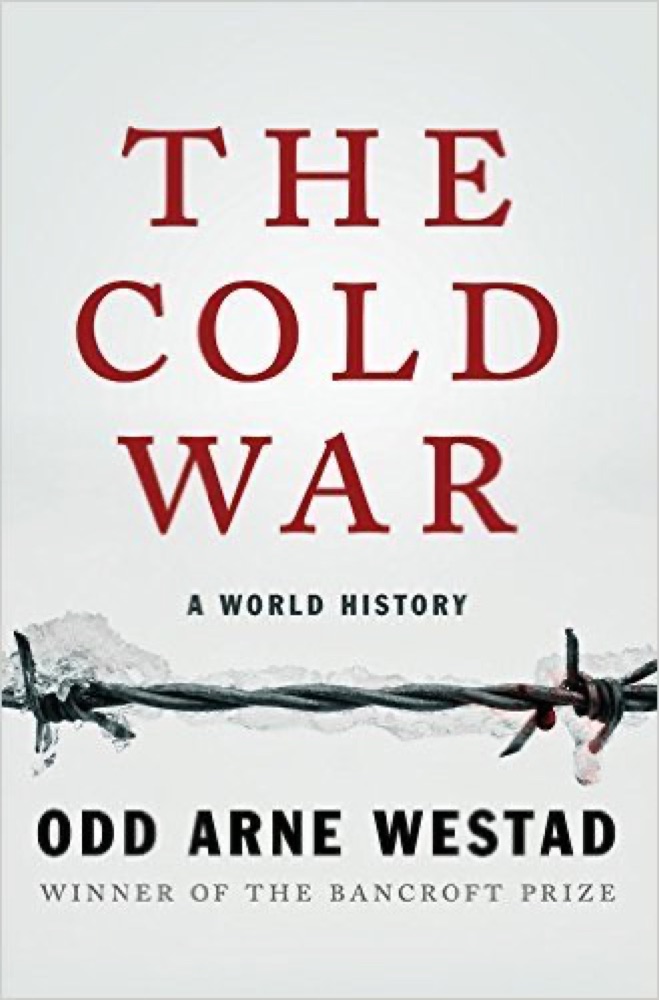
We tend to think of the Cold War as a bounded conflict: a clash of two superpowers, the United States and the Soviet Union, born out of the ashes of World War II and coming to a dramatic end with the collapse of the Soviet Union. But in this major new work, Bancroft Prize-winning scholar Odd Arne Westad argues that the Cold War must be understood as a global ideological confrontation, with early roots in the Industrial Revolution and ongoing repercussions around the world.
In The Cold War, Westad offers a new perspective on a century when great power rivalry and ideological battle transformed every corner of our globe. From Soweto to Hollywood, Hanoi, and Hamburg, young men and women felt they were fighting for the future of the world. The Cold War may have begun on t
Book details
- First published
- 2017
- Author
- Odd Arne Westad
- Genre
- History
- Goodreads rating
- 4.31 (3k ratings)
Keep reading
Postwar: A History of Europe Since 1945
 Flashpoints: The Emerging Crisis in Europe
 The Next 100 Years: A Forecast for the 21st Century
 The Jakarta Method: Washington's Anticommunist Crusade and the Mass Murder Program that Shaped Our World
 Upheaval: Turning Points for Nations in Crisis
 Imperium
 World Order
 Modern Times: The World from the Twenties to the Nineties
 Europe: A History
 Civilization: The West and the Rest
 The Revenge Of Geography: What the Map Tells Us About Coming Conflicts and the Battle Against Fate
 The Untold History of The United States
 The Strange Death of Europe: Immigration, Identity, Islam
 Dark Continent: Europe's Twentieth Century
 Blackshirts and Reds: Rational Fascism and the Overthrow of Communism
 Power Systems: Conversations on Global Democratic Uprisings and the New Challenges to U.S. Empire
 Prisoners of Geography: Ten Maps That Tell You Everything You Need to Know About Global Politics
 Understanding Power: The Indispensable Chomsky
 The End of History and the Last Man
 A World Without Islam
 The New Penguin History of The World
 The Dawn of Everything: A New History of Humanity
 America Alone: The End of the World As We Know It
 Guns, Germs, and Steel: The Fates of Human Societies
 Open Veins of Latin America: Five Centuries of the Pillage of a Continent
 Café Europa: Life After Communism
 Imperial Ambitions: Conversations on the Post-9/11 World
 The End of the Myth: From the Frontier to the Border Wall in the Mind of America
 Principles for Dealing with the Changing World Order: Why Nations Succeed and Fail
 Quotations from Chairman Mao Tsetung
 Conspirators' Hierarchy: The Story of the Committee of 300
 A People's History of the United States
 This Kind of War: A Study in Unpreparedness
 Brave New World Revisited
 The Nutmeg's Curse: Parables for a Planet in Crisis
 Collapse: How Societies Choose to Fail or Succeed
 Freedom: Memoirs 1954-2021
 The War on the West: An Instant NYT Bestselling History of the Modern World
 Defying Hitler
 Leadership : Six Studies in World Strategy
 A Russian Journal
 My Life: A Spoken Autobiography
 The Origins of Totalitarianism
 Twilight of Democracy: The Seductive Lure of Authoritarianism
 The Wizard and the Prophet: Two Remarkable Scientists and Their Dueling Visions to Shape Tomorrow's World
 The Better Angels of Our Nature: Why Violence Has Declined
 The Next Decade: Where We've Been . . . and Where We're Going
 Ill Fares the Land
 The Age of Revolution, 1789–1848
 The Coldest Winter: America and the Korean War
 Fascism: A Warning
 How Should We Then Live? The Rise and Decline of Western Thought and Culture
 Vulture Capitalism: Corporate Crimes, Backdoor Bailouts, and the Death of Freedom
 Capital and Ideology
 Secondhand Time: The Last of the Soviets
 Bloodlands: Europe Between Hitler and Stalin
 The Revolution Betrayed
 The Coming Insurrection
 Vietnam: An Epic Tragedy, 1945-1975