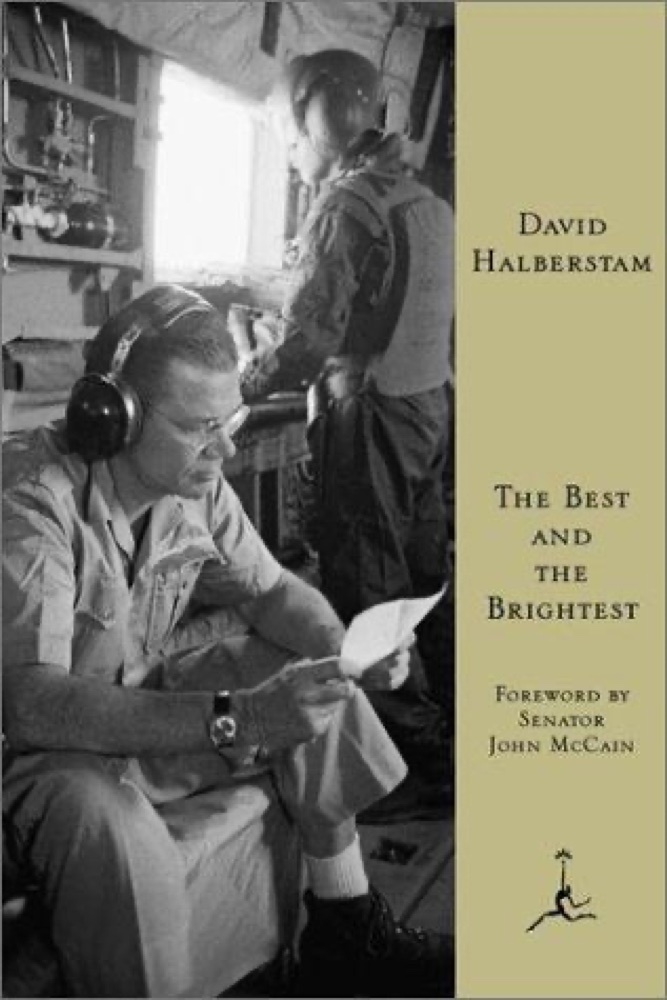
 The Best and the Brightest
Quotes from the Book
Fear was the terrible secret of the battlefiled and could afflict the brave as well as the timid. Worse it was contagious, and could destroy a unit before a battle even began. Because of that, commanders were first and foremost in the fear suppression business.
14
Gen. Matthew Ridgeway "intended not to impose his will on his men, but to allow the men under him to find something in themselves that would make them more confident, more purposeful fighting men. It was their confidence in themselves that would make them fight well, he believed, not so much their belief in him. His job was to keep them to find that quality in themselves.
5
Fear was the terrible secret of the battlefield and could afflict the brave as well as the timid. Worse it was contagious, and could destroy a unit before a battle even began. Because of that, commanders were first and foremost in the fear suppression business.
4
The truth posed a great dilemma for a man who always had to be right, and yet, for all his grandeur, was often wrong.
2
This was the mark of an uncommon soldier, someone whose courage away from the battlefield was the same as that on it.
2
What looked safe was not safe. What looked hard and unsafe was probably safer. Anyway, safe was somewhere else in the world.
2
Most commanders wanted as many good sources of information as possible. MacArthur was focused on limiting and controlling his sources of intelligence.
2
The author describes megalomania as seen in Chairman Mao by saying that what he was familiar with, he was really familiar with. This zeal moved the megalomaniac with a complete lack of appreciation for what he DID NOT know.
2
Major General John Coulter, known as Nervous John to much of his staff, was the most timid of the three corps commanders. That he was not up to the job was not exactly a secret. When Matt Ridgway took over the command of the Eighth Army a month later, Coulter was the first corps commander relieved, though the relief was masked as a promotion, for generals were always to be protected, and a star, his third, was added along with the Distinguished Service Medal.
1
They came from peasant backgrounds, had hated the Japanese colonization of Korea, and believed that the Americans and their proxies in Seoul were agents of the past, not enablers of the future; the Americans were now the allies of the Japanese, as well as the old Korean ruling class, and thus this was a continuation of the struggle that had forced them to leave their native soil years earlier. The leadership of the South Korean Army was in their minds a reflection of those Koreans who had fought alongside the Japanese, and in the upper-level ranks this was often true. The North Koreans troops had trained hard and were extremely well disciplined and motivated. They camouflaged themselves exceptionally well, stayed off the roads, and often moved over the harsh terrain by foot, as the Americans did not. Like the Chinese Communists who had trained them and with whom they had fought, they tended to avoid all-
1
had come all this way and this was what I get paid to do. So I went out and found his home and for four hours it all poured out, what had happened in those three days at Chipyongni when he was a young platoon leader. It was if he had been waiting for me to come by for fifty-five years, and he remembered everything as
1
The problem with a great democracy like the United States, George Kennan once noted, was that it was almost always like a sleeping giant, impervious to its surroundings until suddenly and belatedly awoken, when it proved so angry about what it discovered that it started lashing out wildly.
1
In 1947, Kennan wrote, “The men of the Kremlin would suddenly discover that this fluid and subtle oriental movement which they thought they held in the palm of their hand had quietly oozed away between their fingers and there was nothing left there but a ceremonial Chinese bow and a polite giggle.
1
The Tydings Committee eventually criticized McCarthy for his behavior and exonerated most of those attacked by him. McCarthy’s accusations, it reported, “represented perhaps the most nefarious campaign of half-truths and untruths in the history of the Republic.
1
He and Willoughby preferred that the Pentagon and the Truman administration be completely dependent upon them for any information about what was going on in their area of Asia—with no countervailing intelligence to limit his hand. Control intelligence, and you control decision-making.
1
Sometimes the best virtue learned on the battlefield is modesty.
1
Because history became his (Keenan's) genuine passion, he tended to see the world in terms of deep historical forces that, in his mind, formed a nation's character in ways almost beyond the consciousness of the men who momentarily governed it, as if these historical impulses were more a part of them than they knew.
1
If he (George Keenan)felt on occasion more than a little uncomfortable when being listened to, then he was truly unhappy when not being listened to.
1
Peterson thought it an unusual friendship, one only the Army could forge.
1
the thirty-eighth parallel, selected by the Americans and the Russians back in 1945 as the dividing line between the two Koreas, as a border at all.
What had happened in the Chinese civil war as much as anything else reflected those changes, something MacArthur never chose to understand. Part of that was his very nature, and what had become the nature of his mystique. He did not ask questions; that would imply there was something he did not know. Instead he was oracular, the man that others came to hear. Major
If the bombs dropped on Hiroshima and Nagasaki had seemed to inaugurate a brand-new chapter in the history of warfare, supposedly making all other weapons obsolete and creating a world where military power rested only with the richest, most technologically advanced nations, then the Korean battlefield defeats of early July 1950 shattered that belief
The UN of 1950 was still very much a reflection of American and Western European interests, the only significant dissent coming from the Soviets and their satellites. It was in some ways very much a last vestige of a white man’s world.
Watch on YouTube
About David Halberstam
We have collected 78 quotes from 4 books by David Halberstam on BookQuoters.
More about the author →More by David Halberstam
About the book
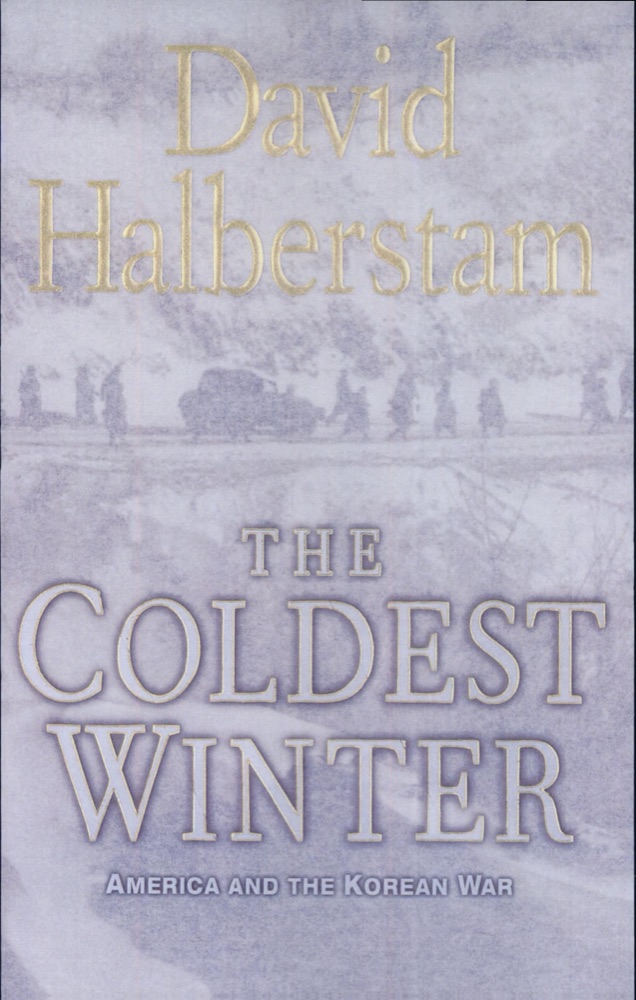
"In a grand gesture of reclamation & remembrance, Mr Halberstam has brought the war back home."--NY Times Halberstam's magisterial & thrilling The Best & the Brightest was a defining book about the Vietnam conflict. More than three decades later, he used his research & journalistic skills to shed light on another pivotal moment in our history: the Korean War. He considered The Coldest Winter his most accomplished work, the culmination of 45 years of writing about America's postwar foreign policy. He gives a masterful narrative of the political decisions & miscalculations on both sides. He charts the disastrous path that led to the massive entry of Chinese forces near the Yalu River & that caught Douglas MacArthur & his soldiers by surprise. He provides vivid & nuanced portraits of all the major figures-Eisenhower, Truman, Acheson, Kim, & Mao, & Generals MacArthur, Almond & Ridgway. At
Book details
- First published
- 2007
- Author
- David Halberstam
- Genre
- History
- Goodreads rating
- 4.23 (9k ratings)
Keep reading
 Mr. Lincoln's Army
The Best and the Brightest
Mr. Lincoln's Army
The Best and the Brightest
 This Kind of War: A Study in Unpreparedness
 Executive Orders
 The Guns of August
 Vietnam: An Epic Tragedy, 1945-1975
 Stilwell and the American Experience in China, 1911-45
 Closing the Ring
 The Civil War, Vol. 3: Red River to Appomattox
 The Winds of War
 The Guns at Last Light: The War in Western Europe, 1944-1945
 We Were Soldiers Once... and Young: Ia Drang - The Battle that Changed the War in Vietnam
 An Army at Dawn: The War in North Africa, 1942-1943
 The Second World War
 Band of Brothers: E Company, 506th Regiment, 101st Airborne from Normandy to Hitler's Eagle's Nest
 Pacific Crucible: War at Sea in the Pacific, 1941-1942
 The Last Lion: Winston Spencer Churchill: Alone, 1932-40
 The Monuments Men: Allied Heroes, Nazi Thieves, and the Greatest Treasure Hunt in History
 The First Salute : View of the American Revolution
 Dispatches
 Flyboys: A True Story of Courage
 A Rumor of War: The Classic Vietnam Memoir
 The Untold History of The United States
 The Splendid and the Vile: A Saga of Churchill, Family, and Defiance During the Blitz
 Truman
 Black Hawk Down
 Radio Free Albemuth
 Tigerman
 Dead Fall
 Into the Silence: The Great War, Mallory and the Conquest of Everest
 Epitaph for a Spy
 The Last Lion 3: Winston Spencer Churchill: Defender of the Realm, 1940-1965
 Homage to Catalonia
 Precipice
 The Invisible Bridge: The Fall of Nixon and the Rise of Reagan
 Agent Zigzag: A True Story of Nazi Espionage, Love, and Betrayal
 The Honourable Schoolboy
 The Looking Glass War
 The Fifties
 Reamde
 Revolutionary Summer: The Birth of American Independence
 One Year After
 Clear and Present Danger
 Ghost Soldiers: The Epic Account of World War II's Greatest Rescue Mission
 Diplomats & Admirals: From Failed Negotiations and Tragic Misjudgments to Powerful Leaders and Heroic Deeds, the Untold Story of the Pacific War from Pearl Harbor to Midway
 April 1865: The Month That Saved America
 The Admirals: Nimitz, Halsey, Leahy, and King—the Five-Star Admirals Who Won the War at Sea
 The Spy Who Came In from the Cold
 Facing the Mountain: A True Story of Japanese American Heroes in World War II
 Fall of Giants
 The Enemy
 Drift
Drift
 Alas, Babylon
 Going After Cacciato
 The Killer Angels
 Modern Times: The World from the Twenties to the Nineties
 Flags of Our Fathers
 The Man Who Saved the Union: Ulysses Grant in War and Peace
 The Black Wolf
 The Path to Power