

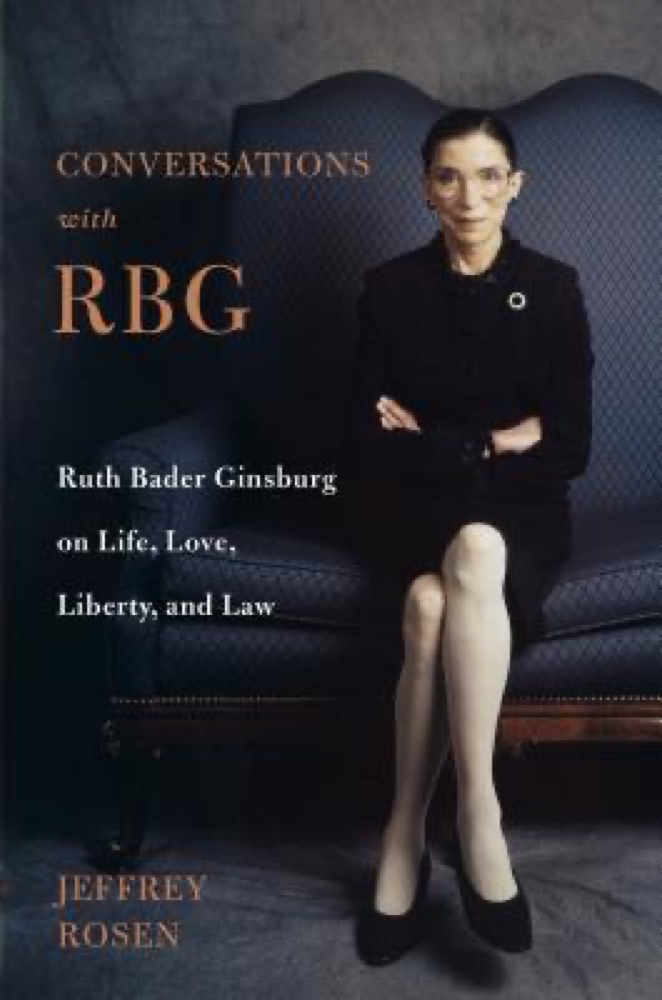
 Conversations with RBG: Ruth Bader Ginsburg on Life, Love, Liberty, and Law
Quotes from the Book
Rabbi Alfred Bettleheim once said: “Prejudice saves us a painful trouble, the trouble of thinking.
74
When a thoughtless or unkind word is spoken, best tune out. Reacting in anger or annoyance will not advance one’s ability to persuade.
73
Feminism … I think the simplest explanation, and one that captures the idea, is a song that Marlo Thomas sang, 'Free to be You and Me.' Free to be, if you were a girl—doctor, lawyer, Indian chief. Anything you want to be. And if you’re a boy, and you like teaching, you like nursing, you would like to have a doll, that’s OK too. That notion that we should each be free to develop our own talents, whatever they may be, and not be held back by artificial barriers—manmade barriers, certainly not heaven sent.
51
My mother was very strong about my doing well in school and living up to my potential. Two things were important to her and she repeated them endlessly. One was to ‘be a lady,’ and that meant conduct yourself civilly, don’t let emotions like anger or envy get in your way. And the other was to be independent, which was an unusual message for mothers of that time to be giving their daughters.
37
Yet what greater defeat could we suffer than to come to resemble the forces we oppose in their disrespect for human dignity?
35
For both men and women the first step in getting power is to become visible to others, and then to put on an impressive show. . . . As women achieve power, the barriers will fall. As society sees what women can do, as women see what women can do, there will be more women out there doing things, and we’ll all be better off for it.
26
We may be anxious to reduce crime, but we should remember that in our system of justice, the presumption of innocence is prime, and the law cannot apply one rule to Joe who is a good man, and another to John, who is a hardened criminal.
20
I remember envying the boys long before I even knew the word feminism, because I liked shop better than cooking or sewing.
19
Another often-asked question when I speak in public: “Do you have some good advice you might share with us?” Yes, I do. It comes from my savvy mother-in-law, advice she gave me on my wedding day. “In every good marriage,” she counseled, “it helps sometimes to be a little deaf.” I have followed that advice assiduously, and not only at home through fifty-six years of a marital partnership nonpareil. I have employed it as well in every workplace, including the Supreme Court of the United States. When a thoughtless or unkind word is spoken, best tune out. Reacting in anger or annoyance will not advance one’s ability to persuade.
17
In Greek mythology, Pallas Athena was celebrated as the goddess of reason and justice.1 To end the cycle of violence that began with Agamemnon’s sacrifice of his daughter, Iphigenia, Athena created a court of justice to try Orestes, thereby installing the rule of law in lieu of the reign of vengeance.2 Recall also the biblical Deborah (from the Book of Judges).3 She was at the same time prophet, judge, and military leader. This triple-headed authority was exercised by only two other Israelites, both men: Moses and Samuel. People came from far and wide to seek Deborah’s judgment. According to the rabbis, Deborah was independently wealthy; thus she could afford to work pro bono.4 Even if its members knew nothing of Athena and Deborah, the U.S. legal establishment resisted admitting women into its ranks far too long.
17
spent no time fretting, and found a way to do what I thought important to get done.
14
the greatest menace to freedom is an inert people; that public discussion is a political duty; and that this should be a fundamental principle of the American government. Brandeis
14
According to Ruth, Nabokov changed the way she read and wrote: “He used words to paint pictures. Even today, when I read, I notice with pleasure when an author has chosen a particular word, a particular place, for the picture it will convey to the reader.” Ruth remembers
13
Each part of my life provided respite from the other and gave me a sense of proportion that classmates trained only on law studies lacked.
10
We will all profit from a more diverse, inclusive society, understanding, accommodating, even celebrating our differences, while pulling together for the common good.
9
We children of public school age can do much to aid in the promotion of peace. We must try to train ourselves and those about us to live together with one another as good neighbors for this idea is embodied in the great new Charter of the United Nations. It is the only way to secure the world against future wars and maintain an everlasting peace.
9
At Cornell University, professor of European literature Vladimir Nabokov changed the way I read and the way I write. Words could paint pictures, I learned from him. Choosing the right word, and the right word order, he illustrated, could make an enormous difference in conveying an image or an idea.
8
Cushman, who assigned her to research McCarthy’s assault on civil liberties, “wanted me to understand two things,” Ruth recalls. “One is that we were betraying our most fundamental values, and, two, that legal skills could help make things better, could help to challenge what was going on.
7
Yet, as the numbers reveal, women in law, even today, are not entering a bias-free profession.
6
(A sense of humor is helpful for those who would advance social change.)
5
Once asked how we could be friends, given our disagreement on lots of things, Justice Scalia answered: 'I attack ideas. I don't attack people.
4
Reacting in anger or annoyance will not advance ones ability to persuade.
4
Justice Sandra Day O’Connor: For both men and women the first step in getting power is to become visible to others, and then to put on an impressive show. . . . As women achieve power, the barriers will fall. As society sees what women can do, as women see what women can do, there will be more women out there doing things, and we’ll all be better off for it.XII
4
Less than 3 percent of positions in the federal government at and above GS-16 rank are held by women.
3
And I give you this picture because it fairly captures our nearly fifty-year happy marriage, during which I have offered up an astonishing number of foolish pronouncements with absolute assurance, and Ruth, with only limited rancor, has ignored almost every one. A
3
certain hallmarks of her legal writing and thought—her care in choosing words, her wariness of politically motivated prosecution, her concern that shortcuts in the name of efficiency often reduce effectiveness in the long run, and her unswerving commitment to individual rights and the presumption of innocence—shone through even in that first letter to her college newspaper.
2
One is that we were betraying our most fundamental values, and, two, that legal skills could help make things better, could help to challenge what was going on.” 3
2
nascent, underfunded Supreme Court. Recent biographies of the great Chief Justice tell how John Marshall used the camaraderie of boardinghouse tables and common rooms, also madeira, to dispel dissent and achieve the one-voiced Opinion of the Court, which he usually composed and delivered himself. The unanimity John Marshall strived to maintain helped the swordless Third Branch fend off attacks from the political branches.9 Although Chief Justice Marshall strictly separated his Court and family life, he did not lack affection for his wife. In a letter from Philadelphia in 1797, John Marshall told Polly of his longing. “I like [the big city] well enough for a day or two,” he wrote Polly, “but I then
2
In every good marriage,” she counseled, “it helps sometimes to be a little deaf.
1
Watch on YouTube
About Ruth Bader Ginsburg
We have collected 29 quotes from 1 book by Ruth Bader Ginsburg on BookQuoters.
More about the author →About the book
Рут Бейдер Ґінзберґ — професійна легенда та культурна ікона американського судочинства, одна з перших жінок у Верховному Суді США та невтомна захисниця гендерної рівності. «Моїми словами», написана за участі Мері Гартнетт і Венді В. Вільямз — коментоване видання обраних статей, виступів і записок Ґінзберґ від її шкільної до суддівської лави, — переконливо демонструє широту юридичних інтересів Судді, її правничу скрупульозність та глибоку відданість ідеалам рівності для всіх, а також вдячність усім, хто торував шляхи для неї й наступних поколінь. Власними словами Ґінзберґ сприяла рівності та опиралася дискримінації, а також висловлювала вдячність і шанувала тих, хто робив це до неї та разом із нею.
Book details
- First published
- 2016
- Author
- Ruth Bader Ginsburg
- Genre
- Nonfiction
- Goodreads rating
- 4.03 (28k ratings)
The buzz
- The Washington PostReview in The Washington Postprofessional review (via Book Marks)
- LA Review of BooksReview in LA Review of Booksprofessional review (via Book Marks)
- Washington Independent Review of BooksReview in Washington Independent Review of Booksprofessional review (via Book Marks)
- NewrepublicReview in Newrepublicprofessional review (via Book Marks)
- UsatodayReview in Usatodayprofessional review (via Book Marks)
- Post GazetteReview in Post Gazetteprofessional review (via Book Marks)
Keep reading
Conversations with RBG: Ruth Bader Ginsburg on Life, Love, Liberty, and Law
 Hell and Other Destinations: A 21st-Century Memoir
 The Autobiography of Eleanor Roosevelt
 My Beloved World
 Shortest Way Home: One Mayor's Challenge and a Model for America's Future
 My Life on the Road
 Elizabeth Finch
 The Truths We Hold: An American Journey
 A Promised Land
 Becoming
 You Can't Be Neutral on a Moving Train: A Personal History of Our Times
 The Truth Will Set You Free, But First It Will Piss You Off!: Thoughts on Life, Love, and Rebellion
 Promises to Keep: On Life and Politics
 What Happened
 In Search of Our Mothers' Gardens: Womanist Prose
 The Small and the Mighty: Twelve Unsung Americans Who Changed the Course of History, from the Founding to the Civil Rights Movement
 Doing Justice: A Prosecutor's Thoughts on Crime, Punishment, and the Rule of Law
 Make Trouble: Standing Up, Speaking Out, and Finding the Courage to Lead
 Outrageous Acts and Everyday Rebellions
 Independent Study
 Gifted Hands: The Ben Carson Story
 Table for Two
 Ravelstein
 No Time To Spare: Thinking About What Matters
 The Downstairs Girl
 The Rebel Angels
 My Name Is Barbra
 Lead from the Outside: How to Build Your Future and Make Real Change
 Letters to a Young Contrarian
 The Sympathizer
 Wide Awake
 The Shape of Mercy
 Rules of Civility
 The Story of My Experiments With Truth
 Defending Jacob
 One Nation: What We Can All Do to Save America's Future
 Notorious RBG: The Life and Times of Ruth Bader Ginsburg
 Disclosure
 United: Thoughts on Finding Common Ground and Advancing the Common Good
 Anthills of the Savannah
 The Blue Sweater: Bridging the Gap Between Rich and Poor in an Interconnected World
 Children of Dune
 The Power
 The Moon is a Harsh Mistress
 The Hands of the Emperor
 The Woman in White
 Scion of Ikshvaku
 The Rosie Effect
 When Twilight Breaks
 The Jewel in the Crown
 The Master's Tools Will Never Dismantle the Master's House
 The Way We Live Now
 The Source of Self-Regard: Selected Essays, Speeches, and Meditations
 The Audacity of Hope: Thoughts on Reclaiming the American Dream
 Knife: Meditations After an Attempted Murder
 Across That Bridge: A Vision for Change and the Future of America
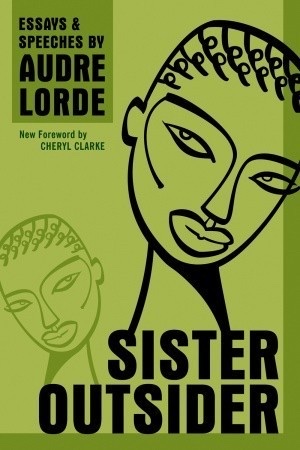 Sister Outsider: Essays and Speeches
 The Virginian
 Ancillary Sword