

 The Reason for God: Belief in an Age of Skepticism
Quotes from the Book
Whenever someone tries to deny the truth, ultimately, reality betrays him.
16
There is no neutral ground when it comes to the tolerance question. Everybody has a point of view she thinks is right, and everybody passes judgment at some point or another. The Christian gets pigeonholed as the judgmental one, but everyone else is judging, too, even people who consider themselves relativists.
13
An alternate explanation is not a refutation.
11
Here is the lesson: Don’t retreat in the face of opposition. Too much is at stake. Be the kind of soldier who instills respect in others because of your courage under fire. Make your case in the presence of hostile witnesses. Throw your gauntlet into the arena and see what the other side has to say. It’s one of the most effective ways to establish your case and to help you cultivate a bullet-proof faith over time.
6
The phrase 'Founding Fathers' is a proper noun. It refers to a specific group: the delegates to the Constitutional Convention. There were other important players not in attendance, but these fifty-five made up the core. Among the delegates were twenty-eight Episcopalians, eight Presbyterians, seven Congregationalists, two Lutherans, two Dutch Reformed, two Methodists, two Roman Catholics, one unknown, and only three deists- Williamson, Wilson, and Franklin. This took place at a time when church membership usually entailed "sworn adherence to strict doctrinal creeds." This tally proves that 51 of 55 -a full 93 percent- of the members of the Constitutional Convention, the most influential group of men shaping the political underpinnings of our nation were Christians, not deists.
6
Jesus said, “You shall love the Lord your God with all your heart, and with all your soul, and with all your mind, and with all your strength” (Mark 12:30). Loving God with the mind is not a passive process. It is not enough to have sentimental religious thoughts. Rather, it involves coming to conclusions about God and his world based on revelation, observation, and careful reflection.
5
Beware when rhetoric becomes a substitute for substance. You always know that a person has a weak position when he tries to accomplish with the clever use of words what argument alone cannot do.
5
The belief that objective good and evil do not exist (relativism) is in conflict (rivalry) with a rejection of God based on the existence of objective evil.
5
In a very real sense, every person who denies God is living of borrowed capital. He enjoys living as if the world is filled with morality, meaning, order and beauty, yet he denies the God whose existence makes such things possible. When you start with theism - "in the beginning God"- these destinations make complete sense. When you start with materialism though - "in the beginning, the particles" - that route takes you over a cliff of absurdity and despair.
3
The only consistent response for a relativist is, "Pushing morality is wrong for me, but that's just my personal opinion, and has nothing to do with you. Please ignore me.
3
When people say you can’t argue anyone into the kingdom, they usually have an alternative approach in mind. They might be thinking that a genuine expression of love, kindness, and acceptance, coupled with a simple presentation of the gospel, is a more biblical approach. If you are tempted to think this way, let me say something that may shock you: You cannot love someone into the kingdom. It can’t be done. In fact, the simple gospel itself is not even adequate to do that job. How do I know? Because many people who were treated with sacrificial love and kindness by Christians never surrendered to the Savior. Many who have heard a clear explanation of God’s gift in Christ never put their trust in him. In each case something was missing that, when present, always results in conversion. What’s missing is that special work of the Father that Jesus referred to, drawing a lost soul into his arms. Of this work Jesus also said, “Of all that He has given Me I lose nothing, but raise it up on the last day” (John 6:39). According to Jesus, then, two things are true. First, there is a particular work of God that is necessary to bring someone into the kingdom. Second, when present, this work cannot fail to accomplish its goal. Without the work of the Spirit, no argument — no matter how persuasive — will be effective. But neither will any act of love nor any simple presentation of the gospel. Add the Spirit, though, and the equation changes dramatically. Here’s the key principle: Without God’s work, nothing else works; but with God’s work, many things work. Under the influence of the Holy Spirit, love persuades. By the power of God, the gospel transforms. And with Jesus at work, arguments convince. God is happy to use each of these methods.
3
Asking questions enables you to escape the charge, “You’re twisting my words.” A question is a request for clarification specifically so you don’t twist their words.
2
C. S. Lewis notes: My argument against God was that the universe seemed so cruel and unjust. But how had I gotten this idea of just and unjust? A man does not call something crooked unless he has some idea of a straight line. 5 This is precisely the problem for the atheist. He must answer the question: Where does the moral scoring system come from that allows one to identify evil in the first place? Where is the transcendent standard of objective good that makes the whole notion of evil intelligible? Are moral laws the product of chance? If so, why obey them? What —or who —establishes how things are supposed to be?
2
G. K. Chesterton saw the problem over half a century ago: [The modernist] goes first to a political meeting where he complains that savages are treated as if they were beasts. Then he takes his hat and umbrella and goes on to a scientific meeting where he proves that they practically are beasts. . . . In his book on politics he attacks men for trampling on morality, and in his book on ethics he attacks morality for trampling on men.
2
If we disqualify legitimate discussion, we compromise our ability to know the truth.
2
Second, pluralism presumes that similarities between faiths are more important than differences. Think about it, though. Are aspirin and arsenic basically the same because they both come in tablet form? For some things, it’s the differences that matter, not the similarities. Religion is one of them.
1
And be forewarned. When someone says there’s no proof of God’s existence, it’s sometimes a trick. It may be a reasonable request for evidence, but often it’s not. Unless you know in advance what kind of evidence would count (scientific data? historical documentation? philosophical arguments? revelation?) or what kind of proof would be satisfying (absolute proof? proof beyond a reasonable doubt? proof based on the preponderance of evidence? proof that’s a reasonable inference to the best explanation?), you’ll probably be wasting your time. If you’re not clear on his criteria for proof, it will be too easy for an intellectually dishonest person to dismiss anything you offer. “Not good enough,” is all he needs to say. “That’s not proof.
1
carefully placed questions put you in the driver’s seat of the conversation. “Being an asker allows you control of situations that statement-makers rarely achieve,” Hewitt notes. “An alert questioner can judge when someone grows uneasy. But don’t stop. Just change directions. . . . Once you learn how to guide a conversation, you have also learned how to control it.”3 Questions can be casual conversation starters providing a simple, friendly way to get the ball rolling in a discussion, like it did for me with the witch in Wisconsin.
1
Richard Lewontin is amazingly candid about this fact. In the New York Review of Books he makes this stunning admission: Our willingness to accept scientific claims that are against common sense is the key to an understanding of the real struggle between science and the supernatural. We take the side of science in spite of the patent absurdity of some of its constructs . . . in spite of the tolerance of the scientific community for unsubstantiated just-so stories, because we have a prior commitment, a commitment to materialism. It is not that the methods and institutions of science somehow compel us to accept a material explanation of the phenomenal world, but, on the contrary, that we are forced by our a priori adherence to material causes to create an apparatus of investigation and a set of concepts that produce material explanations, no matter how counterintuitive, no matter how mystifying to the uninitiated. Moreover, that materialism is absolute, for we cannot allow a Divine Foot in the door.
1
People don’t know what they mean much of the time. Often they’re merely repeating slogans.
1
The greatest evil has not come from people zealous for God. It has resulted when people are convinced there is no God they must answer to.
1
First Amendment restricts the government, not the people (read it). It ensures that the government will not give special favor to any specific religious sect or denomination. It does not prevent religious people with religious convictions from being part of the political process.
MTO: Of course every culture has a flood story of some sort. That’s what you’d expect if there really was a great flood that wiped out most of the human population. Do you think every culture independently invented a fiction like that?
It’s clear we have some differences, including the vital issue of the identity of Jesus. I believe what John teaches in John 1:3, that Jesus is the uncreated Creator. This would make him God.
As ambassadors, we measure our legitimacy by faithfulness and obedience to Christ, who alone will bring the increase. The most important gauge of our success will not be our numbers or even our impact, but our fidelity to our Savior.
A commitment to truth — as opposed to a commitment to an organization — means an openness to refining one’s own views.
Peer review is based on a sound notion. If our ideas are easily destroyed by those acquainted with the facts, they ought to be discarded. But if our ideas are good, they will not be upended so easily. In the process, we will learn what the other side knows. We may even be surprised at how weak their resistance really is.
The more you sweat in training, the less you bleed in battle.
Watch on YouTube
About Gregory Koukl
We have collected 28 quotes from 1 book by Gregory Koukl on BookQuoters.
More about the author →About the book
In a world increasingly indifferent to Christian truth, followers of Christ need to be equipped to communicate with those who do not speak their language or accept their source of authority. Gregory Koukl demonstrates how to get in the driver's seat, keeping any conversation moving with thoughtful, artful diplomacy. You'll learn how to maneuver comfortably and graciously through the minefields, stop challengers in their tracks, turn the tables and—most importantly—get people thinking about Jesus. Soon, your conversations will look more like diplomacy than D-Day. Drawing on extensive experience defending Christianity in the public square, Koukl shows you how to: - Initiate conversations effortlessly - Present the truth clearly, cleverly, and persuasively - Graciously and effectively expose faulty thinking - Skillfully manage the details of dialogue - Maintain an engaging, disarming s
Book details
- First published
- 2000
- Author
- Gregory Koukl
- Genre
- Nonfiction
- Goodreads rating
- 4.35 (10k ratings)
Keep reading
The Reason for God: Belief in an Age of Skepticism
 Reasonable Faith
 Letter to a Christian Nation
 The Sign
 The Age of Reason
 What Is the Bible?: How an Ancient Library of Poems, Letters, and Stories Can Transform the Way You Think and Feel About Everything
 The God Delusion
 I Don't Have Enough Faith to Be an Atheist
 Compassion (&) Conviction: The AND Campaign's Guide to Faithful Civic Engagement
 The Portable Atheist: Essential Readings for the Nonbeliever
 Breaking the Spell: Religion as a Natural Phenomenon
 Jesus Among Other Gods: The Absolute Claims of the Christian Message
 The Story of My Experiments With Truth
 Finding God in the Waves: How I Lost My Faith and Found It Again Through Science
 The World's Last Night: And Other Essays
 The Gospel in a Pluralist Society
 Why I Am Not a Christian and Other Essays on Religion and Related Subjects
 The Crucible of Doubt: Reflections On the Quest for Faith
 Ethics
 Velvet Elvis: Repainting the Christian Faith
 The Case for Faith: A Journalist Investigates the Toughest Objections to Christianity
 Total Truth: Liberating Christianity from its Cultural Captivity
 A Little History of Religion
 Holy Envy: Finding God in the Faith of Others
 Letters and Papers from Prison
 Studies in the Sermon on the Mount
 The End of Faith: Religion, Terror, and the Future of Reason
 The Kingdom of God Is Within You
 What We Talk about When We Talk about God
 The Parafaith War
 The Rage Against God: How Atheism Led Me to Faith
 Mere Christianity
 The Explicit Gospel
 Think: A Compelling Introduction to Philosophy
 Think: The Life of the Mind and the Love of God
 The Everlasting Man
 The Case for Christianity
 How Should We Then Live? The Rise and Decline of Western Thought and Culture
 Rationality: From AI to Zombies
 The Mind of the Maker: Dorothy L. Sayers' Witty Classic on the Trinity, Christianity, and Human Creativity
 The Prodigal God: Recovering the Heart of the Christian Faith
 Heretics
 Amazing Grace: A Vocabulary of Faith
 What's So Great About Christianity
 The Meaning of It All: Thoughts of a Citizen-Scientist
 God Is Not One: The Eight Rival Religions That Run the World--and Why Their Differences Matter
 My Bright Abyss: Meditation of a Modern Believer
 Outgrowing God: A Beginner’s Guide to Atheism
 The Perennial Philosophy
 God's Debris: A Thought Experiment
 Doing Justice: A Prosecutor's Thoughts on Crime, Punishment, and the Rule of Law
 When I Was a Child I Read Books
 Resident Aliens: Life in the Christian Colony
 The Irresistible Revolution: Living as an Ordinary Radical
 The Better Angels of Our Nature: Why Violence Has Declined
 Discipline: The Glad Surrender
 On Christian Doctrine
 The Divine Conspiracy: Rediscovering Our Hidden Life in God
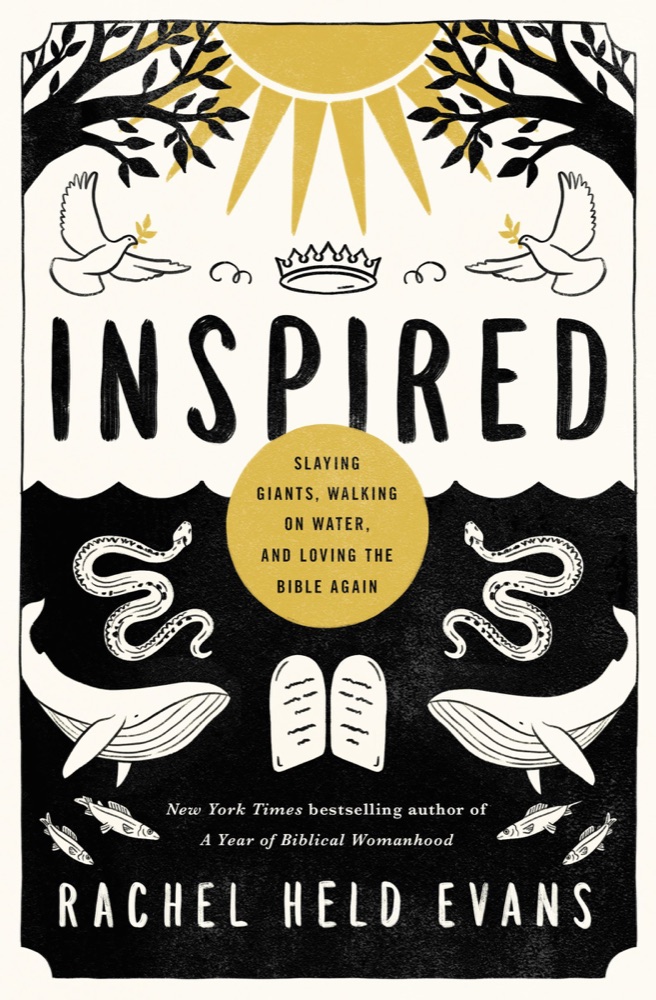 Inspired: Slaying Giants, Walking on Water, and Loving the Bible Again