
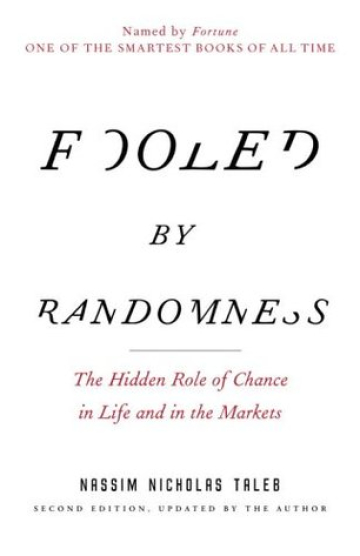
 Fooled by Randomness: The Hidden Role of Chance in Life and in the Markets
Quotes from the Book
I am, at the Fed level, libertarian; at the state level, Republican; at the local level, Democrat; and at the family and friends level, a socialist. If that saying doesn’t convince you of the fatuousness of left vs. right labels, nothing will.
175
The curse of modernity is that we are increasingly populated by a class of people who are better at explaining than understanding, or better at explaining than doing.
104
What matters isn’t what a person has or doesn’t have; it is what he or she is afraid of losing.
76
Courage is the only virtue you cannot fake.
72
The difference between successful people and really successful people is that really successful people say no to almost everything,
66
Those who talk should do and only those who do should talk.
61
You can define a free person precisely as someone whose fate is not centrally or directly dependent on peer assessment.
58
If you do not take risks for your opinion, you are nothing.
57
Bureaucracy is a construction by which a person is conveniently separated from the consequences of his or her actions.
56
For studying courage in textbooks doesn’t make you any more courageous than eating cow meat makes you bovine. By some mysterious mental mechanism, people fail to realize that the principal thing you can learn from a professor is how to be a professor—and the chief thing you can learn from, say, a life coach or inspirational speaker is how to become a life coach or inspirational speaker. So remember that the heroes of history were not classicists and library rats, those people who live vicariously in their texts. They were people of deeds and had to be endowed with the spirit of risk taking
54
Start by being nice to every person you meet. But if someone tries to exercise power over you, exercise power over him.
42
You do not want to win an argument. You want to win.
42
Don’t tell me what you think, tell me what you have in your portfolio.
41
How much you truly “believe” in something can be manifested only through what you are willing to risk for it.
39
Beware of the person who gives advice, telling you that a certain action on your part is “good for you” while it is also good for him, while the harm to you doesn’t directly affect him.
38
Finally, when young people who “want to help mankind” come to me asking, “What should I do? I want to reduce poverty, save the world,” and similar noble aspirations at the macro-level, my suggestion is: 1) Never engage in virtue signaling; 2) Never engage in rent-seeking; 3) You must start a business. Put yourself on the line, start a business.
36
Entrepreneurs are heroes in our society. They fail for the rest of us.
31
Let us return to pathemata mathemata (learning through pain) and consider its reverse: learning through thrills and pleasure. People have two brains, one when there is skin in the game, one when there is none. Skin in the game can make boring things less boring. When you have skin in the game, dull things like checking the safety of the aircraft because you may be forced to be a passenger in it cease to be boring. If you are an investor in a company, doing ultra-boring things like reading the footnotes of a financial statement (where the real information is to be found) becomes, well, almost not boring.
31
Avoid taking advice from someone who gives advice for a living, unless there is a penalty for their advice.
29
It is no secret that large corporations prefer people with families; those with downside risk are easier to own, particularly when they are choking under a large mortgage.
29
Scars signal skin in the game.
28
Alexander said that it was preferable to have an army of sheep led by a lion than an army of lions led by a sheep.
26
You will never fully convince someone that he is wrong; only reality can.
25
The only definition of rationality that I’ve found that is practically, empirically, and mathematically rigorous is the following: what is rational is that which allows for survival. Unlike modern theories by psychosophasters, it maps to the classical way of thinking. Anything that hinders one’s survival at an individual, collective, tribal, or general level is, to me, irrational.
25
A saying by the brothers Geoff and Vince Graham summarizes the ludicrousness of scale-free political universalism. I am, at the Fed level, libertarian; at the state level, Republican; at the local level, Democrat; and at the family and friends level, a socialist.
24
No person in a transaction should have certainty about the outcome while the other one has uncertainty.
24
People who are bred, selected, and compensated to find complicated solutions do not have an incentive to implement simplified ones.
23
But never engage in detailed overexplanations of why something is important: one debases a principle by endlessly justifying it.
22
what you learn from the intensity and the focus you had when under the influence of risk stays with you. You may lose the sharpness, but nobody can take away what you’ve learned. This is the principal reason I am now fighting the conventional educational system, made by dweebs for dweebs. Many kids would learn to love mathematics if they had some investment in it, and, more crucially, they would build an instinct to spot its misapplications.
19
If you want to study classical values such as courage or learn about stoicism, don’t necessarily look for classicists. One is never a career academic without a reason. Read the texts themselves: Seneca, Caesar, or Marcus Aurelius, when possible. Or read commentators on the classics who were doers themselves, such as Montaigne—people who at some point had some skin in the game, then retired to write books. Avoid the intermediary, when possible. Or fuhgetaboud the texts, just engage in acts of courage.
18
Watch on YouTube
About Nassim Nicholas Taleb
We have collected 145 quotes from 5 books by Nassim Nicholas Taleb on BookQuoters.
More about the author →More by Nassim Nicholas Taleb
Fooled by Randomness: The Hidden Role of Chance in Life and in the Markets
 The Black Swan: The Impact of the Highly Improbable
 Antifragile: Things That Gain from Disorder
About the book
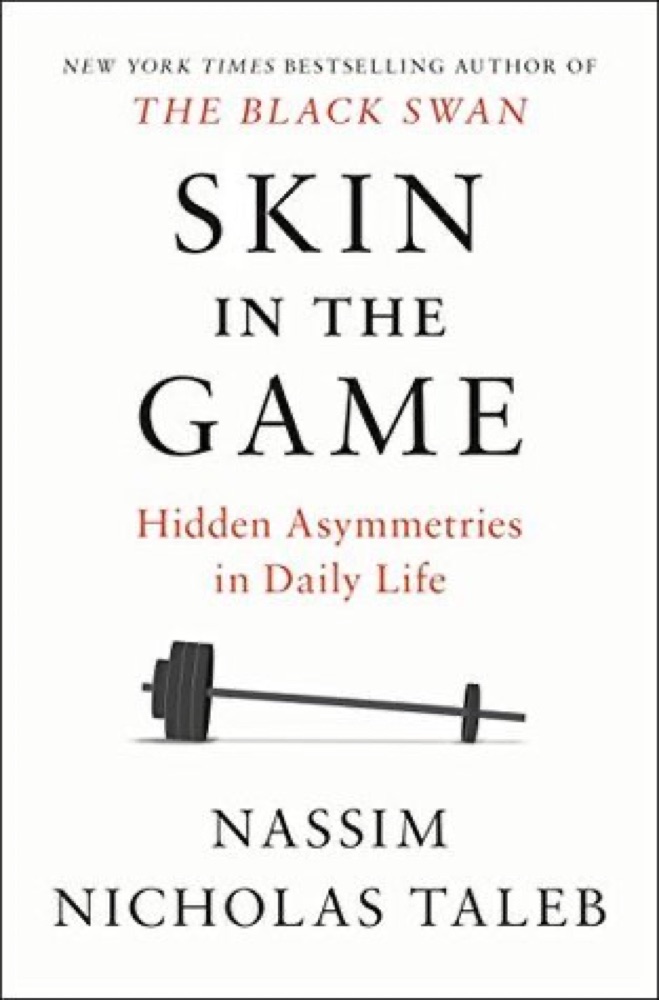
From the New York Times bestselling author of The Black Swan, a bold new work that challenges many of our long-held beliefs about risk and reward, politics and religion, finance and personal responsibility In his most provocative and practical book yet, one of the foremost thinkers of our time redefines what it means to understand the world, succeed in a profession, contribute to a fair and just society, detect nonsense, and influence others. Citing examples ranging from Hammurabi to Seneca, Antaeus the Giant to Donald Trump, Nassim Nicholas Taleb shows how the willingness to accept one’s own risks is an essential attribute of heroes, saints, and flourishing people in all walks of life. As always both accessible and iconoclastic, Taleb challenges long-held beliefs about the values of those who spearhead military interventions, make financial investments, and propagate religious faiths. A
Book details
- First published
- 2018
- Author
- Nassim Nicholas Taleb
- Genre
- Nonfiction
- Goodreads rating
- 3.91 (33k ratings)
Keep reading
 Think Like a Freak
 The Art of Thinking Clearly
The Black Swan: The Impact of the Highly Improbable
The Art of Thinking Clearly
The Black Swan: The Impact of the Highly Improbable
 How to Win Friends & Influence People
Antifragile: Things That Gain from Disorder
How to Win Friends & Influence People
Antifragile: Things That Gain from Disorder
 Think and Grow Rich
 Discourses and Selected Writings
 Children of Dune
 Rationality: From AI to Zombies
 Your Next Five Moves: Master the Art of Business Strategy
 David and Goliath: Underdogs, Misfits, and the Art of Battling Giants
 Barking Up the Wrong Tree: The Surprising Science Behind Why Everything You Know About Success Is (Mostly) Wrong
 Principles: Life and Work
 Independent Study
 Predictably Irrational: The Hidden Forces That Shape Our Decisions
 Wooden: A Lifetime of Observations and Reflections On and Off the Court
 Influence: The Psychology of Persuasion
 Getting There: A Book of Mentors
 Tools of Titans: The Tactics, Routines, and Habits of Billionaires, Icons, and World-Class Performers
 The Algebra of Wealth: A Simple Formula for Financial Security
 Letters to a Young Contrarian
 Unscripted: Life, Liberty, and the Pursuit of Entrepreneurship
 The 48 Laws of Power
 How to Use Your Enemies
 What I Learned Losing a Million Dollars
 Atlas Shrugged
 Courage Is Calling: Fortune Favors the Brave
 The 7 Habits of Highly Effective People: Personal Workbook
 Scion of Ikshvaku
 What the Dog Saw and Other Adventures
 Same as Ever: A Guide to What Never Changes
 You Can Win: A Step by Step Tool for Top Achievers
 Rules for Radicals: A Pragmatic Primer for Realistic Radicals
 How to Be a Bawse: A Guide to Conquering Life
 Do Epic Shit
 Letters from a Self-Made Merchant to His Son
 Excellent Advice for Living: Wisdom I Wish I'd Known Earlier
 Against the Grain: A Coach's Wisdom on Character, Faith, Family, and Love
 The Success Principles: How to Get from Where You Are to Where You Want to Be
 12 Rules for Life: An Antidote to Chaos
 The Power of One
 The Will of the Many
 Shoe Dog: A Memoir by the Creator of NIKE
 The Art of Living: The Classical Manual on Virtue, Happiness and Effectiveness
 The Last Lecture
 You Learn by Living: Eleven Keys for a More Fulfilling Life
 Ego Is the Enemy
 Let My People Go Surfing: The Education of a Reluctant Businessman
 Rich Dad Poor Dad
 Lead from the Outside: How to Build Your Future and Make Real Change
 Freakonomics: A Rogue Economist Explores the Hidden Side of Everything
 The Leader Who Had No Title: A Modern Fable on Real Success in Business and in Life
 Twilight of the Idols
 How To Get Rich
 Time Enough for Love
 Creativity, Inc.: Overcoming the Unseen Forces That Stand in the Way of True Inspiration
 Letters from a Stoic
 The Traveler's Gift: Seven Decisions that Determine Personal Success