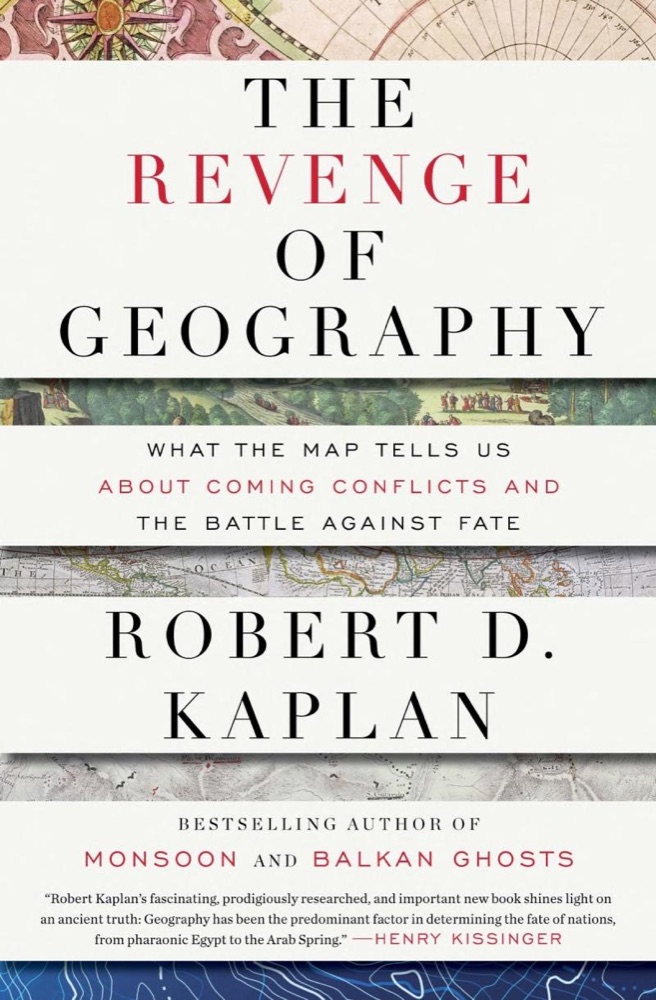
 The Revenge Of Geography: What the Map Tells Us About Coming Conflicts and the Battle Against Fate
Quotes from the Book
Eratosthenes, the mapmaker who was the first man to accurately measure the size of the Earth, was a librarian.
13
Borders may divide us, but, paradoxically, they're also the places where we're nearest to one another.
11
I always feel a certain sense of reverence in libraries, even small city ones that smell like homeless internet users.
11
Arthur Jay Klinghoffer, a professor of political science at Rutgers University, has argued that geography seems less relevant than ever in a world where nonstate actors -- malleable entities like ethnicities, for example -- are as powerful and important as the ones with governments and borders. Where on a map can you point to al-Qaeda? Or Google, or Wal-Mart? Everywhere and nowhere.
5
In his book Why Geography Matters, the geographer Harm de Blij argues that the West’s three great challenges of our time—Islamist terrorism, global warming, and the rise of China—are all problems of geography. An informed citizenry has to understand place, not because place is more important than other kinds of knowledge but because it forms the foundation for so much other knowledge.
4
There were two problems with this idea. First, it led to crappy “virtual reality” movies like Virtuosity and The Lawnmower Man. And second, in the long run, it turned out to be totally wrong.
3
To be rooted,” wrote Simone Weil, “is perhaps the most important and the least recognized need of the human soul.
2
If you never open a map until you're lost, you're missing out on all the fun.
2
Columbus’s fateful voyage was inspired by his study of a map by Paolo Toscanelli. But there was also the 1854 cholera outbreak in London, which killed hundreds of people until a physician, John Snow, drew a map demonstrating that a single contaminated water pump was the source of the illness, thereby founding the science of epidemiology. There was the 1944 invasion at Normandy, which succeeded only because of the unheralded contribution of mapmakers who had stolen across the English Channel by night for months before D-Day and mapped the French beaches.* Even the moon landing was a product of mapping. In 1961, the United States Geological Survey founded a Branch of Astrogeology, which spent a decade painstakingly assembling moon maps to plan the Apollo missions. The Apollo 11 crew pored over pouches of those maps as their capsule approached the lunar surface, much as Columbus did during his voyage. It seems that the greatest achievements in human history have all been made possible by the science of cartography.
1
The essential traits we associate with maps today evolved gradually over millennia. We first see cardinal directions on Babylonian clay tablet maps from five thousand years ago, for instance, but distances don’t appear on maps for three thousand more years—our oldest such example is a bronze plate from China’s Zhou Dynasty. Centuries more pass before we get to our oldest surviving paper map, a Greek papyrus depicting the Iberian Peninsula around the time of Christ. The first compass rose appears in the Catalan Atlas of 1375. “Chloropleth” maps—those in which areas are colored differently to represent different values on some scale, like the red-and-blue maps on election night—date back only to 1826.
1
It would be nice if Americans knew where a country was before we went to war with them.
Watch on YouTube
About Ken Jennings
We have collected 11 quotes from 1 book by Ken Jennings on BookQuoters.
More about the author →About the book
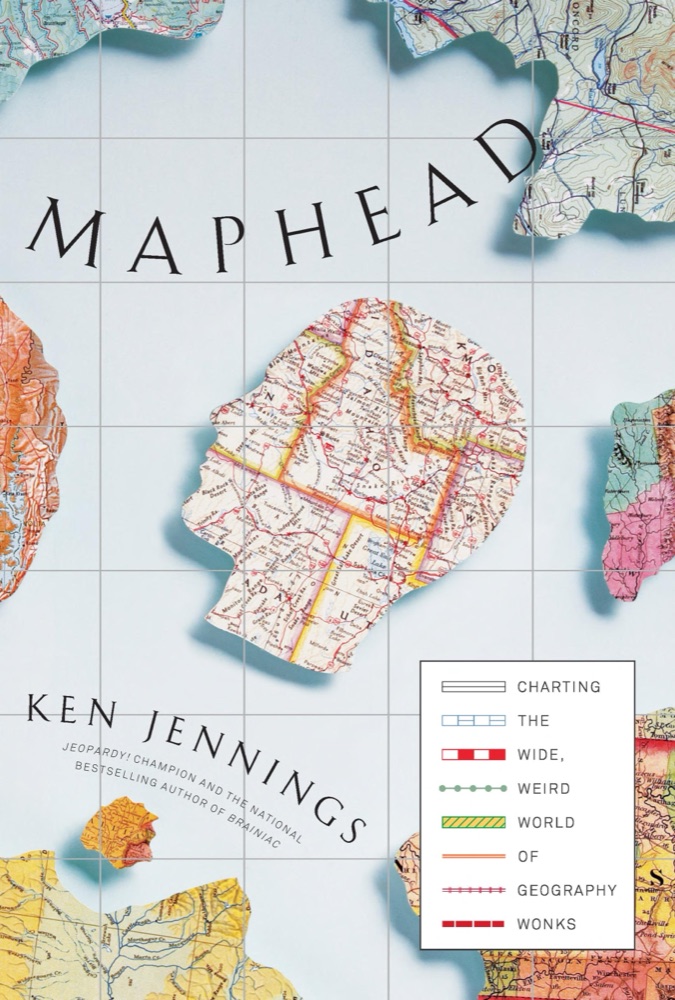
Maphead: Charting the Wide, Weird World of Geography Wonks is Ken's followup to his 2005 best-seller Brainiac. Much as Brainiac offered a behind-the-scenes look at the little-known demimonde of competitive trivia buffs, Maphead finally gives equal time to that other downtrodden underclass: America's map nerds.
In a world where geography only makes the headlines when college students are (endlessly) discovered to be bad at it, these hardy souls somehow thrive. Some crisscross the map working an endless geographic checklist: visiting all 3,143 U.S. counties, for example, or all 936 UNESCO World Heritage Sites. Some pore over million-dollar collections of the rarest maps of the past; others embrace the future by hunting real-world cartographic treasures like "geocaches" or "degree confluences" with GPS device in hand. Some even draw thousands of their own imaginary maps, lovingly detaili
Book details
- First published
- 2011
- Author
- Ken Jennings
- Genre
- Nonfiction
- Goodreads rating
- 3.86 (8k ratings)
Keep reading
The Revenge Of Geography: What the Map Tells Us About Coming Conflicts and the Battle Against Fate
 By the Sea
 The Selected Works of T.S. Spivet
 The Ghost Map: The Story of London's Most Terrifying Epidemic - and How It Changed Science, Cities, and the Modern World
 On Trails: An Exploration
 Prisoners of Geography: Ten Maps That Tell You Everything You Need to Know About Global Politics
 The World Is Flat: A Brief History of the Twenty-first Century
 A Sand County Almanac and Sketches Here and There
 Atlas of Remote Islands: Fifty Islands I Have Never Set Foot On and Never Will
 The Last Train to Zona Verde: My Ultimate African Safari
 The Medium is the Massage
 Where the Bluebird Sings to the Lemonade Springs: Living and Writing in the West
 The Last Continent
 The Geography of Genius: A Search for the World's Most Creative Places from Ancient Athens to Silicon Valley
 Billions & Billions: Thoughts on Life and Death at the Brink of the Millennium
 Distrust That Particular Flavor
 1491: New Revelations of the Americas Before Columbus
 The Information: A History, a Theory, a Flood
 The Wizard and the Prophet: Two Remarkable Scientists and Their Dueling Visions to Shape Tomorrow's World
 Bicycle Diaries
 The Nutmeg's Curse: Parables for a Planet in Crisis
 The Wayfinders: Why Ancient Wisdom Matters in the Modern World
 A History of the World in 100 Objects
 In the Light of What We Know
 Flashpoints: The Emerging Crisis in Europe
 A Field Guide to Getting Lost
 Education of a Wandering Man: A Memoir
 Flatland: A Romance of Many Dimensions
 Revenge of the Tipping Point
 The Lost City of Z: A Tale of Deadly Obsession in the Amazon
 Arctic Dreams
 How We Got to Now: Six Innovations That Made the Modern World
 Travels with Charley: In Search of America
 The Old Ways: A Journey on Foot
 Blue Highways
 The Know-It-All
 Landmarks
 The Lost Symbol
 Gun Island
 Flights
 Starry Messenger: Cosmic Perspectives on Civilization
 The Mapping of Love and Death
 Invisible Cities
 Skinny Legs and All
 The Journey Home: Some Words in Defense of the American West
 The Salmon of Doubt
 Hocus Pocus
 The Dark Forest
 The Partly Cloudy Patriot
 2061: Odyssey Three
 Fall; or, Dodge in Hell
 Understanding Media: The Extensions of Man
 Flâneuse: Women Walk the City in Paris, New York, Tokyo, Venice and London
 The Fifth Science
 The Art of Travel
 The Practice of Everyday Life
 The Lost World
 From Dawn to Decadence: 500 Years of Western Cultural Life, 1500 to the Present
 A Map of Days
 The World Without Us