
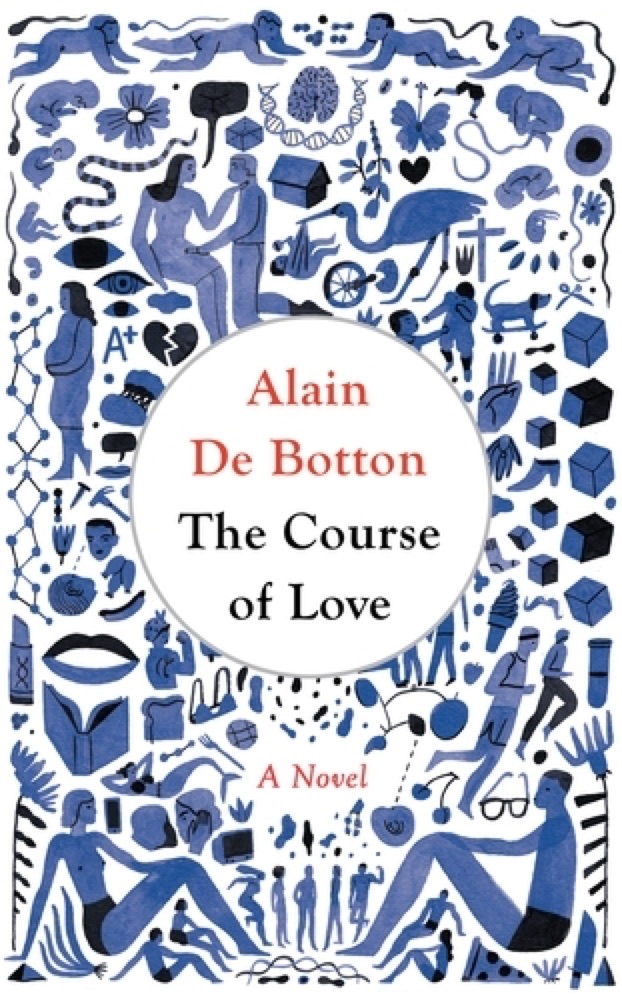
 The Course of Love
Quotes from the Book
Journeys are the midwives of thought. Few places are more conducive to internal conversations than a moving plane, ship or train. There is an almost quaint correlation between what is in front of our eyes and the thoughts we are able to have in our heads: large thoughts at times requiring large views, new thoughts new places. Introspective reflections which are liable to stall are helped along by the flow of the landscape. The mind may be reluctant to think properly when thinking is all it is supposed to do. At the end of hours of train-dreaming, we may feel we have been returned to ourselves - that is, brought back into contact with emotions and ideas of importance to us. It is not necessarily at home that we best encounter our true selves. The furniture insists that we cannot change because it does not; the domestice setting keeps us tethered to the person we are in ordinary life, but who may not be who we essentially are. If we find poetry in the service station and motel, if we are drawn to the airport or train carriage, it is perhaps because, in spite of their architectural compromises and discomforts, in spite of their garish colours and harsh lighting, we implicitly feel that these isolated places offer us a material setting for an alternative to the selfish ease, the habits and confinement of the ordinary, rooted world.
192
It seemed an advantage to be traveling alone. Our responses to the world are crucially moulded by the company we keep, for we temper our curiosity to fit in with the expectations of others...Being closely observed by a companion can also inhibit our observation of others; then, too, we may become caught up in adjusting ourselves to the companion's questions and remarks, or feel the need to make ourselves seem more normal than is good for our curiosity.
167
The pleasure we derive from journeys is perhaps dependent more on the mindset with which we travel than on the destination we travel to.
163
A dominant impulse on encountering beauty is to wish to hold on to it, to possess it and give it weight in one’s life. There is an urge to say, ‘I was here, I saw this and it mattered to me.
98
It is not necessarily at home that we best encounter our true selves. The furniture insists that we cannot change because it does not; the domestic setting keeps us tethered to the person we are in ordinary life, who may not be who we essentially are.
51
The sole cause of a man's unhappiness is that he does not know how to stay quietly in his room.
50
See how small your are next to the mountains. Accept what is bigger that you and what you do not understand. The world may appear illogical to you, but it does not follow that it is illogical per se. Our life is not the measure of all things: consider sublime places a reminder of human insignificance and frailty.
49
It is perhaps sad books that best console us when we are sad, and to lonely service stations that we should drive when there is no one for us to hold or love.
49
A danger of travel is that we see things at the wrong time, before we have had a chance to build up the necessary receptivity and when new information is therefore as useless and fugitive as necklace beads without a connecting chain.
39
There is psychological pleasure in this takeoff, too, for the swiftness of the plane’s ascent is an exemplary symbol of transformation. The display of power can inspire us to imagine analogous, decisive shifts in our own lives, to imagine that we, too, might one day surge above much that now looms over us.” P. 38-39
28
If it is true that love is the pursuit in another of qualities we lack in ourselves, then in our love of someone from another culture, one ambition may be to weld ourselves more closely to values missing from our own culture.
26
Instead of bringing back 1600 plants, we might return from our journeys with a collection of small unfêted but life-enhancing thoughts.
21
The destination was not really the point. The true desire was to get away—to go, as he concluded, ‘anywhere! anywhere! so long as it is out of the world!
18
What we find exotic abroad may be what we hunger for in vain at home.
18
…it seems we may best be able to inhabit a place where we are not faced with the additional challenge of having to be there.” (p.23)
16
A storyteller who provided us with such a profusion of details would rapidly grow maddening. Unfortunately, life itself often subscribes to this mode of storytelling, wearing us out with repetition, misleading emphases and inconsequential plot lines. It insists on showing us Bardak Electronics, the saftey handle in the car, a stray dog, a Christmas card and a fly that lands first on the rim and then in the centre of the ashtray. Which explains how the curious phenomenon whereby valuable elements may be easier to experience in art and in anticipation than in reality. The anticipatory and artistic imaginations omit and compress; they cut away the periods of boredom and direct our attention to critical moments, and thus, without either lying or embellishing, they lend to life a vividness and a coherence that it may lack in the distracting wooliness of the present.
16
And I wondered, with mounting anxiety, What am I supposed to do here? What am I supposed to think?
15
If we are inclined to forget how much there is in the world besides that which we anticipate, then works of art are perhaps a little to blame, for in them we find at work the same process of simplification or selection as in the imagination. Artistic accounts include severe abbreviations of what reality will force upon us. A travel book may tell us, for example, that the narrator journeyed through the afternoon to reach the hill town of X and after a night in its medieval monastery awoke to a misty dawn. But we never simply 'journey through an afternoon'. We sit in a train. Lunch digests awkwardly within us. The seat cloth is grey. We look out the window at a field. We look back inside. A drum of anxieties resolves in our consciousness. We notice a luggage label affixed to a suitcase in a rack above the seats opposite. We tap a finger on the window ledge. A broken nail on an index finger catches a thread. It starts to rain. A drop wends a muddy path down the dust-coated window. We wonder where our ticket might be. We look back at the field. It continues to rain. At last, the train starts to move. It passes an iron bridge, after which it inexplicably stops. A fly lands on the window And still we may have reached the end only of the first minute of a comprehensive account of the events lurking within the deceptive sentence 'He journeyed through the afternoon'. A storyteller who provides us with such a profusion of details would rapidly grow maddening. Unfortunately, life itself often subscribes to this mode of storytelling, wearking us out with repetitions, misleading emphases[,] and inconsequential plot lines. It insists on showing us Burdak Electronics, the safety handle in the car, a stray dog, a Christmas card[,] and a fly that lands first on the rim and then the centre of a laden ashtray. Which explains the curious phenomenon whereby valuable elements may be easier to experience in art and in anticipation than in reality. The anticipatory and artistic imaginations omit and compress; they cut away the periods of boredom and direct our attention to critical moments, and thus, without either lying or embellishing, they lend to life a vividness and a coherence that it may lack in the distracting woolliness of the present.
14
..we may value foreign elements not only because they are new but because they seem to accord more faithfully with our identity and commitments than anything our homeland can provide.
14
We are inundated with advice on where to travel to, but we hear little of why and how we should go, even though the art of travel seems naturally to sustain a number of questions neither so simple nor so trivial, and whose study might in modest ways contribute to an understanding of what the Greek philosophers beautifully termed eudaimonia, or ‘human flourishing’.
12
If we find poetry in the service station and motel, if we are drawn to the airport or train carriage, it is perhaps because, in spite of their architectural compromises and discomforts, in spite of their garish colours and harsh lighting, we implicitly feel that these isolated places offer us a material setting for an alternative to the selfish ease, the habits and confinement of the ordinary, rooted world.
12
Try, before taking off for distant hemispheres to notice what we have already seen.
11
The study of maps and the perusal of travel books aroused in me a secret fascination that was at times almost irresistible.
11
He [Wordsworth] invited his readers to abandon their usual perspective and to consider for a time how the world might look through other eyes, to shuttle between the human and the natural perspective. Why might this be interesting, or even inspiring? Perhaps because unhappiness can stem from only having one perspective to play with.
11
The twenty-four-hour diner, the station waiting room and the motel are sanctuaries for those who have, for noble reasons, failed to find a home in the ordinary world, sanctuaries for those whom Baudelaire might have dignified with the honorific 'poets'.
10
We can see beauty well enough just by opening our eyes, but how long this beauty will survive in memory depends on how intentionally we have apprehended it.
9
If the world seems unfair or beyond our understanding, sublime places suggest that it is not surprising that things should be thus. We are the playthings of the forces that laid out the oceans and chiselled the mountains.
9
Ruskin’s interest in beauty and in its possession led him to five central conclusions. First, beauty was the result of a number of complex factors that affected the mind both psychologically and visually. Second, humans had an innate tendency to respond to beauty and to desire to possess it. Third, there were many lower expressions of this desire for possession (including, as we have seen, buying souvenirs and carpets, carving one’s name on a pillar and taking photographs). Fourth, there was only one way to possess beauty properly, and that was by understanding it, by making oneself conscious of the factors (psychological and visual) responsible for it. And last, the most effective means of pursuing this conscious understanding was by attempting to describe beautiful places through art, by writing about or drawing them, irrespective of whether one happened to have any talent for doing so.
8
Watch on YouTube
About Alain de Botton
We have collected 333 quotes from 12 books by Alain de Botton on BookQuoters.
More about the author →More by Alain de Botton
All books by Alain de Botton →
About the book
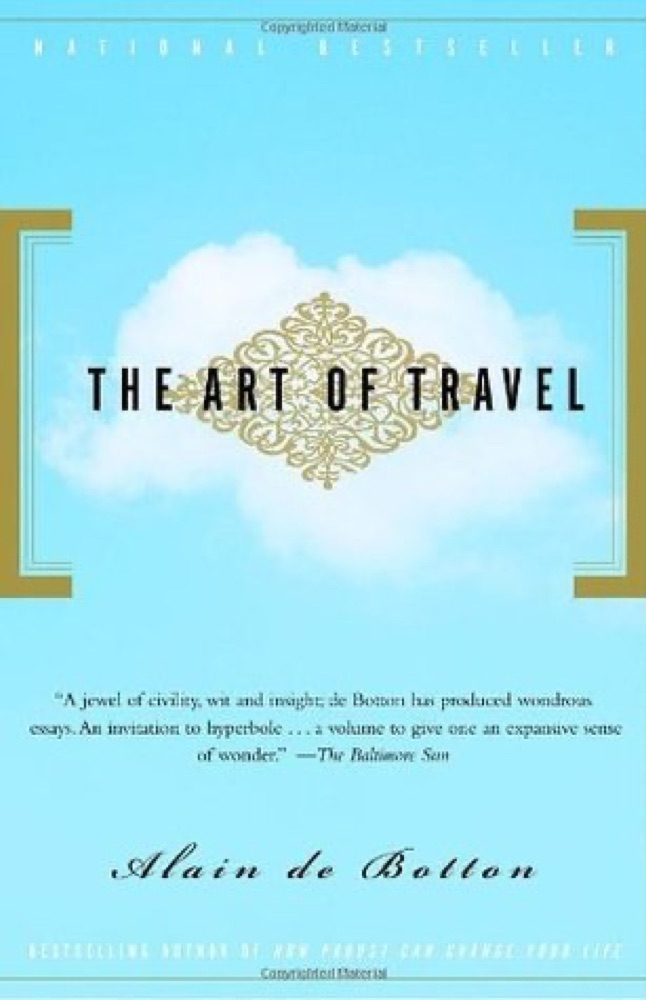
Any Baedeker will tell us where we ought to travel, but only Alain de Botton will tell us how and why. With the same intelligence and insouciant charm he brought to How Proust Can Save Your Life, de Botton considers the pleasures of anticipation; the allure of the exotic, and the value of noticing everything from a seascape in Barbados to the takeoffs at Heathrow. Even as de Botton takes the reader along on his own peregrinations, he also cites such distinguished fellow-travelers as Baudelaire, Wordsworth, Van Gogh, the biologist Alexander von Humboldt, and the 18th-century eccentric Xavier de Maistre, who catalogued the wonders of his bedroom. The Art of Travel is a wise and utterly original book. Don’t leave home without it.
Book details
- First published
- 2002
- Author
- Alain de Botton
- Genre
- Nonfiction
- Goodreads rating
- 3.82 (27k ratings)
Keep reading
 Flights
 How Proust Can Change Your Life
 Alone Time: Four Seasons, Four Cities, and the Pleasures of Solitude
 In Search of Lost Time
 On Such a Full Sea
 A Field Guide to Getting Lost
 The Way of the World
 Art as Therapy
 Destination Truth: Memoirs of a Monster Hunter
 Travels with Charley: In Search of America
 The Journey Home: Some Words in Defense of the American West
 Night Train to Lisbon
 The Pleasures and Sorrows of Work
 The Common Reader
 Time Regained
 Swann's Way
 Ghost Train to the Eastern Star
 Arctic Dreams
 A Year in the World: Journeys of a Passionate Traveller
 The Cat's Table
 Where the Bluebird Sings to the Lemonade Springs: Living and Writing in the West
 The Poetics of Space
 The Three-Cornered World
 Death in Venice and Other Tales
 The Great Railway Bazaar
 West with the Night
 In the Light of What We Know
 The Abundance
 Illuminations: Essays and Reflections
 The Doors of Perception & Heaven and Hell
 At Home in the World: Reflections on Belonging While Wandering the Globe
 Figuring
 The Doors of Perception
 Blue Highways
 A Passage to India
 All the Beauty in the World: The Metropolitan Museum of Art and Me
 Beautiful Ruins
 The Angel Esmeralda
 To Shake the Sleeping Self: A Journey from Oregon to Patagonia, and a Quest for a Life with No Regret
 The Faraway Nearby
 Wanderlust
 No One Writes Back
 The Magic Mountain
 Asymmetry
 Why Fish Don’t Exist: A Story of Loss, Love, and the Hidden Order of Life
 To The Bright Edge of the World
 Paris to the Moon
 On Trails: An Exploration
 The Snow Queen
 My Friends
 In Arabian Nights: A Caravan of Moroccan Dreams
 Blue Octavo Notebooks
 The Letters of Vincent van Gogh
 Big Sur and the Oranges of Hieronymus Bosch
 Sexing the Cherry
 The Empusium
 Winter
 Small World
 A Book of Simple Living
 Humboldt's Gift