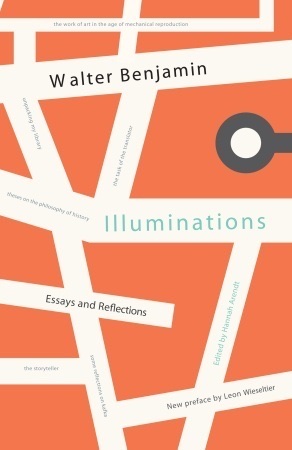
 Illuminations: Essays and Reflections
Quotes from the Book
To walk is to lack a place. It is the indefinite process of being absent and in search of a proper. The moving about that the city mutliplies and concentrates makes the city itself an immense social experience of lacking a place -- an experience that is, to be sure, broken up into countless tiny deportations (displacements and walks), compensated for by the relationships and intersections of these exoduses that intertwine and create an urban fabric, and placed under the sign of what ought to be, ultimately, the place but is only a name, the City...a universe of rented spaces haunted by a nowhere or by dreamed-of places.
50
To practice space is thus to repeat the joyful and silent experience of childhood; it is, in a place, to be other and to move toward the other...Kandinsky dreamed of: 'a great city built according to all the rules of architecture and then suddenly shaken by a force that defies all calculation.
27
The long poem of walking manipulates spatial organizations, no matter how panoptic they may be: it is neither foreign to them (it can take place only within them) nor in conformity with them (it does not receive its identity from them). It creates shadows and ambiguities within them. It inserts its multitudinous references and citations into them (social models, cultural mores, personal factors). Within them it is itself the effect of successive encounters and occasions that constantly alter it and make it the other's blazon: in other words, it is like a peddler carrying something surprising, transverse or attractive compared with the usual choice. These diverse aspects provide the basis of a rhetoric. They can even be said to define it.
14
Far from being writers—founders of their own place, heirs of the peasants of earlier ages now working on the soil of language, diggers of wells and builders of houses—readers are travellers; they move across lands belonging to someone else, like nomads poaching their way across fields they did not write, despoiling the wealth of Egypt to enjoy it themselves.
10
The same is true of stories and legends that haunt urban space like superfluous or additional inhabitants. They are the object of a witch-hunt, by the very logic of the techno-structure. But [the extermination of proper place names] (like the extermination of trees, forests, and hidden places in which such legends live) makes the city a 'suspended symbolic order.' The habitable city is thereby annulled. Thus, as a woman from Rouen put it, no, here 'there isn't any place special, except for my own home, that's all...There isn't anything.' Nothing 'special': nothing that is marked, opened up by a memory or a story, signed by something or someone else. Only the cave of the home remains believable, still open for a certain time to legends, still full of shadows. Except for that, according to another city-dweller, there are only 'places in which one can no longer believe in anything.
10
The panorama-city is a 'theoretical' (that is, visual) simulacrum, in short a picture, whose condition of possibility is an oblivion and a misunderstanding of practices.
10
First, if it is true that a spatial order organizes an ensemble of possibilities (e.g., by a place in which one can move) and interdictions (e.g., by a wall that prevents one from going further), than the walked actualizes some of these possibilities. In that way, he makes them exist as well as emerge. But he also moves them about and he invents others, since the crossing, drifting away, or improvisation of walking privilege, transform, or abandon spatial elements.
9
what does travel ultimately produce if it is not, by a sort of reversal, 'an exploration of the deserted places of my memory,' the return to nearby exoticism by way of a detour through distant places, and the 'discovery' of relics and legends: 'fleeting visions of the French countryside,' 'fragments of music and poetry,' in short, something like an 'uprooting in one's origins (Heidegger)? What this walking exile produces is precisely the body of legends that is currently lacking in one's own vicinity; it is a fiction, which moreover has the double characteristic like dreams or pedestrian rhetoric, or being the effect of displacements and condensations. As a corollary, one can measure the importance of these signifying practices (to tell oneself legends) as practices that invent spaces.
8
It is as though the practices organizing a bustling city were characterized by [city practitioners', everyday citizens'] blindness. The neworks of these moving, intersecting writings compose a manifold story that has neither author nor spectator, shaped out of fragments of trajectories and alterations of spaces: in relation to representations, it remains daily and indefinitely other.
6
His [the pedestrian's] elevation transfigures him into a voyeur. It puts his at a distance. It transforms the bewitching world by which one was 'possessed' into a text that lies before one's eyes. It allows one to read it, to be a solar Eye, looking down like a god. The exaltation of a scopic and gnostic drive: the fiction of knowledge is related to this lust to be a viewpoint and nothing more.
6
A memory is only a Prince Charming who stays just long enough to awaken the Sleeping Beauties of our wordless stories.
5
Their story begins on ground level, with footsteps. They are myriad, but do not compose a series. They cannot be counted because each unit has a qualitative character: a style of tactile apprehension and kinesthetic appropriation. Their swarming mass is an innumerable collection of singularities. Their intertwined paths give their shape to spaces. They weave places together. In that respect, pedestrian movements form one of these 'real systems whose existence in fact makes up the city.' They are not localized; it is rather they that spatialize. They are no more inserted within a container than those Chinese character speakers sketch out on their hands with their fingertips.
5
We travel abroad to discover in distant lands something whose presence at home has become unrecognisable.
4
Every story is a travel story – a spatial practice.
4
Everyday life invents itself by poaching in countless ways on the property of others.
4
When he grew old, Aristotle, who is not generally considered a tightrope dancer, liked to lose himself in the most labyrinthine and subtle of discourses […]. ‘The more solitary and isolated I become, the more I come to like stories,’ he said.
4
Places are fragmentary and inward-turning histories, pasts that others are not allowed to read, accumulated times that can be unfolded but like stories held in reserve, remaining in an enigmatic state, symbolizations encysted in the pain or pleasure of he body. 'I feel good here': the well-being under-expressed in the language it appears in like a fleeting glimmer is a spatial practice.
4
They become liberated spaces that can be occupied. A rich indetermination gives them, by means of a semantic rarefaction, the function of articulating a second, poetic geography on top of the geography of the literal, forbidden or permitted meaning. They insinuate other routes into the functionalist and historical order of movement. Walking follows them: 'I fill this great empty space with a beautiful name.
4
It seems thus possible to give a preliminary definition of walking as a space of enunciation.
4
Reading thus introduces an "art" which is anything but passive.
3
The trace left behind is substituted for the practice. It exhibits the (voracious) property that the geographical system has of being able to transform action into legibility, but in doing so it causes a way of being in the world to be forgotten.
3
Finally, the functionalist organization, by privileging progress (i.e. time), causes the condition of its own possibility--space itself--to be forgotten: space thus becomes the blind spot in a scientific and political technology. This is the way in which the Concept-city functions: a place of transformations and appropriations, the object of various kinds of interference but also a subject that is constantly enriched by new attributes, it is simultaneously the machinery and the hero of modernity.
2
Moreover, the question at hand concerns modes of operation or schemata of action, and not directly the subjects (or persons) who are their authors or vehicles. It concerns an operational logic whose models may go as far back as the age-old ruses of fishes and insects that disguise or transform themselves in order to survive, and which has in any case been concealed by the form of rationality currently dominant in Western culture.
1
Watch on YouTube
About Michel de Certeau
We have collected 23 quotes from 1 book by Michel de Certeau on BookQuoters.
More about the author →About the book
In this incisive book, Michel de Certeau considers the uses to which social representation and modes of social behavior are put by individuals and groups, describing the tactics available to the common man for reclaiming his own autonomy from the all-pervasive forces of commerce, politics, and culture. In exploring the public meaning of ingeniously defended private meanings, de Certeau draws brilliantly on an immense theoretical literature to speak of an apposite use of imaginative literature.
Book details
- First published
- 1980
- Author
- Michel de Certeau
- Genre
- Philosophy
- Goodreads rating
- 4.10 (4k ratings)
Keep reading
Illuminations: Essays and Reflections
 Wanderlust: A History of Walking
 Invisible Cities
 The Poetics of Space
 Flights
 The Medium is the Massage
 Selected Non-Fictions
 One Way Street And Other Writings
 The Arcades Project
 Flâneuse: Women Walk the City in Paris, New York, Tokyo, Venice and London
 The Old Ways: A Journey on Foot
 The Spell of the Sensuous: Perception and Language in a More-Than-Human World
 Understanding Media: The Extensions of Man
 Coventry: Essays
 The Paper Menagerie and Other Stories
 Species of Spaces and Other Pieces
 On Trails: An Exploration
 The Doors of Perception & Heaven and Hell
 Labyrinths: Selected Stories and Other Writings
 The Art of the Novel
 Ghosts of My Life: Writings on Depression, Hauntology and Lost Futures
 A Field Guide to Getting Lost
 The Invention of Solitude
 America
 The Songlines
 Maps of Meaning: The Architecture of Belief
 The Names
 Irrational Man: A Study in Existential Philosophy
 Landmarks
 Time Regained
 Figuring
 From Dawn to Decadence: 500 Years of Western Cultural Life, 1500 to the Present
 The Art of Travel
 The Castle of Crossed Destinies
 Sculpting in Time
 Bicycle Diaries
 The Master and His Emissary: The Divided Brain and the Making of the Western World
 The Faraway Nearby
 The Way of the World
 Myths to Live By
 Reality Hunger: A Manifesto
 By the Sea
 Always Coming Home
 Arctic Dreams
 Mao II
 Flatland: A Romance of Many Dimensions
 The Atrocity Exhibition
 The Common Reader
 Literary Theory: An Introduction
 Galatea 2.2
 Phenomenology of Perception
 The Ground Beneath Her Feet
 Trickster Makes This World: Mischief, Myth, and Art
 The Society of the Spectacle
 Open City
 Simulacra and Simulation
 On Truth and Lies in a Nonmoral Sense
 The Birth of Tragedy
 Anti-Oedipus: Capitalism and Schizophrenia
 The Wayfinders: Why Ancient Wisdom Matters in the Modern World