 Is a River Alive?
Quotes from the Book
We tend to think of landscapes as affecting us most strongly when we are in them or on them, when they offer us the primary sensations of touch and sight. But there are also the landscapes we bear with us in absentia, those places that live on in memory long after they have withdrawn in actuality, and such places -- retreated to most often when we are most remote from them -- are among the most important landscapes we possess.
34
Single trees are extraordinary; trees in number more extraordinary still. To walk in a wood is to find fault with Socrates's declaration that 'Trees and open country cannot teach me anything, whereas men in town do.' Time is kept and curated and in different ways by trees, and so it is experienced in different ways when one is among them. This discretion of trees, and their patience, are both affecting. It is beyond our capacity to comprehend that the American hardwood forest waited seventy million years for people to come and live in it, though the effort of comprehension is itself worthwhile. It is valuable and disturbing to know that grand oak trees can take three hundred years to grow, three hundred years to live and three hundred years to die. Such knowledge, seriously considered, changes the grain of the mind. "Thought, like memory, inhabits external things as much as the inner regions of the human brain. When the physical correspondents of thought disappear, then thought, or its possibility, is also lost. When woods and trees are destroyed -- incidentally, deliberately -- imagination and memory go with them. W.H. Auden knew this. 'A culture,' he wrote warningly in 1953, 'is no better than its woods.'
20
Touch is a reciprocal action, a gesture of exchange with the world. To make an impression is also to receive one, and the soles of our feet, shaped by the surfaces they press upon, are landscapes themselves with their own worn channels and roving lines. They perhaps most closely resemble the patterns of ridge and swirl revealed when a tide has ebbed over flat sand
18
Humans are animals and like all animals we leave tracks as we walk: signs of passage made in snow, sand, mud, grass, dew, earth or moss.... We easily forget that we are track-markers, through, because most of our journeys now occur on asphalt and concrete--and these are substances not easily impressed.
13
As I envisage it, landscape projects into us not like a jetty or peninsula, finite and bounded in its volume and reach, but instead as a kind of sunlight, flickeringly unmappable in its plays yet often quickening and illuminating. We are adept, if occasionally embarrassed, at saying what we make of places -- but we are far less good at saying what place makes of us. For some time now it has seemed to me that the two questions we should ask of any strong landscape are these: firstly, what do I know when I am in this place that I can know nowhere else? And then, vainly, what does this place know of me that I cannot know of myself?
11
Paths are the habits of a landscape. They are acts of consensual making. It's hard to create a footpath on your own...Paths connect. This is their first duty and their chief reason for being. They relate places in a literal sense, and by extension they relate people. Paths are consensual, too, because without common care and common practice they disappear: overgrown by vegetation, ploughed up or built over (through they may persist in the memorious substance of land law). Like sea channels that require regular dredging to stay open, paths NEED walking.
11
We lack - we need - a term for those places where one experiences a 'transition' from a known landscape... into 'another world': somewhere we feel and think significantly differently. They exist even in familiar landscapes: there when you cross a certain watershed, recline or snowline, or enter rain, storm or mist. Such moments are rites of passage that reconfigure local geographics, leaving known places outlandish or quickened, revealing continents within counties.
11
We are adept, if occasionally embarrassed, at saying what we make of places - but we are far less good at saying what places make of us...
9
The compact between writing and walking is almost as old as literature -- a walk is only a step away from a story, and every path tells.
8
Lift is created by the onwards rush of life over the curved wing of the soul.
7
As the pen rises from the page between words, so the walker's feet rise and fall between paces, and as the deer continues to run as it bounds from the earth and the dolphin continues to swim even as it leaps again and again from the sea, so writing and wayfaring are continuous activities, a running stitch, a persistence of the same seam or stream.
6
The whole foot is a document of motion, inscribed by repeated action. Babies - from those first foetal footfalls, the kneading of sole against womb-wall, turning themselves like astronauts in black space - have already creased their soles by the time they emerge into the world.
6
Adam Nicolson has written of the 'powerful absence[s]' that remembered landscapes exert upon us, but they exist as powerful presences too, with which we maintain deep and abiding attachments. These, perhaps, are the landscapes in which we live the longest,warped though they are by time and abraded though they are by distance
5
Felt pressure, sensed texture and perceived space can work upon the body and so too upon the mind, altering the textures and inclinations of thought.
4
From my heel to my toe is a measured space of 29.7 centimetres or 11.7 inches. This is a unit of progress and it is also a unit of thought. 'I can only meditate when I am walking,' wrote Jean-Jacques Rousseau in the fourth book of his 'Confessions', 'when I stop I cease to think; my mind only works with my legs.' Søren Kierkegaard speculated that the mind might function optimally at the pedestrian pace of three miles per hour, and in a journal entry describes going out for a wander and finding himself 'so overwhelmed with ideas' that he 'could scarcely walk'. Christopher Morley wrote of Wordsworth as 'employ[ing] his legs as an instrument of philosophy' and Wordsworth of his own 'feeling intellect'. Nietzsche was typically absolute on the subject - 'Only those thoughts which come from 'walking' have a value' - and Wallace Stevens typically tentative: 'Perhaps / The truth depends on a walk around the lake.' In all of these accounts, walking is not the action by which one arrives at knowledge; it is itself the means of knowing.
3
For pilgrims walking...every footfall is doubled, landing at once on the actual road and also on the path of faith.
3
It felt at that moment unarguable that a horizon line might exert as potent or pull upon the mind as a mountain's summit.
3
Landscape... can 'enlarge the imagined range for self to move in.
3
The best-known connection between footfall, knowledge and memory is the Aboriginal Australian vision of the Songlines. According to this cosmogony, the world was created in an epoch known as the Dreamtime, when the Ancestors emerged to find the earth a black, flat, featureless terrain. They began to walk out across this non-place, and as they walked they broke through the crust of the earth and released the sleeping life beneath it, so that the landscape sprang up into being with each pace. As Bruce Chatwin explained in his flawed but influential account, ‘each totemic ancestor, while travelling through the country, was thought to have scattered a trail of words and musical notes along the line of his footprints'. Depending on where they fell, these foot-notes became linked with particular features of the landscape. Thus the world was covered by ‘Dreaming-tracks’ that ‘lay over the land as “ways” of communication’, each track having its corresponding Song.... To sing out was–-and still is, just about, for the Songs survive, though more and more of them slip away with each generation–-therefore to find one’s way, and storytelling was indivisible from wayfaring.
3
For some time now it has seemed to me that two questions we should ask of any strong landscape are these: firstly, what do I know when I m in this place that I can know nowhere else? And then, vainly, what does this place know of me that I cannot know of myself?
2
He senses that the light-fall, surfaces, slopes and sounds of a landscape are all somehow involved in accessing what he calls the 'keyless chamber[s] of the brain'; that the instinct and the body must know ways that the conscious mind cannot...he recognizes that weather is something we think in- 'the wind, the rain, the steaming road, and the vigorous limbs and glowing brain and that they created...We and the storm are one' - and that we would be better, perhaps, of not speaking of states of mind, but rather of atmospheres of mind or meteorologies of mind.
2
There is a humility to the act of the kora, which stands as a corrective to the self-exaltation of the mountaineer’s hunger for an utmost point. Circle and circuit, potentially endless, stand against the symbolic finality of the summit. The pilgrim on the kora contents himself always with looking up and inwards to mystery, where the mountaineer longs to look down and outwards onto knowledge.
2
I remembered what Thoreau had written in his journal about thinking nothing of walking eight miles to greet a tree.
2
I felt a sensation of candour and amplitude, of the body and mind opened up, of thought diffusing at the body's edges rather than ending at the skin.
2
The miniature sandscapes of ridge and valley pressed into the soles of my feet and for days after the walk I would feel a memory of that pressure and pattern.
2
As the pen rises from the page between words, so the walker’s feet rise and fall between paces, and as the deer continues to run as it bounds from the earth, and the dolphin continues to swim even as it leaps again and again from the sea, so writing and wayfaring are continuous activities, a running stitch, a persistence of the same seam or stream.
1
For him, as for so many other people, the mind was a landscape of a kind and walking a means of crossing it.
1
The footstepping biographer never actually reached his subject; only encountered at best second-order suggestions of their earlier presence: glimpses of afterglow, retinal ghosts, psychic gossamer.
1
Buried seeds thrown to the surface by explosion and trench digging have resulted in surreal sprays of early spring flowers, growing among bones and mess tins.
1
Watch on YouTube
About Robert Macfarlane
We have collected 134 quotes from 5 books by Robert Macfarlane on BookQuoters.
More about the author →More by Robert Macfarlane
About the book
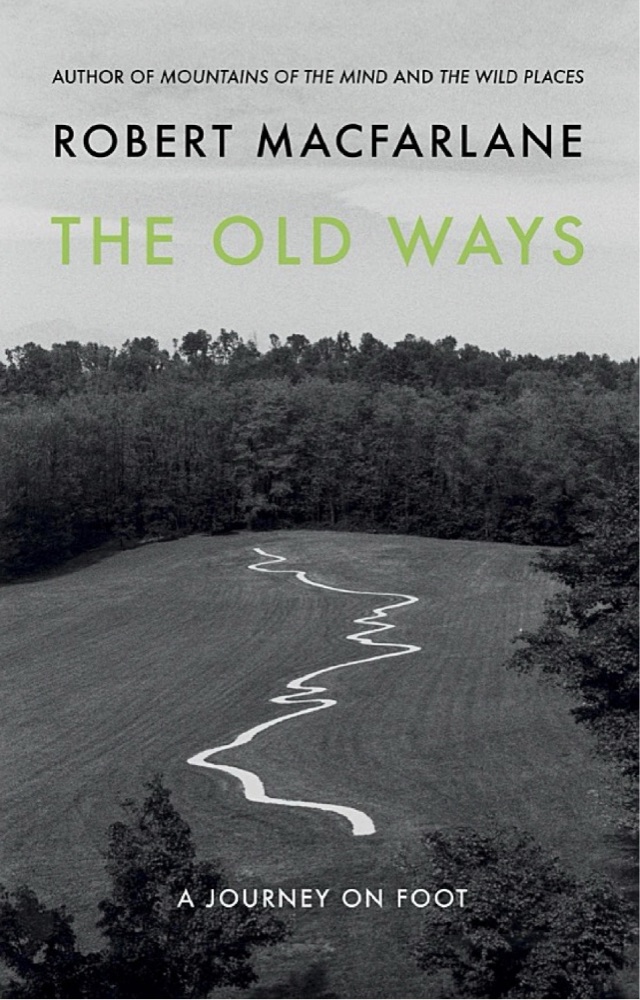
Robert Macfarlane travels Britain's ancient paths and discovers the secrets of our beautiful, underappreciated landscape.
Following the tracks, holloways, drove-roads and sea paths that form part of a vast ancient network of routes criss-crossing the British Isles and beyond, Robert Macfarlane discovers a lost world - a landscape of the feet and the mind, of pilgrimage and ritual, of stories and ghosts; above all of the places and journeys which inspire and inhabit our imaginations.
Book details
- First published
- 2012
- Author
- Robert Macfarlane
- Genre
- Nonfiction
- Goodreads rating
- 4.12 (12k ratings)
Keep reading
 Wanderlust: A History of Walking
 On Trails: An Exploration
 The Wild Places
 Landmarks
 The Journey Home: Some Words in Defense of the American West
 Flights
 Arctic Dreams
 A Field Guide to Getting Lost
 The Practice of Everyday Life
 Walking
 The Poetics of Space
 One Way Street And Other Writings
 The Selected Works of T.S. Spivet
 The Songlines
 Where the Bluebird Sings to the Lemonade Springs: Living and Writing in the West
 Winter Hours: Prose, Prose Poems, and Poems
 Swann's Way
 The Art of Travel
 Flâneuse: Women Walk the City in Paris, New York, Tokyo, Venice and London
 Landlines
 Fugitive Pieces
 The Salt Path
 To The Bright Edge of the World
 The Snow Leopard
 Vesper Flights
 West with the Night
 Pilgrim at Tinker Creek
 Winter
 By the Sea
 Autumn
 The Outermost House: A Year of Life on the Great Beach of Cape Cod
 There Are Rivers in the Sky
 Speak, Memory
 Lands of Lost Borders: Out of Bounds on the Silk Road
 The Hour of Land: A Personal Topography of America's National Parks
 The Wild Silence
 The Abundance
 A Natural History of the Senses
 The Willows
 Upstream: Selected Essays
 Underland: A Deep Time Journey
 Island Home
 H is for Hawk
 In Search of Lost Time
 Blue Octavo Notebooks
 The Immense Journey
 A Year in the World: Journeys of a Passionate Traveller
 Engine Summer
 Plainwater: Essays and Poetry
 Between a Rock and a Hard Place
 On Such a Full Sea
 The Lost Garden
 Invisible Cities
 The Spell of the Sensuous: Perception and Language in a More-Than-Human World
 Teaching a Stone to Talk: Expeditions and Encounters
 In Ascension
 The Notebooks of Malte Laurids Brigge
 Opened Ground
 The Names