
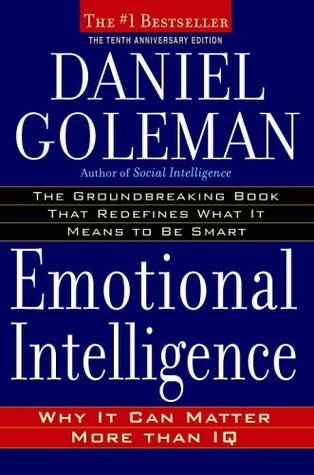
 Emotional Intelligence: Why It Can Matter More Than IQ
Quotes from the Book
Emotional intelligence is your ability to recognize and understand emotions in yourself and others, and your ability to use this awareness to manage your behavior and relationships.
Anyone can become angry—that is easy. But to be angry with the right person, to the right degree, at the right time, for the right purpose, and in the right way, this is not easy.
The biggest obstacle to increasing your self-awareness is the tendency to avoid the discomfort that comes from seeing yourself as you really are.
Remember, feedback is meant to address the problem, not the person.
You do control the thoughts that follow an emotion, and you have a great deal of say in how you react to an emotion—as long as you are aware of it.
Good decisions require far more than factual knowledge. They are made using self-knowledge and emotional mastery when they’re needed most.
The link between EQ and earnings is so direct that every point increase in EQ adds $1,300 to an annual salary.
Intelligence is your ability to learn, and it’s the same at age 15 as it is at age 50.
all emotions are derivations of five core feelings: happiness, sadness, anger, fear, and shame.
Your brain has a difficult time distinguishing between what you see with your eyes and what you visualize in your mind.
The tricky thing about your brain is that, once a negative mood takes over, you lose sight of what’s good in your life, and suddenly you hate your job, you’re frustrated with family and friends, you’re dissatisfied with your accomplishments, and your optimism about the future goes out the window. Deep down, you know that things aren’t as bad as they seem, but your brain just won’t hear it.
EQ is so critical to success that it accounts for 58 percent of performance in all types of jobs. It’s the single biggest predictor of performance in the workplace and the strongest driver of leadership and personal excellence.
Trust is a peculiar resource; it is built rather than depleted by use.
Self-awareness is the process of getting to know yourself from the inside out and the outside in.
Self-management is more than resisting explosive or problematic behavior. The biggest challenge that people face is managing their tendencies over time and applying their skills in a variety of situations.
Emotions serve an important purpose—they clue you into things that you’ll never understand if you don’t take the time to ask yourself why.
people with the highest levels of intelligence (IQ) outperform those with average IQs just 20% of the time, while people with average IQs outperform those with high IQs 70% of the time.
Stay aware of your good moods and the foolish decisions these moods can lead to, and you’ll be able to enjoy feeling good without any regrets.
The secret to winning this culture game is to treat others how they want to be treated, not how you would want to be treated.
Physical appearance is more straightforward—what you wear sends a pretty clear, established message about how you feel. For example, wearing old sweatpants and ratty T-shirts and having disheveled hair every day tells the world you’ve given up, while overdressing for every occasion and never missing your weekly haircut lets people know you are trying too hard.
Your personality is a result of your preferences, such as your inclination to introversion or extroversion. However, like IQ, personality can’t be used to predict emotional intelligence.
Hard times of any kind—financial, familial, or job-related—create more intense and often prolonged negative emotions that ultimately result in stress. In addition to the physical costs of stress, such as weight gain and heart disease, stress also taxes our mental resources.
Greeting someone by name is one of the most basic and influential social awareness strategies you can adopt. It’s a personal and meaningful way to engage someone. If you have a tendency to withdraw in social situations, greeting someone by name is a simple way to stick your neck out; using someone’s name breaks down barriers and comes across as warm and inviting. Even if you are a social butterfly, greeting people by name is a strategy to live by.
Social awareness is your ability to accurately pick up on emotions in other people and understand what is really going on with them.
When you’re stuck in a down mood, it’s not a good time to make important decisions. You’ll have to remain aware of the mood and understand it if you hope to keep it from leading you to make mistakes that will only pull you down further. Not only is it OK to reflect upon recent events that may have brought on the mood, but this is also a good idea—as long as you don’t dwell on them for too long—because often that’s all it takes to get the mood to pass.
This sounds basic, almost too basic to mention, but listening is a strategy and a skill that is losing ground in society. Most people think they are good listeners, but if adults played “the Telephone Game” today, how accurate would the final message be? Listening requires focus, and focus isn’t easy because we’re stretched in several directions. Listening
People high in self-awareness are remarkably clear in their understanding of what they do well, what motivates and satisfies them, and which people and situations push their buttons.
10 Watch EQ at the Movies Hollywood. It’s the entertainment capital of the world known for glitz, glamour, and celebrity. Believe it or not, Hollywood is also a hotbed of EQ, ripe for building your social awareness skills. After all, art imitates life, right? Movies are an abundant source of EQ skills in action, demonstrating behaviors to emulate or completely avoid. Great actors are masters at evoking real emotion in themselves; as their characters are scripted to do outrageous and obvious things, it’s easy to observe the cues and emotions on-screen. To build social awareness skills, you need to practice being aware of what’s happening with other people; it doesn’t matter if you practice using a box office hero or a real person. When you watch a movie to observe social cues, you’re practicing social awareness. Plus, since you are not living the situation, you’re not emotionally involved, and the distractions are limited. You can use your mental energy to observe the characters instead of dealing with your own life. This month, make it a point to watch two movies specifically to observe the character interactions, relationships, and conflicts. Look for body language clues to figure out how each character is feeling and observe how the characters handle the conflicts. As more information about the characters unfold, rewind and watch past moments to spot clues you may have missed the first time. Believe it or not, watching movies from the land of make-believe is one of the most useful and entertaining ways to practice your social awareness skills for the real world.
Remember, planning the future and reflecting on the past are valuable exercises, but doing this throughout your day interferes with what is in front of you—your present.
Much of doing and saying the right things in social situations comes from understanding the rules of the culture game. Our world is a melting pot of vastly different cultures. These cultures interact, live, and conduct business with each other according to very specific rules. There is no way around it, and it is a requirement to learn how to become emotionally intelligent across cultures. The secret to winning this culture game is to treat others how they want to be treated, not how you would want to be treated. The trick is identifying the different rules for each culture. To make matters even more complicated, the rules you should be watching for and mastering include the rules not only of ethnic culture but also of family and business culture. How do you go about mastering multiple sets of rules at once? The first step is to listen and watch even more and for a longer period of time than you would with people from your own culture. Collect multiple observations and think before you jump to conclusions. Consider yourself new in town, and before you open your mouth and insert your foot, observe other people’s interactions. Look for similarities and differences between how you would play the game versus how others are playing it. Next,
Watch on YouTube
About Travis Bradberry
We have collected 30 quotes from 1 book by Travis Bradberry on BookQuoters.
More about the author →Book details
- Author
- Travis Bradberry
- Genre
- Nonfiction
- Goodreads rating
- 3.85 (85k ratings) →
Keep reading
Emotional Intelligence: Why It Can Matter More Than IQ
 Social Intelligence: The New Science of Human Relationships
 The Laws of Human Nature
 Mastery
 Surrounded by Idiots
 Why Has Nobody Told Me This Before?
 The 7 Habits of Highly Effective People: Personal Workbook
 The Happiness Advantage: The Seven Principles of Positive Psychology That Fuel Success and Performance at Work
 Be a People Person
 How to Be a Bawse: A Guide to Conquering Life
 The Relationship Cure: A 5 Step Guide to Strengthening Your Marriage, Family, and Friendships
 Psycho-Cybernetics
 Crucial Conversations: Tools for Talking When Stakes are High
 Atlas of the Heart: Mapping Meaningful Connection and the Language of Human Experience
 The Highly Sensitive Person: How to Thrive When the World Overwhelms You
 The Daily Laws: 366 Meditations
 Excellent Advice for Living: Wisdom I Wish I'd Known Earlier
 How to Know a Person: The Art of Seeing Others Deeply and Being Deeply Seen
 Karamo: My Story of Embracing Purpose, Healing, and Hope
 The Art of Thinking Clearly
 Flow: The Psychology of Optimal Experience
 Blink: The Power of Thinking Without Thinking
 The Subtle Art of Not Giving a F*ck: A Counterintuitive Approach to Living a Good Life
 Your Erroneous Zones: Step-By-Step Advice for Escaping the Trap of Negative Thinking and Taking Control of Your Life
 The Things You Can See Only When You Slow Down: How to Be Calm in a Busy World
 Mindwise: How We Understand What Others Think, Believe, Feel, and Want
 The Social Animal: The Hidden Sources of Love, Character, and Achievement
 Maybe You Should Talk to Someone: A Therapist, Her Therapist, and Our Lives Revealed
 Awaken The Giant Within
 The Mountain Is You: Transforming Self-Sabotage Into Self-Mastery
 The Elephant in the Brain: Hidden Motives in Everyday Life
 The Happiness Hypothesis: Finding Modern Truth in Ancient Wisdom
 Delivering Happiness: A Path to Profits, Passion, and Purpose
 Maximum Achievement: Strategies and Skills That Will Unlock Your Hidden Powers to Succeed
 How to Fail at Almost Everything and Still Win Big: Kind of the Story of My Life
 If I Understood You, Would I Have This Look on My Face?: My Adventures in the Art and Science of Relating and Communicating
 Will
Will
 Build the Life You Want: The Art and Science of Getting Happier
 Principles: Life and Work
 Difficult Conversations: How to Discuss What Matters Most
 Presence: Bringing Your Boldest Self to Your Biggest Challenges
 Dare to Lead
 Smarter Faster Better: The Secrets of Being Productive in Life and Business
 Emotional Design: Why We Love (or Hate) Everyday Things
 The Complete Enneagram: 27 Paths to Greater Self-Knowledge
 How to Stay Sane
 The School of Life: An Emotional Education
 Tools of Titans: The Tactics, Routines, and Habits of Billionaires, Icons, and World-Class Performers
 The Power of Focus
 Feeling Good: The New Mood Therapy
 101 Essays That Will Change The Way You Think
 Adulting: How to Become a Grown-up in 468 Easy(ish) Steps
 Untangle Your Emotions: Naming What You Feel and Knowing What to Do About It
 Ego Is the Enemy
 The World According to Mister Rogers: Important Things to Remember
 The Art of Communicating
 It Worked for Me: In Life and Leadership
 The Element: How Finding Your Passion Changes Everything
 Think Again: The Power of Knowing What You Don't Know