
 Guns, Germs, and Steel: The Fates of Human Societies
Quotes from the Book
The great hatred of capitalism in the hearts of the oppressed, ancient and modern, I think, stems not merely from the ensuing vast inequality in wealth, and the often unfair and arbitrary nature of who profits and who suffers, but from the silent acknowledgement that under a free market economy the many victims of the greed of the few are still better off than those under the utopian socialism of the well-intended. It is a hard thing for the poor to acknowledge benefits from their rich moral inferiors who never so intended it. (p.272)
10
This revolutionary idea of Western citizenship—replete with ever more rights and responsibilities—would provide superb manpower for growing legions and a legal framework that would guarantee that the men who fought felt that they themselves in a formal and contractual sense had ratified the conditions of their own battle service. The ancient Western world would soon come to define itself by culture rather than by race, skin color, or language. That idea alone would eventually bring enormous advantages to its armies on the battlefield. (p. 122)
5
For a capitalist system to work, the state had to protect, not regulate or interfere with, free markets. Both for political and religious reasons, this the sultan could not do: The Ottomans had then no idea of the balance of trade. . . . Originated from an age-old tradition in the Middle East, the Ottoman trade policy was that the state had to be concerned above all that the people and craftsmen in the cities in particular would not suffer a shortage of necessities and raw material. Consequently, the imports were always welcomed and encouraged, and exports discouraged.
4
Given the Western ability to produce deadly weapons, its propensity to create cheap, plentiful goods, and its tradition of seeing war in pragmatic rather than ritual terms as a mechanism to advance political ends, it is no surprise that Mesoamericans, African tribes, and native North Americans all joined European forces to help kill off Aztecs, Zulus, and Lakotas.
2
Mexica warriors were predicated on birth and status. In a cyclical pattern of cause and effect, such greater innate advantages gave aristocrats predominance on the battlefield in taking captives, which in turn provided proof of their martial excellence—and
2
Japan would live and die by the race card—defining (and demonizing) America as “white” and thus Japan as a kindred but clearly superior “yellow” people.
2
After Salamis an imperial democratic culture arose at Athens that ruled the Aegean and gave us Aeschylus, Sophocles, the Parthenon, Pericles, Socrates, and Thucydides. Salamis proved that free peoples fought better than unfree, and that the most free of the free—the Athenians—fought the best of all.
1
Over the long haul, men fight better when they know that they have had the freedom to choose the occasion of their own deaths.
1
Martin Luther was excommunicated in the year Cortés first occupied Tenochtitlán, yet nascent Protestantism and its accompanying debate about religious doctrine would find no receptive audience back in contemporary Castile.
1
Watch on YouTube
About Victor Davis Hanson
We have collected 9 quotes from 1 book by Victor Davis Hanson on BookQuoters.
More about the author →About the book
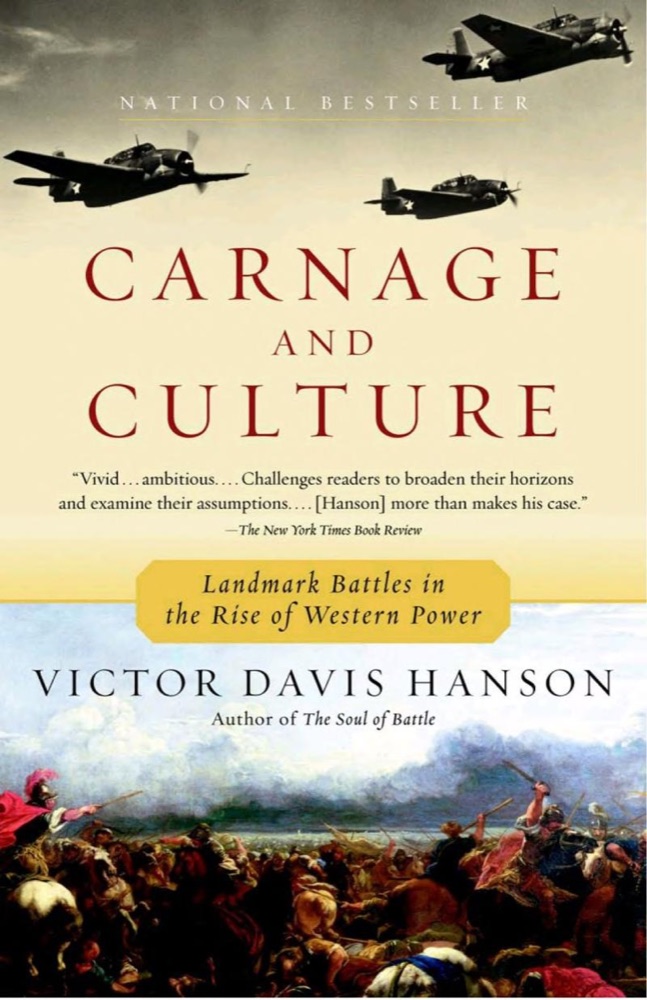
Examining nine landmark battles from ancient to modern times--from Salamis, where outnumbered Greeks devastated the slave army of Xerxes, to Cortes’s conquest of Mexico to the Tet offensive--Victor Davis Hanson explains why the armies of the West have been the most lethal and effective of any fighting forces in the world.
Looking beyond popular explanations such as geography or superior technology, Hanson argues that it is in fact Western culture and values–the tradition of dissent, the value placed on inventiveness and adaptation, the concept of citizenship–which have consistently produced superior arms and soldiers. Offering riveting battle narratives and a balanced perspective that avoids simple triumphalism, Carnage and Culture demonstrates how armies cannot be separated from the cultures that produce them and explains why an army produced by a free culture will always have the ad
Book details
- First published
- 2001
- Author
- Victor Davis Hanson
- Genre
- History
- Goodreads rating
- 4.07 (3k ratings)
Keep reading
Guns, Germs, and Steel: The Fates of Human Societies
 Civilization: The West and the Rest
 A History of the World in 100 Objects
 Flashpoints: The Emerging Crisis in Europe
 The Lessons of History
 The Untold History of The United States
 The Dawn of Everything: A New History of Humanity
 The New Penguin History of The World
 A People's History of the United States
 The Histories
 Open Veins of Latin America: Five Centuries of the Pillage of a Continent
 1491: New Revelations of the Americas Before Columbus
 Europe: A History
 Collapse: How Societies Choose to Fail or Succeed
 Capitalism: The Unknown Ideal
 The Wretched of the Earth
 The End of the Myth: From the Frontier to the Border Wall in the Mind of America
 Battle Cry of Freedom
 Caesar and Christ
 Discourse on Colonialism
 Genghis Khan and the Making of the Modern World
 A Distant Mirror: The Calamitous 14th Century
 The Age of Revolution, 1789–1848
 The Will to Battle
 SPQR: A History of Ancient Rome
 The End of History and the Last Man
 The History of the Decline and Fall of the Roman Empire Volume I
 Black Rednecks and White Liberals
 Freedom
 Modern Times: The World from the Twenties to the Nineties
 The First Salute : View of the American Revolution
 The Strange Death of Europe: Immigration, Identity, Islam
 The Revenge Of Geography: What the Map Tells Us About Coming Conflicts and the Battle Against Fate
 The War on the West: An Instant NYT Bestselling History of the Modern World
 Upheaval: Turning Points for Nations in Crisis
 The Better Angels of Our Nature: Why Violence Has Declined
 From Dawn to Decadence: 500 Years of Western Cultural Life, 1500 to the Present
 The Black Jacobins: Toussaint L'Ouverture and the San Domingo Revolution
 This Kind of War: A Study in Unpreparedness
 The Discourses
 The Machiavellians: Defenders of Freedom
 Destiny Disrupted: A History of the World Through Islamic Eyes
 The Inconvenient Indian: A Curious Account of Native People in North America
 A Short History of Progress
 How the Irish Saved Civilization
 The Next 100 Years: A Forecast for the 21st Century
 Defying Hitler
 An Indigenous Peoples' History of the United States
 The Decline and Fall of the Roman Empire
 The Crusades: The Authoritative History of the War for the Holy Land
 Culture and Imperialism
 Liberalism: The Classical Tradition
 Imperial Ambitions: Conversations on the Post-9/11 World
 These Truths: A History of the United States
 Principles for Dealing with the Changing World Order: Why Nations Succeed and Fail
 Arguably: Selected Essays
 The Committed
 Postwar: A History of Europe Since 1945
 The Hemingses of Monticello: An American Family
 America: The Farewell Tour