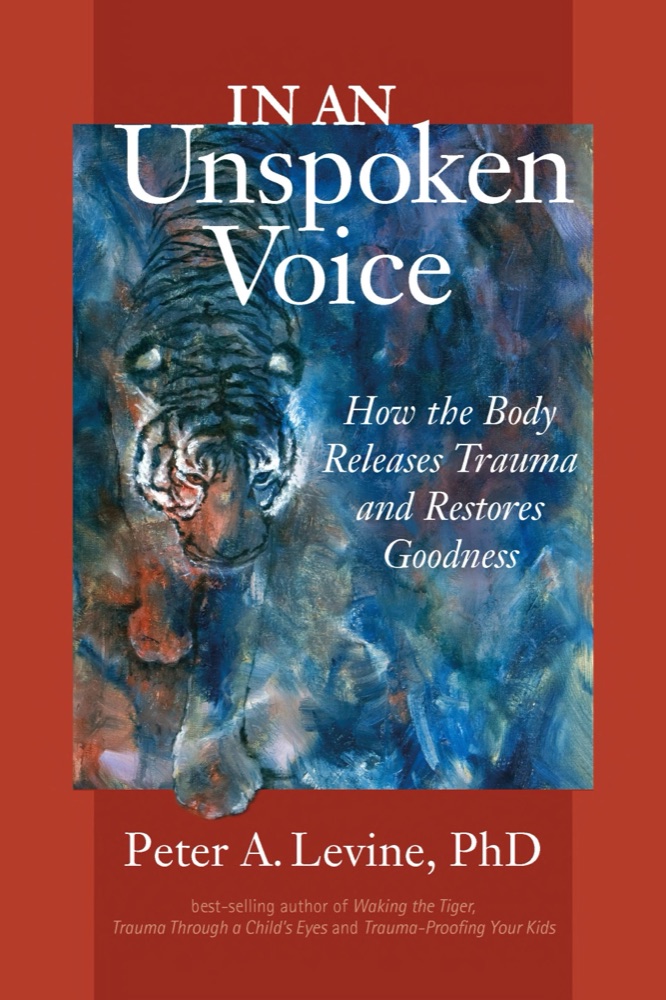
 In an Unspoken Voice: How the Body Releases Trauma and Restores Goodness
Quotes from the Book
Resilient strength is the opposite of helplessness. The tree is made strong and resilient by its grounded root system. These roots take nourishment from the ground and grow strong. Grounding also allows the tree to be resilient so that it can yield to the winds of change and not be uprooted. Springiness is the facility to ground and ‘unground’ in a rhythmical way. This buoyancy is a dynamic form of grounding. Aggressiveness is the biological ability to be vigorous and energetic, especially when using instinct and force. In the immobility (traumatized) state, these assertive energies are inaccessible. The restoration of healthy aggression is an essential part in the recovery from trauma. Empowerment is the acceptance of personal authority. It derives from the capacity to choose the direction and execution of one’s own energies. Mastery is the possession of skillful techniques in dealing successfully with threat. Orientation is the process of ascertaining one’s position relative to both circumstance and environment. In these ways the residue of trauma is renegotiated.
23
The body has been designed to renew itself through continuous self-correction. These same principles also apply to the healing of psyche, spirit, and soul.
14
Every trauma provides an opportunity for authentic transformation. Trauma amplifies and evokes the expansion and contraction of psyche, body, and soul. It is how we respond to a traumatic event that determines whether trauma will be a cruel and punishing Medusa turning us into stone, or whether it will be a spiritual teacher taking us along vast and uncharted pathways. In the Greek myth, blood from Medusa’s slain body was taken in two vials; one vial had the power to kill, while the other had the power to resurrect. If we let it, trauma has the power to rob our lives of vitality and destroy it. However, we can also use it for powerful self-renewal and transformation. Trauma, resolved, is a blessing from a greater power.
9
Because the symptoms and emotions associated with trauma can be extreme, most of us (and those close to us) will recoil and attempt to repress these intense reactions. Unfortunately, this mutual denial can prevent us from healing. In our culture there is a lack of tolerance for the emotional vulnerability that traumatized people experience. Little time is allotted for the working through of emotional events. We are routinely pressured into adjusting too quickly in the aftermath of an overwhelming situation. Denial is so common in our culture that it has become a cliché.
8
When a young tree is injured it grows around that injury. As the tree continues to develop, the wound becomes relatively small in proportion to the size of the tree. Gnarly burls and misshapen limbs speak of injuries and obstacles encountered through time and overcome. The way a tree grows around its past contributes to its exquisite individuality, character, and beauty. I certainly don't advocate for traumatization to build character, but since trauma is almost a given at some point in our lives, the image of the tree can be a valuable mirror.
8
Although we rarely die, humans suffer when we are unable to discharge the energy that is locked in by the freezing response. The traumatized veteran, the rape survivor, the abused child, the impala, and the bird all have been confronted by overwhelming situations. If they are unable to orient and choose between fight or flight, they will freeze or collapse. Those who are able to discharge that energy will be restored. Rather than moving through the freezing response, as animals do routinely, humans often begin a downward spiral characterized by an increasingly debilitating constellation of symptoms.
7
Physicians and mental health workers today don't speak of retrieving souls, but they are faced with a similar task—restoring wholeness to an organism that has been fragmented by trauma. Shamanistic concepts and procedures treat trauma by uniting lost soul and body in the presence of community. This approach is alien to the technological mind. However, these procedures do seem to succeed where conventional Western approaches fail.
6
Today, our survival depends increasingly on developing our ability to think rather than being able to physically respond. Consequently, most of us have become separated from our natural, instinctual selves—in particular, the part of us that can proudly, not disparagingly, be called animal. Regardless of how we view ourselves, in the most basic sense we literally are human animals. The fundamental challenges we face today have come about relatively quickly, but our nervous systems have been much slower to change. It is no coincidence that people who are more in touch with their natural selves tend to fare better when it comes to trauma. Without easy access to the resources of this primitive, instinctual self, humans alienate their bodies from their souls. Most of us don't think of or experience ourselves as animals. Yet, by not living through our instincts and natural reactions, we aren't fully human either. Existing in a limbo in which we are neither animal nor fully human can cause a number of problems, one of which is being susceptible to trauma.
6
Trauma has become so commonplace that most people don't even recognize its presence. It affects everyone. Each of us has had a traumatic experience at some point in our lives, regardless of whether it left us with an obvious case of post-traumatic stress. Because trauma symptoms can remain hidden for years after a triggering event, some of us who have been traumatized are not yet symptomatic.
6
Trauma can be prevented more easily than it can be healed.
6
In many ways, the felt sense is like a stream moving through an ever-changing landscape. It alters its character in resonance with its surroundings. When the land is rugged and steep, the stream moves with vigor and energy, swirling and bubbling as it crashes over rocks and debris. Out on the plains, the stream meanders so slowly that one might wonder whether it is moving at all. Rains and spring thaw can rapidly increase its volume, possibly even flood nearby land. In the same way, once the setting has been interpreted and defined by the felt sense, we will blend into whatever conditions we find ourselves. This amazing sense encompasses both the content and climate of our internal and external environments. Like the stream, it shapes itself to fit those environments.
5
In order to stay healthy, our nervous systems and psyches need to face challenges and to succeed in meeting those challenges. When this need is not met, or when we are challenged and cannot triumph, we end up lacking vitality and are unable to fully engage in life. Those of us who have been defeated by war, abuse, accidents, and other traumatic events suffer far more severe consequences.
5
In moving through apprehensive chills to mounting excitement and waves of moist tingling warmth, the body, with its innate capacity to heal, melts the iceberg created by deeply frozen trauma. Anxiety and despair can become creative wellspring when we allow ourselves to experience bodily sensations, such as trembling, that stem from traumatic symptoms. Held within the symptoms of trauma are the very energies, potentials, and resources necessary for their constructive transformation. The creative healing process can be blocked in a number of ways—by using drugs to suppress symptoms, by overemphasizing adjustment or control, or by denial or invalidation of feelings and sensations.
5
Learning to know yourself through the felt sense is a first step toward healing trauma.
5
If we feel inclined to focus on memories (even if they are basically accurate), it is important to understand that this choice will impair our ability to move out of our traumatic reactions. Transformation requires change. One of the things that must change is the relationship that we have with our “memories.
5
This leading-edge research echoes what ancient wisdom has always known: that each organ of the body, including the brain, speaks its own “thoughts,” “feelings,” and “promptings,” and listens to those of all the others.
5
Until we understand that traumatic symptoms are physiological as well as psychological, we will be woefully inadequate in our attempts to heal them. The heart of the matter lies in being able to recognize that trauma represents animal instincts gone awry. When harnessed, these instincts can be used by the conscious mind to transform traumatic symptoms into a state of well-being. Acts
4
Animals do not view freezing as a sign of inadequacy or weakness, nor should we.
3
Trauma is so arresting that traumatized people will focus on it compulsively. Unfortunately, the situation that defeated them once will defeat them again and again. Body sensations can serve as a guide to reflect where we are experiencing trauma, and to lead us to our instinctual resources. These resources give us the power to protect ourselves from predators and other hostile forces. Each of us possesses these instinctual resources. Once we learn how to access them we can create our own shields to reflect and heal our traumas.
3
If healing is what you want, your first step is to be open to the possibility that literal truth is not the most important consideration. The conviction that it really happened, the fear that it may have happened, the subtle searching for evidence that it did happen, can all get in your way as you try to hear what the felt sense wants to tell you about what it needs to heal.
2
Some things must be dealt with at the roots. Trauma is one of these things.
2
Sometimes, traumatized individuals have an investment in being ill and may form a kind of attachment to their symptoms. There are innumerable reasons (both physiological and psychological) to explain why this attachment occurs. I don’t think it’s necessary to go into detail on this subject. The important thing to keep in mind is that we can only heal to the degree that we can become unattached from these symptoms. It is almost as if they become entities unto themselves through the power we give them. We need to release them from our minds and hearts along with the energy that is locked in our nervous systems.
2
when we cling strongly to the concrete version of memory we are re-stricted to doing what we have always done in relation to it. The dilemma is that unresolved trauma forces us to repeat what we have done before. New and creative assemblages of possibilities will not easily occur to us.
2
Fortunately, because we are instinctual beings with the ability to feel, respond, and reflect, we possess the innate potential to heal even the most debilitating traumatic injuries. I am convinced, as well, that we as a global human community can begin to heal from the effects of large-scale social traumas such as war and natural disaster.
1
The body is the shore on the ocean of being. —Sufi (anonymous)
1
The changes can be extremely subtle: something that feels internally like a rock, for example, may suddenly seem to melt into a warm liquid. These changes have their most beneficial effect when they are simply watched, and not interpreted. Attaching meaning to them or telling a story about them at this time may shift the child’s perceptions into a more evolved portion of the brain, which can easily disrupt the direct connection established with the reptilian core. Bodily responses that emerge along with sensations typically include involuntary trembling, shaking, and crying. The body may want, slowly, to move in a particular way. If suppressed or interrupted by beliefs about being strong (grown up, courageous), acting normal, or abiding by familiar feelings, these responses will not be able to effectively discharge the accumulated energy.
1
Transformation requires a willingness to challenge your basic beliefs about who you are. We must have the faith to trust responses and sensations that we can’t fully understand, and a willingness to experience ourselves flowing in harmony with the primitive, natural laws that will take over and balance our seemingly incongruous perceptions. Traumatized people must let go of all kinds of beliefs and preconceptions in order to complete the journey back to health.
1
Acts must be carried through to their completion. Whatever their point of departure, the end will be beautiful. It is (only) because an action has not been completed that it is vile. —Jean Genet, from Thiefs Journal
1
Traumatic re-enactment is one of the strongest and most enduring reactions that occurs in the wake of trauma. Once we are traumatized, it is almost certain that we will continue to repeat or re-enact parts of the experience in some way. We will be drawn over and over again into situations that are reminiscent of the original trauma.
1
If you bring forth that which is within you, Then that which is within you Will be your salvation. If you do not bring forth that which is within you, Then that which is within you Will destroy you. from the Gnostic Gospels[1]
1
Watch on YouTube
About Peter A. Levine
We have collected 56 quotes from 2 books by Peter A. Levine on BookQuoters.
More about the author →More by Peter A. Levine
In an Unspoken Voice: How the Body Releases Trauma and Restores Goodness
About the book
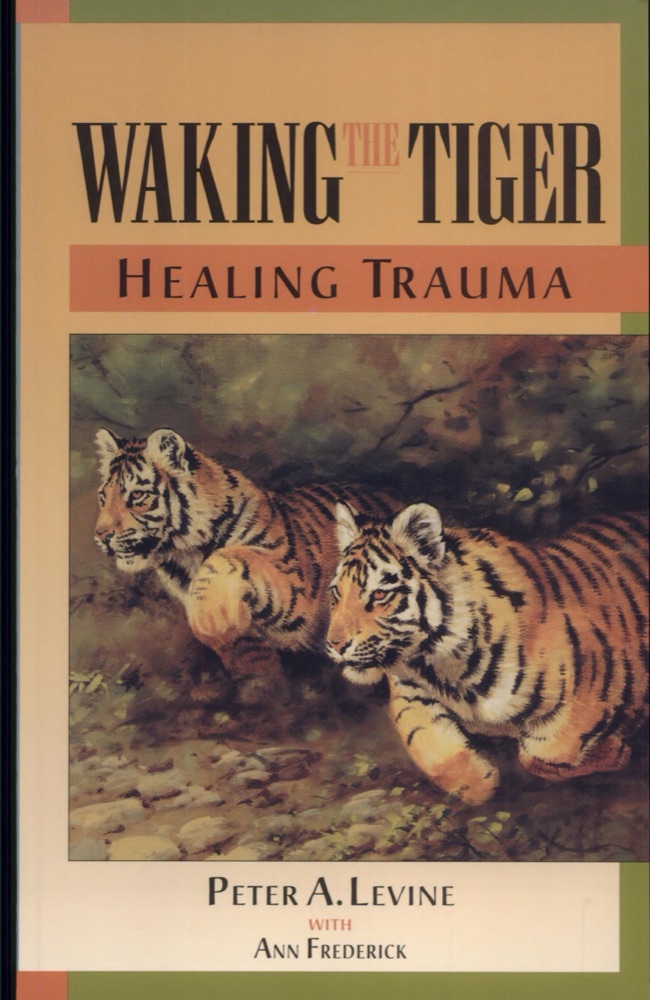
Waking the Tiger offers a new and hopeful vision of trauma. It views the human animal as a unique being, endowed with an instinctual capacity. It asks and answers an intriguing question: why are animals in the wild, though threatened routinely, rarely traumatized? By understanding the dynamics that make wild animals virtually immune to traumatic symptoms, the mystery of human trauma is revealed.
Waking the Tiger normalizes the symptoms of trauma and the steps needed to heal them. People are often traumatized by seemingly ordinary experiences. The reader is taken on a guided tour of the subtle, yet powerful impulses that govern our responses to overwhelming life events. To do this, it employs a series of exercises that help us focus on bodily sensations. Through heightened awareness of these sensations trauma can be healed.
Book details
- First published
- 1997
- Author
- Peter A. Levine
- Genre
- Nonfiction
- Goodreads rating
- 4.06 (11k ratings)
Keep reading
In an Unspoken Voice: How the Body Releases Trauma and Restores Goodness
 What Happened To You?: Conversations on Trauma, Resilience, and Healing
 The Boy Who Was Raised as a Dog: And Other Stories from a Child Psychiatrist's Notebook
 When the Body Says No: The Cost of Hidden Stress
 What My Bones Know
 The Wisdom of Your Body: Finding Healing, Wholeness, and Connection through Embodied Living
 My Grandmother's Hands: Racialized Trauma and the Mending of Our Bodies and Hearts
 Good Morning, Monster: A Therapist Shares Five Heroic Stories of Emotional Recovery
 The Courage to Heal: A Guide for Women Survivors of Child Sexual Abuse
 Complex PTSD: From Surviving to Thriving
 Letting Go: The Pathway To Surrender
 In the Realm of Hungry Ghosts: Close Encounters with Addiction
 True Refuge: Finding Peace and Freedom in Your Own Awakened Heart
 Anatomy of the Spirit: The Seven Stages of Power and Healing
 Unfuck Your Brain: Using Science to Get Over Anxiety, Depression, Anger, Freak-Outs, and Triggers
 When Things Fall Apart: Heart Advice for Difficult Times
 No Bad Parts: Healing Trauma & Restoring Wholeness with the Internal Family Systems Model
 Eastern Body, Western Mind: Psychology and the Chakra System as a Path to the Self
 Kitchen Table Wisdom: Stories that Heal
 Full Catastrophe Living: Using the Wisdom of Your Body and Mind to Face Stress, Pain, and Illness
 What It Takes to Heal: How Transforming Ourselves Can Change the World
 Reconciliation: Healing the Inner Child
 In Shock: My Journey from Death to Recovery and the Redemptive Power of Hope
 The Wild Edge of Sorrow: Rituals of Renewal and the Sacred Work of Grief
 Letting Go of the Person You Used to Be: Lessons on Change, Loss, and Spiritual Transformation
 Any Ordinary Day
 A General Theory of Love
 The Places That Scare You: A Guide to Fearlessness in Difficult Times
 Mindsight: The New Science of Personal Transformation
 The Wise Heart: A Guide to the Universal Teachings of Buddhist Psychology
 Option B: Facing Adversity, Building Resilience, and Finding Joy
 Healing Back Pain: The Mind-Body Connection
 Atlas of the Heart: Mapping Meaningful Connection and the Language of Human Experience
 Fear: Essential Wisdom for Getting Through the Storm
 The Brain That Changes Itself: Stories of Personal Triumph from the Frontiers of Brain Science
 Maps of Meaning: The Architecture of Belief
 It Didn't Start with You: How Inherited Family Trauma Shapes Who We Are and How to End the Cycle
 Living Beautifully with Uncertainty and Change
 Social Intelligence: The New Science of Human Relationships
 Messages from the Masters: Tapping into the Power of Love
 Journey of Souls: Case Studies of Life Between Lives
 You Are the Placebo: Making Your Mind Matter
 Many Lives, Many Masters: The True Story of a Prominent Psychiatrist, His Young Patient, and the Past Life Therapy That Changed Both Their Lives
 The Book of Secrets: Unlocking the Hidden Dimensions of Your Life
 Why Zebras Don't Get Ulcers
 My Stroke of Insight: A Brain Scientist's Personal Journey
 Behave: The Biology of Humans at Our Best and Worst
 Descartes' Error: Emotion, Reason and the Human Brain
 Advice Not Given: A Guide to Getting Over Yourself
 The Tools: Transform Your Problems into Courage, Confidence, and Creativity
 Radical Love: Learning to Accept Yourself and Others
 Belonging: Remembering Ourselves Home
 Be Not Afraid of Love: Lessons on Fear, Intimacy, and Connection
 Why Has Nobody Told Me This Before?
 Burnout: The Secret to Unlocking the Stress Cycle
 Women Who Run With the Wolves
 Becoming Supernatural: How Common People are Doing the Uncommon
 Changes That Heal: How to Understand the Past to Ensure a Healthier Future
 What Doesn't Kill Us: How Freezing Water, Extreme Altitude, and Environmental Conditioning Will Renew Our Lost Evolutionary Strength