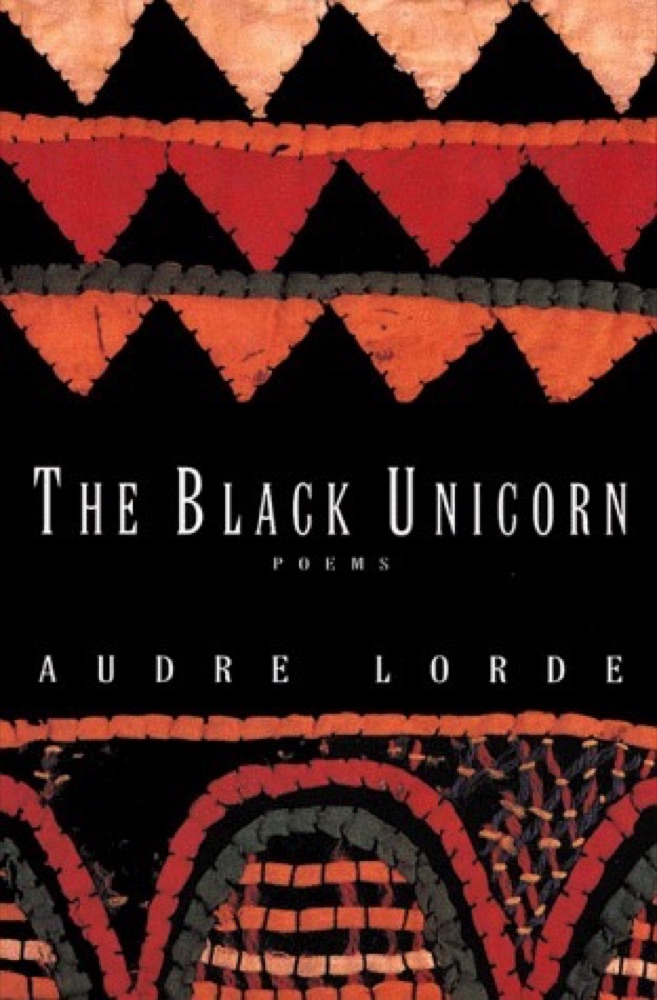
 The Black Unicorn: Poems
Quotes from the Book
The erotic has often been misnamed by men and used against women. It has been made into the confused, the trivial, the psychotic, the plasticized sensation. For this reason, we have often turned away from the exploration and consideration of the erotic as a source of power and information, confusing it with its opposite, the pornographic. But pornography is a direct denial of the power of the erotic, for it represents the suppression of true feeling. Pornography emphasizes sensation without feeling. The erotic is a measure between the beginnings of our sense of self and the chaos of our strongest feelings. It is an internal sense of satisfaction to which, once we have experienced it, we know we can aspire.
176
We have been raised to fear the yes within ourselves, our deepest cravings. For the demands of our released expectations lead us inevitably into actions which will help bring our lives into accordance with our needs, our knowledge, our desires. And the fear of our deepest cravings keeps them suspect, keeps us docile and loyal and obedient, and leads us to settle for or accept many facets of our oppression as women.
16
The principal horror of any system which defines the good in terms of profit rather than in terms of human need, or which defines human need to the exclusion of the psychic and emotional components of that need—the principal horror of such a system is that it robs our work of its erotic value, its erotic power and life appeal and fulfillment.
10
For the erotic is not a question only of what we do; it is a question of how acutely and fully we can feel in the doing. Once we know the extent to which we are capable of feeling that sense of satisfaction and completion, we can then observe which of our various life endeavors bring s closest to that fullness.
8
The very word erotic comes from the Greek word eros, the personification of love in all its aspects - born of Chaos, and personifying creative power and harmony. When I speak of the erotic, then, I speak of it as an assertion of the lifeforce of women; of that creative energy empowered, the knowledge and use of which we are now reclaiming in our language, our history, our dancing, our loving, our work, our lives.
6
And yes, there is a hierarchy. There is a difference between painting a back fence and writing a poem, but only one of quantity. And there is, for me, no difference between writing a good poem and moving into sunlight against the body of a woman I love.
5
in touch with the erotic, I become less willing to accept the powerlessness, or those other supplied states of being which are not native to me, such as resignation, despair, self-effacement, depression, self-denial.
5
But the erotic offers a well of replenishing and provocative force to the woman who does not fear its revelation, nor succumb to the belief that sensation is enough.
5
And that deep and irreplaceable knowledge of my capacity for joy comes to demand from all of my life that it be lived within the knowledge that such satisfaction is possible, and does not have to be called marriage, nor god, nor an afterlife.
4
The aim of each thing which we do is to make our lives and the lives of our children richer and more possible.
3
For once we begin to feel deeply all the aspects of our lives, we begin to demand from ourselves and from our life-pursuits that they feel in accordance with that joy which we know ourselves to be capable of.
2
Recognizing the power of the erotic within our lives can give us the energy to pursue genuine change within our world, rather than merely settling for a shift of characters in the same weary drama. For not only do we touch our most profoundly creative source, but we do that which is female and self-affirming in the face of a racist, patriarchal, and anti-erotic society.
2
But when we begin to live from within outward, in touch with the power of the erotic within ourselves, and allowing that power to inform and illuminate our actions upon the world around us, then we begin to be responsible to ourselves in the deepest sense. For as we begin to recognize our deepest feelings, we begin to give up, of necessity, being satisfied with suffering and self-negation, and with the numbness which so often seems like their only alternative in our society. Our acts against oppression become integral with self, motivated and empowered from within.
2
Beyond the superficial, the considered phrase, "It feels right to me," acknowledges the strength of the erotic into a true knowledge, for what that means is the first and most powerful guiding light toward any understanding...The erotic is the nurturer or nursemaid of all our deepest knowledge.
2
Of course, women so empowered are dangerous. So we are taught to separate the erotic demand from most vital areas of our lives other than sex. And the lack of concern for hte erotic root and satisfactions of our work is felt in our disaffection from so much of what we do. For instance, how often do we truly love our work even at its most difficult?
2
It has become fashionable to separate the spiritual (psychic and emotional) from the political, to see them as contradictory or antithetical. ‘What do you mean, a poetic revolutionary, a meditating gunrunner?
1
But giving in to the fear of feeling and working to capacity is a luxury only the unintentional can afford, and the unintentional are those who do not wish to guide their own destinies.
1
...We have attempted to separate the spiritual and the erotic, thereby reducing the spiritual to a world of flattened affect, a world of the ascetic who aspires to feel nothing. But nothing is farther from the truth. For the ascetic position is one of the highest fear, the gravest immobility. The severe abstinence of the ascetic becomes the ruling obsession. And it is one not of self-discipline but of self-abnegation.
Watch on YouTube
About Audre Lorde
We have collected 178 quotes from 7 books by Audre Lorde on BookQuoters.
More about the author →More by Audre Lorde
The Black Unicorn: Poems
 The Collected Poems of Audre Lorde
 Sister Outsider: Essays and Speeches
 The Cancer Journals
About the book
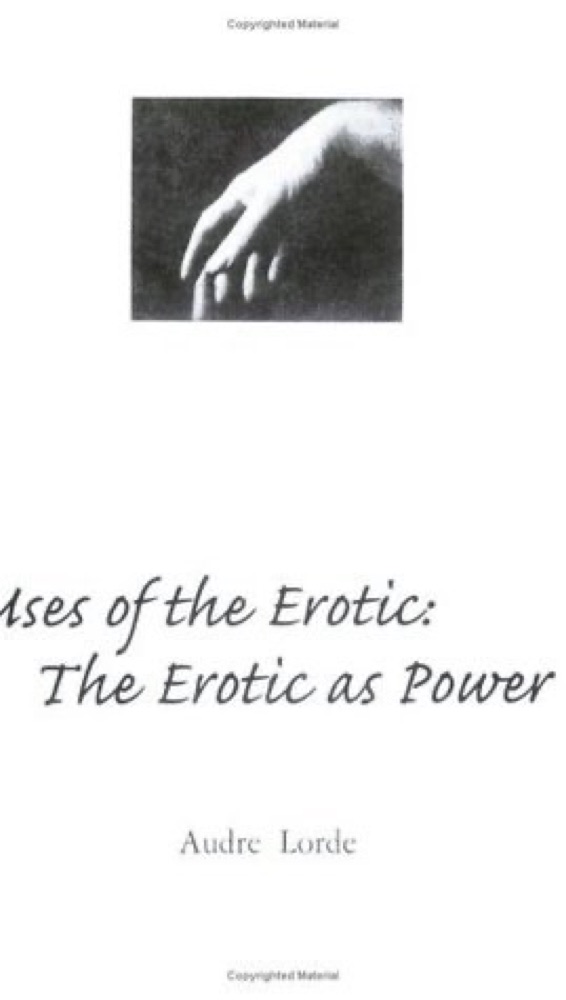
"There are many kinds of power, used and unused, acknowledged or otherwise." Thus begins this powerful essay; Uses of the Erotic defines the power of the erotic, names the process by which women have been stripped of this power, and considers how women can reclaim it.
Uses of the Erotic shines among Audre Lorde's powerful legacy of speeches and essays, and has influenced feminist thinking for more than 15 years. The false dichotomies that Lorde debunks persist in our cultural imagination: the separation of the erotuc from the spiritual and political. Now, Kore Press brings this essay into stand-alone focus, reprinting it in a fine, handbound pamphlet illustrated with photographs by Tucson photographer Camille Bonzani. Designed by book artist Nancy Solomon, the essay is offset and letterpress printed in an edition of 1000.
Book details
- First published
- 1978
- Author
- Audre Lorde
- Genre
- Nonfiction
- Goodreads rating
- 4.64 (2k ratings)
Keep reading
 Pleasure Activism: The Politics of Feeling Good
 Mating in Captivity: Reconciling the Erotic and the Domestic
 A Woman's Worth
 The Master's Tools Will Never Dismantle the Master's House
 The Argonauts
 How to Think More About Sex
 Women Who Run With the Wolves
 Women's Bodies, Women's Wisdom: Creating Physical and Emotional Health and Healing
 Appetites: Why Women Want
 Passionate Marriage: Keeping Love and Intimacy Alive in Committed Relationships
 The Art of Seduction
 Finding Meaning in the Second Half of Life: How to Finally, Really Grow Up
 Communion: The Female Search for Love
 On Such a Full Sea
 A Certain Hunger
 Untamed
 Trick Mirror: Reflections on Self-Delusion
 This Here Flesh: Spirituality, Liberation, and the Stories That Make Us
 The Source of Self-Regard: Selected Essays, Speeches, and Meditations
 Love and Will
 Anatomy of the Spirit: The Seven Stages of Power and Healing
 Of Woman Born: Motherhood as Experience and Institution
 On Our Best Behavior: The Seven Deadly Sins and the Price Women Pay to Be Good
 The Home and the World
 The Varieties of Religious Experience
 Care of the Soul: A Guide for Cultivating Depth and Sacredness in Everyday Life
 The Way of the Superior Man: A Spiritual Guide to Mastering the Challenges of Women, Work, and Sexual Desire
 Come as You Are: The Surprising New Science that Will Transform Your Sex Life
 Eros the Bittersweet
 The Diary of Anaïs Nin, Vol. 1: 1931-1934
 Like Streams to the Ocean: Notes on Ego, Love, and the Things That Make Us Who We Are
 Belonging: Remembering Ourselves Home
 On Connection
 Skin: Talking About Sex, Class And Literature
 The Will to Power
 Body Work: The Radical Power of Personal Narrative
 Status Anxiety
 The Ethical Slut: A Guide to Infinite Sexual Possibilities
 The Spiral Dance: A Rebirth of the Ancient Religion of the Great Goddess
 This Is Not a Book About Benedict Cumberbatch: The Joy of Loving Something--Anything--Like Your Life Depends On It
 Upstream: Selected Essays
 How to Be an Adult in Relationships: The Five Keys to Mindful Loving
 The Common Reader
 The Cost of Living: A Working Autobiography
 In Search of Our Mothers' Gardens: Womanist Prose
 Captivating: Unveiling the Mystery of a Woman's Soul
 The Invitation
 Now Is the Time to Open Your Heart
 Journal of a Solitude
 The State of Affairs: Rethinking Infidelity
 Sexual Personae: Art and Decadence from Nefertiti to Emily Dickinson
 The Spiral Staircase: My Climb Out of Darkness
 The God Who Weeps: How Mormonism Makes Sense of Life
 Missing Out: In Praise of the Unlived Life
 On Freedom: Four Songs of Care and Constraint
 Devotion
 I Love Dick
 Toward a Psychology of Being
 Sexus
Sexus