
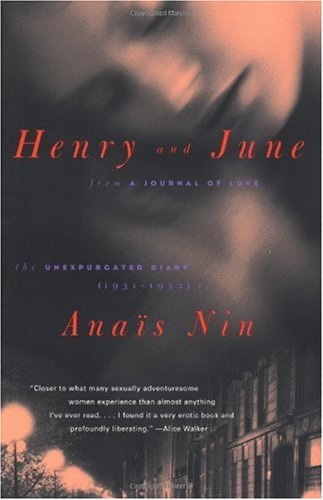
 Henry and June: From "A Journal of Love"--The Unexpurgated Diary of Anaïs Nin
Quotes from the Book
Each friend represents a world in us, a world possibly not born until they arrive, and it is only by this meeting that a new world is born.
You live like this, sheltered, in a delicate world, and you believe you are living. Then you read a book… or you take a trip… and you discover that you are not living, that you are hibernating. The symptoms of hibernating are easily detectable: first, restlessness. The second symptom (when hibernating becomes dangerous and might degenerate into death): absence of pleasure. That is all. It appears like an innocuous illness. Monotony, boredom, death. Millions live like this (or die like this) without knowing it. They work in offices. They drive a car. They picnic with their families. They raise children. And then some shock treatment takes place, a person, a book, a song, and it awakens them and saves them from death. Some never awaken.
Man can never know the loneliness a woman knows. Man lies in the woman's womb only to gather strength, he nourishes himself from this fusion, and then he rises and goes into the world, into his work, into battle, into art. He is not lonely. He is busy. The memory of the swim in amniotic fluid gives him energy, completion. Woman may be busy too, but she feels empty. Sensuality for her is not only a wave of pleasure in which she is bathed, and a charge of electric joy at contact with another. When man lies in her womb, she is fulfilled, each act of love a taking of man within her, an act of birth and rebirth, of child rearing and man bearing. Man lies in her womb and is reborn each time anew with a desire to act, to be. But for woman, the climax is not in the birth, but in the moment man rests inside of her.
What we call our destiny is truly our character and that character can be altered. The knowledge that we are responsible for our actions and attitudes does not need to be discouraging, because it also means that we are free to change this destiny. One is not in bondage to the past, which has shaped our feelings, to race, inheritance, background. All this can be altered if we have the courage to examine how it formed us. We can alter the chemistry provided we have the courage to dissect the elements.
There is not one big cosmic meaning for all; there is only the meaning we each give to our life, an individual meaning, an individual plot, like an individual novel, a book for each person.
I disregard the proportions, the measures, the tempo of the ordinary world. I refuse to live in the ordinary world as ordinary women. To enter ordinary relationships. I want ecstasy. I am a neurotic — in the sense that I live in my world. I will not adjust myself to the world. I am adjusted to myself.
Ordinary life does not interest me. I seek only the high moments. I am in accord with the surrealists, searching for the marvelous. I want to be a writer who reminds others that these moments exist; I want to prove that there is infinite space, infinite meaning, infinite dimension. But I am not always in what I call a state of grace. I have days of illuminations and fevers. I have days when the music in my head stops. Then I mend socks, prune trees, can fruits, polish furniture. But while I am doing this I feel I am not living.
To think of him in the middle of the day lifts me out of ordinary living.
I don’t really want to become normal, average, standard. I want merely to gain in strength, in the courage to live out my life more fully, enjoy more, experience more. I want to develop even more original and more unconventional traits
In my childhood diary I wrote: “I have decided that it is better not to love anyone, because when you love people, then you have to be separated from them, and that hurts too much.
I have no brakes on...analysis is for those who are paralyzed by life.
I would like to have your sureness. I am waiting for love, the core of a woman's life." Don't wait for it," I said. "Create a world, your world. Alone. Stand alone. And then love will come to you, then it comes to you. It was only when I wrote my first book that the world I wanted to live in opened to me.
If I love you it means we share the same fantasies, the same madnesses
I am aware of being in a beautiful prison, from which I can only escape by writing.
Since desire always goes towards that which is our direct opposite, it forces us to love that which will make us suffer.
Ordinary life does not interest me. I seek only the high moments. I am in accord with the surrealists, searching for the marvelous.
I can elect something I love and absorb myself in it.
Sex must be mixed with tears, laughter, words, promises, scenes, jealousy, envy, all the spices of fear, foreign travel, new faces, novels, stories, dreams, fantasies, music, dancing, opium, wine.
The struggle to emerge out of the past, clean of memories; the inadequacy of our hearts to cut life into separate and final portions; the pain of this constant ambivalence and interrelation of emotions; the hunger for frontiers against which we might learn as upon closed doors before we proceed forward; the struggle against diffusion, new beginnings, against finality in acts without finality or end, in our cursedly repercussive being..
I palliate the sufferings of others. yes I see myself as softening the blows, dissolving acids, neutralizing poisons, every moment of the day. I try to fulfill the wishes of others, to perform miracles. I exert myself performing miracles.
The two men who have done the greatest harm to the world are Christ and Columbus. Christ taught us guilt and sacrifice, to live only in the other world, and Columbus discovered America and materialism.
The other night we talked about literature's elimination of the unessential, so that we are given a concentrated "dose" of life. I said, almost indignantly, "That's the danger of it, it prepares you to live, but at the same time, it exposes you to disappointments because it gives a heightened concept of living, it leaves out the dull or stagnant moments. You, in your books, also have a heightened rhythm, and a sequence of events so packed with excitement that I expected all your life to be delirious, intoxicated." Literature is an exaggeration, a dramatization, and those who are nourished on it (as I was) are in great danger of trying to approximate an impossible rhythm. Trying to live up to Dostoevskian scenes every day. And between writers there is a straining after extravagance. We incite each other to jazz-up our rhythm.
I only feel close to people who arouse my energy, who make enormous demands of me, who are capable of enriching me with experience, pain, people who do not doubt my courage, or my toughness. People who do not believe me naive or innocent, but who challenge my keenest wisdom, who have the courage to treat me like a woman in spite of the fact that they are aware of my vulnerability.
She makes use of the soft of the bread for a napkin. She falls asleep at times with shoes on, on unmade beds. When a little money comes in, June buys delicacies, strawberries in the winter, caviar and bath salts.
A big enough artist, I say, can eat anything, must eat everything and then alchemize it. Only the feeble writer is afraid of expansion.
Don't wait for it," I said. "Create a world, your world. Alone. Stand alone. Create. And then the love will come to you, then it comes to you. It was only when I wrote my first book that the world I wanted to live in opened to me.
June, you have killed my sincerity too. I will never again know who I am, what I am, what I love, what I want. Your beauty has drowned me, the core of me. You carry away with you a part of me reflected in you. When your beauty struck me, it dissolved me. Deep down, I am not different from you. I dreamed you, I wished for your existence. You are the woman I want to be. I see in you that part of me which is you. I feel compassion for your childish pride, for your trembling unsureness, your dramatization of events, your enhancing of the loves given to you. I surrender my sincerity because if I love you it means we share the same fantasies, the same madness.
..he made me understand something very important. Whether because I am a Latin, or because I am a neurotic, I have a need of gestures. I am myself expressive, demonstrative; every feeling I have takes on expression: words, gestures, signs, letters, articulateness or action. I need this in others.
The writer is the duelist who never fights at the stated hour, who gathers up an insult, like another curious object, a collector's item, spreads it out on his desk later, and then engages in a duel with it verbally. Some people call it weakness. I call it postponement. What is weakness in the man becomes a quality in the writer. For he preserves, collects what will explode later in his work. That is why the writer is the loneliest man in the world; because he lives, fights, dies, is reborn always alone; all his roles are played behind a curtain. In life he is an incongruous figure.
I must know, he thinks. It must be clear to me. There is a world which is closed to him, a world of shadings, gradations, nuances, and subtleties. He is a genius and yet he is too explicit. June slips between his fingers. You cannot posses without loving.
Watch on YouTube
About Anaïs Nin
We have collected 117 quotes from 4 books by Anaïs Nin on BookQuoters.
More about the author →More by Anaïs Nin
Henry and June: From "A Journal of Love"--The Unexpurgated Diary of Anaïs Nin
 Delta of Venus
 A Spy in the House of Love
Book details
- Author
- Anaïs Nin
- Genre
- Nonfiction
- Goodreads rating
- 4.18 (8k ratings) →
Keep reading
 The Journals of Sylvia Plath
Henry and June: From "A Journal of Love"--The Unexpurgated Diary of Anaïs Nin
The Journals of Sylvia Plath
Henry and June: From "A Journal of Love"--The Unexpurgated Diary of Anaïs Nin
 The Unabridged Journals of Sylvia Plath
 The World and Other Places: Stories
 Journal of a Solitude
 Sexus
Sexus
 Selected Stories
 A Breath of Life
 A History of My Brief Body
 Girl in the Dark
 Doctor Zhivago
 Last Words from Montmartre
 In the Heart of the Heart of the Country and Other Stories
 An Unnecessary Woman
 Lost in Translation: A Life in a New Language
 A Writer's Diary
 The Story of My Life
 Winter Hours: Prose, Prose Poems, and Poems
 Gut Symmetries
 Like Streams to the Ocean: Notes on Ego, Love, and the Things That Make Us Who We Are
 Tropic of Cancer
 The Golden Notebook
 Either/Or: A Fragment of Life
 Diaries, 1910-1923
 The Stream of Life
 Upstream: Selected Essays
 Near to the Wild Heart
 Diary of a Drug Fiend
 What I Loved
 Tropic of Capricorn
 The Thief's Journal
 Hourglass: Time, Memory, Marriage
 No One Writes Back
 Sexing the Cherry
 The Story of the Lost Child
 Blueberries: Essays Concerning Understanding
 The Book of Disquiet
 A Lover's Discourse: Fragments
 Girl with Curious Hair
 Confessions
 Johnny Panic and the Bible of Dreams: Short Stories, Prose and Diary Excerpts
 Possession
 The Chronology of Water
 I Love Dick
 Rilke's Book of Hours: Love Poems to God
 Min kamp 2
 New and Selected Poems, Vol. 2
 On Connection
 The Notebooks of Malte Laurids Brigge
 Broken Music
 Identity
 The Star Rover
 Gift from the Sea
 Make It Scream, Make It Burn
 Kokoro
 Life After Death
 Dust Tracks on a Road
 Eyeless in Gaza
 Good Morning, Destroyer of Men's Souls: A Memoir of Women, Addiction, and Love
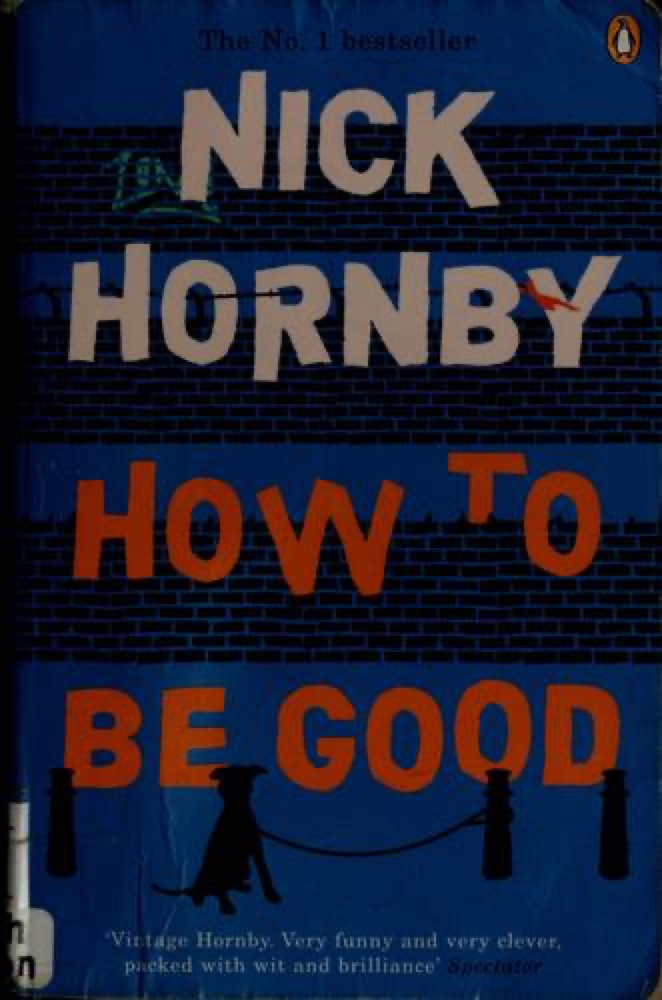 How to Be Good