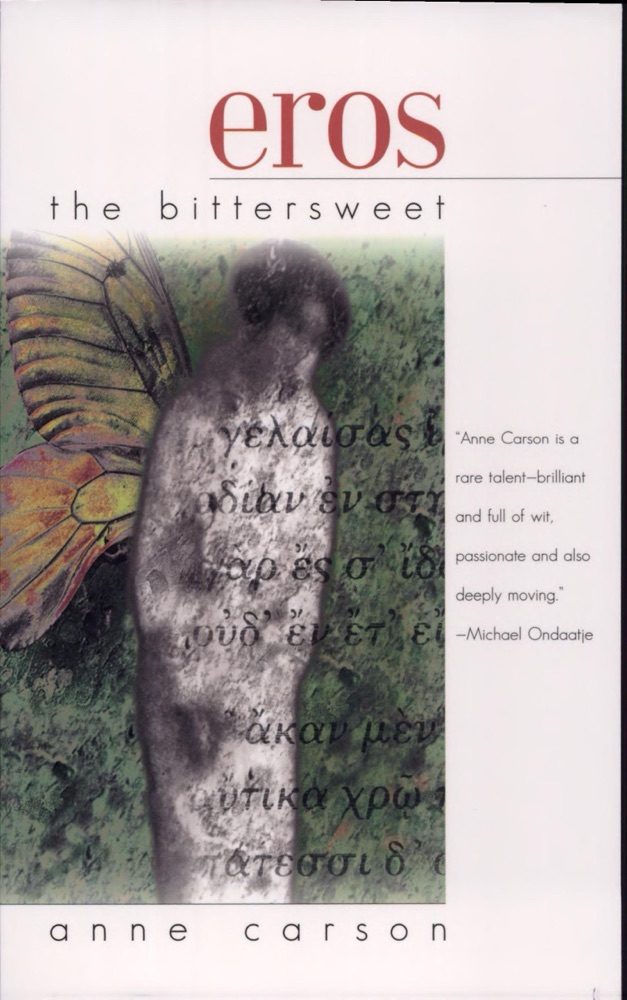

 Grief Lessons: Four Plays by Euripides
Quotes from the Book
To be running breathlessly, but not yet arrived, is itself delightful, a suspended moment of living hope.
251
Eros is an issue of boundaries. He exists because certain boundaries do. In the interval between reach and grasp, between glance and counterglance, between ‘I love you’ and ‘I love you too,’ the absent presence of desire comes alive. But the boundaries of time and glance and I love you are only aftershocks of the main, inevitable boundary that creates Eros: the boundary of flesh and self between you and me. And it is only, suddenly, at the moment when I would dissolve that boundary, I realize I never can.
239
The words we read and words we write never say exactly what we mean. The people we love are never just as we desire them. The two symbola never perfectly match. Eros is in between.
165
As Sokrates tells it, your story begins the moment Eros enters you. That incursion is the biggest risk of your life. How you handle it is an index of the quality, wisdom, and decorum of the things inside you. As you handle it you come into contact with what is inside you, in a sudden and startling way. You perceive what you are, what you lack, what you could be.
90
When I desire you a part of me is gone.
68
Novels institutionalize the ruse of eros. It becomes a narrative texture of sustained incongruence, emotional and cognitive. It permits the reader to stand in triangular relation to the characters in the story and reach into the text after the objects of their desire, sharing their longing but also detached from it, seeing their view of reality but also its mistakenness. It is almost like being in love.
36
When you are falling in love it is always already too late: dēute, as the poets say.
35
A thinking mind is not swallowed up by what it comes to know. It reaches out to grasp something related to itself and to its present knowledge (and so knowable in some degree) but also separate from itself and from its present knowledge (not identical with these). In any act of thinking, the mind must reach across this space between known and unknown, linking one to the other but also keeping visible to difference. It is an erotic space.
33
Sappho begins with a sweet apple and ends in infinite hunger.
23
All lovers believe they are inventing love.
16
Then the edge asserts itself. You are not a god. You are not that enlarged self. Indeed, you are not even a whole self, as you now see. Your new knowledge of possibilities is also a knowledge of what is lacking in the actual.
13
Desire is not simple. In Greek the act of love is a mingling and desire melts the limbs. Boundaries of body, category of thought, are confounded.
12
When I contemplate the physical spaces that articulate the letters 'I love you' in a written text, I may be led to think about other spaces, for example the space that lies between 'you' in the text and you in my life.
10
When an individual appreciates that he alone is responsible for the content and coherence of his person, an influx like eros becomes a concrete personal threat. So in the lyric poets, love is something that assaults or invades the body of the lover to wrest control of it from him, a personal struggle of will and physique between the god and his victim. The poets describe this struggle from within a consciousness – perhaps new in the world – of the body as a unity of limbs, senses and self, amazed at its own vulnerability.
10
Who ever desires what is not gone? No one. The Greeks were clear on this. They invented eros to express it.
9
When I desire you a part of me is gone: my want of you partakes of me.
7
It is the edge separating my tongue from the taste for which it longs that teaches me what an edge is.
7
I would like to grasp why it is that these two activities, falling in love and coming to know, make me feel genuinely alive. There is something like an electrification in them.
6
Love does not happen without loss of vital self. The lover is the loser. Or so he reckons. But his reckoning involves a
6
Jealousy is a dance in which everyone moves, for it is the instability of the emotional situation that preys upon a jealous lover's mind.
4
The presence of want awakens in him nostalgia for wholeness. His thoughts turn toward questions
3
He loved, that is, the process of coming to know… In any act of thinking, the mind must reach across this space between known and unknown… It is an erotic space. When the mind reaches out to know, the space of desire opens.
2
Who is the real subject of most love poems? Not the beloved. It is that hole.
2
The experience of eros as lack alerts a person to the boundaries of himself, of other people, of things in general. It is the edge separating my tongue from the taste for which it longs that teaches me what an edge is.
2
In fact, neither reader nor writer nor lover achieves such consumation. The words we read and the words we write never say exactly what we mean. The people we love are never just as we desire them. The two symbola never perfectly match. Eros is in between.
2
Suppression of impertinence is not the lover’s aim. Nor can I believe this philosopher really runs after understanding. Rather, he has become a philosopher (that is, one whose profession is to delight in understanding) in order to furnish himself with pretexts for running after tops.
2
Imagine a city where there is no desire. Supposing for a moment that the inhabitants of the city continue to eat, drink and procreate in some mechanical way: still, their life looks flat. They do not theorize or spin tops or speak figuratively. Few think to shun pain; none give gifts. They bury their dead and forget where. Zeno finds himself elected mayor and is set to work copying the legal code on sheets of bronze. Now and again a man and a woman may marry and live very happily, as travellers who meet by chance at an inn; at night falling asleep they dream the same dream, where they watch fire move along a rope that binds them together, but it is unlikely they remember the dream in the morning. The art of storytelling is widely neglected.
1
If you are reading, you are not at the beginning.
1
Is it a matter of coincidence that the poets who invented Eros, making of him a divinity and a literary obsession, were also the first authors in our tradition to leave us their poems in written form? To put the question more pungently, what is erotic about alphabetization?
1
Watch on YouTube
About Anne Carson
We have collected 227 quotes from 11 books by Anne Carson on BookQuoters.
More about the author →More by Anne Carson
Grief Lessons: Four Plays by Euripides
 An Oresteia
 Plainwater: Essays and Poetry
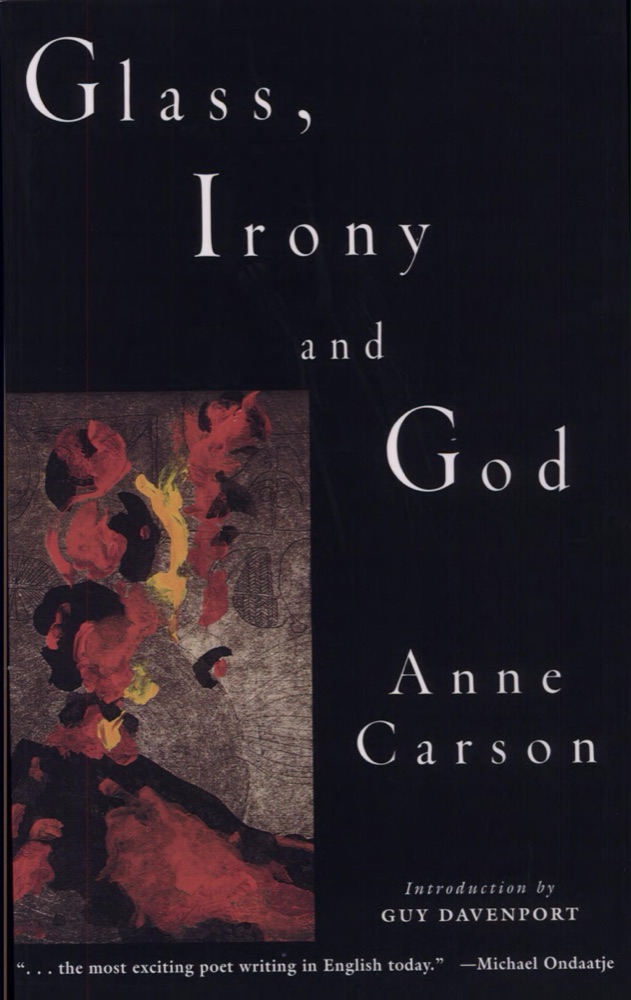 Glass, Irony and God
About the book
The insights presented in the volume are many and wide-ranging, recognizably in tune with the subtlest modern discussions of desire (such as triangulation. or loving what others love), yet offering new solutions to old problems, like the proper interpretation of Plato's Phaedrus. On the frequently discussed effect of literacy on Greek civilization, the book offers a fresh view: it was no accident that the poets who invented Eros were also the first readers and writers of the Western literate tradition.
Originally published in 1989.
Book details
- First published
- 1986
- Author
- Anne Carson
- Genre
- Literature
- Goodreads rating
- 4.45 (7k ratings)
Keep reading
 A Lover's Discourse: Fragments
 Love and Will
 The Symposium
 Sexus
Sexus
 Mating in Captivity: Reconciling the Erotic and the Domestic
 On Love
 The Unbearable Lightness of Being
 The Book of Love: Poems of Ecstasy and Longing
 The Passion
 Works of Love
 The Argonauts
 Madness, Rack, and Honey: Collected Lectures
 Sexing the Cherry
 The Invention of Love
 Identity
 Corelli's Mandolin
 Figuring
 Last Words from Montmartre
 Either/Or: A Fragment of Life
 Confessions of a Mask
 The Diary of Anaïs Nin, Vol. 1: 1931-1934
 Doctor Zhivago
 Phaedrus
 Conversations on Love
 In Search of Lost Time
 Just Above My Head
 Stars in My Pocket Like Grains of Sand
 The Three-Cornered World
 The State of Affairs: Rethinking Infidelity
 Levels of Life
 Nutshell
 A History of the World in 10½ Chapters
 Hourglass: Time, Memory, Marriage
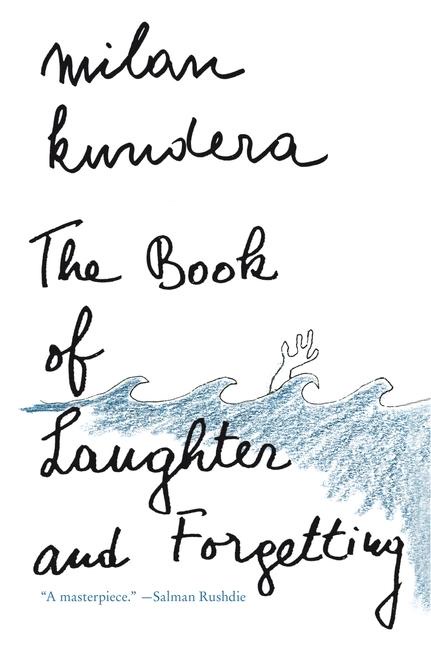 The Book of Laughter and Forgetting
 The Summer Without Men
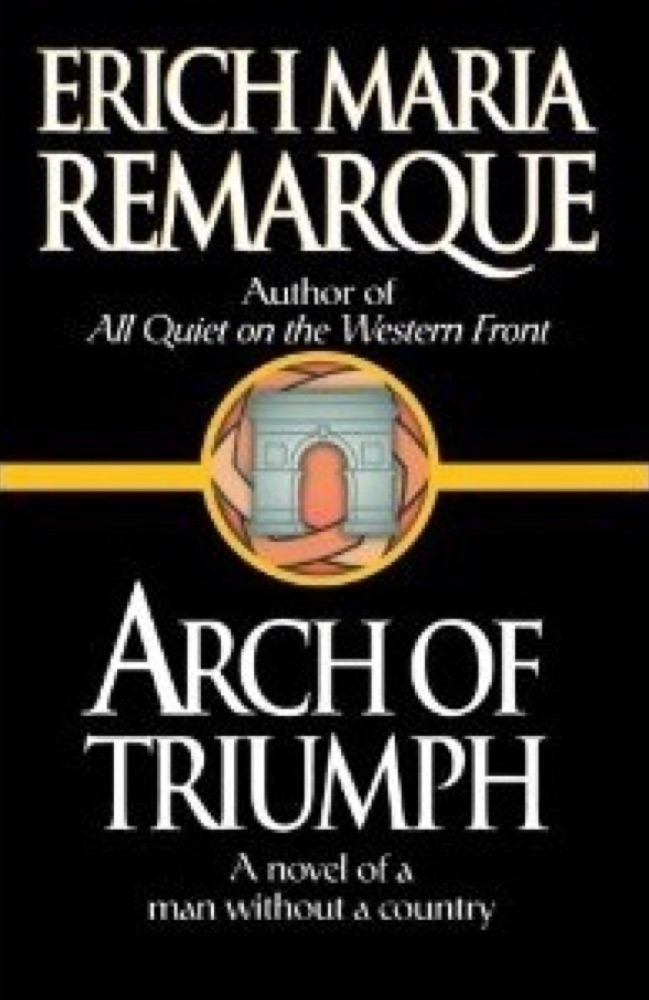 Arch of Triumph
 Oblomov
 The Art of Loving
 Summertime
 Narcissus and Goldmund
 Seven Types of Ambiguity
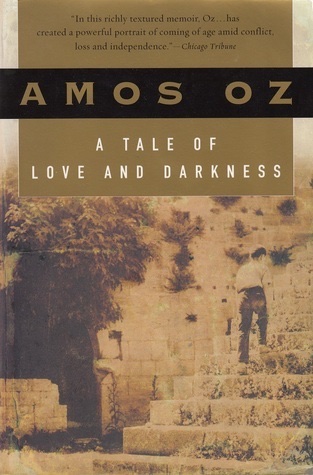 A Tale of Love and Darkness
 The End of the Affair
 The Lover's Dictionary
 Death in Venice and Other Tales
 Kokoro
 Love, Freedom, and Aloneness: The Koan of Relationships
 The History of Love
 Dearest Josephine
 The Devil in the Flesh
 The Friend
 Possession
 Girl with Curious Hair
 Exit to Eden
 The Zahir
 Bluets
 The Myth of Sisyphus and Other Essays
 Thirst for Salt
 Open Water
 Intimacy: Trusting Oneself and the Other